The Essential Identity: Why Manual Precision Defines Modern Geometric Art
In an era saturated with algorithmically generated imagery, the value of the human hand is undergoing a profound re-evaluation. While high-end auction sales for "vanity" art assets plummeted by 44% in 2024, according to Marketplace, a counter-movement is rising. Discerning collectors and homeowners are shifting away from overpriced speculative pieces toward custom, hand-painted works that offer real emotional and architectural value.
The appeal of geometric art lies in its paradox: it demands the cold, structural accuracy of a blueprint while requiring the warm, "essential identity" that only a physical medium can provide. Research from the University of Chicago suggests that digital replicas and NFTs often fail to preserve this "essential identity," leading to a collapse in perceived value among consumers. When you view a hand-painted geometric piece, your brain isn't just processing shapes; it is interacting with the biochemical crystallization of apex human visual attention.
The Anatomy of a Fine Line: Technical Mastery and Tooling
Achieving a sharp, architectural line on a large-scale canvas is a feat of engineering as much as it is an artistic endeavor. Many beginners assume that "fine-liner" geometric art is simply a matter of a steady hand, but the reality involves a complex interplay of tool maintenance, fluid dynamics, and neural control.
Specialized Brushes and Bristle Fatigue
Experienced geometric artists often eschew standard round brushes in favor of flat brushes with firm, synthetic bristles. For the most critical sections, the use of #20/0 liner brushes is common, though there is a technical distinction to be made. While marketing often conflates these with fine-liner pens, a #20/0 brush is designed for watercolor or ink wash techniques. True geometric precision on canvas often requires specialized fine-tip liner brushes that can hold a specific volume of pigment without "belly" expansion, which would otherwise distort the line width.
One non-obvious hurdle is bristle fatigue. Over a long session, the structural integrity of fine bristles can degrade due to pigment buildup near the ferrule. Professionals often rotate through multiple disposable fine-liners or perform mid-session deep cleans to maintain a consistent line width, typically aiming for 0.1mm to 0.3mm consistency.
Viscosity Control and the "Bleed" Problem
The sharp edges seen in high-quality geometric art are the result of meticulous viscosity management. If the paint is too thick, it creates "drag," leading to jagged edges; if it is too thin, it bleeds into the canvas fibers. Artists often thin pigments with specific mediums to achieve a "high-flow" state. However, as noted by Golden Artist Colors, adding more than 20% water can destroy the paint film's adhesion and durability.
Modeling Note: Geometric Precision Parameters This model represents the typical technical thresholds required for gallery-grade geometric hand-painting (not a controlled lab study).
Parameter Target Range Unit Logic / Source Category Line Consistency 0.1 - 0.3 mm Artist Practical Baseline Paint Viscosity 150 - 300 cP Fluid Dynamics Heuristic Substrate Humidity 45 - 55 % ASTM D4303 Standards Bristle Tension High/Firm N/A Tool Selection Heuristic Drying Rate 15 - 30 min Shop Practical Baseline

The Chemistry of the Canvas: Safety and Longevity
For the aesthetic-driven home improver, the beauty of a mural or canvas must be matched by its safety profile. Indoor air quality (IAQ) is a critical concern, especially when commissioning large-scale works for residential or healthcare settings.
VOC Emissions and Non-Toxic Pigments
The EPA warns that indoor air pollution can be significantly higher than outdoor levels. This makes the choice of paints paramount. While industrial turpentine solvents are historically common in oil painting, they emit high levels of Volatile Organic Compounds (VOCs). Modern professionals are increasingly adopting eco-friendly alternatives, such as walnut oil or water-based acrylics, which pass strict air quality tests.
An experiment by Aalto University demonstrated that coatings on wood with 16% moisture emitted significantly lower VOCs during the curing process than dry wood. This highlights the importance of understanding the curing timelines for interior design.
The Cadmium and Lead Question
When it comes to pigment safety, the stakes are high. The International Agency for Research on Cancer (IARC) classifies cadmium as a Group 1 carcinogen. While some artists prefer cadmium for its unparalleled opacity and vibrancy, it poses risks if inhaled as dust or absorbed through the skin.
Furthermore, consumers should be wary of the "ASTM D-4236" label. As EPA documentation clarifies, this label only means the warning labels comply with regulations—it does not guarantee the pigment itself is non-toxic. For homes with children or pets, opting for "Cadmium-Free" hues or high-quality acrylic underpaintings can provide the same visual impact without the heavy metal risk.
The Psychological Impact of Geometric Precision
Why do we find sharp geometric lines so satisfying? The answer lies in neuroaesthetics. Geometric art often mimics the structural order found in nature and architecture, triggering specific neurological responses.
Stress Reduction and Mood Improvement
A review by the University of Pennsylvania noted that 73% of patients in clinical environments reported significant mood improvements when exposed to environmental artworks. Passive art viewing consistently activates the medial prefrontal cortex (mPFC) and the amygdala, which are core circuits for emotional regulation.
In a residential context, geometric art acts as a visual anchor. The precision of the lines provides a sense of "predictability" and "order" that can counteract the cognitive fatigue of modern life. This is particularly effective in biophilic design, where geometric patterns inspired by natural landscapes (like the Fibonacci sequence) produce stress-reduction effects similar to being outdoors.
The Science of "Micro-Shadows"
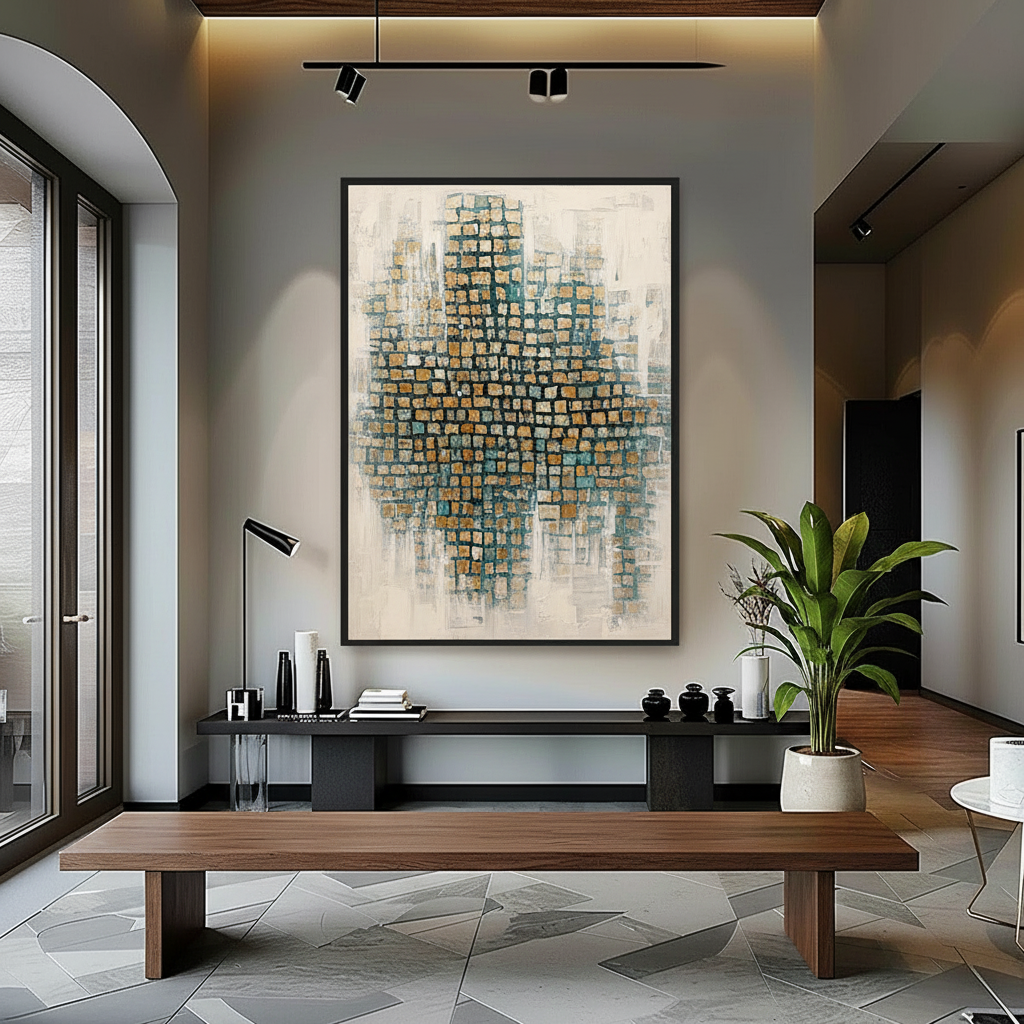
One of the most significant differentiators between a hand-painted piece and a digital print is the interaction with light. Geometric art often utilizes thick impasto layers or precise ridges of paint. These physical textures create "micro-shadows"—subtle variations in light and shadow that change as the viewer moves through the room.
Research published in Optica explains that when pigment particles approach half the wavelength of visible light, their scattering capability reaches a theoretical extreme. This creates a depth and saturation that canvas prints simply cannot mimic. This dimensional quality is why many high-net-worth buyers recognize the value of hand-painted texture immediately.

Economic Value and Property Appreciation
Beyond aesthetics and wellness, geometric art serves as a strategic investment for property owners. Whether it's a private residence or a commercial development, the presence of high-quality "placemaking" art has a measurable impact on value.
Boosting Real Estate Prices
A 10-year study by the Royal Society found that neighborhoods with higher "art" geo-tags experienced greater relative house price ranking gains. In the commercial sector, the effect is even more pronounced. For instance, public art projects in Chicago's Millennium Park drove an estimated $1.4 billion in real estate-related growth.
For business owners, a custom mural isn't just decor; it's a "permanent physical billboard." According to University of Cincinnati research, large-scale murals remain directly correlated with significant pedestrian foot traffic increases, making them a low-cost generator of commercial activity.
The Resilience of E-commerce Art
While traditional galleries have faced challenges, the habit of purchasing high-end original art online has fully matured. The Artsy 2024 Art Market Report showed that online gallery sales grew 15% YoY. This shift is supported by the National Endowment for the Arts (NEA), which found a positive correlation between consuming art via digital media and physical arts participation. This "O2O" (Online-to-Offline) model—where you browse and approve a custom piece online before it is delivered—perfectly aligns with modern consumer habits.
Choosing Your Piece: A Guide to Geometric Certainty
For many home improvers, the greatest anxiety is the "risk of the unknown." Will the final piece look like the preview? Will the geometric lines be as sharp as promised?
The Preview and Approval Process
To mitigate risk, look for services that offer a "preview before ship" workflow. This allows you to inspect the technical execution of the geometric lines and the color balance before the canvas is finalized. This step is crucial for ensuring that the blending mastery and line precision meet your architectural requirements.
Spotting Quality Indicators
When evaluating a piece, look for the following "Expert Markers":
- Dimensional Texture: Tilt your head to the side. Do the geometric lines cast tiny shadows? If so, it's authentic hand-painting, not a gel-coated print.
- Support Integrity: Check for "Support Induced Discoloration" (SID). High-quality artists use proper priming techniques to prevent yellowing caused by impurities in the canvas fibers.
- Pigment Saturation: Authentic pigments (like Titanium White) offer a level of "hiding power" and opacity that digital inks cannot achieve.
The Future of the Craft: 2026 and Beyond
As we look toward 2026, the trends in high-end interior design are moving toward "understated elegance" with texture as its soul. Zillow data already shows a 21% rise in mentions of "artisan craftsmanship," according to the Pennsylvania Association of Realtors.
Geometric art is evolving from simple shapes into immersive "escapism." The NKBA 2025 Design Awards highlighted a dominant trend of "wrapping mural wallpaper" or hand-painted panoramic murals entirely around a room to create a seamless, structural environment.
By choosing hand-painted geometric art, you are not just buying a decorative item; you are investing in a piece of cultural heritage. As National Gallery research reminds us, while some pigments may fade over centuries, the structural intent and "essential identity" of a hand-crafted piece remain irreplicable.
Whether you are looking to balance textured art with minimalist decor or create a bold commercial landmark, the mastery of the fine line offers a level of precision and soul that defines the pinnacle of modern home improvement.
Disclaimer: This article is for informational purposes only and does not constitute professional medical, legal, or financial advice. The safety data regarding pigments and VOCs are based on general industry standards and research; individuals with specific health conditions or sensitivities should consult with a qualified professional before engaging in art projects or selecting specific materials.