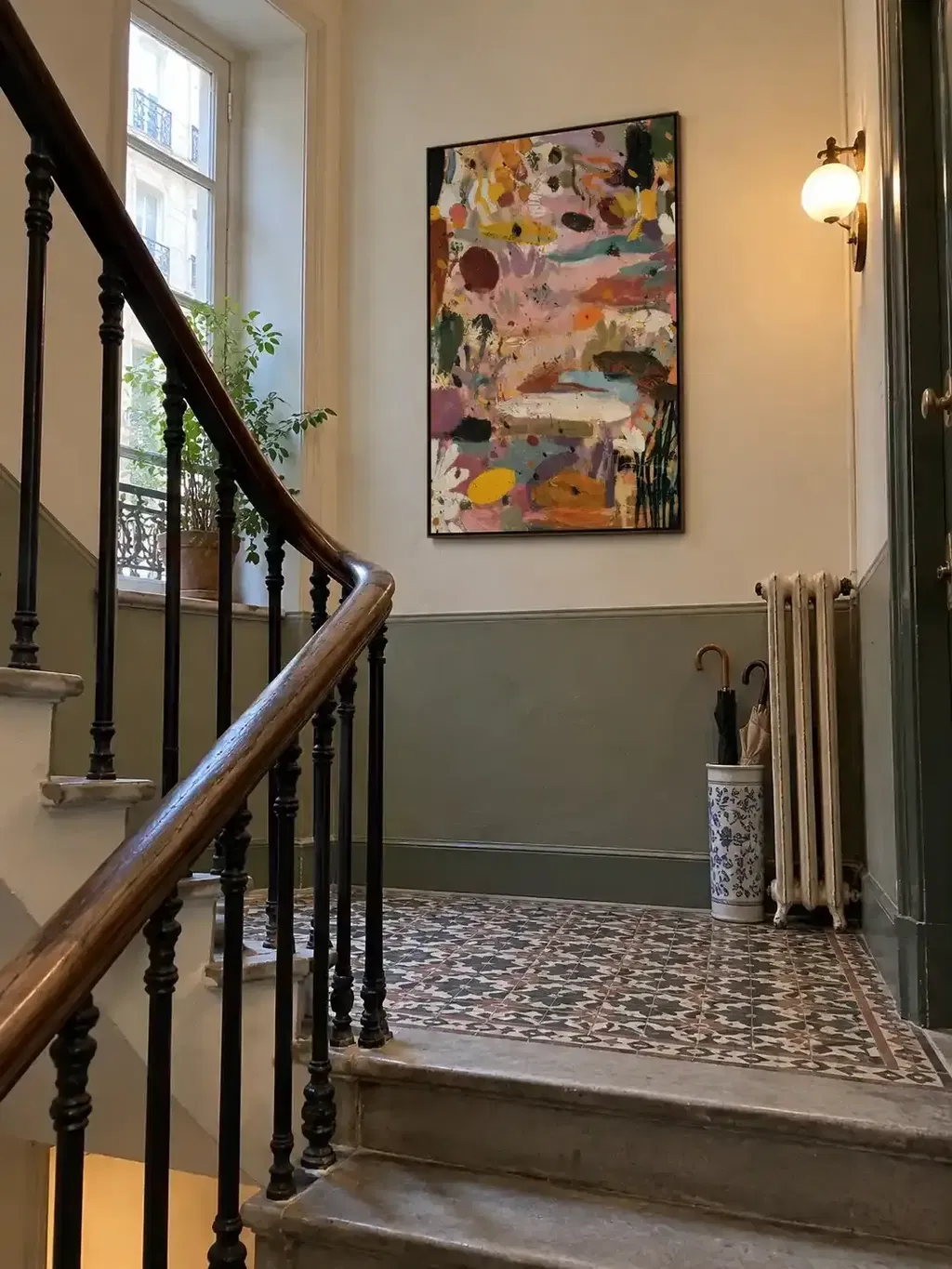
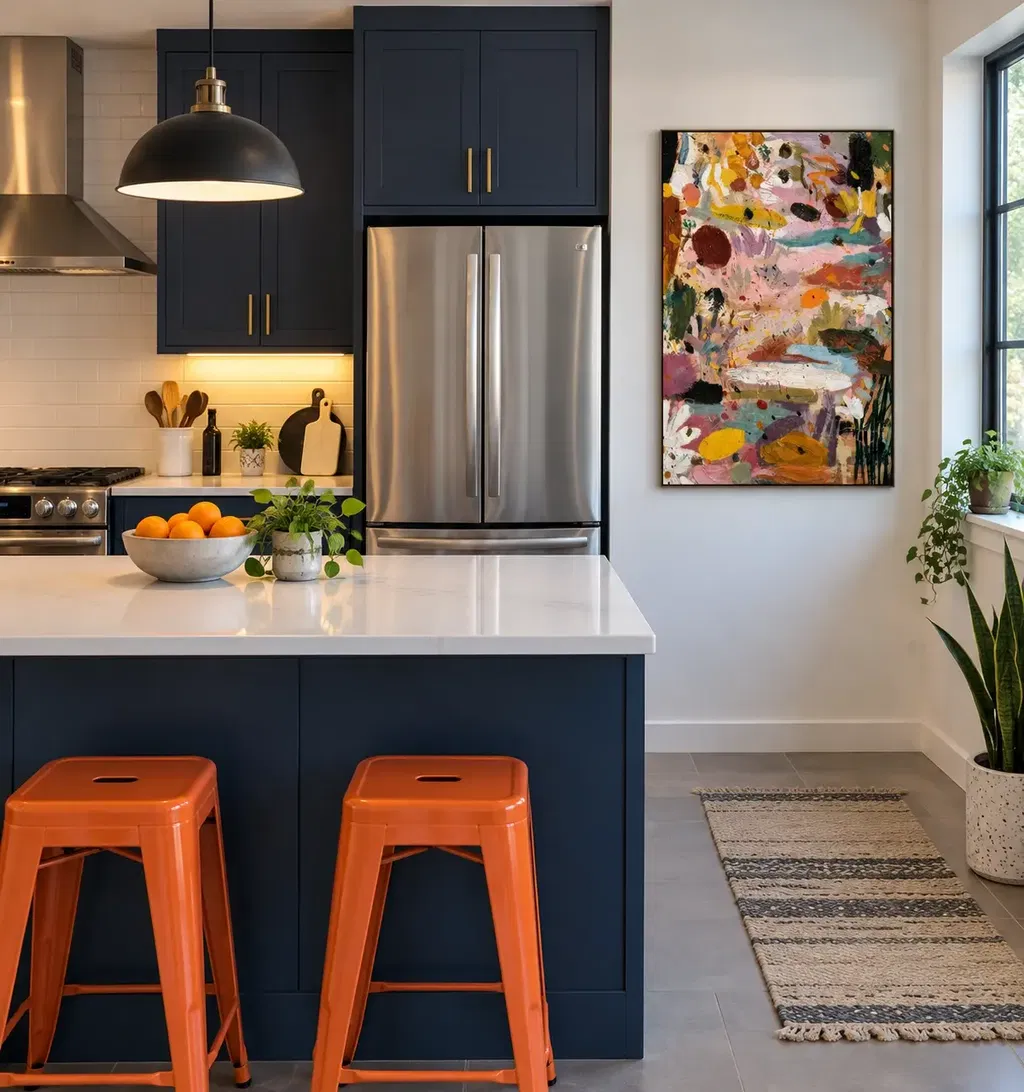
The safest starting point for hanging canvas art around kids and pets is placement, not hardware. Move the piece out of predictable reach, ball-bounce, and climbing paths, then record the artwork's actual weight and wall type before choosing wall hardware. Add compatible anti-shift measures only after the mounting matches those verified facts.
The Safer Starting Point: Placement Before Hardware
Where you hang a painting matters as much as what you hang it with. Start by mapping the room's real traffic, ball-bounce, and reach zones before picking any wall hardware.
Make Placement the First Safety Decision
- Choose a wall segment outside routine hand, shoulder, and furniture-assisted reach.
- Treat ball and toy trajectories in playrooms and living rooms as part of the wall location, not an afterthought.
- Note where pets jump from couches, beds, or shelving, since those launch points count as reach too.
- Once the spot is settled, record the artwork's actual weight, frame or panel construction, and wall type, and check placement against our centerline measurements guide so the final height still works for the room.
What Secure Hanging Does—and Does Not—Solve
Secure wall attachment keeps a painting from shifting or falling; it does nothing to stop a thrown ball, a curious hand, or a cat mid-leap from touching the surface. Treat placement and mounting as two separate decisions that work together, not one problem solved by the other.
Choose Hardware From the Artwork and Wall Facts
Hardware choice follows directly from the artwork's weight and the wall behind it. There is no single hardware type that fits every drywall, stud-backed, or masonry wall, so match the approach to what you actually have.
- Stud-compatible hook or screw: Use when a stud lines up with your chosen spot. Driving hardware into a stud gives more holding stability than drywall alone, but only where the stud location matches the placement you already picked.
- Wall anchor for a large or heavy piece: Use when no stud is available or the artwork is sizable. Conservation guidance describes appropriately sized sturdy hardware matched to a painting's size and weight, with a proper wall anchor for large or heavy pieces instead of a light-duty hook.
- Picture wire on compatible eye screws: Use only when the frame has two-sided eye screws built to hold the artwork's weight. Wire strung on mismatched or single-point attachments is not a substitute for a rated anchor or stud fastener.
Before ordering hardware for a framed oil painting for sale, such as our Urban Abstract textured canvas piece, get the finished weight, delivery format, and rear attachment points in writing. Listed dimensions alone don't tell you which hardware branch applies.

Reduce Movement With Compatible Anti-Shift Measures
Wall security and contact reduction solve different problems, so treat them as separate layers. Add anti-shift measures only when the frame, backing, and hardware instructions explicitly support them.
Separate Wall Security From Contact Reduction
A tightly anchored painting can still get touched, leaned on, or pawed at, because hardware only controls what happens at the wall, not at the surface. A rigid backing board fitted to the artwork's actual back can help reduce direct contact and vibration from pressure or bumps, and a properly built frame can shield the more vulnerable edges. Both need to be sized for that specific piece to help at all.
Use Tamper-Resistance Only When the System Is Compatible
Closed or security-style hangers can make removal harder, but only when the maker confirms they work with that frame's weight and attachment points. Forcing an incompatible fitting can loosen the mount instead of securing it. Spaced glass or acrylic glazing, held clear of the paint surface, cuts down on hand contact and airborne grime without making the painting impact-proof.
Adjust the Plan for Each Family-Home Scenario
The dominant risk changes by room, so the placement fix should change with it. Use this table to match each setting to the exposure worth removing first.
| Setting | Main exposure | Placement adjustment | Remaining check |
|---|---|---|---|
| Hallway | Shoulder-height touching, leaning, pet traffic | Move off the main walking line and away from doorframes people brush past | Confirm hardware tolerates repeated light contact, not just static weight |
| Playroom or ball zone | Direct ball and toy impact | Relocate outside the throwing lane and off walls behind active play | Recheck the mount after any noticeable bump |
| Child's room | Furniture-assisted reach from beds, dressers, chairs | Keep clear of climbable furniture, not just floor-height reach | Verify hardware after any nearby furniture is moved |
| Pet-accessible room | Jumping from couches, shelves, or cat trees | Place beyond typical launch arcs, not just paw height | Watch for rubbing or scratch marks needing inspection |
None of these adjustments replace matching hardware to the wall and weight; they only change where the artwork can safely wait while that match gets confirmed.
Protect Textured Canvas From Dust, Contact, and Cleaning
Textured, painted surfaces need gentler handling than framed prints or photos behind glass. Prevent contact first, then follow a conservative cleaning rule instead of experimenting.
Prevent Routine Family-Home Contact
- Keep drinks, food, and plant misting away from the wall the painting hangs on.
- Discourage kids or pets from using the frame as a handhold or scratching post.
- Add a compatible backing, frame, or spaced glazing only if the artwork's construction allows it; forcing glazing onto raw canvas can trap moisture instead of protecting it.
Follow the Conservative Cleaning Stop Rule
- Do not use household cleaners, commercial paint cleaners, water, solvents, a vacuum, or compressed air on the painted surface.
- Skip stiff brushes, feather dusters, or cloths that can catch raised or textured paint. Conservative painting-cleaning guidance rules out most household dusting tools for painted surfaces.
- Stop immediately if paint looks loose, flaking, or lifted, and route stains, splashes, or unknown coatings to a paintings conservator instead of testing a cleaner yourself.
For day-to-day upkeep between these checks, our canvas care guide covers humidity and storage habits that help keep canvas stable.
Use One Verification Path When the Setup Is Unclear
Generic hanging advice stops being enough once weight, wall type, or the room's stakes are uncertain. Work through this path before you drill anything.

- Confirm the finished weight of the artwork as delivered, not just the canvas size advertised online.
- Confirm how the piece is actually built and attached in back, whether that is frame, panel, stretcher bars, or wire, since that construction determines which hardware even applies.
- Identify whether the wall is drywall, stud-backed, or masonry, then match it to hardware rated for the artwork's confirmed weight and the maker's instructions.
- Recheck hooks, screws, wire, and frame attachments periodically, and again right after any bump, furniture change, or visible tilt or loosening.
- Pause and get installation guidance specific to the artwork, hardware, and wall before mounting above or beside a crib, or anywhere generic advice leaves a material fact unresolved.
FAQs
Are adhesive strips suitable for heavy canvas art in a home with kids or pets?
Generic adhesive strips are not a substitute for weight-rated hardware once a canvas painting has real heft. Get the delivered weight, confirm the wall type, and only use an adhesive system when its own rating actually covers that weight and surface; otherwise choose a stud screw or rated anchor instead.
What should I do if a child or pet leaves a mark on textured canvas?
Stop before rubbing, wiping, or wetting the spot. Document what happened, then check with the maker or a paintings conservator before cleaning if the paint is textured, stained, or already loose, since improvised cleaning is more likely to spread a mark than remove it.
When should I recheck a painting's hanging hardware?
Recheck after any bump, a move to a new wall, a furniture rearrangement nearby, or the first sign of tilt or looseness in the hook, screw, wire, or frame. Keep the area off-limits until you've confirmed the hardware is still holding as intended.