
The Evolution of Value in the Modern Art Market
The global art market is undergoing a structural realignment. While high-end auction sales for purely financial art assets plummeted by 44% in 2024 according to Marketplace.org, a different story is emerging in the realm of authentic, hand-painted works. Buyers are increasingly retreating from "vanity" pieces in favor of art with real application value—pieces that offer genuine emotional resonance and physical craftsmanship.
This shift is backed by hard data. Despite volatility in the speculative market, global art sales reached $65 billion in 2023, with the US holding a dominant share of the market baseline, as reported by The Art Basel and UBS Art Market Report 2024. However, as the market for original work matures, so does the sophistication of deceptive reproductions. For the aesthetic-driven decorator, the primary challenge is no longer finding art, but verifying its soul.
The rise of "embellished prints"—giclee canvases topped with a thin layer of transparent gel to simulate brushstrokes—has created a grey market. While these pieces are often marketed as "hand-touched," they lack the "essential identity" that human-created art possesses. A Columbia University study confirmed that consumers value art labeled as authentic human-created work 62% higher than AI-generated or mass-reproduced alternatives.

Visual Forensics: Identifying "Brushstroke Memory"
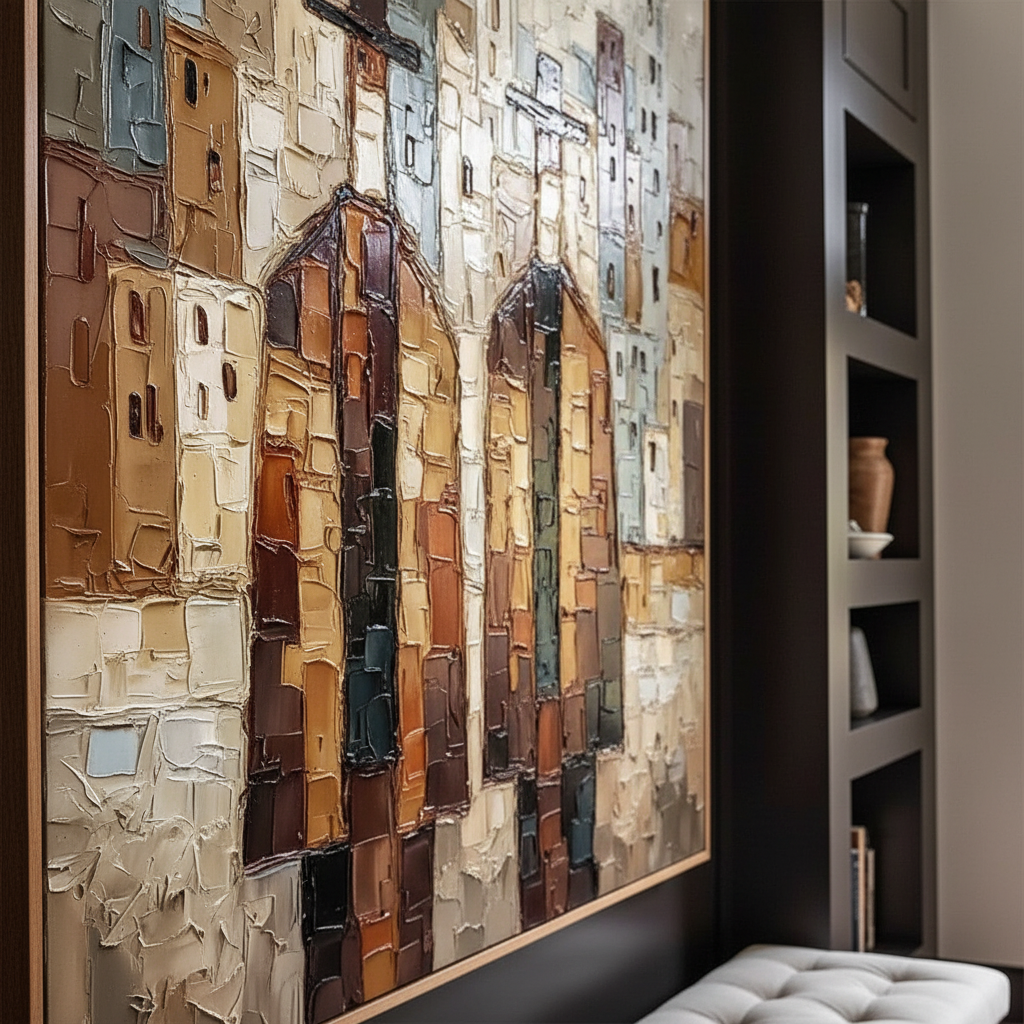
The most profound difference between a genuine oil painting and an embellished print lies in what restorers call "brushstroke memory." When an artist applies oil or heavy-body acrylic paint, the medium retains the exact path, pressure, and speed of the human hand.
The RID (Ridges and Valleys) Test
In a 100% hand-painted work, the texture is a direct result of the paint’s viscosity and the tool used (brush or palette knife). This creates a topographical landscape of "ridges and valleys."
- Genuine Art: Ridges are irregular. They follow a logical, directional flow based on the composition. If a figure is painted, the strokes follow the anatomy.
- Gel-Coated Prints: These often exhibit uniform "peaks." Because the gel is applied quickly over a flat print, the texture often lacks directional consistency. You may see repetitive patterns that do not align with the underlying colors.
The Edge Inspection Method
Seasoned collectors often use the "edge inspection" test to verify authenticity. By examining the perimeter where the paint meets the raw canvas or the frame, you can spot the mechanical nature of a print.
- The Integration Check: Genuine works show gradual paint thinning and canvas fiber integration. You can see the paint "soaking" into the weave at the edges.
- The Abrupt Boundary: Gel coats typically create a sharp, abrupt boundary that looks like a transparent plastic layer applied over the top. It sits on the surface rather than becoming part of the substrate.
Logic Summary: Our verification framework assumes that authentic hand-painting involves a 5-15μm penetration depth into canvas pores. Gel mediums, applied at 0.5-2mm thickness, fail to interact with the substrate microstructure, creating an optical "disconnect" detectable under close inspection.
The Physics of Light: Why Replicas Feel "Flat"
The "soul" of a painting is often a function of its optical complexity. According to the Getty Conservation Institute, pigment reflection is dominated by absorption and scattering coefficients (the Kubelka-Munk equation).
In a hand-painted oil work, light doesn't just bounce off the surface; it travels through translucent layers of pigment and binder, reflecting off lower layers and the white primer of the canvas. This creates a "glow" that prints cannot replicate.
Refractive Index Disparity
A major breakthrough in art authentication involves analyzing the refractive index of surface materials.
- Natural Substrates: Canvas typically has a refractive index of ~1.53.
- Synthetic Gels: Most acrylic gels used in embellished prints have a refractive index between 1.45 and 1.55. Research suggests that forensic analysis using polarized light microscopy can detect gel-medium application with 95% accuracy because synthetic gels create uniform refractive patterns, whereas natural oil paint and canvas show irregular, complex optical properties.

The Metamerism Trap
Printed pigments often suffer from "geometric metamerism," where the color appears to change drastically depending on the viewing angle or light source. Hand-painted pigments, especially those using high-quality Titanium White (which accounts for 90% of the white pigment market due to its extreme hiding power), maintain a more stable and "heavy" visual presence.
Longevity and Material Integrity: The 10-Year Fade
Beyond aesthetics, the choice between genuine art and embellished prints is a matter of investment durability. While a properly cared-for oil painting can last centuries, synthetic gel coats are prone to rapid degradation.
Delamination and Yellowing
Studies have shown that acrylic gel mediums can degrade 3 to 5 times faster than the natural textures found in oil paintings. Common issues include:
- Photo-oxidative Degradation: Exposure to UV light causes synthetic polymers to become brittle and yellow.
- Delamination: Because the gel is a separate layer from the printed ink, it can begin to peel or "bubble" away from the canvas within 10-15 years.
- Moisture Sensitivity: Research published via ResearchGate indicates that under high humidity (83%), certain acrylic pigments can swell by over 7% in mass, leading to structural instability.
Comparison of Material Performance
| Feature | Hand-Painted Oil/Acrylic | Embellished Gel Print |
|---|---|---|
| Surface Bond | Molecular integration with primer | Mechanical adhesion to ink |
| Texture Depth | Variable (0.1mm to 5mm+) | Uniform (0.5mm to 2mm) |
| Longevity | 50 - 100+ years | 10 - 20 years |
| Cleaning | Water-based swabs (for acrylics) | High risk of surface dissolution |
| UV Resistance | High (with lightfast pigments) | Moderate to Low (gel yellowing) |
Modeling Note: Our durability estimates are based on accelerated aging data comparing oxidative cross-linking in oils versus physical coalescence in acrylic polymers. These are typical observations and may vary based on environmental VOC levels and humidity.
Health and Ethics: The Invisible Cost of Deception
For the modern homeowner, "beauty" is no longer just skin deep. Environmental and ethical considerations are now central to the purchasing process.
Indoor Air Quality (IAQ)
Deceptive mass-market prints often use industrial inks and cheap sealants that emit high levels of Volatile Organic Compounds (VOCs). In contrast, high-end artisan studios are moving toward eco-friendly alternatives. Aalto University research proves that coatings on properly cured substrates emit significantly lower toxic VOCs over time. Furthermore, the EPA warns that indoor air pollution can be a significant health risk, making low-VOC, LEED-compliant art a prerequisite for health-conscious spaces.
The "Fair Trade" of Fine Art
The "human-made" premium isn't just a psychological preference; it’s an ethical stance. A Wharton School survey found that 87% of consumers believe artists should receive fair compensation for their unique styles. By choosing genuine hand-painted work, buyers support a creative economy that adds $1.2 trillion to the US GDP, according to the National Endowment for the Arts.
Safety Guardrails
It is critical to distinguish between professional pigments and low-grade industrial substitutes. Some cheap "hand-painted" imports have been found to contain Cadmium, a Group 1 carcinogen. Authentic artisan works typically adhere to strict safety standards like ASTM D-4236, ensuring that the materials are reviewed by toxicologists for chronic health hazards.
The Economic Impact: Art as an Asset
For property owners and developers, the distinction between "decor" and "art" has direct financial implications. Royal Society data shows a direct correlation between high-quality art participation in a neighborhood and relative house price gains.
Boosting Commercial Value
In the commercial sector, the "authenticity gap" is even more pronounced.
- Hospitality: A 2025 hospitality white paper emphasizes that integrating original artworks provides travelers with "scarce authenticity" that mass-produced prints cannot offer.
- Real Estate: Large-scale hand-painted murals have been shown to reduce neighborhood crime by 40% (University of Michigan's "Busy Streets Theory") and drive significant increases in pedestrian foot traffic.

Authentication Checklist for the Home Decorator
If you are evaluating a piece online or in a showroom, use this 5-step verification framework to ensure you are investing in genuine craftsmanship:
- The Price-to-Size Ratio: If a 48x48 inch canvas is marketed as "100% hand-painted" for under $200, exercise caution. The labor time and material costs (pigments, canvas sizing, and framing) for genuine work typically exceed this threshold.
- Directional Impasto: Look for heavy texture that follows the logic of the subject. Use a flashlight at a low angle (raking light) to reveal the "ridges and valleys."
- Pigment Saturation: Real oils show slight translucency at the edges. Check if the pigment sits uniformly atop the surface (print) or interacts with the canvas weave (hand-painted).
- The Olfactory Test: New oil paintings have a distinct, slightly sweet scent of linseed or walnut oil. Gel prints often have a sterile, plastic, or "new car" chemical smell.
- Artist Documentation: Genuine works should come with a clear provenance or a statement from the studio regarding the lightfastness and materials used.
Investing in "Essential Identity"
Choosing hand-painted art over embellished prints is more than an aesthetic preference—it is a decision to value human attention over mechanical reproduction. As UChicago research suggests, a digital replica lacks the "essential identity" of the artist. By understanding the visual cues of brushstroke memory and the chemical realities of pigment, you can curate a space that is not only beautiful but authentically soulful.
Whether you are seeking to balance textured art with minimalist decor or looking for a piece that will resist fading in bright spaces, the key is verification. In a world of digital abundance, the physical evidence of the artist’s hand remains the ultimate luxury.
Disclaimer: This article is for informational purposes only. When handling or purchasing art materials, always refer to the manufacturer's safety data sheets (SDS). If you have concerns about indoor air quality or toxic pigments in older works, consult a certified industrial hygienist or art restoration professional.
Sources
- Marketplace: The Expensive Art Market Struggles
- Columbia Business School: Human vs. AI Art Perception
- The Art Basel and UBS Art Market Report 2024
- Royal Society: Quantifying Art and Property Prices
- EPA: Indoor Air Quality and Low-VOC Paints
- IARC: Cadmium and Cadmium Compounds
- Getty Conservation Institute: Color Science in Art
- University of Michigan: Busy Streets Theory and Public Art
- Artsy 2024 Art Market Report
- ResearchGate: Ageing of Commercial Oil and Acrylic Paints











