Explore our collection of Minimalist Wall Art and Modern Minimalist Decor, designed to bring calm, elegance, and simplicity to your home. Featuring clean lines, neutral color palettes, and carefully composed negative space, our minimalist artwork is perfect for living rooms, bedrooms, offices, or gallery walls. Transform your interiors with minimalist wall decor that combines timeless sophistication with serene, modern style.








Minimalist Wall Art with Clean Lines and Open Space
Minimalist wall art does a lot with very little. A few lines, a block of color or a single figure in open space can hold a wall as firmly as a busy composition, provided each element is placed with care. Because there is less to look at, what remains carries more weight, and the way the painting sits in the room matters as much as the image itself.
MontCarta's minimalist collection is led by abstract work, including line, grid and geometric compositions, alongside pared-back landscapes, seascapes, figures and architectural studies. Palettes run from white, beige and grey to black, brown, blue and green. Use the orientation, subject, style, color and room filters to narrow the selection, then open each painting to compare its available sizes and frame finishes.
Understand what the painting is built on
Most minimalist paintings rely on one main device. Knowing which one appeals to you makes the collection easier to browse.
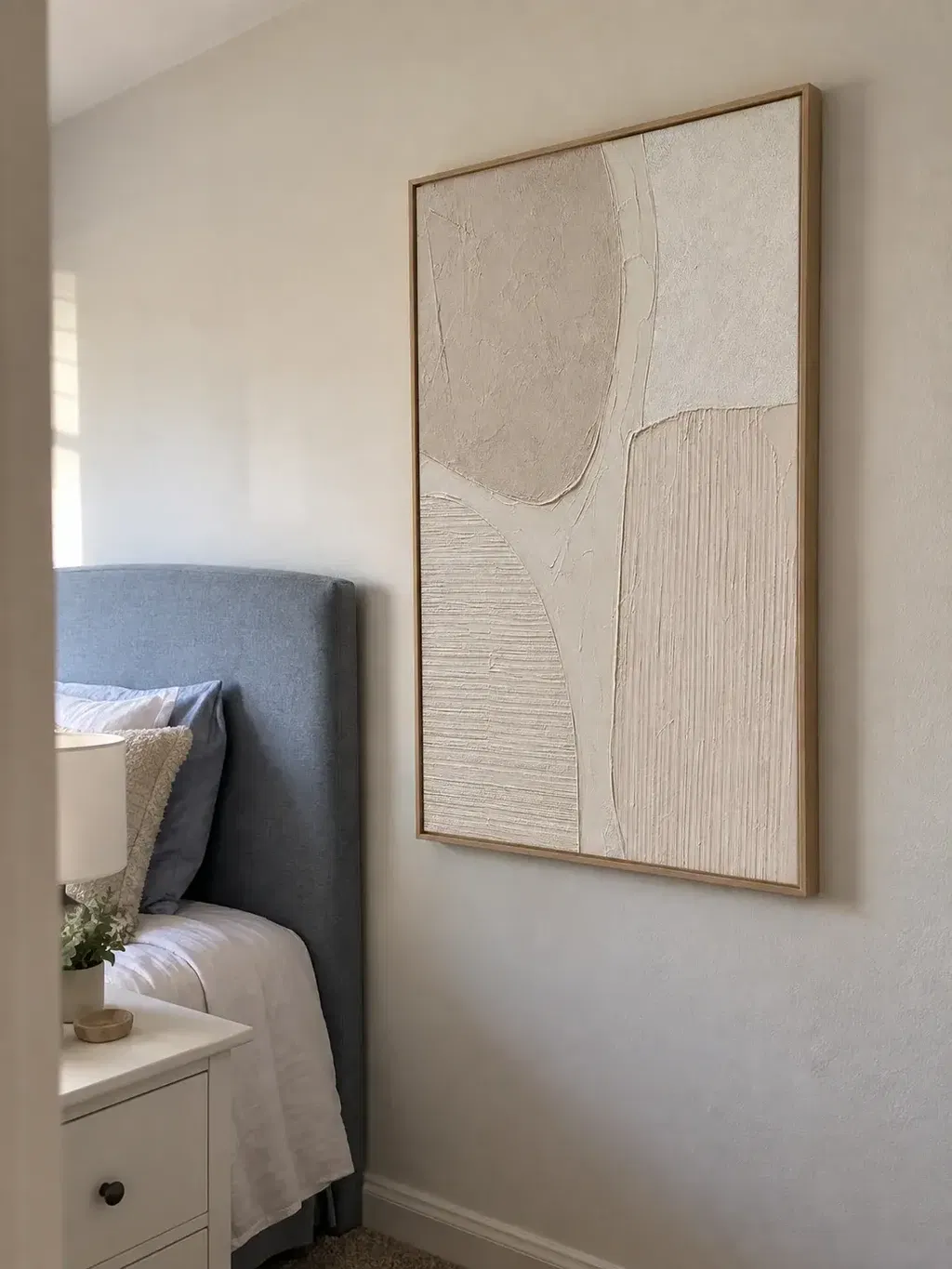
Line is the most direct. Linear Calm by Javier Ramirez is made of carefully rendered vertical lines across a richly textured, warm beige canvas. The repetition creates order, while the textured surface keeps it from feeling mechanical. It is offered from 20''x28'' to 48''x80'' and suits a hallway, office or living room where a calm, structured focal point is wanted.
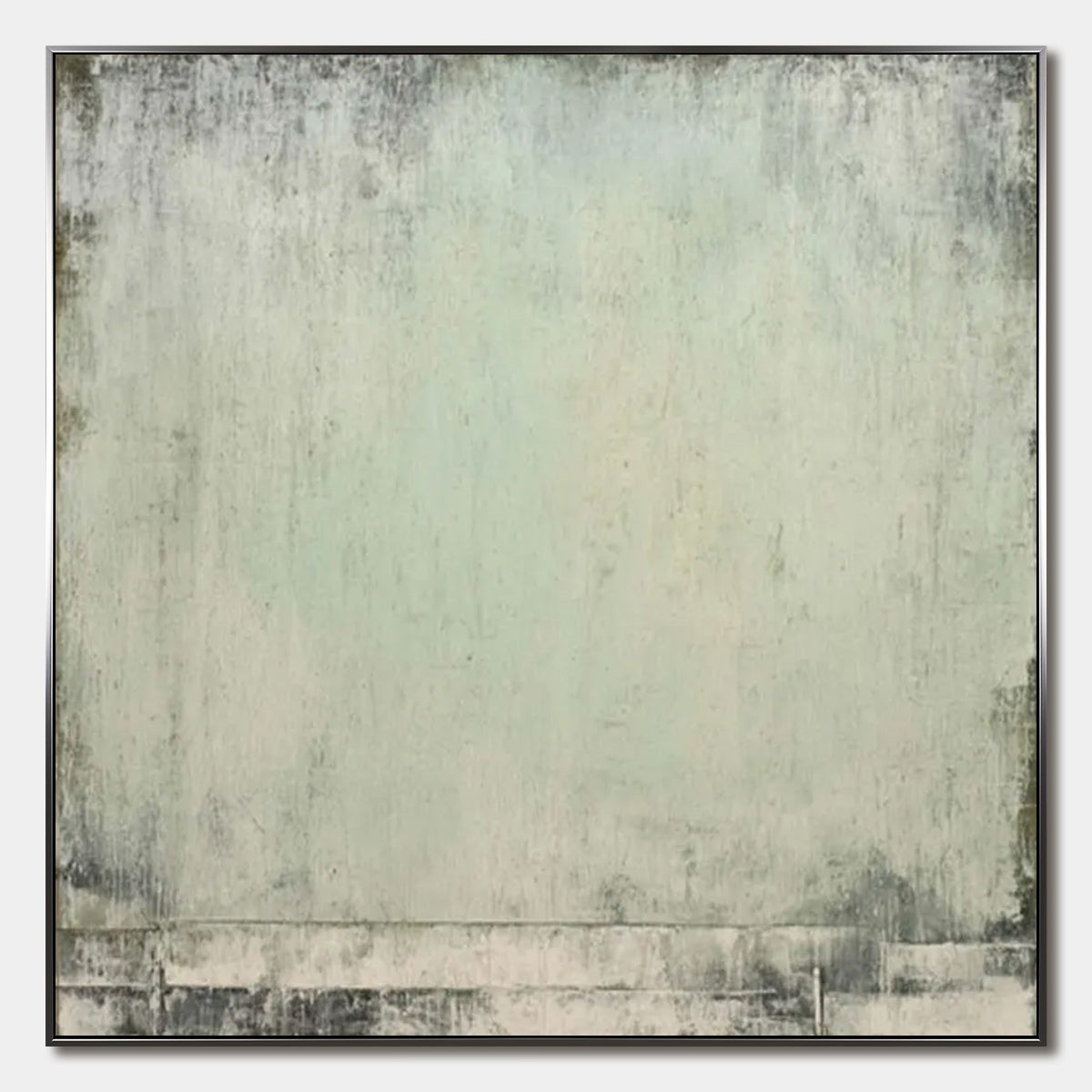
Color and proportion are another route. Color Field Study, also by Javier Ramirez, sets a grid of soft white rectangles on a muted beige ground, each marked with a single brushstroke in a different color. The small accents give the eye somewhere to travel without disturbing the overall calm. Its square format, from 20''x20'' to 48''x48'', works well above a desk, a bench or a bedside table.
Minimalist landscapes and figures
Reduced form can also describe a place or a person. Landscapes and figures in this collection keep only what is needed: a horizon, a few blocks of color, a single silhouette.
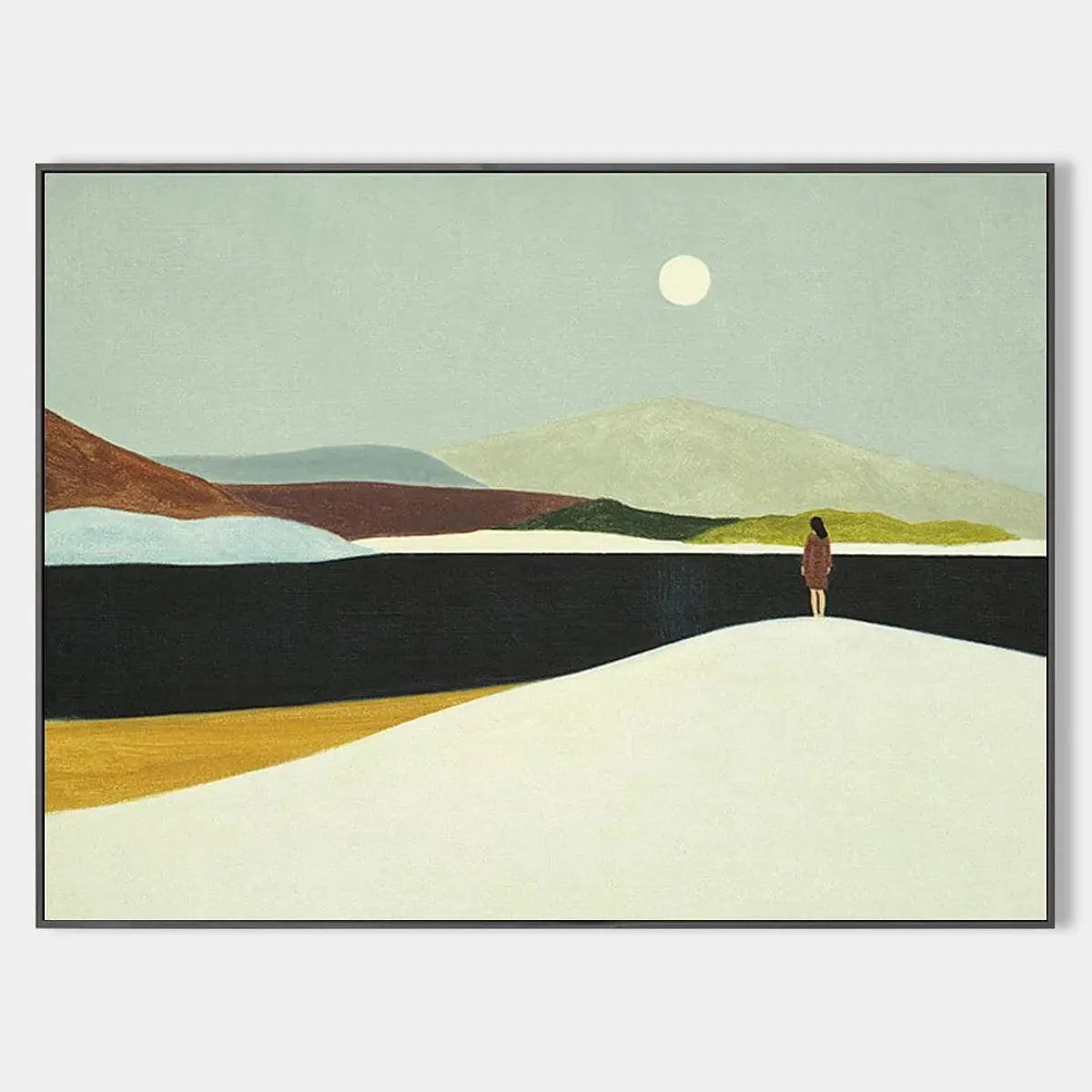
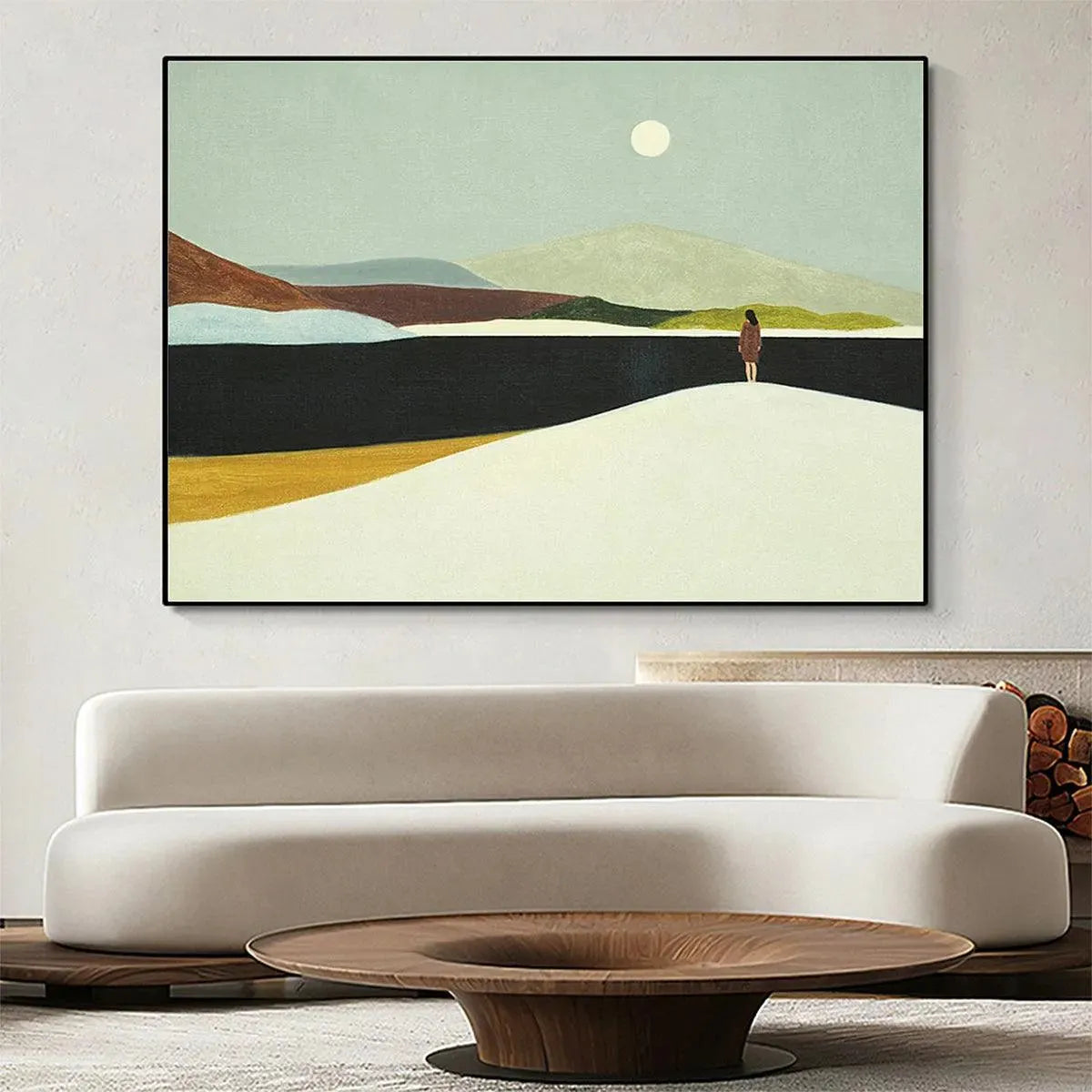
Solitary Figure in Minimalist Landscape by Isabella Rossi places a lone figure overlooking a vast landscape built from blocks of soft, muted color. The figure gives the composition a sense of scale and a quiet story, which can make it easier to live with than pure abstraction in a shared room. This horizontal work is offered from 20''x28'' to 48''x80''.
Give the painting space to work
Negative space is part of the design of a minimalist painting, and the wall around it acts as an extension of that space. Crowding the canvas with shelves, clocks or other frames weakens the effect. Where possible, let a minimalist piece hang on its own, or with one related work, and keep nearby surfaces clear.
Scale follows the same logic. A small minimalist painting on a large wall can look lost, because there is little detail to draw the eye toward it. If the wall is generous, choose a larger size or a pair of related works so the composition still reads from across the room. Mark the outline on the wall and view it from the doorway before settling on dimensions.
Choose a palette that fits the room
Minimalist art is often associated with white and beige, and many works in this collection use them. Other palettes carry the same restraint. Black and white works bring sharp contrast; blue, green and brown compositions add color while keeping the same simplicity.
In a room with pale walls and light furniture, a darker or higher-contrast painting gives the space an anchor. In a room that already has strong color or pattern, a quieter white or beige piece provides relief. For work where warm neutrals lead, compare the beige collection.
Consider texture as well as form
Many paintings here combine clean composition with a raised or layered surface. From a distance they read as simple shapes; up close, the brushwork and ridges become visible. That combination suits rooms where the painting is seen at both distances, such as a living room or a hallway you walk past every day.
If you are drawn to texture and a more natural, imperfect character, the wabi sabi collection explores that direction further.
| What you want | Start with | Confirm before ordering |
|---|---|---|
| Order and rhythm | Line or grid compositions | Direction of the lines relative to the wall |
| A single strong focus | A square with one defined shape or field | Clear space around the canvas |
| A calm scene with a story | A minimalist landscape or figure | How the horizon sits with nearby furniture |
| Contrast in a pale room | Black, brown or blue compositions | Balance with other dark elements in the room |
The featured paintings are offered as rolled canvas, frameless stretched canvas, or stretched with a gold, silver, white, black or wood frame. A frameless stretched option keeps the edges clean, but compare each finish with your room before choosing.
Questions about minimalist wall art
What makes a painting minimalist?
A minimalist painting uses a small number of elements, such as lines, shapes, color fields or a single figure, and leaves open space around them. The aim is clarity and calm rather than detail.
Is minimalist wall art always black, white or beige?
No. Neutrals are common, but this collection also includes grey, brown, blue and green works. Minimalism comes from restraint in composition, and that restraint can appear in any palette.
How is minimalist art different from wabi sabi art?
The two overlap. Minimalist work focuses on reduced form and clean composition, while wabi sabi places more weight on texture, natural character and imperfection. Some paintings suit both descriptions.
Will a minimalist painting look too plain on a large wall?
Not if the size is right. Minimalist work relies on scale and space rather than detail, so choose dimensions that relate to the wall and the furniture, or use a pair of related paintings.
★ Reviews