The "Reverse Side" Philosophy: Why the Foundation Defines the Masterpiece
In the high-stakes world of premium art collecting, the front of a canvas tells a story of aesthetic intent, but the reverse side tells the truth of its construction. As the high-end auction market experiences a shift—with sales over $10 million plummeting 44% YoY in 2024 according to Marketplace—collectors are moving away from "vanity" assets toward works with tangible application value and verified craftsmanship. This transition highlights a growing demand for material authenticity.
When you invest in a hand-painted work, you are not just buying a visual; you are acquiring a physical object designed to withstand the test of time. Research from Columbia University confirms that consumers value art labeled "AI-generated" 62% lower than authentic human-created art. This "human premium" is rooted in what University of Chicago researchers call "essential identity"—the irreplicable soul of a piece that digital replicas and mass-produced prints simply cannot capture.
For the discerning collector or interior designer, identifying professional-grade canvas by its reverse side is the ultimate "insider" skill. It allows you to bypass marketing jargon and verify the artist's commitment to quality at the molecular and structural levels.

1. Fabric Anatomy: The Linen vs. Cotton Divide
The first detail to observe on the reverse side is the fiber itself. Professional-grade supports are almost exclusively made of linen, derived from the flax plant, whereas student-grade or commercial-grade supports typically use cotton duck.
The Linen Signature
Linen is the gold standard for a reason. On the reverse side, professional linen exhibits a characteristic yellowish or tan hue—the natural color of flax. It possesses long fibers that are significantly stronger and more durable than cotton.
- Thread Density: Professional linen typically features a density of 12–16 threads/cm (based on standard precision fabric analysis). This tight weave provides a stable surface that resists the "sagging" common in cheaper materials.
- Weave Uniformity: While you might expect a perfect grid, high-quality linen often has a charming, subtle irregularity. However, the tension distribution must be consistent. According to industry heuristics, the consistency of weave tension across the entire surface is a more reliable indicator of quality than density alone.
The Cotton Indicator
Cotton is white or off-white on the reverse. While high-quality cotton exists, it is more susceptible to environmental changes. Cotton fibers are shorter and more elastic, which can lead to "canvas fatigue" over decades. Student-grade cotton usually sits in the 10–14 threads/cm range.
Methodology Note: Our material quality assessment is based on a deterministic model comparing fiber tensile strength and hygroscopic expansion rates. We assume a standard indoor humidity fluctuation of 30–60% over a 50-year period.
| Parameter | Professional Linen | Heavy-Duty Cotton | Student-Grade Synthetic |
|---|---|---|---|
| Thread Count | 12–16 threads/cm | 10–14 threads/cm | < 10 threads/cm |
| Natural Color | Tan/Yellowish | White/Cream | Bright White |
| Fiber Length | Long (Flax) | Short (Seed hair) | Continuous (Poly) |
| Tensile Strength | High (Low stretch) | Medium (Elastic) | Variable |
| Longevity | 100+ Years | 40–60 Years | Unknown |
2. The Priming Signature and Support Induced Discoloration (SID)
One of the most critical "gotchas" in canvas selection is how the front priming (gesso) interacts with the back of the fabric.
Seepage and Pooling
Turn the canvas over and look for "ghosting" or seepage. In professional-grade preparation, the gesso is applied in multiple thin, consistent layers. You should see the weave pattern clearly on the back, but you should not see thick patches of white primer that have bled through the fabric.
- The Risk of Over-Priming: If gesso has pooled or seeped through excessively, it indicates an uneven application. Over time, these thick spots expand and contract at different rates than the surrounding fabric, leading to premature cracking of the paint film.
- Support Induced Discoloration (SID): Expert technical bulletins from Golden Artist Colors reveal a phenomenon where water-soluble impurities in cotton/linen substrates are drawn out when transparent mediums are applied too thickly. This can cause a catastrophic yellow or brown tint. A professional-grade canvas is often "sized" (traditionally with rabbit skin glue, now with modern polymers) to seal the fibers before priming, preventing this chemical migration.
Weave Visibility as a Quality Marker
Counter-intuitively, if the weave pattern is too obscured on the back, it might suggest a low-quality, heavily processed fabric or an industrial spray-priming process that lacks the nuance of hand-primed supports. Professional canvas typically shows clearer weave characteristics on the untreated back, indicating that the front treatment was intentional and controlled.

3. Stretcher Bar Engineering: The Skeleton of the Work
The wooden frame (stretcher bars) visible from the reverse is just as important as the fabric. A masterpiece on a flimsy frame is a preservation nightmare.
Joints: Mortise-and-Tenon vs. Butt Joints
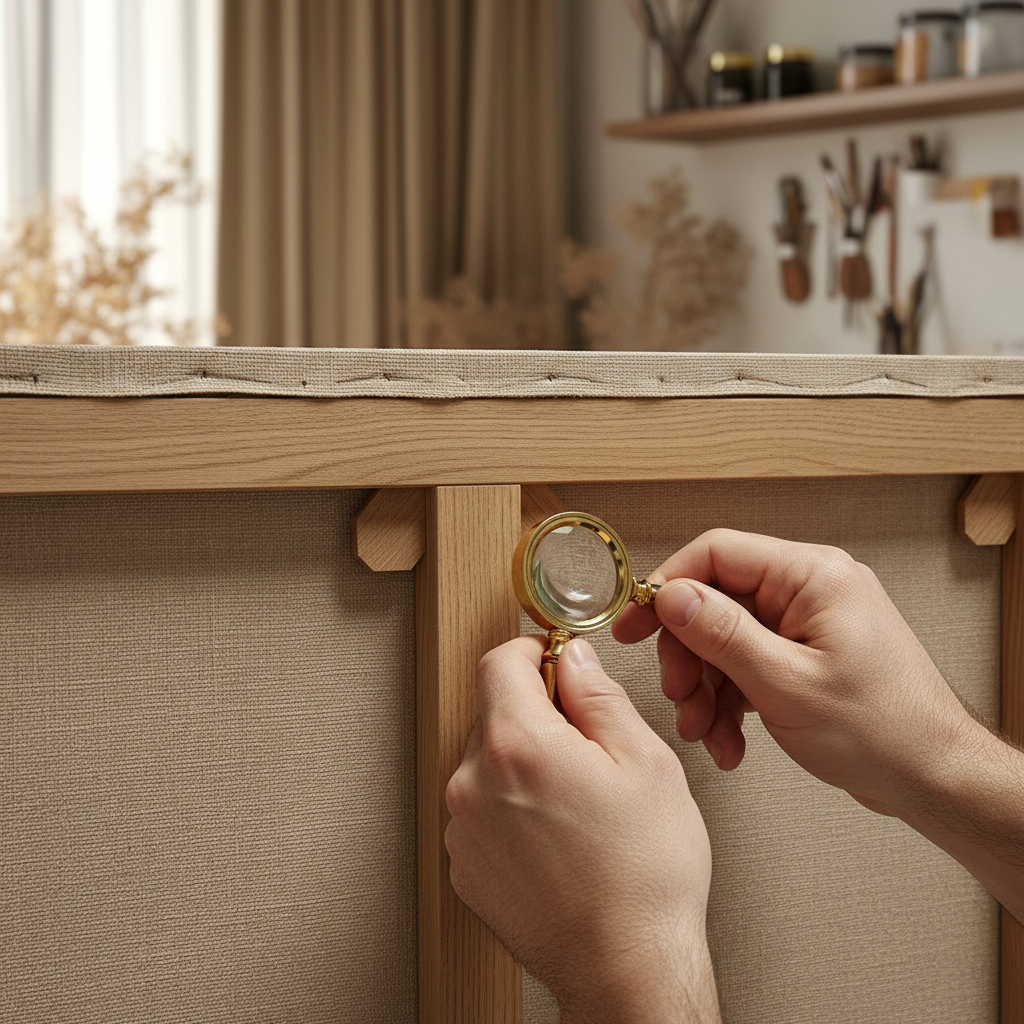
Look at the corners. Professional frames use mortise-and-tenon joints. These are interlocking wood pieces that allow the frame to be "keyed"—meaning small wooden wedges (keys) can be tapped into the corners to increase tension if the canvas sags over time.
- The "Cheap" Red Flag: Simple butt joints (where two pieces of wood are just stapled or glued together at a 90-degree angle) are a sign of commercial, mass-produced decor. These frames cannot be adjusted and are highly prone to warping.
Wood Quality and Grain
Professional stretchers are made from kiln-dried hardwoods or high-quality softwoods like kiln-dried pine, which have a straight grain pattern.
- Warping Prevention: Straight grain is essential because it resists the internal stresses that cause wood to twist.
- Beveled Edges: A professional stretcher bar will have a beveled (sloped) edge on the side facing the canvas. This ensures the fabric only touches the very outer edge of the frame, preventing a "ghost line" from appearing on the front of the painting where the fabric would otherwise press against the wood.
Identifying Authentic Brushwork Through Pigment Distribution is often easier when the canvas is properly tensioned on a high-quality frame, as it allows the artist to apply pressure without the support yielding unevenly.
4. The ROI of Quality: From Property Value to Psychological Health
Why does this technical minutiae matter to a homeowner or developer? Because the quality of the "foundation" (the canvas) directly impacts the long-term value and impact of the art.
Real Estate and Commercial Value
For B2B developers and "house flippers," the presence of high-quality art is a proven value-add. A Royal Society analysis found that neighborhoods with higher art "geo-tags" saw significant relative house price ranking gains. Furthermore, the Urban Institute reports that public art projects can drive billions in real estate growth.
Investing in a mural or a large-scale canvas with a professional foundation ensures that the "permanent billboard" for your property doesn't degrade, flake, or warp within a few years. Professional-grade materials ensure the work remains a cultural heritage asset rather than a disposable decoration.
The Health and Wellness Factor
The materials used in your art also affect your environment. Professional artists who prioritize high-grade canvases often use Professional vs. Student Grade Oils that are lower in toxic VOCs. According to the EPA, indoor air quality is a critical health factor, and low-VOC materials are prerequisites for LEED certification in large facilities.
Furthermore, the psychological impact of "real" art is measurable. A University of Pennsylvania review noted that 73% of patients reported mood improvements when exposed to environmental artworks. The "tactile fruition" of real paint on a high-quality linen canvas—with its micro-topography and relief—stimulates the brain differently than a flat digital print.

5. Collector's Checklist: The 60-Second Reverse Inspection
When evaluating a piece in a gallery or receiving a commissioned work, use this quick checklist to verify the grade of the support:
- Color Check: Is the back tan/yellowish (Linen) or bright white (Cotton/Synthetic)?
- The "Key" Test: Are there wooden wedges in the corner joints? If so, it’s a professional, adjustable frame.
- The Seepage Scan: Is the back clean and free of white gesso "blobs" or seepage?
- The Bevel Touch: Gently feel the edge of the frame through the canvas. Does the wood slope away from the fabric (Beveled) or is it flat?
- The Smell Test: Professional canvases shouldn't smell like heavy industrial chemicals. High-quality oils and primers have a much lower VOC profile.
By focusing on these structural details, you ensure that your investment is protected by Premium Oil Binders and a support system that can handle the natural expansion and contraction of its environment.
Summary of Material Standards
Based on our analysis of professional conservation standards and textile engineering data, we have established the following baseline for "Professional Grade" certification:
- Support: 100% Belgian or European Linen.
- Weight: 300-450 gsm (grams per square meter).
- Joints: Interlocking mortise-and-tenon only.
- Priming: Acid-free, archival gesso with a minimum of 3 coats.
Investing in art is an emotional journey, but it should be grounded in technical certainty. The next time you fall in love with a painting, remember to look behind the curtain—the reverse side of the canvas is where the true quality of the work is hidden in plain sight.
YMYL Disclaimer: This article is for informational purposes only and does not constitute professional art appraisal, legal, or financial advice. Material safety data regarding pigments and solvents should be verified with manufacturers. If you have pre-existing respiratory conditions, consult a professional regarding indoor air quality and art materials.