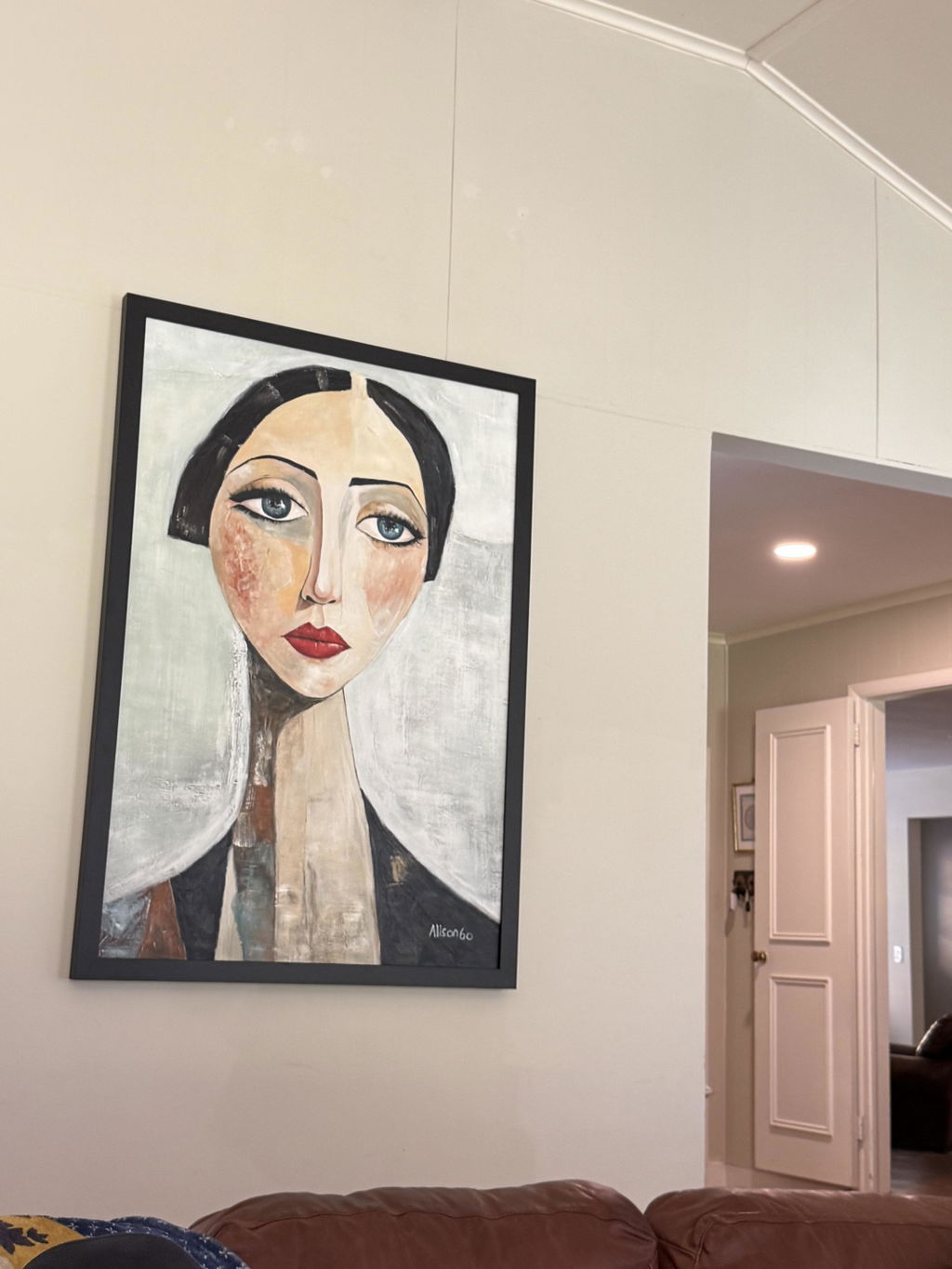
Before you approve online original art for shipment, you should receive enough information to identify the finished work, inspect its visible surface, compare its dimensions with your wall, and understand the seller's approval terms. That usually means a complete final-work photo, relevant close-ups, edge or corner views, stated dimensions, and a written explanation of the response deadline and revision boundary.
Treat the proof as a practical review checkpoint—not a guarantee that a screen will reproduce the painting's exact color, texture, or physical condition. If an important detail remains unclear, pause and request a focused answer or another view before approving.
Start With a Complete Finished-Work Proof
A complete proof should make the final painting identifiable and give you enough visual information to decide whether more detail is needed. If the images show only a cropped section, a room scene, or a progress stage, the proof is not yet ready for a meaningful approval decision.
Full-View Photos Set the Reference
The full view is your reference for the final composition, proportions, and visible finish. It should show the entire painting without cropping, including the relationship between the edges and the central design.
Check that the image represents the completed work rather than an earlier progress photo. If the painting was commissioned from an agreed composition, compare the final view with the features you discussed: major shapes, placement, dominant colors, and any specifically requested details. A full view also helps you distinguish a finished-work question from a photography question; a close-up may look convincing while concealing an edge treatment or proportion issue.

For a closer look at the image-review method, use this guide to fine-detail approval photos after you have confirmed that the complete work is visible.
Close-Ups Reveal Texture and Edges
A front-facing image may not show raised paint, recessed areas, surface transitions, sheen, or edge treatment clearly. Ask for close-ups that cover the parts of the painting most likely to affect display, framing, or handling:
- raised paint and other visible surface variation;
- edges and corners, including any unfinished or wrapped areas;
- transitions between major colors or textured sections; and
- surface irregularities that are part of the intended finish.
If a flat image does not make texture clear, request a side or angled view. Different light directions can make subtle surface changes easier to observe, so side or angled lighting can reveal surface variation. Use that view as supplementary evidence, not as a precise measurement of texture depth or a guarantee of how the surface will feel in person.
Also request the finished dimensions. For a multi-panel piece, the proof should let you identify each panel and, where relevant, see the intended order or arrangement. Missing dimensions or missing edge information are practical reasons to ask questions before treating a proof as approval-ready.
Check Color, Texture, and Scale for Online Original Art
When you review an original painting photo online, separate three decisions: whether the color relationships look consistent with your expectation, whether the surface character is visible enough to understand, and whether the stated size works in your display space. Digital images can support comparison, but they cannot remove the effects of capture, screens, lighting, perspective, or room conditions.
Separate Color From Lighting Effects
Use the proof to compare dominant colors and their relationships rather than to demand an exact screen-to-wall match. Lighting, camera white balance, screen settings, and your viewing environment can change apparent color; lighting and white balance can change apparent color.
Before approving, note whether you are viewing the image on a phone or desktop, in bright daylight or warm indoor light, and whether a particular color is central to the purchase. If a dominant blue, neutral, or accent color must work with your room, ask a focused question such as: "Can you confirm whether the main background reads warmer or cooler than this image suggests?" Request another view or written clarification if the answer could change your decision. Do not treat the proof as an exact physical color promise.

Inspect Texture Without Overreading Pixels
Close-ups and angled views can help you understand whether the painting has a smooth, layered, raised, or otherwise varied surface. Look for transitions, raised areas, edges, and the way light moves across the surface. This is a visual indication of character, not a complete physical substitute for handling the work in person.
Avoid judging texture from extreme digital enlargement alone. Pixelation can make a smooth area look irregular, while a flat front view can hide relief. If surface character is a major reason you chose the painting, ask which visible features are intentional and request a view that shows them under a different angle or lighting direction. You can also browse textured wall art for style comparison, but a collection page is not a substitute for the finished proof of a specific commission.
Verify Size Against the Display Space
Use a measurement sequence rather than relying on the room photograph:
- Measure the usable wall area, including the space that furniture, trim, and nearby objects leave available.
- Compare that area with the seller's stated finished dimensions, including height and width.
- For a diptych or triptych, check each panel's dimensions, orientation, order, and intended spacing.
- Mark the approximate outer dimensions on the wall with painter's tape or paper before approving if fit is uncertain.
A room image can suggest proportion, but it does not prove scale because perspective and cropping change how large the work appears. Use a scale reference or clear parallel view, then compare those dimensions with your actual wall. Viewing distance matters too: a detail that appears prominent in a close-up may read more subtly from across the room.
Confirm the Approval Deadline and Revision Boundary
The approval process for a painting is controlled by the seller's written terms, not by a universal industry deadline or revision count. Before signing off, make sure you know when and how to respond, what a revision can address, what happens if you do not respond, and which version of the proof your approval refers to.
Clarify When Your Response Is Due
Ask for these points in writing before you approve:
- the response deadline or approval window;
- the required response channel, such as email or an order portal;
- the wording that counts as approval; and
- the consequence of no response by the stated date.
Do not infer that silence means approval, or that every seller gives the same amount of review time. If the deadline is unclear, ask for the exact date and time zone and keep the answer with your proof. A commission guide describes staged approval as a practical workflow; use this commission-process guidance as background, then confirm the approval stages and revision scope in the seller's terms.
Define What a Revision Can Address
A revision request should be separated from a new preference introduced after the work is complete. The first may concern an agreed feature that appears unresolved; the second may ask for a different direction than the original scope. The seller's terms determine whether either request is available and how it is handled.
| Request type | What it may clarify | Confirm first |
|---|---|---|
| Agreed feature | A stated color relationship or composition detail appears different from the agreed brief | How the seller defines an in-scope correction |
| New preference | You want a different color, arrangement, or finish after seeing the completed work | Whether a new preference is outside the stated scope |
| Unclear visual detail | A proof does not show an edge, surface, or panel clearly enough to judge | Whether another view is available before approval |
Never assume that revisions are unlimited. Ask how the seller distinguishes a correction from a redesign, whether changes affect timing or cost, and whether approval is required again after a revision.
Save the Proof and Your Approval
Keep one folder or thread containing the final full view, close-ups, dimensions, your questions, seller replies, requested changes, and exact approval wording. Write a specific message such as, "I approve the version shown in the attached proof dated May 8, including the stated dimensions," instead of relying on "looks good."
A saved, annotated record gives you a clearer reference if you later need to compare a delivered painting with the approved version. An approval record checklist can help organize the material, but it does not create a legal right or guarantee a particular remedy.
If the Delivered Painting Differs Materially
If the delivered painting appears materially different from the approved proof, pause before altering it and build a specific comparison record. The seller's current terms control the reporting process and any available remedy, so document first and request instructions rather than assuming a return, correction, replacement, or refund.
- Pause and preserve the condition. Do not clean, repair, reframe, install, or return the work before checking the seller's instructions.
- Document and compare. Photograph the painting, packaging, labels, and visible issue. Compare the arrival with the approved proof, including dimensions, composition, surface or edge features, color impressions, and visible condition.
- Contact the seller in writing. Include the order reference, approved proof, arrival photos, exact discrepancy, and packaging or condition notes. Ask what process applies and what information is needed next.
Compare the Arrival With the Approved Record
Start with the exact discrepancy, not a general reaction that the painting "looks wrong." Compare the approved proof with the received work across:
- composition or major design features;
- stated versus observed dimensions;
- surface or edge features visible in the proof;
- color impressions that differ in a decision-relevant way; and
- visible condition, packaging, and labels.
Use side-by-side images and annotate the location of each concern. Annotated comparisons can make a specific feature or discrepancy easier to describe, but they do not establish a universal test for what counts as a material difference.
Document the Condition Before Taking Action
Photograph the painting, packaging, labels, and visible issue as soon as practical. Keep the order reference, delivery details, and communications together. Do not clean, repair, reframe, install, or otherwise alter the work while you are waiting for the seller's instructions, unless the seller tells you to do so.
The goal is to preserve a factual record of what arrived and how it compares with the approved version. Documentation does not prevent shipping damage and does not guarantee a resolution; it simply gives both sides a more precise basis for discussing the issue.
Ask for the Next Remedy in Writing
Contact the seller promptly through the channel named in the applicable terms. Include the order reference, the approved proof, arrival photos, the exact discrepancy, and any packaging or condition notes. Ask what process applies and what information the seller needs next.
Follow the written instructions you receive before returning or modifying the painting. If the seller's policy is not clear, ask for the reporting window, required photos, shipping instructions, and next decision point in writing. You can separately browse finished ready-to-ship artwork if you are comparing non-custom inventory, but that collection link should not be treated as a remedy for a custom-order discrepancy.
FAQs
Before buying original art online, confirm the proof, dimensions, approval terms, and record-keeping steps. Seller-specific deadlines, revision limits, and remedies should be confirmed in writing.
What Should I Ask Before Buying Original Art Online?
Ask what finished views and dimensions you will receive, how approval is recorded, when your response is due, and how discrepancies are reported.
Can I Judge Exact Paint Color From an Approval Photo?
No. Compare color relationships, but ask for clarification when a dominant color could change your decision.
What Should I Save After Approval?
Save the final proof, dimensions, brief, revisions, seller replies, deadline, and exact approval message.
How Should I Review a Multi-Panel Painting?
Check each panel's dimensions, order, orientation, edges, spacing, and color or surface consistency before approving.