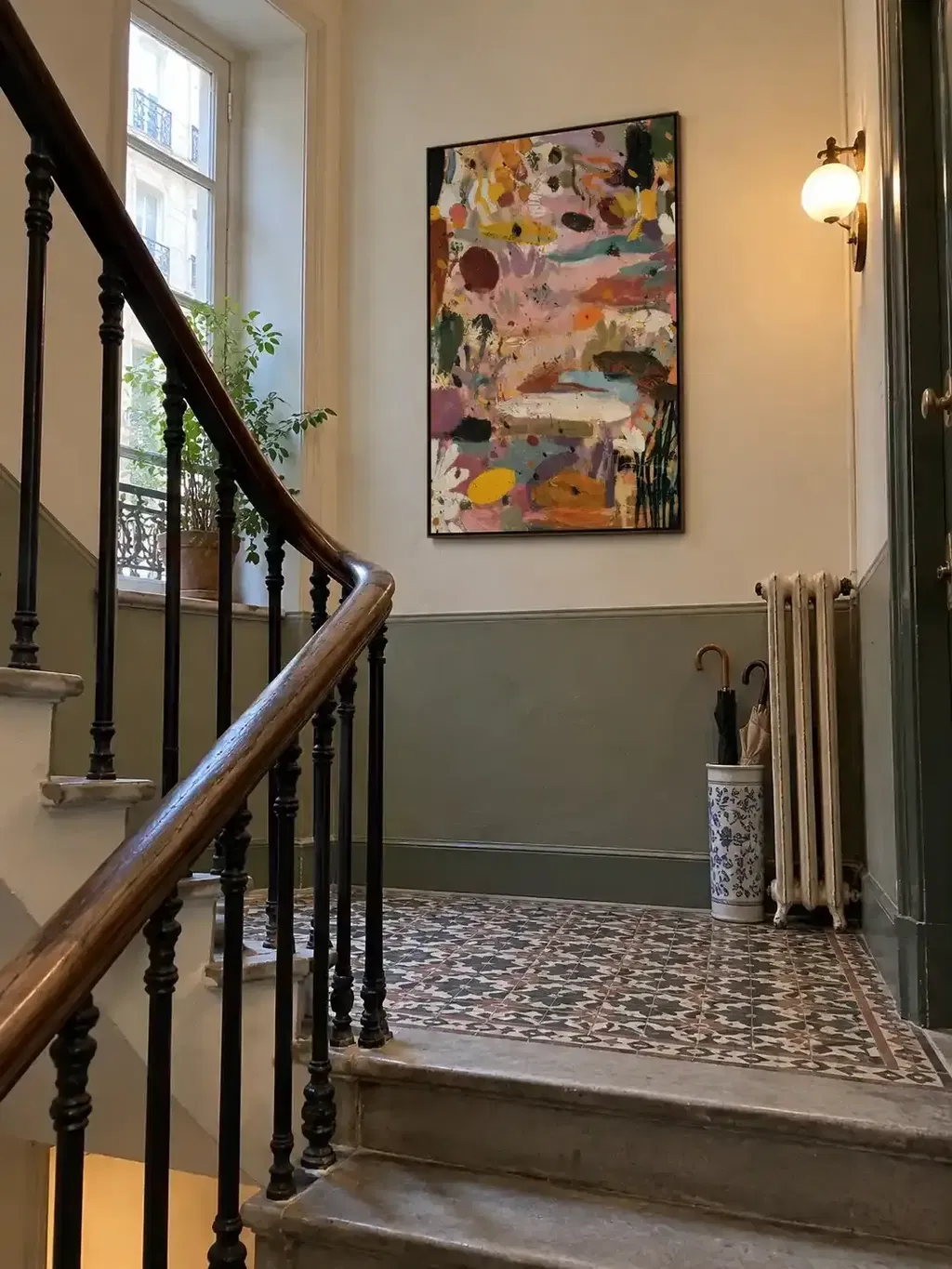
The Shift from Vanity Assets to Tangible Artistry
The landscape of high-end art is undergoing a structural correction. Recent data indicates that sales for auction pieces exceeding $10 million plummeted by 44% year-over-year in 2024, according to Marketplace. This retreat from purely financial "vanity" assets signals a return to real application value. Modern collectors and interior designers are moving away from speculative auction pieces and toward custom, hand-painted works that offer predictable, high-performance outcomes.
When you invest in a professional oil painting, you are not just buying a image; you are purchasing a complex chemical system. The most critical, yet often overlooked, component of this system is the canvas substrate. In our studio experience, the way a canvas is primed dictates how much oil is absorbed, which directly influences the color's final glow and the preservation of that coveted "wet look."
The Physics of Vibrancy: Why Surface Prep Matters
Vibrancy is not merely a result of high-quality pigments. It is an optical phenomenon governed by how light interacts with the paint film and the underlying substrate. According to the Getty Conservation Institute, pigment reflection is dominated by absorption and scattering coefficients (the Kubelka-Munk equation).
When a canvas is too absorbent, it acts like a sponge, drawing the oil binder out of the pigment layer and into the fibers. This "sinking in" leaves the pigment particles high and dry on the surface, creating a matte, chalky appearance that lacks depth. Conversely, a properly prepared surface maintains a high refractive index, allowing light to penetrate the paint layers and bounce back with maximum saturation.
Logic Summary: The Refractive Index Heuristic
- Mechanism: Higher oil retention on the surface ensures pigment particles are fully "wetted," reducing air-pigment interfaces that cause light scattering.
- Analysis: We estimate that maintaining approximately 70% oil retention on the surface is necessary to preserve the "wet look" indefinitely. Excessive absorption can drain pigment intensity within 48 hours of application.

Linen vs. Cotton: Deciding the Foundation
A common debate in professional circles is whether linen justifies its premium over cotton. While linen is traditionally favored for its strength and irregular texture, technical performance depends heavily on the priming layer.
Spectrophotometer studies conducted by Agilent show that properly primed cotton canvas can achieve equal or even superior color saturation compared to linen. This is because cotton’s more uniform fiber structure creates consistent light reflection. However, linen typically absorbs 15–20% less oil than cotton equivalents due to its naturally higher density and oil content.
| Parameter | Cotton Canvas | Linen Canvas | Impact on Vibrancy |
|---|---|---|---|
| Fiber Structure | Uniform, soft | Irregular, crisp | Cotton offers smoother gradients; Linen offers "character." |
| Natural Absorbency | High | Low | Linen holds the "wet look" longer with fewer primer layers. |
| Oil Retention | Baseline | +15-20% | Higher retention in linen translates to brighter initial colors. |
| Stability | Moderate | High | Linen resists humidity-induced swelling better than cotton. |
Note: These ranges are estimated based on common studio practice and material density modeling.
The Gesso Paradox: Thickness vs. Clarity
There is a persistent myth that more primer always leads to better results. In reality, excessive gesso thickness can be a "death sentence" for vibrancy. Research insights suggest that applying gesso at a thickness of 1–2mm creates uniform light scattering that dilutes the specific spectral curves of your pigments.
We recommend an optimal priming thickness of 0.1–0.3mm. This creates a sufficient mechanical bond without interfering with the pigment’s light refraction. Professional artists often use three thin coats, sanding between layers, to create superior oil retention rather than one thick, heavy application.
Methodology Note: Absorbency Modeling Our analysis of surface prep assumes a standard "Oil Drop Test" as a baseline for absorbency.
- The Test: Place a single drop of linseed oil on the primed canvas.
- Success Metric: If the oil remains visible as a bead for over 30 minutes, the surface is "sealed." If it disappears in under 5 minutes, the surface is too absorbent for transparent glazing techniques.

Identifying and Avoiding "Support Induced Discoloration" (SID)
One of the most frustrating quality issues for advanced painters is when a pristine white canvas turns a bizarre yellow or brown after drying. This is known as Support Induced Discoloration (SID).
Technical bulletins from Golden Artist Colors reveal that water-soluble impurities in common cotton or linen substrates are forcefully drawn out when painters apply transparent acrylic mediums or thin oil glazes. These impurities migrate through the paint film, staining the artwork from the inside out. To prevent this, a high-quality, non-porous primer is essential to act as a chemical barrier between the "dirty" fibers and the "clean" pigment.
This chemical stability is one reason why Evaluating Pigment Saturation is a critical step for any designer seeking longevity.
The Human Element: Why Authenticity Drives Value
In an era of AI-generated prints, the "essential identity" of a hand-painted work has become a massive commercial premium. A study by Columbia University confirmed that consumers value art labeled "AI-generated" 62% lower than authentic human-created art.
Furthermore, research from the University of Chicago suggests that digital replicas lack the artist's "essential identity." A hand-painted canvas retains an irreplicable soul because the microtopography of the brushstrokes—the mm-scale texture—contains human life-time that is uncompressible by algorithms.
When you choose a custom mural or a hand-painted canvas, you are also supporting ethical labor. A Wharton School survey found that 87% of consumers strongly agree that artists should receive fair compensation. This moral demand aligns with our commitment to hiring real artists who understand the technical nuances of Premium Oil Binders.
Health, Safety, and the Indoor Environment
For home improvers and designers, the safety of art materials is non-negotiable. The EPA warns that indoor air pollution can be more significant than outdoor pollution. Low-VOC (Volatile Organic Compound) paints are a prerequisite for achieving LEED or WELL certifications in high-end developments.
While some traditional pigments contain heavy metals, modern professional standards have evolved. For instance, Aalto University found that coatings on wood with 16% moisture emit significantly lower toxic VOCs than dry wood during the curing process. We prioritize water-based acrylic primers and non-toxic oil mediums to ensure that your art enhances your space without compromising your health.
Trust & Safety Sidebar: The ASTM D-4236 Label
- What it means: The formula has been reviewed by a toxicologist.
- What it doesn't mean: It doesn't mean the paint is "edible" or "risk-free."
- Action: Always ensure proper ventilation, as even "odorless" mineral spirits can cause central nervous system issues if inhaled in high concentrations (Source: Princeton University EHS).
The ROI of Art: Boosting Property and Well-being
Beyond aesthetics, art is a proven economic driver. A Royal Society analysis of 10-year data found that neighborhoods with higher "art" geo-tags saw greater relative house price ranking gains. In commercial settings, public art projects have driven billions in real estate growth, as seen in Chicago’s Millennium Park.
The psychological impact is equally profound. A University of Pennsylvania review noted that 73% of patients reported significant mood improvements when exposed to environmental artworks. Large, nature-themed murals effectively activate the medial prefrontal cortex (mPFC), optimizing emotional regulation.
For corporate clients, this translates to reduced cognitive fatigue. Research on Biophilic Design suggests that natural landscapes in the workspace produce the same stress-reduction effects as being outdoors.
Technical Summary: Optimizing Your Canvas
To ensure your investment maintains its vibrancy for decades, we recommend following these technical guidelines:
| Feature | Recommendation | Why? |
|---|---|---|
| Primer Type | Acrylic Gesso or Oil Primer | Prevents oil from rotting natural fibers. |
| Coat Count | 3 Thin Layers | Balances absorbency with optical clarity. |
| Sanding | Between each layer | Ensures mechanical tooth for paint adhesion. |
| Canvas Choice | High-density Linen | Minimizes long-term cracking and sagging. |
| UV Protection | Final Varnish | Prevents photochemical aging (Source: PMC). |
Understanding the Lightfastness of your paints is also essential, as the substrate can only do so much if the pigments themselves are prone to fading.
Investing in Cultural Heritage
When you commission a hand-painted work, you are moving from "disposable decor" to an "investable cultural asset." The physical relief of oil paint, the meticulous preparation of the canvas, and the expert application of pigments create a piece that lives and breathes with the room.
By prioritizing technical expertise—from canvas absorbency to pigment safety—you reduce the "commitment anxiety" often associated with high-end art. You are not just decorating a wall; you are curating an environment that boosts property value, improves mental well-being, and stands as a testament to authentic human craftsmanship.
Disclaimer: This article is for informational purposes only. When working with art materials, always refer to the manufacturer's Safety Data Sheets (SDS). If you have pre-existing respiratory conditions or are pregnant, consult a healthcare professional before using traditional oil solvents or powdered pigments.
Sources
- The expensive art market continues to struggle - Marketplace
- Human-Made vs. AI Art: Consumer Perception Study - Columbia Business School
- Quantifying the link between art and property prices - Royal Society Publishing
- Color Science and Pigment Mixture - Getty Conservation Institute
- VOC Emissions from Painted Wood - Aalto University/PubMed
- Safety in Artists' Paints and Toxic Pigments - EPA
- Measuring the Color of a Paint on Canvas - Agilent Technologies
- Stopping Support Induced Discoloration - Golden Artist Colors
- Visual Art in the Built Environment: A Critical Review - University of Pennsylvania
- Painting and Drawing Safety - Princeton University EHS