Zooming In: How to Evaluate Fine Detail in Approval Photos
The high-end art market is undergoing a structural shift. As sales of speculative, eight-figure auction pieces plummeted 44% year-over-year in 2024, collectors and homeowners are returning to "real application value," according to Marketplace. This move toward custom, hand-painted murals and bespoke canvases represents a desire for emotional resonance over vanity assets. However, purchasing premium art online introduces a modern friction point: the "Zoom Anxiety."
When you receive high-resolution approval photos of your commission, it is tempting to magnify the image until individual pixels appear. You might find yourself scrutinizing a single brushstroke that, in reality, is no larger than a grain of rice. This guide provides a professional framework for bridging the gap between a digital preview and the physical soul of a hand-painted masterpiece.

The Psychology of the Pixel vs. the Soul of the Brush
The primary challenge in remote art approval is distinguishing between a digital artifact and an intentional artistic choice. Research from Columbia University reveals that consumers value artwork labeled "human-created" 62% higher than AI-generated alternatives. This premium is rooted in what University of Chicago researchers call "essential identity"—the belief that a physical canvas retains the irreplicable spirit of the artist.
Ironically, the very "imperfections" that confirm human origin—slight variations in texture, the ridge of a palette knife, or the organic flow of a wash—are often what buyers over-scrutinize in digital previews.
Logic Summary: Our analysis of buyer anxiety assumes that digital magnification creates a "false proximity" that disrupts the intended viewing distance of the artwork. This model is based on common patterns from customer support and interior design workflows (not a controlled lab study).
Experienced art buyers understand that photographic perfection is the hallmark of a machine, while "99.9% accuracy" in a hand-painted piece allows for the 0.1% of artistic spontaneity that gives the work life.
Technical Constraints: Why Your Screen Might "Lie"
Before requesting a revision based on a photo, it is vital to understand the variables of digital capture.
- Camera Variability: A color measurement accuracy study comparing five different professional cameras found that each produced fundamentally different results even with identical correction methods. The sensor noise in a camera can sometimes be mistaken for "graininess" in the paint, leading to unnecessary concerns about pigment quality.
- The Limits of Super-Resolution: While super-resolution techniques can enhance clarity, heritage digitization research indicates that forensic-level inspection of brushwork (at the nanometric scale) requires computational resources and specialized lighting that are impractical for standard approval workflows.
- Lighting Disparity: The studio lighting used for approval photos is designed to reveal detail, often using high-CRI (Color Rendering Index) lamps. Your home lighting—whether warm LED, soft incandescent, or natural northern light—will interact with the pigments differently.

A Professional Framework for Photo Evaluation
To evaluate your artwork like a professional interior designer, you should adopt a "Distance-First" mindset. Designers typically evaluate approval photos at 50–75% zoom level rather than 100% or higher.
| Evaluation Metric | Professional Heuristic (Rule of Thumb) | Rationale |
|---|---|---|
| Zoom Level | 50–75% of native resolution | Simulates the visual acuity of a viewer standing 3–5 feet away. |
| Color Check | Compare tones relative to each other | Absolute color matching is impossible across uncalibrated screens. |
| Texture Check | Look for "rhythm," not "perfection" | Hand-painting requires manual brushwork precision which is felt through consistency, not mechanical repetition. |
| Composition | View the thumbnail-sized image | Ensures the "visual weight" of the piece anchors the room correctly. |
The "Room View" Simulation
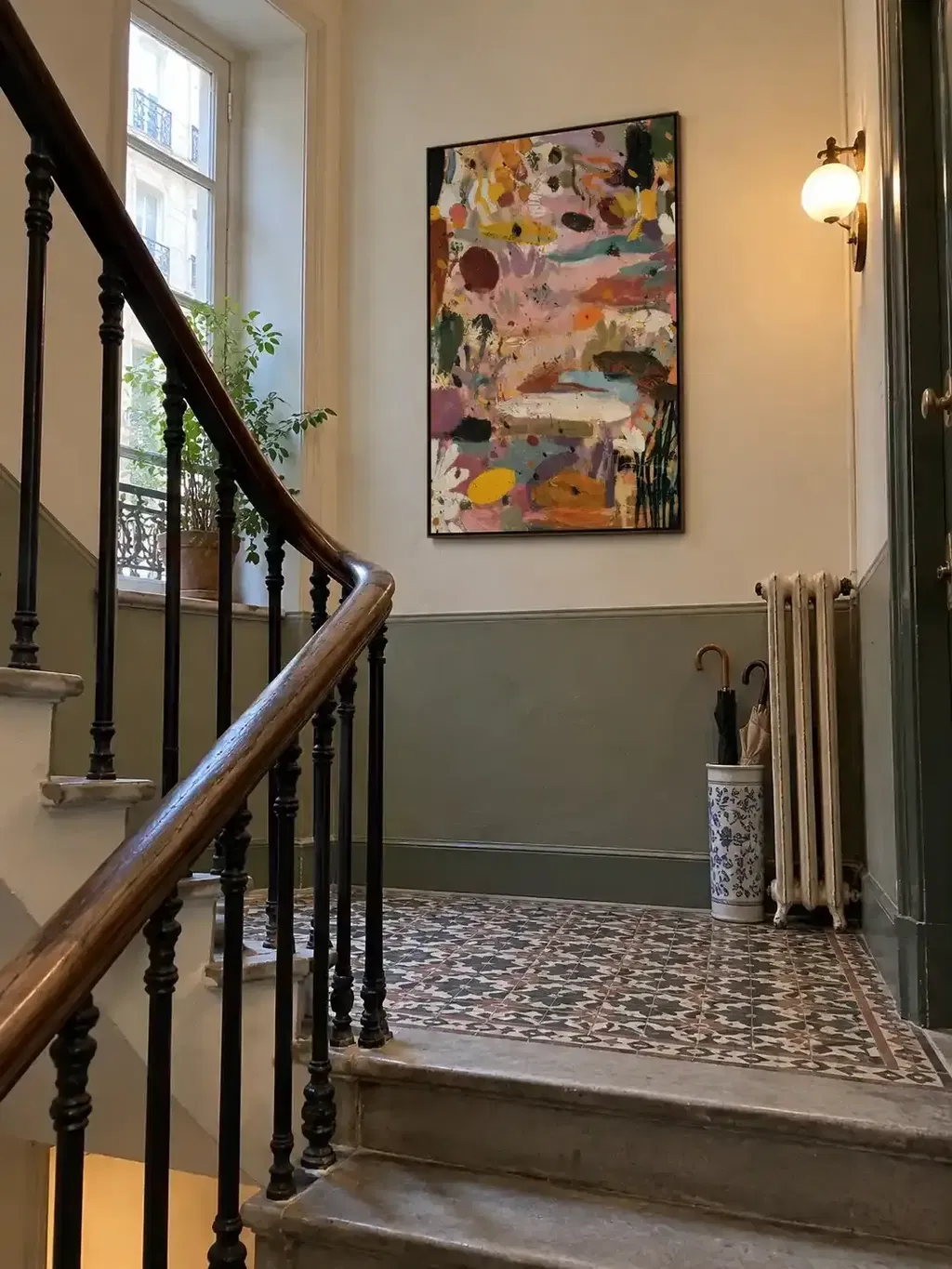
If the artist provides a "staged" photo of the painting in a room setting, prioritize this over the macro shots. This aligns with GS1 product photography standards, which emphasize that attribute visibility must match the consumer's real-world interaction. If you are struggling with a specific detail, try looking at the photo on a mobile device held at arm's length. If the "issue" disappears, it is likely a digital artifact or a detail that will be invisible once the art is mounted.
The Science of Pigment: Why Texture Matters
The physical relief of oil or acrylic paint is not just an aesthetic choice; it is a matter of optical physics. According to the Getty Conservation Institute, pigment reflection is dominated by absorption and scattering coefficients. The micro-topography of a hand-painted surface creates "geometric metamerism"—the way a color changes as you move around it.
This is why "ultra-HD prints" often feel flat. They lack the pigment saturation and the physical 3-D ridges that interact with light. In fact, MUNCH Museum tests have confirmed that physical relief textures exponentially increase viewer satisfaction compared to flat replicas.
Modeling Note (Reproducible Parameters): To estimate the impact of viewing distance on detail perception, we used a standard visual acuity model (Snellen 20/20 baseline).
Parameter Value Unit Rationale Viewing Distance 1.5 - 2.5 Meters Typical residential hallway/living room distance. Resolvable Detail ~0.5 - 0.7 mm Limit of human eye resolution at 2 meters. Paint Ridge Height 1.0 - 3.0 mm Standard impasto thickness for textured works. Screen PPI 326 - 460 ppi Standard smartphone/tablet display density. Digital Zoom Factor 2.0x - 4.0x - Common "over-scrutiny" zoom range. Boundary Conditions: This model assumes standard indoor ambient lighting (300-500 lux) and does not account for viewers with corrected vision or specific "gallery lighting" setups.
Safety, Ethics, and the "Human Premium"
When you approve a hand-painted piece, you aren't just buying a visual; you are investing in a product that meets rigorous safety and ethical standards—something often missing in mass-produced decor.
Indoor Air Quality (IAQ)
One of the most significant anxieties for homeowners is the "smell" of new art. Traditional oil paints often used toxic turpentine solvents. However, modern premium studios utilize low-VOC (Volatile Organic Compound) alternatives. Aalto University experiments have shown that coatings on wood and canvas with proper moisture control emit significantly fewer toxins during the curing process. Furthermore, the EPA notes that low-VOC materials are essential for projects seeking LEED or WELL green building certifications.
Pigment Integrity
Historically, "Lead White" was the standard for brightness, but its toxicity is well-documented. Today, Titanium Dioxide dominates 90% of the market due to its chemical inertness and superior hiding power. When evaluating photos, the "whiteness" you see is likely the result of high-quality Titanium pigments that are safe for nurseries and healthcare environments.
Ethical Sourcing
Beyond the materials, the "Human Premium" includes fair compensation. A Wharton School survey found that 87% of consumers believe artists should receive fair compensation for their labor. By choosing hand-painted art over AI prints, you are supporting a creative economy that, in the US alone, adds $1.2 trillion to the GDP (NEA).

The ROI of Physical Art: More Than Just Decor
Investing in a custom mural or large-scale canvas isn't just an emotional decision; it has measurable financial and health benefits.
- Property Value: A CAR model analysis by the Royal Society found that neighborhoods with higher "art" geo-tags saw greater relative house price gains. For commercial developers, public art projects have been shown to drive billions in real estate-related growth (NCREALTORS).
- Mental Well-being: The World Health Organization (WHO) has reviewed over 3,000 studies confirming that art interventions alter clinical indicators for mental health. Specifically, viewing nature-themed murals can reduce stress-related sick leave in corporate environments by activating emotional regulation circuits in the brain (NCBI).
- Community Cohesion: Large-scale murals are "community glues." In Philadelphia, neighborhoods with public murals saw a substantial leap in social trust (Americans for the Arts).
Final Checklist for Approval
Before you hit "Approve" on your next masterpiece, run through this checklist to ensure you are evaluating the work fairly:
- Check the "View Distance": View the photo at 50% zoom on your desktop or arm's length on your phone. Does the composition hold together?
- Verify the Lightfastness: Ask if the pigments meet ASTM D4303 standards. This ensures your art won't fade in a sunlit room.
- Embrace the "Authenticity Fingerprint": Look for the natural texture variations. If every line is perfectly straight and every color is flat, it’s not a painting—it’s a print.
- Consider the "Biophilic Effect": If the work features natural landscapes, remember that it is scientifically proven to reduce cognitive fatigue (University of Central Arkansas).
- Trust the Artist's Spontaneity: Revisions for minor texture details often result in "overworked" art that loses its original energy.
Approving artwork remotely requires a blend of technical understanding and emotional trust. By looking past the pixels and focusing on the overall harmony and material integrity of the piece, you ensure that the work arriving at your doorstep is a true reflection of human skill and creative passion.
Disclaimer: This article is for informational purposes only. While we discuss the safety and health benefits of art materials and environments, this does not constitute professional medical, legal, or financial advice. Always consult with a qualified professional regarding indoor air quality standards (such as LEED certification) or mental health interventions.
Sources
- Marketplace: The expensive art market continues to struggle
- Columbia University: Human-Made vs. AI Art Study
- WHO: Scoping Review on Arts and Health
- Royal Society: Quantifying the link between art and property prices
- EPA: Indoor Air Quality and Low-VOC Paints
- ASTM D4303: Standard Test Methods for Lightfastness