The Shift from Vanity to Verifiable Authenticity
In recent years, we have observed a tectonic shift in how high-net-worth individuals and interior designers approach art acquisition. The traditional high-end auction market, once the playground for purely financial art assets, is struggling. According to Marketplace, sales of auction pieces over $10 million plummeted by 44% year-over-year in 2024. This retreat from "vanity assets" signals a return to real application value: art that serves the home’s atmosphere rather than a portfolio’s bottom line.
Despite the volatility of high-end speculation, the global art market remains a massive economic baseline, reaching $65 billion in 2023, as detailed in the Art Basel and UBS Art Market Report 2024. For homeowners, this stability is found not in the gamble of the auction house, but in the "performative authenticity" of hand-painted works.
When you select art for a foyer—the home’s primary psychological threshold—the stakes are uniquely high. You are not just choosing a color palette; you are managing "Social Presence." Figurative art, in particular, carries a weight that landscapes or abstracts do not. It introduces a "person" into the space, and if not navigated carefully, that presence can transition from welcoming to intrusive.

The Psychology of Social Presence in the Foyer
The foyer is a transitional zone where guests undergo a rapid psychological shift from the "public" world to your "private" sanctuary. Introducing figurative art—paintings of the human form—activates specific neurological pathways. A systematic review of 85 records published in NCBI shows that passive art viewing consistently activates the medial prefrontal cortex (mPFC) and the amygdala, the brain's centers for emotional regulation and social cognition.
The Gaze Direction Rule
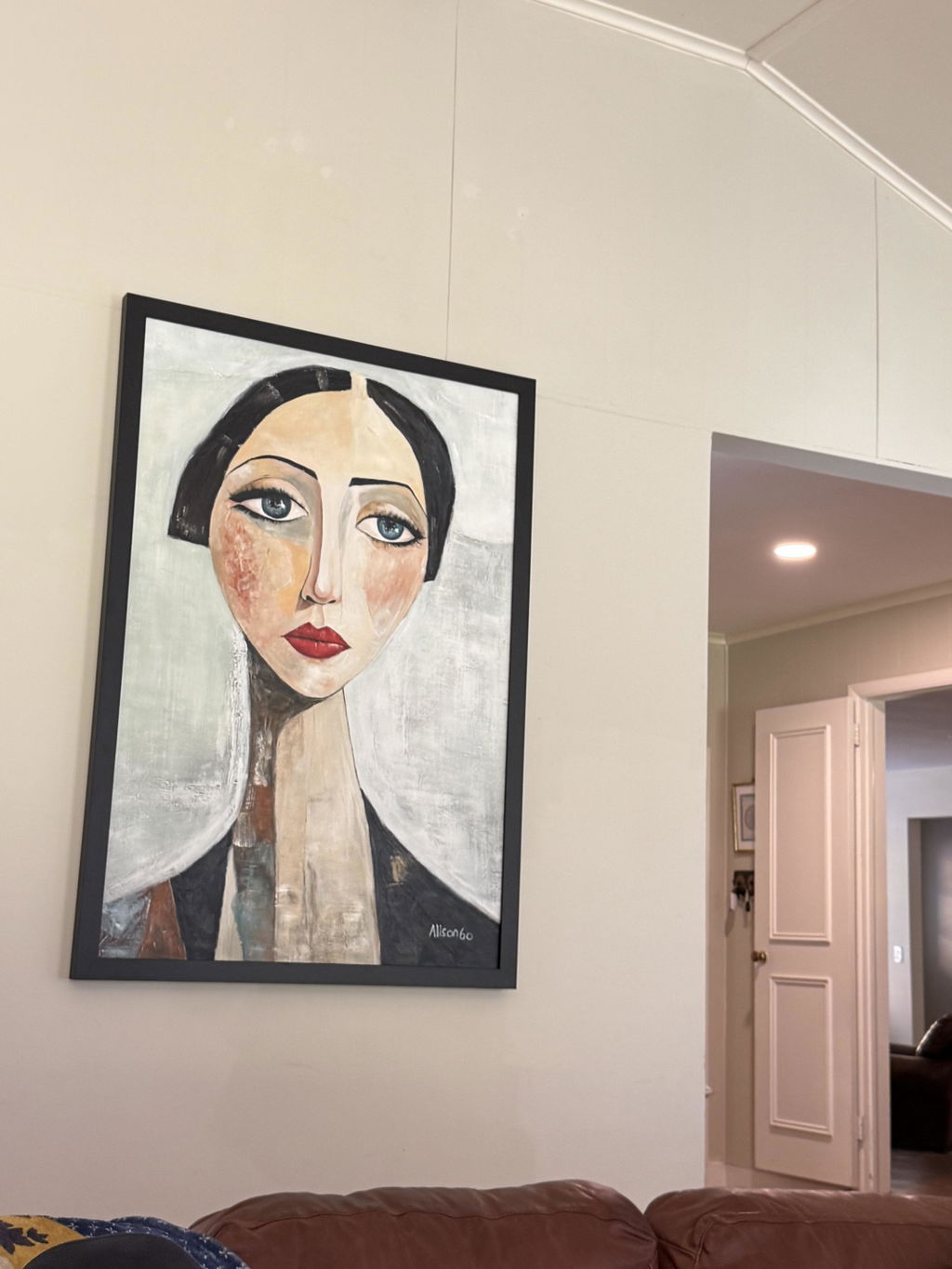
One of the most critical heuristics we apply in high-end residential design is the "Gaze Direction Rule." Portraits with direct eye contact placed in narrow foyers can trigger a subconscious "startle response." To a guest entering a confined space, a direct gaze can feel like being monitored or confronted.
To mitigate this, we recommend selecting figurative works where the subject is in profile or looking away. This creates a "narrative atmosphere"—where the guest feels they are observing a moment—rather than a "social confrontation." This approach aligns with Social Presence Theory, which suggests that the "richness" of a medium (or in this case, the intensity of a gaze) directly impacts the perceived psychological distance between the viewer and the subject.
The Human Scale Ratio
Another professional heuristic is the "Human Scale Ratio." In a small entryway, avoid figurative subjects where the head or features are significantly larger than life-size. Oversized features can create a sense of spatial distortion and intimidation. We typically aim for a 1:1 scale or smaller for portraits in transitional spaces to maintain a sense of groundedness.
Logic Summary: Our analysis of social presence assumes that the foyer's narrow geometry amplifies the "perceived gaze." We prioritize subjects in profile to lower the "social load" on guests during their first 30 seconds in the home.
Materiality: Why "Hand-Painted" is a Decision-Safety Metric
In an era of AI-generated prints and digital replicas, the "essential identity" of a work has become its most valuable attribute. Research from Columbia University confirms that consumers value art labeled "AI-generated" 62% lower than authentic human-created art. Furthermore, University of Chicago empirical research shows that digital replicas lack the "essential identity" that consumers crave; the physical canvas retains a soul that a print cannot replicate.
The Role of Physical Relief (Impasto)
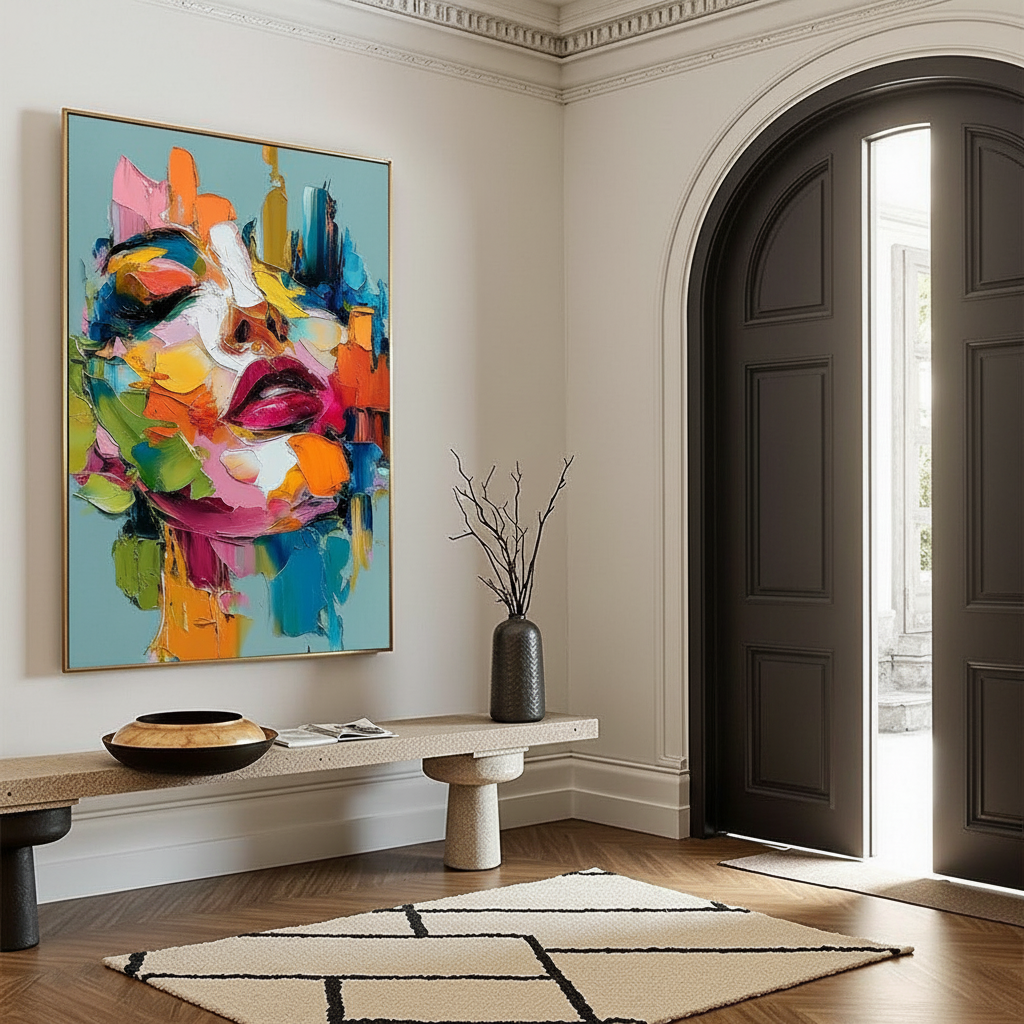
Textured oil paintings, particularly those using the impasto technique, are exceptionally effective in entryways. The physical relief of the paint—the actual 3D topography of the brushstrokes—breaks up the flatness of the "gaze."
Optical microprofilometry proves that an oil painting's microtopography (mm-scale texture) is crucial to its aesthetic impact. When a painting has physical depth, the subject feels more like a "sculptural object" and less like a "person" watching the door. This tactile fruition stimulates intrinsic motivation and satisfaction in viewers, as confirmed by MUNCH Museum tests.

The Science of Longevity and Safety
For the risk-averse homeowner, "decision safety" extends beyond aesthetics to the very chemistry of the paint. We often encounter concerns regarding Indoor Air Quality (IAQ), especially with large-scale works or murals.
VOC Emissions and Indoor Air Quality
The EPA warns that indoor air pollution can be significantly more concentrated than outdoor air. For high-end residential projects, using low-VOC (Volatile Organic Compound) paints is a strict prerequisite. Aalto University’s 28-day chamber experiments prove that coatings on wood with proper moisture levels emit significantly lower VOCs during the curing process, making them safe for immediate occupancy.
Pigment Evolution: Titanium vs. Lead
Historically, "Lead White" was the standard for its opacity, but its toxicity is now well-documented. REACH Annex XVII strictly prohibits lead carbonate concentrations exceeding 0.1%. Today, Titanium Dioxide dominates 90% of the market due to its superior chemical inertness and hiding power, providing a safe, brilliant white that will not yellow or pose health risks to the household.
| Pigment Type | Toxicity Level | Market Share | Key Benefit |
|---|---|---|---|
| Titanium White | Low/Inert | ~90% | Strongest hiding power, non-toxic |
| Lead White | High (Neurotoxin) | <0.1% (Restricted) | Historical use only; unsafe for homes |
| Cadmium Red | High (Carcinogen) | Specialized | Brilliant hue; requires strict handling |
| Zinc White | Low | ~5% | Excellent for glazing/transparency |
Why these numbers? These figures are derived from NCBI and REACH regulatory data. Homeowners should verify the presence of the ASTM D-4236 label on artist materials, though this only indicates compliance with labeling laws, not absolute non-toxicity.
Strategic Curation: Residential vs. Commercial ROI
While homeowners focus on emotional comfort, commercial developers view figurative art through the lens of property valuation. The Royal Society used a CAR model to analyze 10 years of data, finding that neighborhoods with higher "art" geo-tags saw greater relative house price ranking gains.
In the B2B sector, large-scale figurative murals act as "permanent physical billboards." For example, Chicago's Millennium Park art projects drove $1.4 billion in real estate-related growth. Whether you are staging a home for sale or designing a luxury hotel lobby, the presence of hand-painted art signals a "premium" status that digital decor cannot achieve.
Biophilic Figurative Art
A rising trend for 2026 is the fusion of figurative subjects with biophilic design. Research from the University of Central Arkansas shows that nature-themed art produces the same stress-reduction effects as being outdoors. When figurative subjects are placed within a natural or botanical context, the "social presence" is softened by the calming influence of the environment. This is particularly effective in high-density office spaces or private clinics to reduce "cognitive fatigue" (a common issue in Tokyo office studies).

Implementation: Navigating the Foyer Layout
Selecting the right piece is only half the battle; placement dictates the guest's experience. If you are debating between a large canvas and a mirror, consider our guide on Art vs. Mirrors: Evaluating Scale and Light in Entryway Design.
For foyers with architectural constraints, such as windows or wainscoting, refer to our technical breakdown on Navigating Obstacles: Sizing Art Around Windows and Wall Molding. We often find that a single, large-scale figurative work can actually make a small entry feel more expansive by providing a clear focal point, a concept we explore in Expanding Boundaries: Why Large Art Makes Small Living Rooms Feel Grand.
The "Decision-Safety" Checklist for Figurative Foyer Art:
- Gaze Check: Is the subject looking directly at the door? (Prefer profile or averted gaze).
- Scale Check: Is the head larger than life-size? (Prefer 1:1 or smaller).
- Texture Check: Does the piece have physical relief to break the "flatness"?
- Safety Check: Does the artist provide a low-VOC or non-toxic pigment guarantee?
- Context Check: Does the subject's "energy" match the transitional nature of the space?
The Future of Curated Presence
As the art market continues to pivot toward "real application value," the foyer will remain the most critical gallery in the home. By understanding the neurological impact of figurative subjects and the material science of hand-painted canvases, you can create a space that feels both sophisticated and safe.
The goal is "performative authenticity"—a home that looks curated because it is curated, using materials that respect both the environment and the psychological comfort of everyone who crosses the threshold. For deeper insights into the neurological mechanics of art, we recommend exploring the Environmental Psychology of Art to understand how your walls are talking to your brain.
Disclaimer: This article is for informational purposes only. While we discuss VOC safety and pigment toxicity based on EPA and REACH guidelines, this does not constitute professional medical or environmental safety advice. Always consult with a certified industrial hygienist or medical professional regarding specific health concerns or indoor air quality requirements in your region.
Sources
- Marketplace: The expensive art market continues to struggle
- Art Basel and UBS Art Market Report 2024
- Columbia University: Human-Made vs. AI Art Study
- NCBI: Neurological mechanisms of creative arts
- Royal Society: Quantifying the link between art and property prices
- EPA: Indoor Air Quality and Low-VOC Paints
- REACH Annex XVII: Lead Carbonate Restrictions