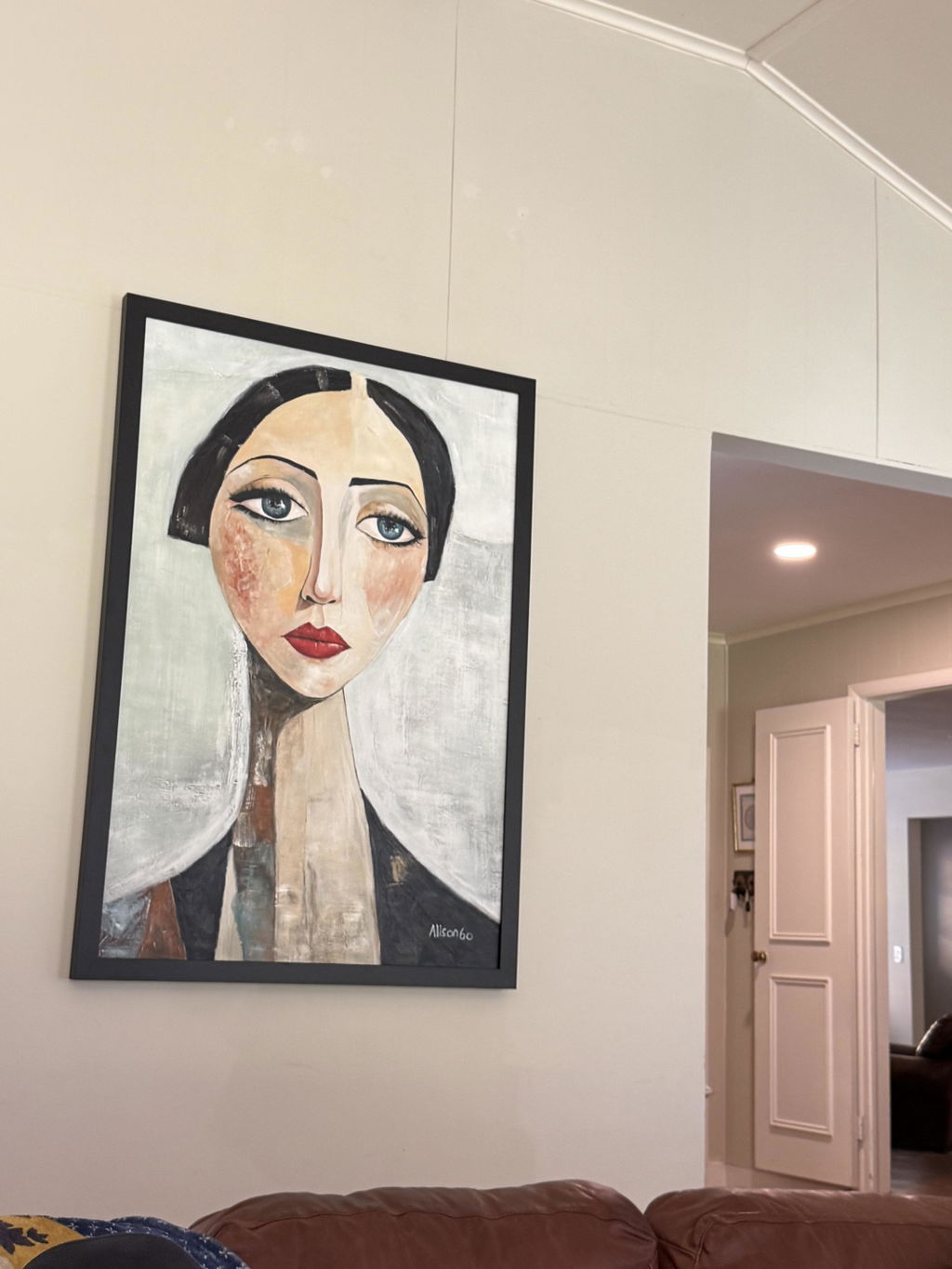
A large abstract painting can work in a small home, but it has to pass two separate tests. First, the finished piece must fit the usable wall without crowding furniture, openings, or walkways. Second, the packed shipment must clear every part of the route from the delivery point to the intended room. Measure both before you order: use the finished dimensions for the wall, then request the exact packed dimensions and handling details for the route. If either check fails—or a key specification is missing—change the format or pause instead of assuming the piece will fit.
Check the Wall for a Large Abstract Painting
Judge the painting against the usable wall, not the room's total wall area. A piece can fit between two corners and still feel wrong if furniture, doors, windows, trim, vents, outlets, or walking space leave too little room around its finished footprint.
Start a simple wall worksheet with these measurements:

- Record the wall width and height available after accounting for trim, openings, fixtures, and the circulation path.
- Measure the main furniture anchor below or beside the artwork, such as a sofa, bed, console, or dining cabinet.
- Write down the painting's finished outer width and height, including the frame or other finished elements when applicable.
- Note whether the piece will be mounted or leaned. A leaning piece also uses floor depth and affects circulation.
A sizing tool may offer a starting range based on a sofa, bed, console, or usable wall, but it is not a universal proportion rule or a fit guarantee. Let the actual finished dimensions and the remaining wall determine the choice. For practical context, see how to avoid overcrowding a room.
Move on to the mockup when the finished footprint fits the usable area without compressing furniture, openings, or circulation. If it technically fits but its relationship to the furniture or room entry feels questionable, treat it as a borderline result and test it at full size.
Test the Layout Before You Order
A full-size temporary outline is the fastest way to see whether a large painting will work visually in a small room. It tests scale and placement in your actual space, but it does not confirm package access, mounting strength, or installation requirements.
- Mark the finished artwork footprint with paper, cardboard, or removable tape. Match the listed finished width and height, and include the outer edge that will actually be visible. If you may lean the piece, represent the intended lower position and angle rather than testing only a flat wall rectangle.
- Place the outline at the proposed location. View it from normal seating, the room entrance, and the main approach—not only from a straight-on position across from the wall.
- Check the outline against sofa or bed edges, door swings, windows, outlets, vents, shelving, and the path people use through the room. If it crowds any of these points, reduce the size, move the placement, or investigate another format before ordering.
A full-size mockup is a visual decision aid, not proof that the shipment will reach the room. The finished dimensions control this test; packed dimensions control the delivery check that follows.

Measure the Route Into the Room
The access decision remains unresolved until you compare the exact packed shipment with every narrow point from the building entrance, loading area, or delivery point to the final room. A front-door measurement alone is not enough, and a wall-fit result says nothing about the package route.
Check Doors, Hallways, and Stair Turns
Measure the route as one continuous path. At each checkpoint, record the clear opening with the door fully open, the usable depth or turning space, and anything that reduces clearance.
| Checkpoint | What to measure or observe | Order-changing condition |
|---|---|---|
| Entry and interior doors | Clear width and height with doors fully open; handles, trim, thresholds, and nearby obstructions | A nominal door label is not a route measurement; unresolved trim or handle interference keeps the check open. |
| Hallways and final approach | Narrowest width, usable depth, furniture, railings, corners, and the space immediately beyond each opening | A straight comparison may not show how a rigid package must change orientation at a corner. |
| Stairs, landings, and turns | Landing dimensions, stair width, railings, overhead restrictions, and turning space | If the package envelope or orientation limits cannot be checked at the turn, pause rather than improvise. |
Measure the clear opening rather than the nominal door or slab size, and include the path beyond it. This distinction is reflected in clear-opening measurement guidance. A route survey should cover doors, hallways, turns, stairs, elevators, and the final staging area—not just the first threshold. General continuous-route planning guidance can help organize that survey, but it does not confirm a painting's fit or handling requirements.
Confirm Packaging, Elevator, and Building Constraints
Ask for the exact configuration's packed width, height, depth, weight, protection or crate details, orientation limits, and delivery method. These are seller-confirmed shipment facts, not details you can infer from a product title, collection, or image. Finished dimensions answer the display question; packed specifications answer the access question.
For an apartment, treat the elevator as a separate branch. Check its clear door opening, usable cab dimensions, approach and turning space, weight limits, reservation process, loading area, delivery window, and any service-elevator or building rules. Clearing the apartment door does not establish elevator access; elevator route guidance makes the same distinction for large-item planning.
Apply this stop rule: if a critical checkpoint, exact packed envelope, orientation limit, or building procedure is unknown, pause or investigate a less demanding format. Do not assume a tight turn can be solved by carrying or angling the shipment, and do not treat solo lifting or installation as risk-free. You can also review general expectations around shipping large textured paintings, but that article does not confirm the packed specifications of a specific configuration.
Choose the Format That Fits the Room and Route
Change the format according to the test that failed. A narrower piece may solve a wall-width problem but not a difficult stair turn; a shorter horizontal piece may solve limited height but create a new width issue. Every alternative still needs a finished-dimension check and a packed-route check.
| Constraint | Format to investigate | Pre-order check |
|---|---|---|
| Narrow or furniture-heavy wall | Vertical or narrower single piece | Confirm finished width against the usable wall, then verify packed width, depth, and orientation. |
| Limited wall height or low opening | Horizontal or panoramic format | Compare finished height and width with trim and furniture; confirm the package's orientation limits. |
| Route too tight for one oversized piece | Set or multiple-piece arrangement | Check the finished footprint and packed specifications for every component, not just the combined wall layout. |
| Wall and route both constrained | Smaller single piece or pause | Re-measure the usable wall and complete route; do not treat a smaller label as proof of access. |
You can browse large wall artwork after identifying the failed constraint, or use a vertical red abstract painting as a format example. These links are starting points, not evidence that a particular piece fits your room or building. Confirm the candidate's finished dimensions, packed dimensions, depth, weight, mount style, and delivery method before treating it as an option.
A set can be easier to distribute visually, but it creates multiple package checks. A leaning display may avoid some wall-mount questions, yet it uses floor depth, changes the piece's angle and stability requirements, and can narrow circulation. Mock up the complete floor footprint and follow the seller's configuration-specific handling or installation guidance.
Complete the wall-and-route worksheet, make the full-size mockup, and request exact packed-shipment details before adding a large abstract painting to your cart. Proceed when both tests are supported by confirmed measurements; otherwise, browse a format that addresses the failed constraint or pause until the missing information is available.
FAQs
Use these quick answers to close out the wall, package, elevator, and display-method checks before ordering.
How much wall space should remain around a large painting?
There is no universal clearance number. Compare the finished dimensions with the usable wall and nearby furniture, then use a full-size mockup if the result is borderline.
Do I measure the painting or the shipping box for a doorway?
Use both: finished dimensions test the wall, while packed width, height, depth, weight, protection details, and orientation limits test the route. Request the packed specifications for the exact configuration.
Can it fit through the apartment door but fail at the elevator?
Yes. Check the elevator door, cab, approach, turning space, weight limits, and building procedures separately. If any of these are unconfirmed, leave the access decision unresolved.
Is a leaning display automatically easier?
No. It uses floor depth and changes stability and circulation conditions. Mock up the full footprint and obtain configuration-specific handling or installation guidance.