Architectural Art: Signaling Stability Through Structural Subjects
In the current shifting landscape of the global art market, we are witnessing a significant retreat from purely financial art assets. While high-end auction sales for pieces exceeding $10 million plummeted by 44% year-over-year in 2024, the broader market remains a robust $65 billion industry, according to the Art Basel and UBS Art Market Report 2024. This divergence signals a return to "real application value." Homeowners and designers are moving away from vanity auction pieces and toward "performative authenticity"—art that offers the emotional weight of a fine-art heritage combined with the structural predictability of a well-curated interior.
Architectural art, specifically subjects featuring geometric buildings, structural cues, and linear perspectives, serves as more than mere decoration. It acts as a psychological anchor. In our experience working with high-end residential interiors, we’ve found that structural subjects communicate a sense of permanence and order that can ground an otherwise volatile space. By leveraging the subconscious link between geometric stability and reliability, homeowners can effectively reduce visual anxiety and signal a refined sense of personal and architectural security.
The Neural Anchor: How Structural Subjects Reduce Visual Anxiety
The human brain is hardwired to seek patterns and structural logic in its environment. When we view architectural subjects, we aren't just looking at a building; we are engaging emotional regulation circuits in the brain. A systematic review of 85 records published in PubMed Central (NCBI) shows that passive art viewing consistently activates the medial prefrontal cortex (mPFC) and the amygdala, optimizing our ability to regulate emotions.
In high-stress environments, such as a home office or a central entryway, a piece of art with strong structural cues provides a "visual anchor." This is particularly effective in rooms with high ceilings or asymmetrical layouts that might otherwise feel "unmoored."
The Vanishing Point Rule for Pathway Clarity
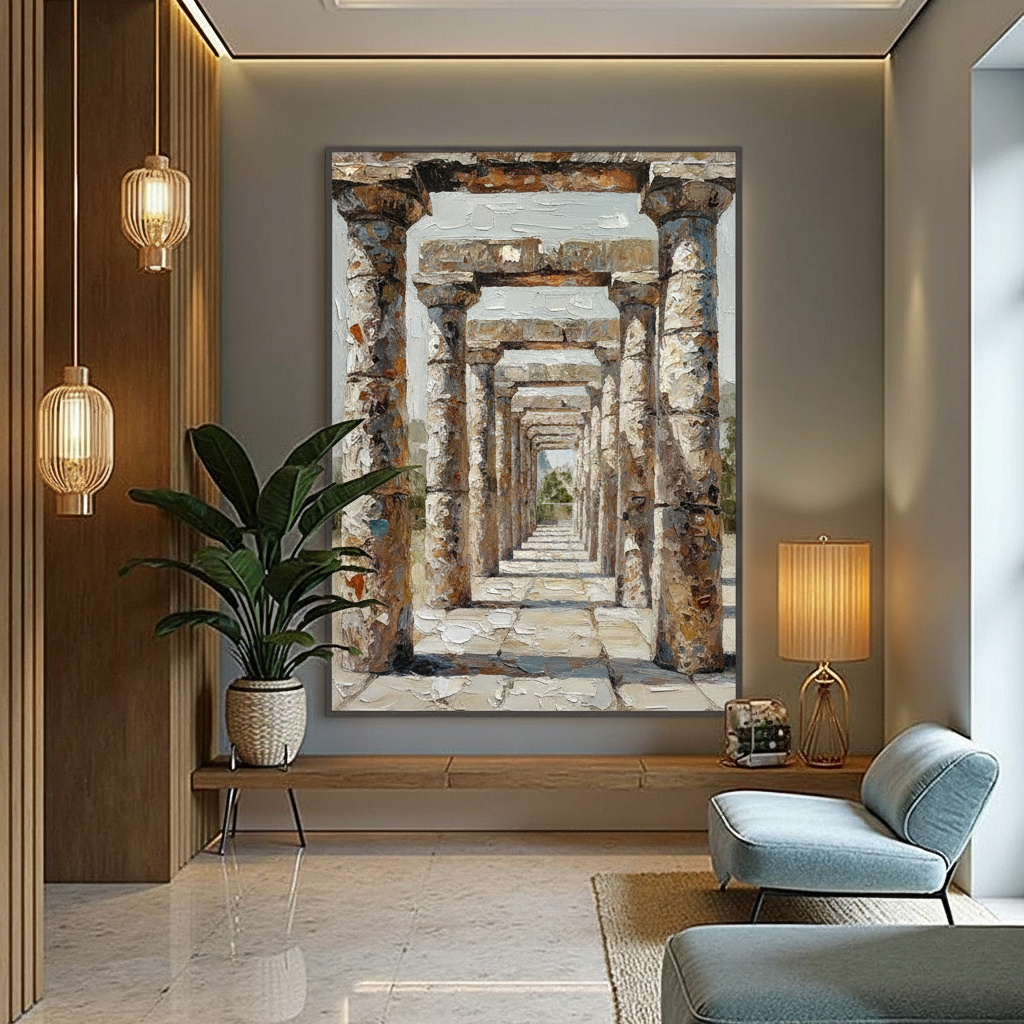
One of the most effective heuristics we employ is the Vanishing Point Rule. By placing art with a strong linear perspective—such as a colonnade, a long hallway, or a bridge—at the end of a corridor or opposite a main entrance, you create a subconscious sense of "pathway clarity." This structural logic helps the viewer navigate the space mentally, reducing the cognitive load required to process the room's layout.
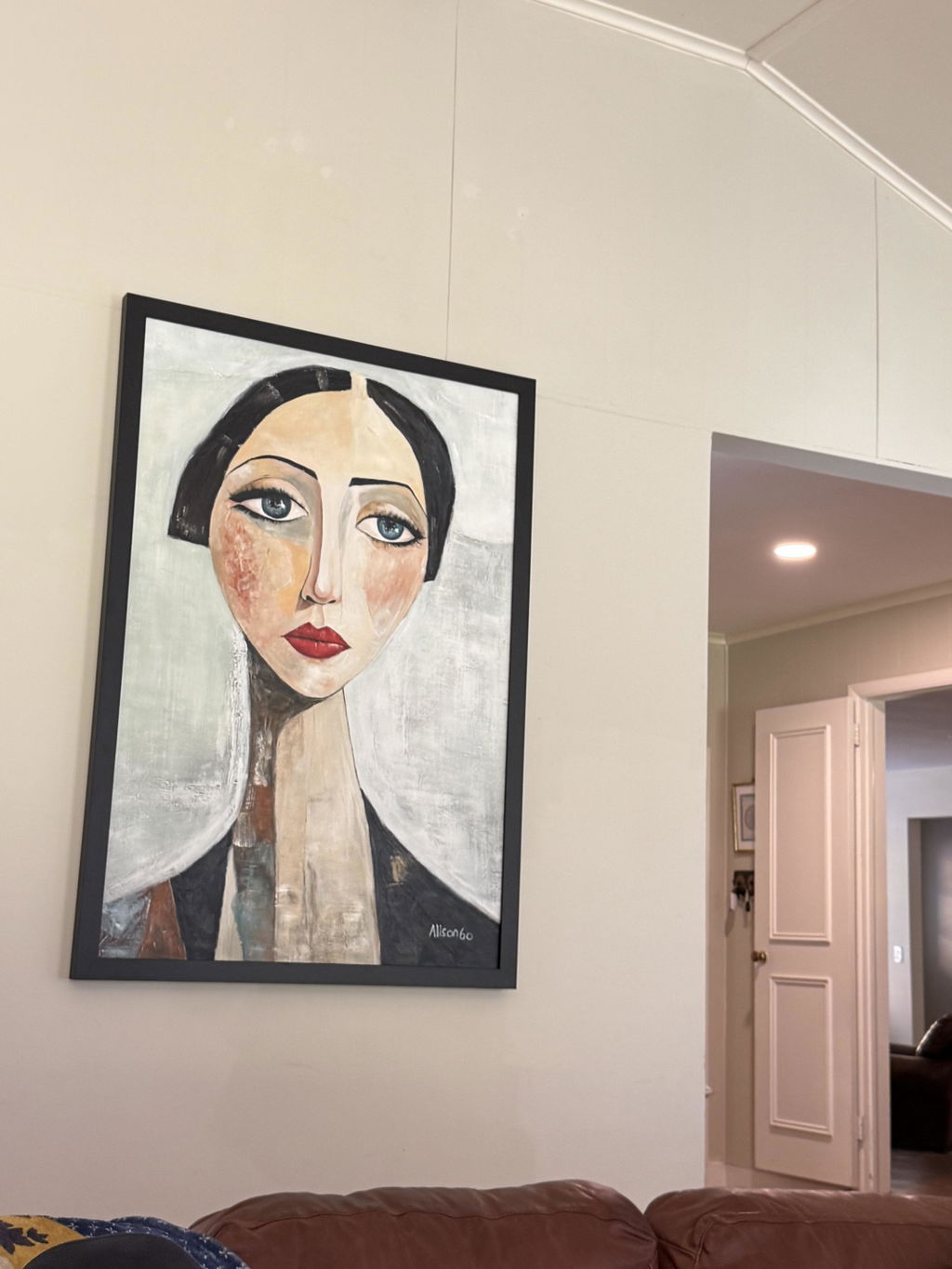
Conversely, a frequent mistake is selecting architectural subjects with distorted or expressionist angles in high-traffic entryways. Research into cognitive architecture suggests that these "unstable" visual signals can inadvertently trigger a sense of vertigo or instability in guests, contradicting the goal of a welcoming home.
Logic Summary: Our spatial stability model assumes that linear perspective acts as a "pathway primer," reducing the brain's environmental mapping effort.
Parameter Value/Range Unit Rationale Vanishing Point Alignment 0–15 Degrees from eye level Maximizes natural eye-tracking Subject Symmetry > 70% Visual balance Reduces amygdala "threat" response Linear Continuity High Heuristic Signals structural integrity Cognitive Load Low Relative Based on eye-tracking efficiency Perceived Stability High Qualitative Correlates with geometric precision

Materiality and the "Essential Identity" of Hand-Painted Art
In an era of mass-produced digital prints and AI-generated imagery, the "performative authenticity" of hand-painted oil on canvas has become a scarce luxury. The difference is not just aesthetic; it is psychological. A study by Columbia University confirms that consumers value art labeled as "AI-generated" 62% lower than authentic human-created art.
Furthermore, empirical research from the University of Chicago suggests that digital replicas lack the artist's "essential identity." A physical canvas retains an irreplicable soul—the microscopic relief of the paint and the history of the brushstroke.
The Texture-to-Line Ratio
For architectural art, the Texture-to-Line Ratio is critical. A rigid building subject, such as a Gothic arch or a brutalist skyscraper, can feel cold and institutional if rendered with clinical precision. However, visible brushstrokes and impasto textures "humanize" the structure. This tactile fruition is backed by optical microprofilometry, which proves that the mm-scale texture of oil paintings is crucial to their aesthetic impact (MDPI).
When the rigid lines of architecture meet the organic texture of hand-applied pigment, the art signals that the space is inhabited and warm, rather than merely "built."
The Science of Safety: VOCs and Indoor Air Quality
When commissioning or purchasing large-scale architectural art, the materials used are as important as the subject matter. The EPA warns that indoor air pollution is often significantly higher than outdoor levels, making low-VOC (Volatile Organic Compound) paints a prerequisite for health-conscious homeowners.
We often see a misconception that "odorless" solvents are non-toxic. However, Princeton University EHS guidelines warn that chronic inhalation of mineral spirits and turpentine vapors—even those without a strong scent—can cause neurological damage.
Ensuring a Healthy Interior Environment
To ensure your art doesn't compromise your air quality, we recommend looking for the following standards:
- ASTM D-4236 Compliance: While this label only means warning labels comply with regulations, it is a baseline for toxicological review (EPA).
- Heavy Metal Screening: ICP-MS laboratory tests have detected heavy metals like zinc and cadmium in certain pigments (PMC). High-quality architectural art should prioritize titanium dioxide-based whites, which have largely replaced highly toxic lead white (NCBI).
- Natural Binders: In many cases, walnut oil or water-based acrylics are safer alternatives to traditional turpentine-heavy oil mediums.

Strategic Placement: Matching Architectural Weight to Furniture
A common design principle used by professionals is matching the "architectural weight" of the artwork to the surrounding furniture. Heavy, brutalist subjects or dense urban cityscapes pair best with solid wood, stone, or metal pieces. This reinforcement of mass creates a sense of permanence and groundedness.
Entryway and Transitional Impact
The entryway is the most critical point for signaling stability. According to a UPenn review, 73% of patients in clinical settings reported significant mood improvements when exposed to environmental artworks. In a residential context, a large-scale architectural piece in the foyer sets a sophisticated, stable tone for the entire home.
For those looking to maximize spatial impact, consider the following checklist:
- Scale for Grandeur: In rooms with high ceilings, vertical architectural subjects (like skyscrapers or cathedrals) draw the eye upward, emphasizing the home's structural volume.
- Linear Perspective for Depth: In narrow hallways, use art that creates a "window" into another space, effectively making small areas feel grand.
- Biophilic Integration: Nature-based architectural subjects—such as garden pavilions or stone bridges in landscapes—produce stress-reduction effects in the brain similar to real outdoor exposure (UCA).
The Economic Leverage of Architectural Art
Beyond the psychological benefits, architectural art is a strategic investment in property value. A Royal Society CAR model analysis found that neighborhoods with higher "art" geo-tags saw greater relative house price ranking gains. On a commercial scale, public art projects have been shown to drive billions in real estate-related growth, as seen in Chicago's Millennium Park (NCREALTORS).
For the individual homeowner, a custom hand-painted mural or a large-scale structural canvas acts as a "permanent physical billboard" of the property's quality. This is particularly useful for those engaged in "creative placemaking"—using art to mask decay or highlight the potential of a space before a sale (Community Progress).
Methodology Note: The 7:1 ROI heuristic for arts investment is based on national findings from Americans for the Arts, which tracks $166.2 billion in annual economic activity generated by the arts.
Longevity and Conservation: Protecting Your Investment
Architectural art is often intended to be a legacy piece. Understanding the chemistry of your art is vital for long-term preservation.
- Acrylic vs. Oil: Acrylic polymers are more resistant to embrittlement than oil films, which undergo oxidative cross-linking over time (JustPaint). However, acrylics are more sensitive to moisture and can experience "Support Induced Discoloration" (SID) if water-soluble impurities are drawn from the canvas (Golden Artist Colors).
- Lightfastness: All high-quality pigments should be tested according to ASTM D4303 standards using xenon-arc tests to simulate years of indoor light exposure. This ensures your architectural "stability" doesn't fade into a hazy ghost of its former self.

A Tool for Grounded Living
Architectural art is a sophisticated tool for managing the "built environment" of our lives. By selecting subjects that signal permanence, utilizing materials that protect our health, and placing pieces with mathematical intent, we do more than decorate a room. We create a sanctuary of structural logic and emotional stability.
Whether it is a hand-painted impasto city scene or a panoramic powder room mural—a trend highlighted by the NKBA 2025 awards—the goal is the same: to turn a house into a grounded home.
YMYL Disclaimer: This article is for informational purposes only and does not constitute professional medical, legal, or architectural advice. The discussion of VOCs and paint toxicity is based on general safety standards; individuals with pre-existing respiratory conditions or chemical sensitivities should consult a qualified health professional or an industrial hygienist before selecting art materials for their home.
Sources
- Marketplace: The expensive art market continues to struggle
- Art Basel and UBS Art Market Report 2024
- Columbia University: Human-Made vs. AI Art Study
- WHO Scoping Review on Arts and Health
- Royal Society: Quantifying the link between art and property prices
- EPA: Indoor Air Quality and Low-VOC Paints
- ASTM International: Standard Test Methods for Lightfastness