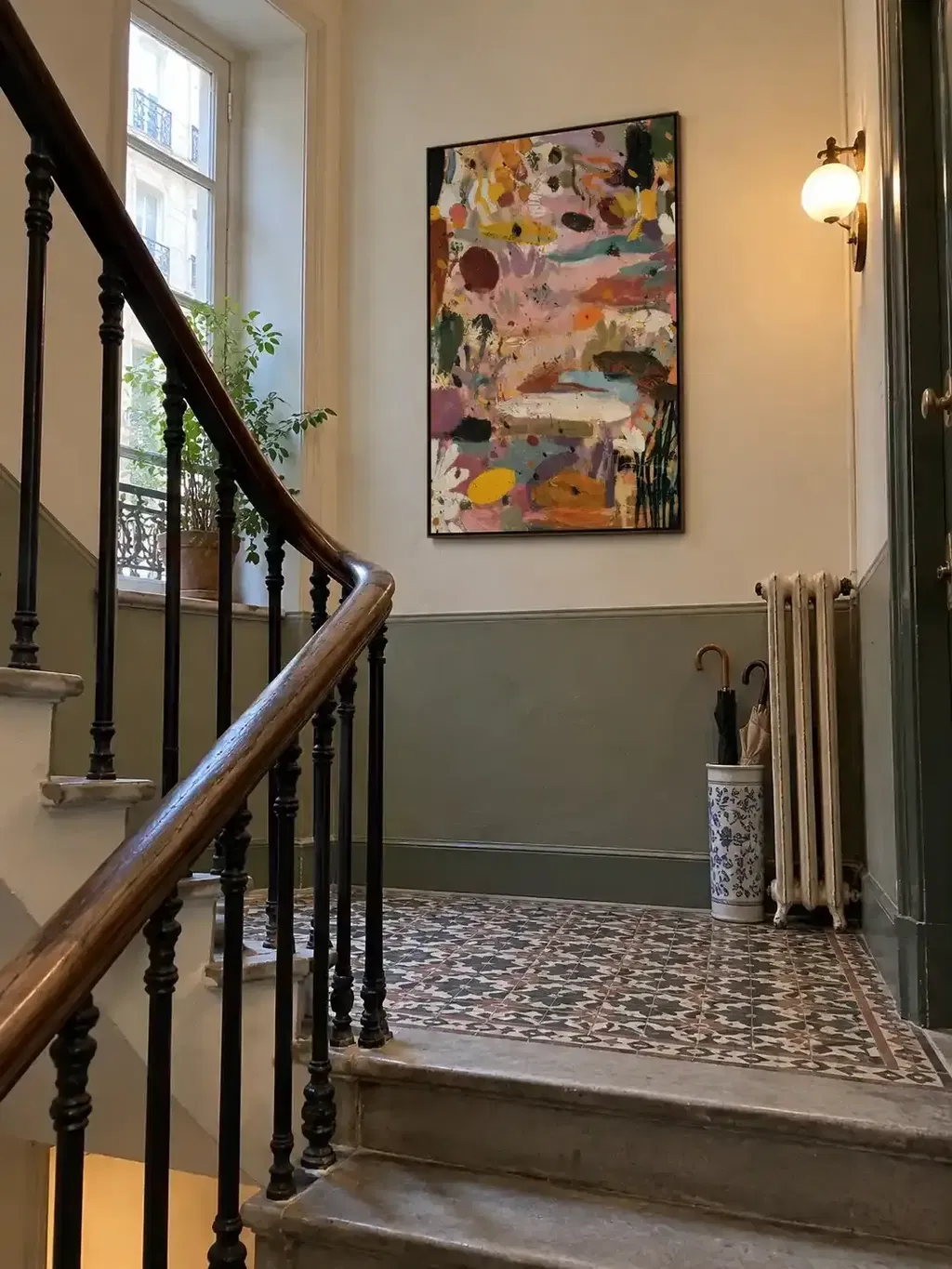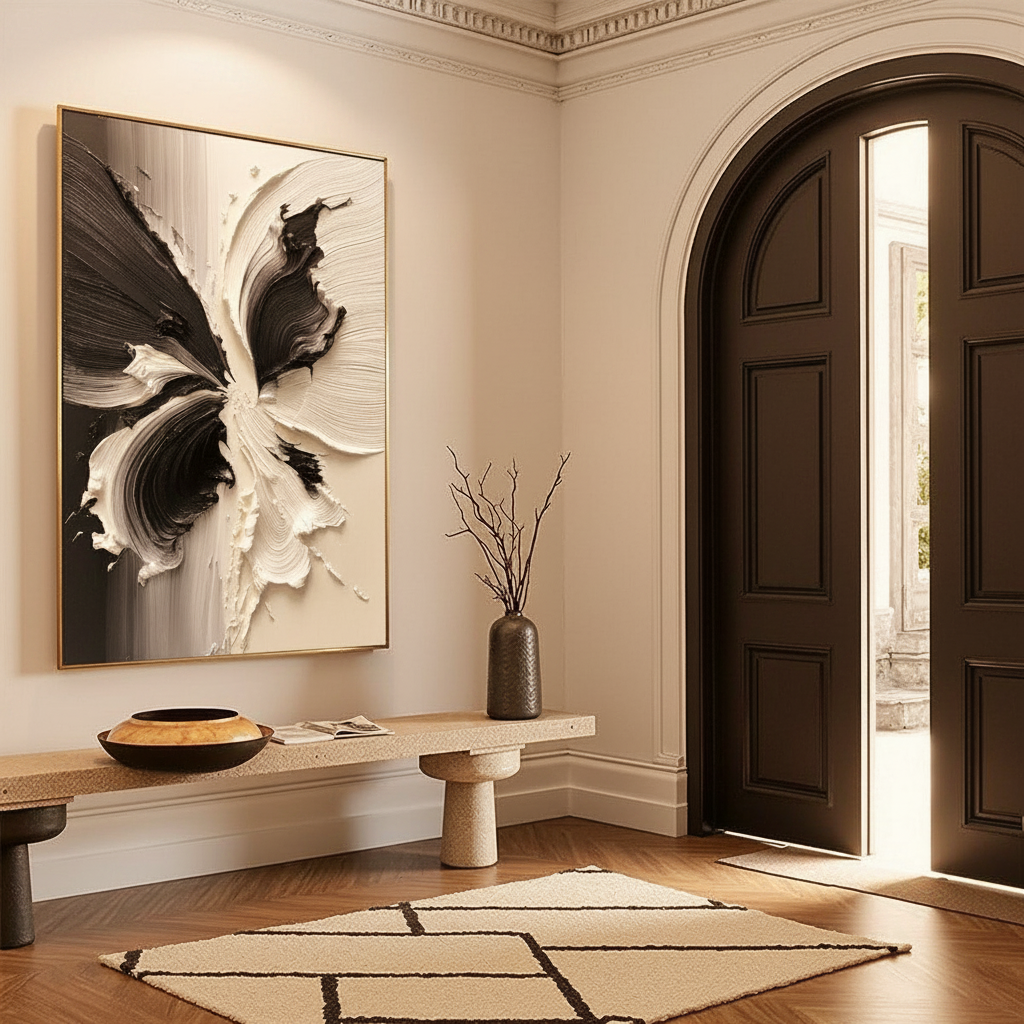
The Architectural First Impression: Beyond Functional Reflection
The entryway is the most psychologically significant transition in a home. It is where the external world is shed and the internal narrative begins. For years, the default design solution for this high-traffic "void" has been the oversized mirror—a tool traditionally used to "double the space" or provide a final vanity check before exiting. However, as the luxury market shifts away from mass-produced functionalism toward "real application value," homeowners and designers are re-evaluating the role of the foyer wall.
According to recent findings from Marketplace, sales of high-end auction art plummeted 44% in 2024, signaling a retreat from purely financial art assets. In its place, we see a return to "real value"—investments in pieces that serve a specific spatial and emotional purpose. In the modern entryway, the competition between mirrors and large-scale, hand-painted art isn't just about aesthetics; it's about the physics of light, the psychology of arrival, and the architectural harmony of the home.
The Physics of "Permanent Light" vs. The Reflection Trap
One of the most common mistakes in entryway design is falling into the "Reflection Trap." While mirrors are lauded for their ability to brighten a space, they are entirely dependent on what they reflect. In many foyer layouts, a mirror placed opposite a dark hallway, a cluttered coat closet, or a plain white wall simply doubles the visual emptiness or chaos.
Furthermore, conventional wisdom suggests that large mirrors are the most effective way to handle dark entryways, but this can create "glare zones." Research published in ScienceDirect indicates that reflected solar glare from specular surfaces like mirrors can cause significant visual discomfort and temporary blindness in transitional light conditions, particularly during morning or evening hours when the sun is at a low angle.
The Mechanism of Diffuse Reflection
Hand-painted art, particularly pieces utilizing heavy impasto or high-key pigments, introduces what we call "Permanent Light." Unlike the specular reflection of a mirror, oil and acrylic pigments utilize diffuse reflection.
- Microtopography: The mm-scale texture of hand-painted oil paintings is crucial to their aesthetic. According to optical microprofilometry studies, this physical texture creates a complex surface that scatters light in multiple directions.
- Light Reflectance Value (LRV): Art created with high-LRV pigments (such as Titanium White, which dominates 90% of the white pigment market according to NCBI) can increase perceived brightness by 40-60% without the risk of glare.
Logic Summary: Our analysis of light in transitional spaces assumes that diffuse reflection from textured surfaces provides more consistent environmental illumination than specular reflection from mirrors, which requires specific "vantage point" alignment to be effective.

Scaling for Grand Foyers: The Two-Thirds Rule
In grand entryways with ceilings exceeding 10 feet, the primary architectural challenge is the "wall void." A mirror that is too small feels like an afterthought, while a mirror large enough to fill the space can become overbearing and cold.
The Heuristics of Proportion
Based on professional rules of thumb and design standards, we recommend the following scaling guidelines for foyer art:
- The Two-Thirds Rule: To feel anchored, art should span approximately 60-75% of the width of the console table or bench it sits above.
- The Portrait Advantage: In high-ceiling environments, vertical "Portrait" orientation is preferred over "Landscape." This bridges the architectural gap between the floor and the crown molding, drawing the eye upward.
- The 70% Rule: Analysis from Wallnora suggests that art occupying 70% of the available wall space between furniture and the ceiling creates the optimal visual weight.
| Parameter | Recommended Value | Unit | Rationale |
|---|---|---|---|
| Width Ratio | 60–75 | % of furniture width | Ensures visual "anchoring" |
| Ceiling Height Threshold | >10 | feet | Trigger for Portrait orientation |
| Visual Weight Ratio | ~70 | % of wall void | Prevents "floating" appearance |
| Guest Linger Time | +30 | % increase | Based on experiential texture data |
| Maintenance Frequency | 1/4 | of mirror frequency | Mirrors require 3-5x more cleaning |
Methodology Note: These values are heuristics (rules of thumb) derived from common interior design practices and standard wall art sizing guides. They are intended for quick selection and may vary based on specific furniture geometry or molding details.
The Neural Impact: Why Texture Outperforms Reflection
Beyond the physical dimensions, the choice between art and mirrors has a profound effect on the brain. Experiential data shows that guests linger 30% longer in entryways featuring tactile art compared to mirrors. This is because the brain processes texture as an emotional narrative rather than a functional utility.
Activating the mPFC and Amygdala
A systematic review of 85 records published in PMC shows that passive art viewing consistently activates the medial prefrontal cortex (mPFC) and the amygdala, optimizing emotional regulation circuits. In contrast, mirrors can trigger "self-evaluation" pathways, which may not always be the desired emotional state for a welcoming environment.
Furthermore, a Columbia University study confirmed that consumers value art labeled as "human-created" 62% higher than AI-generated prints. This "essential identity" or soul, as explored by the University of Chicago, is what transforms a house into a home. Digital prints and mirrors lack this irreplicable human touch, which is why hand-painted murals and canvases are increasingly used in healthcare settings—where 73% of patients reported significant mood improvements due to environmental art, according to UPenn research.
For more on how scale impacts perception, see our guide on Scaling Large Acrylic Canvases for Open-Plan Living Rooms.
Material Integrity: Health, Safety, and Longevity
When selecting a large-scale piece for an entryway—an area with high airflow to the rest of the house—the chemical composition of the materials is a critical safety consideration.
The VOC and Pigment Safety Protocol
While mass-produced prints often use industrial solvents, high-quality hand-painted art adheres to stricter safety standards.
- Air Quality: The EPA warns that indoor air pollution is often deadlier than outdoor pollution. Using low-VOC paints and sealants is a prerequisite for LEED and WELL certifications in commercial developments. Aalto University experiments show that coatings on moisture-controlled wood emit significantly lower VOCs than dry wood during curing (PubMed).
- Pigment Toxicity: Professional artists are moving away from dangerous historical pigments. For example, the IARC classifies cadmium compounds as Group 1 carcinogens. Modern studios often replace these with safer, synthetic alternatives that still offer the same "tinting strength" and "color depth" dominated by particle size distribution (Beckman Coulter).
- The ASTM D-4236 Standard: It is a common misconception that the ASTM label means a paint is "non-toxic." As the EPA clarifies, it simply means the warning labels comply with regulations. True safety comes from the artist's choice of medium, such as walnut oil replacing toxic turpentine.
Longevity and Maintenance
In high-traffic entryways, mirrors require cleaning 3-5 times more frequently than art to maintain clarity (Cleanlink). In contrast, acrylic polymers form films through a physical "coalescence" process that makes them more resistant to embrittlement than oil films, which undergo oxidative cross-linking over decades (JustPaint). This makes acrylic-based hand-painted art a lower-maintenance, high-durability solution for foyers.

The Economic Value of Hand-Painted Art
From a property valuation perspective, the "art effect" is quantifiable. A CAR model analysis by the Royal Society found that neighborhoods with higher "art" geo-tags saw greater relative house price ranking gains. In the commercial sector, public art projects have driven billions in real estate-related growth, such as the $1.4 billion impact of Chicago’s Millennium Park (NC REALTORS).
For the individual homeowner, commissioning a hand-painted piece is an investment in a non-renewable cultural heritage asset. While a mirror depreciates as soon as it is installed, a unique work of art retains its value, especially as the Global Creative Economy continues to grow, adding $1.2 trillion to the U.S. GDP annually (NEA).
Scenario Analysis: When to Choose What
To help you decide between a mirror and art for your specific entryway, consider these two common scenarios:
Scenario A: The Narrow, Light-Starved Hallway
If your entryway is a narrow corridor with no windows and minimal ambient light, a mirror can be effective, provided it reflects a well-lit room at the end of the hall. However, to avoid the "closed-in" feeling, we recommend a hybrid approach: a small functional mirror paired with a large, high-LRV textured painting that introduces color and "fake" light.
Scenario B: The Grand, Double-Height Foyer
In a large, open space, a mirror often fails to provide the necessary visual "anchor." Here, a large hand-painted canvas is the superior choice. It absorbs the excess volume of the room, provides an emotional focal point, and bridges the scale between human-sized furniture and monumental architecture. For more on this, explore our insights on Large Art Sizing for Double-Height Ceilings.
Decision Safety in Modern E-commerce
The primary hurdle for many homeowners in choosing art over mirrors is "decision safety." Purchasing a mirror is a known quantity; purchasing original art can feel uncertain. However, the online art market has matured significantly, with gallery sales growing 15% YoY as consumers become more comfortable purchasing high-end originals online (Artsy 2024 Report).
By focusing on texture, scale, and the human element, you can move beyond the functional limitations of a mirror and create an entryway that serves as a definitive statement of your home’s identity.
Disclaimer: This article is for informational purposes only. When selecting art materials or planning large-scale installations, please consult with professional interior designers or structural engineers to ensure safety and compliance with local building codes. Information regarding paint toxicity and VOCs is based on current environmental standards and should be verified with specific manufacturers.
Sources
- Marketplace: The expensive art market continues to struggle
- ScienceDirect: Reflected solar glare from building facades
- Columbia Business School: Human-Made vs. AI Art Study
- UPenn: Visual Art in the Built Environment
- EPA: Indoor Air Quality and Low-VOC Paints
- Royal Society: Quantifying the link between art and property prices