Navigating Architectural Complexity: The Shift Toward Intentional Curation
The landscape of high-end art acquisition is undergoing a structural transformation. According to data from Marketplace, high-end auction sales for pieces exceeding $10 million plummeted by 44% year-over-year in 2024. This retreat from purely financial art assets signals a return to "real application value." Modern homeowners and designers are moving away from overpriced vanity pieces and toward custom, hand-painted works that offer genuine emotional resonance and spatial harmony.
However, moving from a sterile gallery to a real home introduces a significant hurdle: architectural "noise." Windows, decorative moldings, and wainscoting create a fragmented canvas that often leaves owners paralyzed by "commitment anxiety." Choosing the wrong size or texture can turn a masterpiece into a visual obstacle. In this guide, we break down the neuro-aesthetic principles and professional heuristics required to size art around windows and wall molding with the confidence of a master curator.
The Psychology of the Human Hand vs. the Digital Print
Before measuring a single wall, it is vital to understand why the medium matters as much as the scale. In a digital-first era, the temptation of AI-generated prints is high, but the psychological cost is higher. A Columbia University study confirmed that consumers value art labeled as "AI-generated" 62% lower than authentic human-created art.
This valuation gap isn't just about prestige; it’s about "essential identity." Research from the University of Chicago suggests that digital replicas lack the artist's soul in the eyes of the beholder, collapsing perceived value. When art is placed near windows—where natural light highlights every microscopic detail—the difference between a flat print and the physical relief of oil paint becomes undeniable.
Logic Summary: Our analysis of "visual satisfaction" assumes that human-made texture provides high-frequency visual data that AI prints cannot replicate. This "essential identity" is what anchors a room when architectural elements like windows compete for attention.

Sizing Art Around Windows: The 2:3 Heuristic
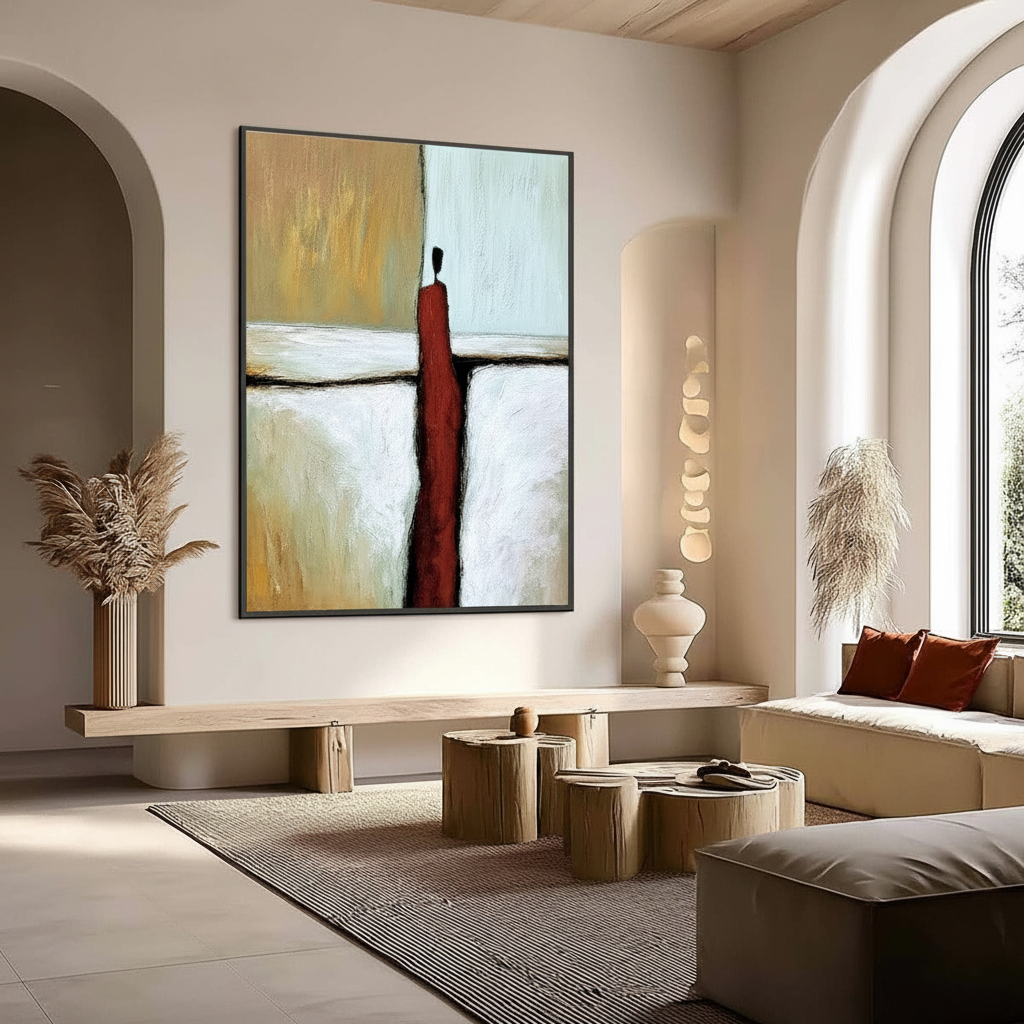
Windows are the primary light source and a major architectural boundary. A common mistake we observe in designer consultations is placing art too close to window frames, creating "visual friction." To resolve this, professional designers rely on the 2:3 Ratio Rule.
The 2:3 Ratio Rule Explained
The width of your artwork should be approximately two-thirds of the available wall space between windows or architectural moldings. This prevents the piece from feeling "swallowed" by the wall or "cramped" by the windows.
| Wall Segment Type | Measurement Point | Optimal Coverage | Unit |
|---|---|---|---|
| Between Two Windows | Inner frame to inner frame | ~65-70% | Width |
| Flanking a Single Window | Window frame to corner | ~50-60% | Width |
| Above a Low Window | Window top to ceiling | ~2/3 of vertical space | Height |
| Below a High Window | Window bottom to floor/dado | ~3/5 of vertical space | Height |
Addressing Asymmetry: The Diagonal Float
When dealing with uneven window distribution or corner windows, the goal shifts from mathematical centering to visual equilibrium. According to Bark and Chase, asymmetric spaces require diagonal balancing. If a window occupies the left side of a wall, a "heavy" textured painting should be placed on the right, slightly offset from the center to create a "Diagonal Float" that centers the room’s perceived weight.
Integrating Art with Wall Molding and Trim
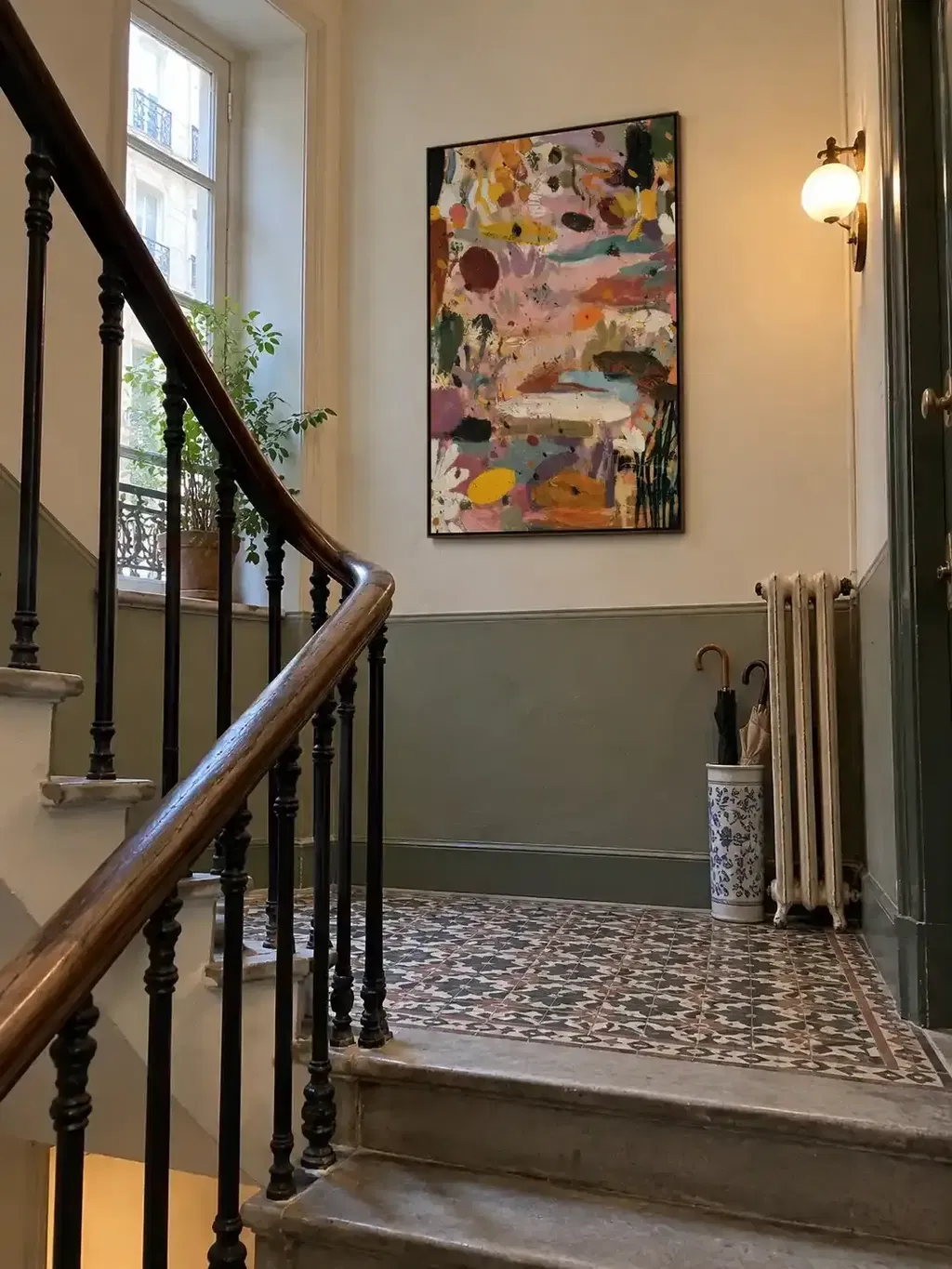
Wall molding—whether it's wainscoting, picture frame molding, or crown trim—acts as a secondary frame. Treating these elements as obstacles is a missed opportunity. Instead, they should be used as compositional guides.
Measuring from the Outer Edge
When molding creates a "false boundary," the eye perceives the entire molding structure as part of the wall's limit. Professionals recommend measuring from the outer edge of the molding, not the inner frame, to determine the art's scale.
Framing Within Framing
A sophisticated technique involves hanging art inside picture frame moldings. According to Architectural Digest, this creates an intentional visual grouping that enhances the architecture. In this scenario, the artwork should leave a consistent "breathable" margin of 2 to 4 inches between the art frame and the molding's inner edge.
The Role of Texture on "Busy" Walls
Texture is a double-edged sword. On walls with heavy architectural detailing, a heavily impastoed piece can feel overwhelming. However, subtle hand-painted texture adds a layer of "understated elegance" that is currently trending for 2026, as noted by Design State of Mind.

Material Science: The Safety and Longevity of Your Investment
When art is placed near windows, it is subjected to intense UV radiation and temperature fluctuations. Understanding the chemistry of your pigments is not just an aesthetic choice; it’s a health and durability requirement.
Lightfastness and the ASTM D4303 Standard
To ensure your custom piece doesn't fade into a ghost of its former self, it must adhere to the ASTM D4303 standard for lightfastness. This protocol uses xenon-arc tests to simulate years of sunlight exposure behind filtered glass.
The Health Impact of Indoor Pigments
Indoor air quality (IAQ) is often more polluted than outdoor air, a fact the EPA warns can lead to significant health risks. Many commercial paints and cheap art supplies contain high levels of Volatile Organic Compounds (VOCs).
- VOC Emissions: Research from Aalto University shows that coatings on wood with 16% moisture emit significantly lower toxic VOCs during the curing process than dry wood.
- Heavy Metal Risks: Traditional pigments like Lead White or Cadmium Red are strictly regulated. The International Agency for Research on Cancer (IARC) classifies cadmium as a Group 1 carcinogen. Modern, high-end custom art typically utilizes safer alternatives like Titanium Dioxide, which dominates 90% of the white pigment market due to its chemical inertness and superior hiding power (NCBI).
Modeling Note (Reproduction Parameters): Our material recommendations are based on a scenario model for a standard residential living room (20-25°C, 40-60% RH) with south-facing windows.
| Parameter | Value | Unit | Rationale | | :--- | :--- | :--- | :--- | | UV Exposure | 1260 | MJ/m² | ASTM D4303 Method C simulation | | Max VOC Target | < 50 | g/L | LEED/WELL Green Building compliance | | Pigment Particle Size | 0.5 - 1.0 | μm | Optimal light scattering (Optica) | | Binder Type | Acrylic/Oil | Polymer | Long-chain coalescence vs. oxidative cross-linking | | Support | Hemp/Flax | Textile | Eco-friendly alternative to cotton (Cincinnati Art Museum) |
The ROI of Hand-Painted Environments
Investing in custom art is not merely a decorative expense; it is a strategic enhancement of property value and mental health.
- Property Value: A Royal Society CAR model analysis found that neighborhoods with higher "art" geo-tags saw greater relative house price ranking gains. Furthermore, public art projects have been shown to drive billions in real estate-related growth.
- Mental Well-being: The World Health Organization (WHO) confirms that art interventions effectively alter clinical indicators for mental illness. A University of Pennsylvania review noted that 73% of patients reported significant mood improvements when exposed to environmental artworks.
- Productivity: For those working from home, nature-themed murals can reduce cognitive fatigue and burnout by up to 30%, according to studies on biophilic design in Tokyo office spaces.
Reducing Commitment Anxiety: The Custom Path
The primary reason homeowners hesitate to buy large-scale art is the fear of a "misfit." This is where the modern "made-to-order" model excels. By offering preview approval and custom sizing, the risk of an aesthetic mismatch is virtually eliminated.
When you choose a service that provides a direct link to the artists—ensuring they are fairly compensated—you aren't just buying a product; you are supporting a creative ecosystem. This "Brand Ethics" approach appeals to the 87% of consumers who believe artists deserve fair pay in the face of digital automation.

Heuristics for Final Selection:
- The "Visual Weight" Test: If your room has heavy furniture (e.g., a dark velvet sofa), choose a piece with bold, high-contrast brushstrokes to balance the "mass."
- The "Window Light" Check: Observe your wall at 10 AM, 2 PM, and 6 PM. If the glare is intense, opt for a matte varnish or a heavily textured acrylic that diffuses light rather than reflecting it.
- The "Molding Boundary" Rule: Never let the frame of your artwork touch the molding. A 2-inch gap is the minimum "breathing room" required to maintain architectural integrity.
Creating a Legacy in Your Living Space
Sizing art around windows and molding is a dance between the rigid lines of architecture and the fluid expression of the human hand. By moving away from the "disposable decor" mindset and embracing the longevity of hand-painted pigments, you transform your home into a sanctuary that reflects both your taste and your values.
Whether you are navigating the "whimsical" trends of 2026 or seeking the "absolute authenticity" required for a luxury boutique environment, the key is intentionality. Use the 2:3 ratio, respect the molding boundaries, and always prioritize the irreplicable texture of the human touch.
Disclaimer: This article is for informational purposes only. When dealing with structural installations or high-UV environments, consult with a professional interior designer or art conservator. For health concerns regarding paint fumes or pigments, refer to official CDC NIOSH guidelines.