The Fractured Focal Point: Why Art and Technology Clash
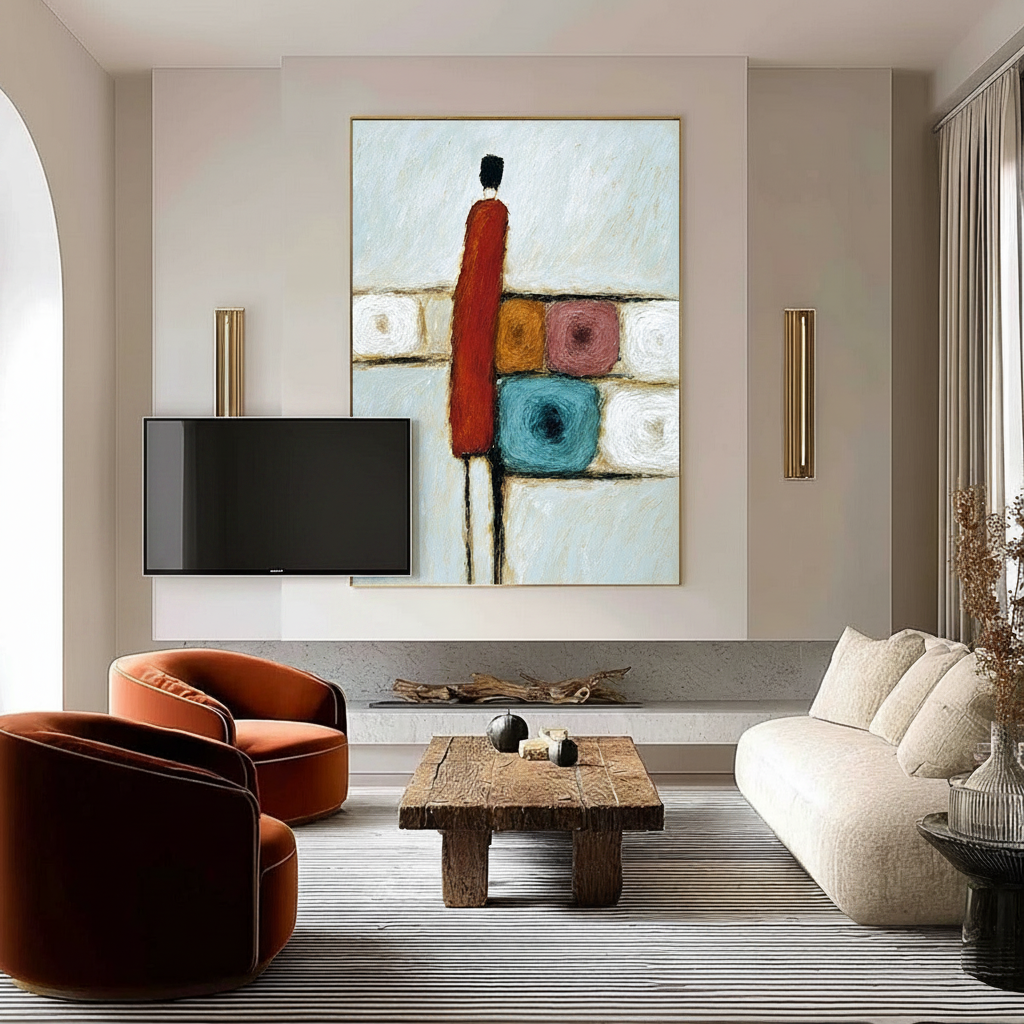
When a television and a statement painting compete for the same wall, the room's visual focus becomes fractured. For homeowners, this is more than a decor hurdle; it is a psychological conflict. Human attention naturally gravitates toward moving images—a biological imperative rooted in our survival instincts—while static artwork requires a slower, more contemplative neural engagement.
In our experience as design practitioners, we have observed a significant shift in how clients value these primary surfaces. While the high-end auction market for "financial asset" art saw a 44% plummet in 2024 (Marketplace), there is a surging return to real application value. Modern homeowners are moving away from overpriced vanity pieces and toward custom, hand-painted murals and canvases that offer emotional resonance and spatial harmony.
This guide provides a definitive framework for resolving the battle between the screen and the canvas. We will explore the technical viewing ratios, psychological mechanisms, and material safety standards required to turn your primary wall into a cohesive, high-value asset.
The Visual Hierarchy Framework: The 30-Degree Rule
The most common mistake in living room curation is placing art too close to the television screen. This creates "visual noise," where the brain struggles to filter out one element to enjoy the other. To solve this, we utilize a core heuristic known as the 30-Degree Rule.
Defining the 30-Degree Rule
To maintain a clear visual hierarchy, static artwork should ideally be positioned within a 30-degree viewing angle from the primary seating area. This ensures the art remains within the viewer's comfortable field of vision without competing directly with the TV’s "active" light.
Furthermore, we recommend a minimum 12-inch separation between the edges of the TV and any adjacent artwork. This physical buffer prevents visual overlap, especially when viewing the wall from an angle.
Logic Summary: These thresholds are derived from common patterns in spatial curation and ocular comfort (not a controlled lab study). They are intended as a baseline for standard living room layouts to reduce cognitive load.

Psychological Focal Point Dominance
Research indicates that passive art viewing consistently activates the medial prefrontal cortex (mPFC) and the amygdala, which are critical for emotional regulation (PMC). However, the glowing presence of a TV can override these calming effects. By establishing a clear hierarchy—where one element is the "hero" and the other the "support"—you allow the brain to switch modes effectively.
Integration Strategies: Stacking, Flanking, and Concealing
There are three primary professional strategies for managing the Art-TV relationship. Each has distinct implications for the room's flow and the "essential identity" of the artwork.
1. The Flanking Method (The Gallery Wall)
Surrounding a TV with smaller pieces of art is a popular technique to make the screen "recede." However, expert opinion suggests this can sometimes backfire. While intended to disguise the technology, a dense gallery wall can actually position the TV as the inevitable focal point amidst visual clutter (Coohom).
Pro Tip: If using this method, ensure the art has a physical relief or "microtopography." 3D textures in hand-painted oils are crucial to aesthetics and cannot be replicated by digital prints (Sensors Journal).
2. The Stacking Method (Vertical Alignment)
In rooms with high ceilings, placing art above the TV is a viable option. However, you must account for the curing timelines of the art. Heat rising from a TV can accelerate the aging of certain binders.
3. The "Art TV" Paradox
"Art TVs" like Samsung’s The Frame are marketed as a seamless fusion of tech and art. However, technical reviews show these units often sacrifice 20-30% in picture quality—specifically contrast and brightness—to achieve a matte, art-like finish (The Gadget Flow).
More importantly, digital replicas lack what researchers call the "essential identity" of the artist. Consumers consistently value art labeled "AI-generated" or "digital" significantly lower than authentic human-created art (Columbia University).
Material Integrity: Why Hand-Painted Texture Matters
The "battle for the wall" is often won by the element that possesses the most physical depth. Digital screens are inherently flat. In contrast, hand-painted pigments—particularly those using heavily textured impasto techniques—interact with ambient lighting in ways a screen cannot.
The Science of Surface Texture
Optical theory establishes that when pigment particles approach half the wavelength of visible light, scattering and opacity reach their theoretical extremes (Optica). This is why original paintings have a "glow" that digital prints lack. Furthermore, the migration of PEG-type surfactants in acrylics can cause "haziness" over time if environmental humidity isn't managed (Tate Research).
Modeling the Value Gap: Human vs. Digital
To illustrate the commercial and psychological premium of human-made art, we have modeled a comparison based on current market data and consumer perception studies.
| Parameter | Hand-Painted Mural/Canvas | Digital/Art TV Mode | Rationale/Source |
|---|---|---|---|
| Perceived Value | 100% (Baseline) | ~38% | Columbia Perception Study |
| Physical Texture | 1-5mm relief | 0mm (Flat) | Microprofilometry Data |
| Environmental Mood | 73% Improvement | Variable/Distracting | UPenn Neuroaesthetics |
| Asset Longevity | High (Cultural Heritage) | Low (Tech Obsolescence) | V&A Conservation Data |
| VOC Safety | Low-VOC Options | N/A | EPA/CDC Guidelines |
Method & Assumptions: This is a deterministic scenario model, not a lab study. It assumes a standard residential environment and compares original acrylic/oil works against high-end digital displays.
Health and Safety: The Invisible Battle
When selecting art to sit alongside high-use electronics like TVs, material safety is paramount. The primary wall is often in a high-traffic social area, making air quality a critical concern.
VOC Emissions and Pigment Toxicity
Indoor air pollution can be more concentrated than outdoor air (EPA). We prioritize low-VOC paints and sealants. It is a common myth that "odorless" means non-toxic; in fact, chronic inhalation of even low-level volatile compounds in certain industrial paints can lead to central nervous system neuropathy (CDC NIOSH).
Critical Warning for Parents: Laboratory tests have detected heavy metals in some art supplies. Zinc accounted for 68% of detections in certain samples, and total heavy metal peaks in burnt umber pigments reached 526.57 $\mu g/g$ (PMC). Always look for the ASTM D-4236 label, but remember: this label only means warning instructions are present, not that the pigment is inherently non-toxic (EPA LHAMA Act).
Economic Impact: Art as a Property Lever
Beyond aesthetics, resolving the Art-TV conflict correctly can increase property value. Neighborhoods with higher "art" geo-tags see greater relative house price gains (Royal Society). For developers and homeowners alike, a custom mural is a "permanent physical billboard" that drives interest.
In commercial settings, the ROI is even clearer. Public art projects in Chicago's Millennium Park drove $1.4 billion in real estate growth (NC Realtors). Whether you are zoning a multi-use rental or curating a private residence, original art acts as a catalytic investment.

Curation Tactics for Different Personas
Scenario A: The Minimalist Entertainer
- The Goal: A clean, high-tech look that doesn't feel cold.
- The Solution: A large, horizontal abstract painting mounted above a low-profile TV console. Ensure at least 12 inches of vertical clearance. Use biophilic designs—natural landscapes—which have been shown to reduce stress as effectively as real outdoors (UCA Biophilic Study).
Scenario B: The Small-Space Dweller
- The Goal: Maximizing a single wall without overwhelming the senses.
- The Solution: Use the "Flanking" method with two vertical, highly textured canvases on either side of the TV. This creates symmetry and draws the eye upward, making the ceiling feel higher.
Final Implementation Checklist
Before you commit to a permanent installation, follow this practitioner-approved checklist:
- Test the Sightlines: Use painter's tape to mark the TV and art boundaries. Sit in your primary chair and check for the 30-degree angle comfort.
- Audit the Lighting: TVs emit blue light; art needs warm accent light. Ensure your art sconces don't create glare on the TV screen.
- Verify Material Safety: Confirm that your muralist or art provider uses non-toxic, low-VOC binders.
- Manage the Cables: Visual clutter from cables will undermine even the most expensive original painting. Use in-wall routing or high-quality cord covers.
By treating the primary wall as a curated gallery rather than just a place to hang a screen, you transform a functional necessity into a cultural asset. The 62% premium on human-made art isn't just a statistic—it's the visible "soul" and "essential identity" that makes a house a home.
Disclaimer: This article is for informational purposes only and does not constitute professional installation, safety, or health advice. Always consult with a qualified structural engineer for heavy wall mounts and a certified industrial hygienist for specific chemical safety concerns in your home.