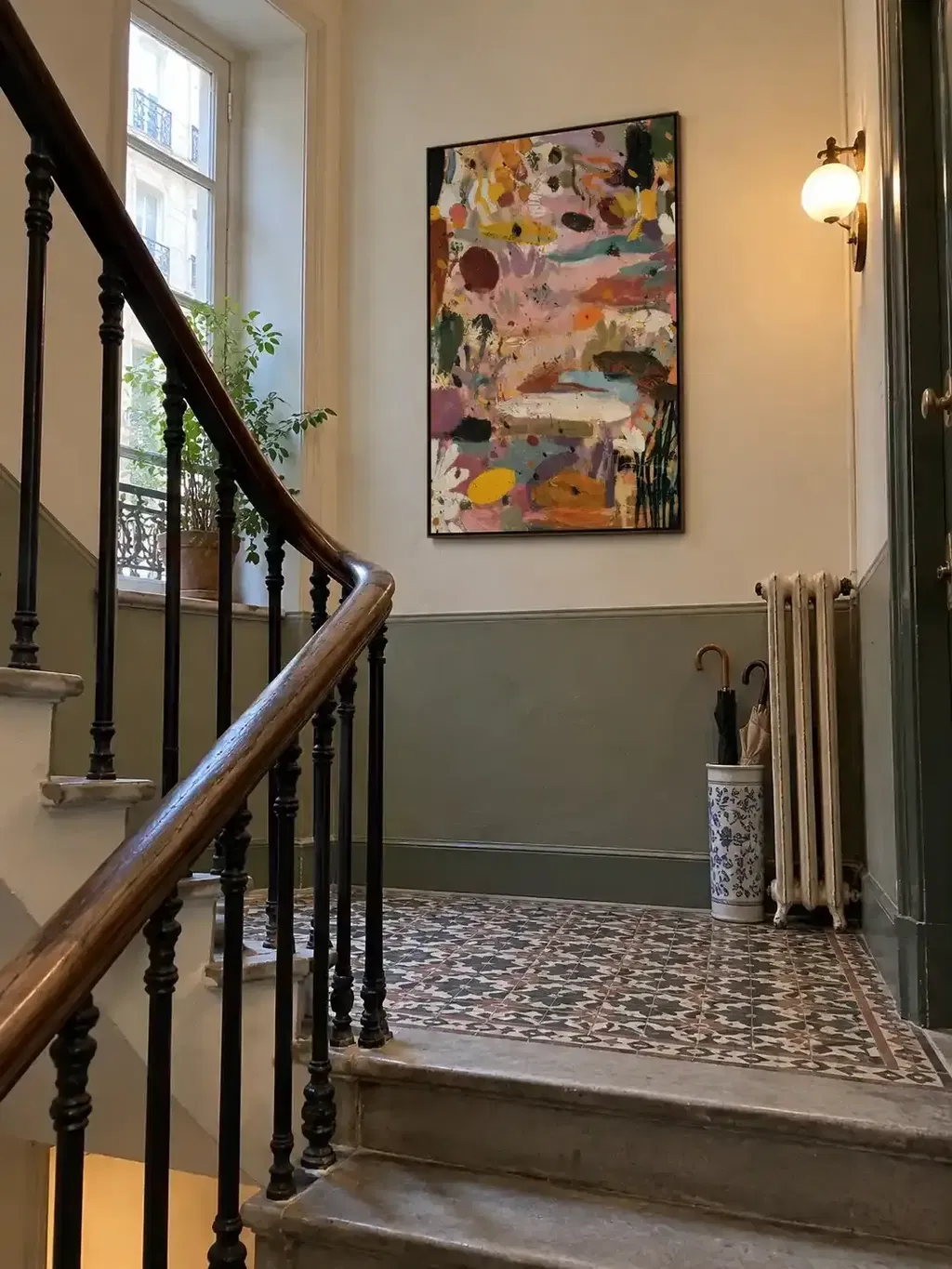
You glance up from the couch and see a blank wall cutting off your view at eight feet. Scenic wall art changes that. A well-chosen landscape painting pulls the eye into distance, light, and open air. The right one feels less like decoration and more like a window.
Key Takeaways
- Look for layered depth, a low horizon, and light coming from within the scene.
- Cool tones calm. Warm tones energize. Match the palette to the room's mood.
- Size: two-thirds to three-quarters of the sofa width. Hang center at 57 in (145 cm) from floor.
- Horizontal and panoramic formats expand a room. Vertical formats add height.
What Makes Scenic Wall Art Feel Like a Window
Not every landscape painting creates escape. When you are choosing, look for these three things.
Depth
Look for a scene with a clear foreground, middle ground, and background. A path leading into trees, a shoreline receding to the horizon, mountains behind a valley. These layers pull the eye through the painting and create the sensation of real distance.
Horizon Placement
For the strongest open-space effect, choose a low horizon. Low horizon means more sky, more openness. A mid-height horizon also works well. It places you at eye level inside the scene rather than above it.
Light Direction
Avoid flat, evenly lit compositions. Look for paintings where light comes from within the scene: a sunrise, sun breaking through trees, a glowing sky at dusk. That internal light source is what makes a painting read as a view rather than a surface.
Which Scenes Create the Strongest Sense of Escape
Here are the 10 scene types available in Montcarta's landscape collection, and what each one brings to a room.
Ocean and Seascape
Open, expansive, free. Cool blues and greens. Works well in living rooms and bedrooms, and gives the eye maximum distance to travel.
Mountain and Valley
Grounded and awe-inspiring. Cool to neutral tones. A strong fit for living rooms and home offices.
Forest and Woodland
Calm, sheltered, restorative. Deep greens and earthy tones. Best in bedrooms and reading nooks.
Meadow and Field
Light, peaceful, unhurried. Warm greens and gold. Works well in dining rooms and hallways.
Sunset and Golden Hour
Warm, nostalgic, hopeful. Orange, gold, and amber. Good for living rooms and dining rooms, and effective in cold or underlit spaces.
Night Sky and Starfield
Meditative, vast, still. Deep blue and indigo. Suits bedrooms and home offices.
Desert Landscape
Stark, open, quietly dramatic. Warm terracotta, ochre, and sand. Works well in spaces that need warmth and visual texture without feeling busy.
Autumn Woodland
Warm and grounding. Rich reds, oranges, and golds. Particularly effective in fall-toned interiors or rooms with wood and natural materials.
Misty Forest Path
Soft, atmospheric, introspective. Muted greens, grey, and diffused light. A good choice for spaces where you want calm without high contrast.
Rainy City Street
Moody and contemplative. Blues, greys, and warm interior light. Adds an urban, cinematic quality. Works well in modern interiors and home offices.
Cool-toned scenic paintings (ocean, forest, mountain) suit rest, reading, and focus. Warm-toned ones (sunset, meadow, autumn woodland, desert) work better in social spaces or cold, underlit rooms.
Ocean and mountain scenes produce the most visual distance. A panoramic seascape or wide mountain valley gives the eye the most room to travel.

Where Scenic Art Does the Most Work in a Home
Living Room
Above the sofa, spanning two-thirds to three-quarters of its width. For an 84 in (213 cm) sofa: 56 to 63 in (142 to 160 cm) wide. One large piece creates more depth than several smaller ones.
Bedroom
The wall facing the bed. Forest, meadow, and night sky compositions work well here. Cooler tones and calm subjects suit this space.
Dining Room
The wall at the head of the table, or the longest unbroken wall in the room. Warm-toned scenes (meadows, golden hour, autumn woodland) add energy to a social space. A single wide horizontal piece works better than a gallery arrangement here.
Hallway and Entryway
A wide horizontal canvas at the end of a hallway draws the eye forward and makes the space feel longer. Vertical nature wall art suits narrow side walls.
Home Office
A mountain or forest scene at desk level gives visual relief during long work sessions. Calming landscape paintings in the peripheral field of view reduce mental fatigue.
Bathroom
A single smaller piece above the basin or on the wall opposite the shower. Misty forest, coastal, and soft meadow scenes work well here. Keep the scale modest and the subject calming.
How to Choose Scenic Art That Fits Your Room
Size
Aim for 60 to 75% of the wall width, or two-thirds to three-quarters of the furniture beneath it. When in doubt, go larger.
- Small room or accent wall: 24 to 36 in (61 to 91 cm) wide
- Living room above sofa: 48 to 60 in (122 to 152 cm) wide
- Large wall or open-plan space: 60 in (152 cm) and up
Orientation
| Format | Effect | Use For |
|---|---|---|
| Horizontal | Expands width | Above furniture, wide walls, hallway end walls |
| Vertical | Adds height | Narrow walls, tall spaces, stairways |
| Panoramic(2:1+) | Strongest escape effect | Feature walls, open coastlines, mountain valleys |
Light and Color
- Bright rooms: warm and cool tones both work.
- Low-light or north-facing rooms: warmer tones or paintings with strong internal light. A dark painting in a dark room disappears.
- Cold or clinical rooms: sunset colors, autumn forest, or golden fields add warmth.
Single vs Multi-Panel
- Single canvas wall art creates a focused focal point. Best when the wall has one strong anchor position.
- 2-piece wall art sets work well for wider walls where a single canvas would need to be very large. The two panels read as one scene with a natural break.
- Triptych (3-piece) wall art covers the most wall while keeping visual cohesion. Keep panel gaps at 2 to 3 in (5 to 7.5 cm) and align all panels along a shared horizon line so the scene reads as continuous.
Frame or No Frame
| Option | Best Rooms |
|---|---|
| Frameless stretched canvas | Minimalist, contemporary |
| Dark frame | Traditional, moody interiors |
| Natural wood frame | Farmhouse, transitional, organic modern |
Hanging Height
Standard: center at 57 in (145 cm) from floor. For scenic art, drop to 54 to 56 in (137 to 142 cm) to place the horizon at seated eye level and deepen the sense of looking into the scene.
Montcarta's hand-painted scenic canvas art is available in horizontal, vertical, and panoramic formats, from 16 × 32 in (40 × 80 cm) up to 48 × 96 in (120 × 240 cm), with framing options from frameless to wood and painted finishes.

Find Your Scene at Montcarta
The right scenic wall art does not just fill a wall. It opens it. A landscape painting with depth, the right palette, and a size that fits the space becomes a permanent view you chose. Montcarta offers original hand-painted landscape paintings, from impressionist forest scenes to panoramic mountain views and coastal seascapes. Find the scene that fits your room at Montcarta.
FAQs
Q1: Does scenic wall art work in a room that already has a real window view?
Yes. A window shows what is outside right now. A scenic painting gives you a consistent, chosen view that matches the room's mood and palette on your terms. Designers often use scenic art on walls adjacent to windows to extend depth, or where the actual view is plain.
Q2: What size scenic painting works best in a living room?
Two-thirds to three-quarters of the sofa's width. For an 84 in (213 cm) sofa, that means 56 to 63 in (142 to 160 cm) wide. Hang with 6 to 8 in (15 to 20 cm) between the top of the sofa and the bottom of the painting, center at 57 in (145 cm) from the floor.
Q3: Is realistic or abstract scenic art better for creating depth?
Realistic and semi-realistic scenery paintings create stronger depth because the eye reads familiar spatial cues: a receding path, layered mountains, a horizon. Abstract landscape wall art can suggest depth through color recession but requires more interpretation. For escape effect, go realistic. For mood and texture, abstract works well.
Q4: Can scenic wall art make a dark or small room feel bigger?
Yes. In a small room, one larger painting outperforms several small ones. Choose a wide horizontal scene with a low horizon and open sky. In low-light rooms, avoid dark or heavily saturated paintings. Scenic art with pale skies, internal light, or misty depth reads as open space even without natural light.