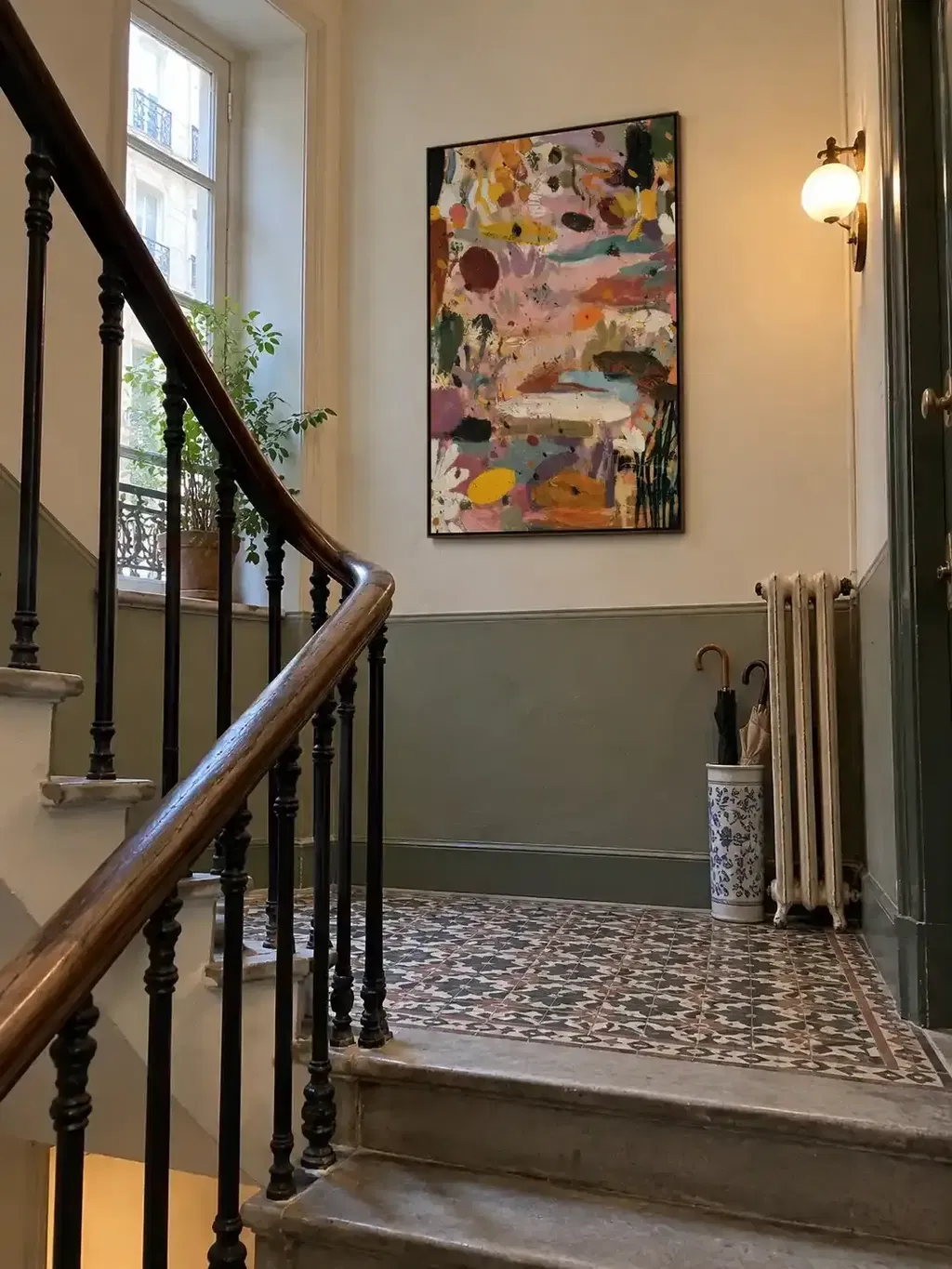
You found a piece you love. You order it. It arrives, and it looks tiny on that big wall, like a sticky note on a billboard. Or it fills the whole wall in a way that feels crowded and off. Getting the scale right before you buy is what separates a room that feels pulled-together from one that feels slightly off. Here's what to check first.
Key Takeaways
-
Art should be 2/3 to 3/4 the width of the furniture below it
-
For a blank wall, aim for 57–75% of the wall width
-
"Oversized" typically starts at 36" wide or larger
-
Hang the center of the piece at 57–60" from the floor
-
When unsure between two sizes, go with the larger one
-
One large piece almost always reads better than several small ones on a big wall
Why Do So Many People End Up With Art That's Too Small?
The most common mistake isn't bad taste. It's buying without measuring. A piece that looks bold on a product page can disappear on a 10-foot wall. Here's why it keeps happening:
-
The scale illusion: Art photographed against a white backdrop looks larger than it will on a wall surrounded by furniture, trim, and architecture.
-
Skipping the tape test: Most people don't tape out the dimensions on the wall before buying. A few minutes with painter's tape would prevent most returns.
-
Playing it safe: Shoppers often size down to avoid "going too big," but undersized art on a large wall creates visual imbalance. The wall feels empty even with something on it.
-
Ignoring furniture width: The sofa, bed, or console below the art sets the visual anchor. Art that doesn't relate to that width floats.
The result? A 24×36" canvas above an 84" sofa that looks like a postage stamp.
What Is the Sizing Formula That Actually Works?
This is the rule interior designers use consistently across room types:
Art width = 2/3 to 3/4 of the furniture width below it
Above a Sofa
An 84" sofa calls for art between 56" and 63" wide. That puts you squarely in large wall art for living room territory: typically a single canvas in the 48"–60" range, or a two-panel set that spans the same width.
Above a Bed
A queen bed (60" wide headboard) works best with art between 40" and 45" wide. A king headboard (76") needs art in the 50"–57" range.
On a Blank Wall (No Furniture Below)
Measure the wall width and multiply by 0.57 and 0.75. That gives you the ideal size range. A 120"-wide wall calls for art between 68" and 90" wide, which is where extra large wall art canvas pieces come in.
Quick Reference Table
| Wall/Furniture Width | Recommended Art Width |
|---|---|
| 60" sofa | 40"–45" |
| 72" sofa | 48"–54" |
| 84" sofa | 56"–63" |
| Queen bed (60") | 40"–45" |
| King bed (76") | 50"–57" |
| 10-ft blank wall (120") | 68"–90" |
| 12-ft blank wall (144") | 82"–108" |
Hanging height: Center the piece at 57–60 inches from the floor. If it's above furniture, leave 6–10 inches of breathing room between the top of the furniture and the bottom of the frame.

One Large Piece or Multiple Smaller Ones: Which Works Better?
For most large walls, one oversized wall art piece reads cleaner and stronger than a cluster of smaller frames. Here's how to decide:
Choose One Large Piece When:
-
The wall is behind a single dominant piece of furniture (sofa, bed, console)
-
You want the room to feel calm and cohesive
-
The ceiling height is 9 feet or above
-
You're working with large abstract wall art or landscape paintings, subjects that benefit from scale
Choose Multiple Smaller Pieces When:
-
You want to display a personal mix of prints, photos, and artwork
-
The wall has architectural interruptions (windows, sconces, doors)
-
You're filling a long hallway or staircase wall
-
The wall is 8 feet tall or less and a single large canvas could feel top-heavy
Gallery Wall Sizing Rule
If you go with a group arrangement, treat the entire cluster as one unit. The total width of the grouping, gaps included, should still follow the 2/3 rule relative to the furniture below.
How Does Large Art Change the Way a Room Feels?
Scale does specific things to perception. Here's what changes when you go large:
-
Ceiling height: A tall vertical canvas makes an 8-foot ceiling read higher. Wide horizontal art makes a room feel wider and more settled.
-
Room size: Large abstract painting on a focal wall draws the eye and makes the surrounding space recede. A small room with one bold large piece often feels more intentional than a room with scattered small frames.
-
Furniture weight: Art that properly scales to the sofa or bed below it anchors the furniture to the wall. Without it, furniture can feel like it's floating.
-
Color temperature: Large-format art in warm tones makes a space feel cozier. Cool-toned large pieces open a room up visually.
Large abstract wall art in particular is effective in neutral, minimalist rooms. It carries the color and energy load that the rest of the room intentionally avoids.
Room by Room: What Does "Large" Mean in Each Space?
"Large" is relative. Here's what the right scale looks like in each space:
Living Room
The focal wall behind the sofa is the most common placement. Aim for 48"–60"+ wide. This is where oversized wall art and large wall art for living room formats earn their place. A single canvas in this range can define the entire room's look. Ceiling height above 9 feet? Go taller as well as wider; a 60×48" horizontal or a 48×60" vertical both work.
Bedroom
Above the bed, scale to the headboard width. Consider hanging height carefully: art above a bed sits lower in your visual field when you're lying down, so center it at roughly 8–10 inches above the top of the headboard, not the standard 57" floor rule.
Dining Room
The wall at the end of a dining table (or behind a buffet) benefits from a single large piece. Width should match or slightly exceed the table length. A 72" dining table works with art in the 48"–60" range.
Entryway / Hallway
Vertical format works well here. A tall narrow canvas (24×48" or 30×60") creates a strong first impression without blocking sightlines. Extra large wall art canvas pieces work in entryways with high vaulted ceilings.
Home Office
Behind a desk or on the wall facing your chair, mid-to-large scale art (30"–48" wide) adds presence without competing with screens. Abstract pieces with muted palettes tend to hold attention without being distracting.
Summary Table: Scale by Room
| Room | Recommended Size Range | Best Orientation |
|---|---|---|
| Living room | 48"–72"+ wide | Horizontal |
| Bedroom | Scale to headboard width | Horizontal or square |
| Dining room | 48"–60"+ wide | Horizontal |
| Entryway | 24"–36" wide, tall | Vertical |
| Hallway | 20"–30" wide per piece | Vertical |
| Home office | 30"–48" wide | Horizontal or square |
Size It Right, Then Find the Right Piece
Scale is the decision most people make last, but it should come first. Measure the wall, check the furniture width, apply the 2/3 formula, and you'll know your target dimensions before you start looking. From there, it's about finding a piece that fits both the wall and the room's tone.
Montcarta works with artists around the world to bring original, hand-painted work into everyday homes. Every piece is painted by hand, which means the texture, brushwork, and finish you see in the photo is what arrives at your door. You can find large wall art and large abstract paintings in a wide range of formats at MONTCARTA®.

FAQs
Q1: Can large wall art work in a small room?
Yes. One large piece on a single accent wall often reads better than several small frames, which can make the space feel cluttered. Keep the other walls clear and let the one piece carry the visual weight. Scale to the wall width using the 57–75% rule.
Q2: How high should large wall art be hung?
Center the piece at 57–60 inches from the floor in most rooms. Above furniture, keep 6–10 inches of gap between the top of the furniture and the bottom of the frame. In rooms with very high ceilings (10 feet+), you may hang slightly higher to keep the art visually connected to the furniture below.
Q3: What is considered oversized wall art?
Generally, oversized wall art refers to pieces 36 inches wide or larger. In practice, most designers use "oversized" for anything 48" wide and up. Extra large wall art canvas pieces (60" or wider) are typically used in open-concept living spaces, commercial settings, or rooms with high ceilings.
Q4: Is it better to go bigger or smaller when unsure about size?
Go bigger. Undersized art is the more common mistake, and it's harder to fix. A piece that's too small on a large wall creates visual imbalance that no hanging arrangement can correct. A slightly larger piece can be balanced with furniture placement or kept as the room's focal point.