A landscape painting is a flat surface, yet a successful one can make the viewer feel that the scene continues far beyond the canvas. A path disappears between trees, mountains dissolve into the distance, or an opening in the sky draws the eye toward the horizon.
This illusion is known as pictorial depth. Artists create it by organizing shapes, color, scale, light, edges, and brushwork so that some elements appear close while others seem far away.
Learning how depth in landscape painting works can change the way you experience art. Instead of seeing only a mountain, field, forest, or coastline, you begin to notice how the artist guides you through the scene—and why certain landscapes feel open, immersive, or atmospheric.
What Does Depth Mean in a Landscape Painting?
Depth is the visual impression that a two-dimensional painting contains three-dimensional space.
The canvas itself remains flat. What changes is the way the viewer interprets the relationships between objects. A large, detailed tree may appear close, while a smaller and softer mountain appears distant. An overlapping shoreline can suggest that one section of water extends behind another.
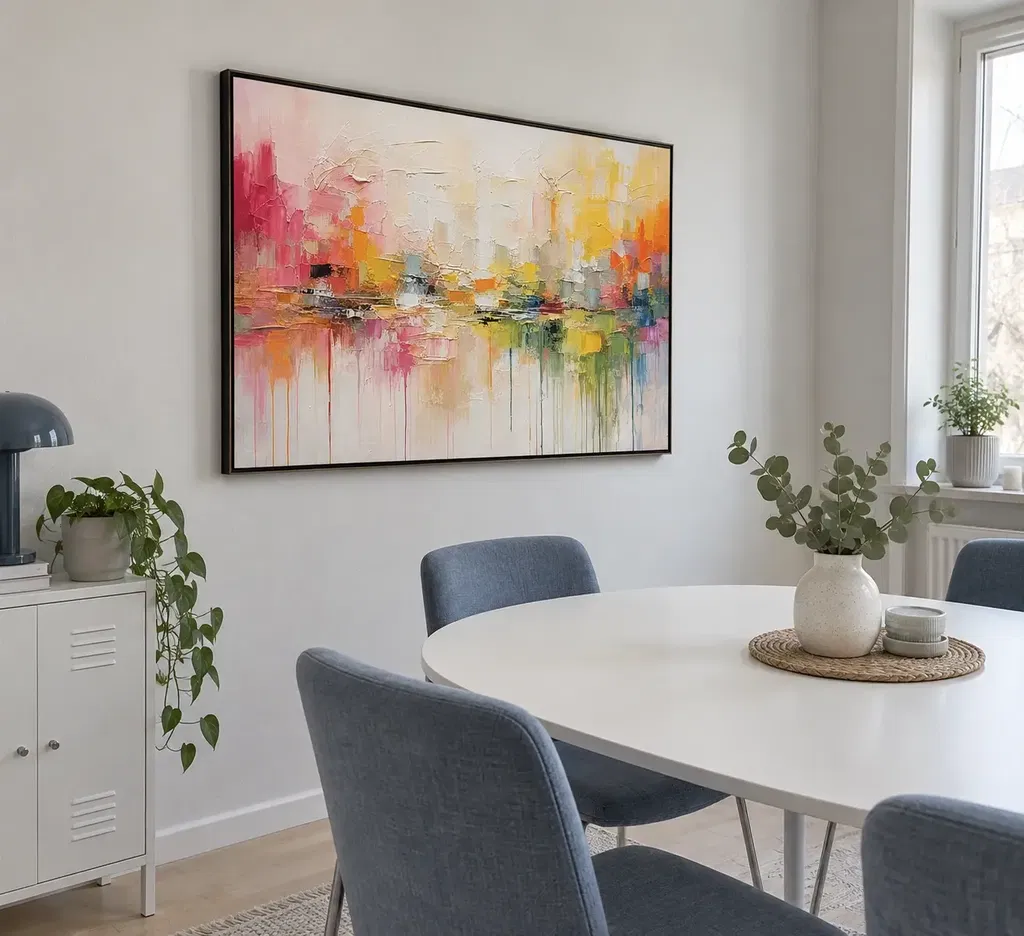
Artists do not need to make every landscape completely realistic. Even abstract landscape paintings can suggest distance through horizontal layers, color recession, changes in contrast, or the placement of shapes.
Depth is therefore not one technique. It is the combined result of several visual decisions working together.
Foreground, Middle Ground, and Background
One of the clearest ways to analyze a landscape painting is to divide it into three spatial areas:
- Foreground: the area that appears closest to the viewer.
- Middle ground: the transitional space between near and distant elements.
- Background: the area that appears farthest away.
The foreground often contains larger shapes, stronger contrast, and more visible detail. The background usually contains smaller, quieter, or less defined forms. The middle ground connects the two.
This structure gives the eye a route through the painting. A rock, group of flowers, tree, or figure may establish the foreground. A field, river, road, or shoreline then carries the eye into the middle ground. Mountains, sky, ocean, or distant architecture complete the background.
The Getty’s landscape education materials identify foreground, middle ground, background, overlapping, and relative size as fundamental methods for creating the illusion of spatial depth. The Getty: From Foreground to Background.
Once you recognize these spatial layers, you can also examine how focal paths, horizons, and areas of visual rest influence the experience of a landscape. MontCarta’s guide to what famous landscape paintings teach us about choosing wall art explores these broader compositional decisions.

How Linear Perspective Creates Distance
Linear perspective uses directional lines and changes in scale to suggest that space recedes.
A road that becomes narrower toward the horizon is an obvious example. Rows of trees, fences, buildings, fields, or waves may also appear to converge as they move farther into the scene.
Artists can use these directional elements as visual pathways. The viewer’s eye follows a road, river, shoreline, or line of light from the front of the composition toward a more distant focal point.
Relative size reinforces the effect. Two trees may be similar in real life, but the tree placed farther away is painted smaller. Repeated objects—such as fence posts, boats, flowers, or figures—can therefore establish a measurable sense of distance.
A landscape does not need a strict architectural vanishing point to feel convincing. Organic lines can also suggest recession, especially when they become smaller, closer together, or less distinct as they approach the horizon.
How Atmospheric Perspective Makes Objects Recede
Linear perspective describes how forms reduce in apparent scale. Atmospheric perspective describes how their appearance changes with distance.
In many landscape paintings, distant objects are represented with:
- softer edges;
- lower contrast;
- fewer visible details;
- lighter or more muted colors;
- greater influence from the color of the sky or atmosphere.
A nearby tree might contain dark shadows and clearly separated leaves. A distant group of trees may appear as a softer blue-gray mass with little internal detail.
This does not mean every background must be pale blue. Weather, time of day, climate, and artistic style can all change the palette. The essential principle is that distant forms often separate less strongly from their surroundings than nearby forms.
When artists gradually reduce detail and contrast, the landscape can feel deeper without making the technique itself obvious.
A landscape with clear recession and quieter distant areas may also feel less visually dense on a compact wall. For a room-focused application of these principles, explore whether large landscape paintings can make a small room feel more open.

Why Warm and Cool Colors Affect Spatial Depth
Color temperature can strengthen the impression of distance.
Warm colors such as red, orange, ochre, and some yellows often attract attention quickly, especially when surrounded by cooler colors. Blues, blue-grays, muted greens, and violets can appear to recede when their contrast and saturation are reduced.
An artist might therefore place warmer earth tones or flowers in the foreground while allowing distant hills to shift toward cooler, quieter colors.
This is not an absolute rule. A bright blue foreground or warm sunset background can reverse the relationship. The effect depends on contrast, saturation, surrounding colors, and the overall composition.
When examining color perspective in landscape art, ask:
- Where are the strongest and warmest colors?
- Where do the colors become cooler or less saturated?
- Does the change happen gradually from front to back?
- Is one warm accent creating a focal point rather than depth?
The answers reveal whether color is defining space, directing attention, or doing both.
How Light and Shadow Shape the Landscape
Light helps describe the volume of individual forms, but it can also connect different spatial areas.
A bright path passing through a darker foreground may invite the viewer into the scene. Bands of sunlight across fields can separate one layer of land from another. A distant illuminated horizon can draw attention beyond the foreground.
Shadow provides structure. Dark foreground shapes can create a visual frame, while lighter middle and background areas appear to open behind them. Alternating areas of light and shadow can establish rhythm and guide the eye across the canvas.
The direction of light also affects mood. Soft, diffused light may reduce contrast and make the landscape feel atmospheric. Strong directional light can reveal texture, create dramatic shadows, and emphasize particular landforms.
When studying light and shadow in a landscape painting, do not look only for the brightest object. Follow the way light moves through the whole composition.

Sharp Edges, Soft Edges, and the Viewer’s Focus
Edges are one of the less obvious tools artists use to create depth.
A sharp edge clearly separates one shape from another. It attracts attention and may make an object feel closer. A soft edge allows adjacent colors or values to merge, which can make a form feel more distant or atmospheric.
If every tree, cloud, rock, and building has the same sharpness, the painting may feel visually flat or overly busy. Varying the edges creates hierarchy.
Artists frequently reserve their sharpest edges for the focal area. Elsewhere, some boundaries may disappear almost completely. This combination of defined and lost edges prevents the viewer from treating every part of the canvas as equally important.
To locate the focal point, look for the area where strong edges, contrast, color, and detail come together.
How Brushwork Changes the Sense of Distance
Brushwork does more than describe texture. It can influence how near or far a surface appears.
When paint is applied thickly enough to retain raised brush or palette-knife marks, the technique is generally described as impasto. Readers interested in the physical surface of oil paint can continue with MontCarta’s guide to impasto painting, texture, and visible brushwork.
In the foreground of a landscape, an artist may use larger, more visible marks to suggest grass, rocks, water, or flowers. Raised paint and directional strokes can give the area a stronger physical presence.
As the landscape recedes, the brushwork may become smaller, smoother, or less distinct. Individual leaves turn into grouped shapes, while complex rock formations become quieter silhouettes.
Some artists deliberately reverse this approach. Expressive or abstract landscapes may use bold marks across the entire canvas, reducing traditional depth in favor of rhythm and surface energy. The result can still suggest a landscape, but the viewer becomes more conscious of the paint itself.
Neither approach is automatically better. Deep, atmospheric space encourages the eye to travel into the scene, while flatter and more visible brushwork emphasizes the physical character of the painting.
How to Read Depth When Viewing a Landscape Oil Painting
When comparing landscape paintings, use this short viewing sequence:
- Find the foreground. Identify the nearest visible shape or surface.
- Follow the visual path. Look for a road, shoreline, river, light pattern, or sequence of overlapping forms.
- Locate the horizon or farthest layer. Notice how the artist treats scale, color, and detail.
- Compare the edges. Determine which areas are sharp and which dissolve into the atmosphere.
- Study brushwork. Look for differences between near and distant marks.
- Step back. Check whether the scene still creates a clear impression of space from normal viewing distance.
This method is useful when viewing art online, but close-up images are especially important for judging brushwork and surface texture. Screen images can communicate composition and general color direction, yet they cannot reproduce every physical quality of an oil-painted surface.
When purchasing online, review the complete composition as well as detailed views of the surface. MontCarta’s Worry-Free Purchase process explains how customers receive photos and videos of the completed painting for review before shipment.
MontCarta offers hand-painted works across landscape, seascape, abstract-landscape, and nature-inspired subjects. The landscape painting collection can be viewed using the same foreground, atmosphere, edge, color, and brushwork checks described above.

Depth Turns a Flat Canvas into a Place You Can Enter
The sense of distance in a landscape painting is rarely created by one device alone.
Foreground, middle ground, and background establish the basic structure. Linear perspective and relative scale organize recession. Atmospheric perspective softens distant forms. Color, light, edges, and brushwork then determine how the viewer moves through the scene.
Once you recognize these choices, landscape paintings become easier to understand and compare. You are no longer judging only whether you like the subject. You can identify how the painting creates space, where it directs attention, and whether its visual depth produces the experience you want to live with.
Frequently Asked Questions
How Do Artists Create Depth in Landscape Paintings?
Artists create depth through overlapping forms, relative scale, linear perspective, atmospheric perspective, changes in color and contrast, varied edges, light, shadow, and differences in brushwork.
What Is Atmospheric Perspective in Art?
Atmospheric perspective uses softer edges, reduced detail, lower contrast, and changes in color to make distant objects appear affected by the atmosphere between them and the viewer.
Why Do Distant Objects Look Lighter and Cooler in Paintings?
Artists often make distant forms lighter, cooler, or less saturated to suggest atmospheric distance. This is a common technique rather than a rule that applies to every landscape or lighting condition.
What Are Foreground, Middle Ground, and Background?
The foreground is the area appearing closest to the viewer. The middle ground connects the near and distant areas, while the background appears farthest away. Together, they organize the illusion of space on a flat surface.