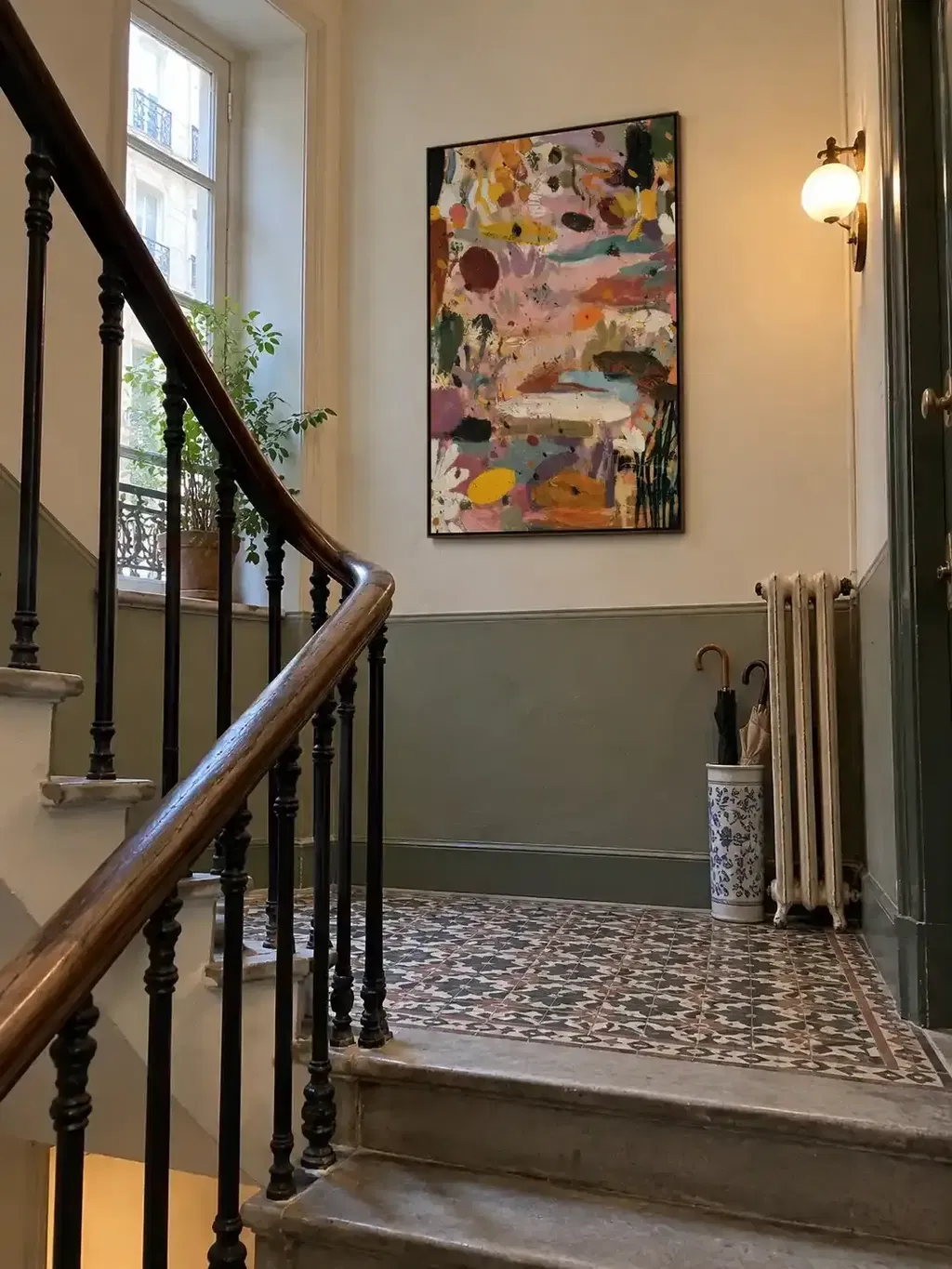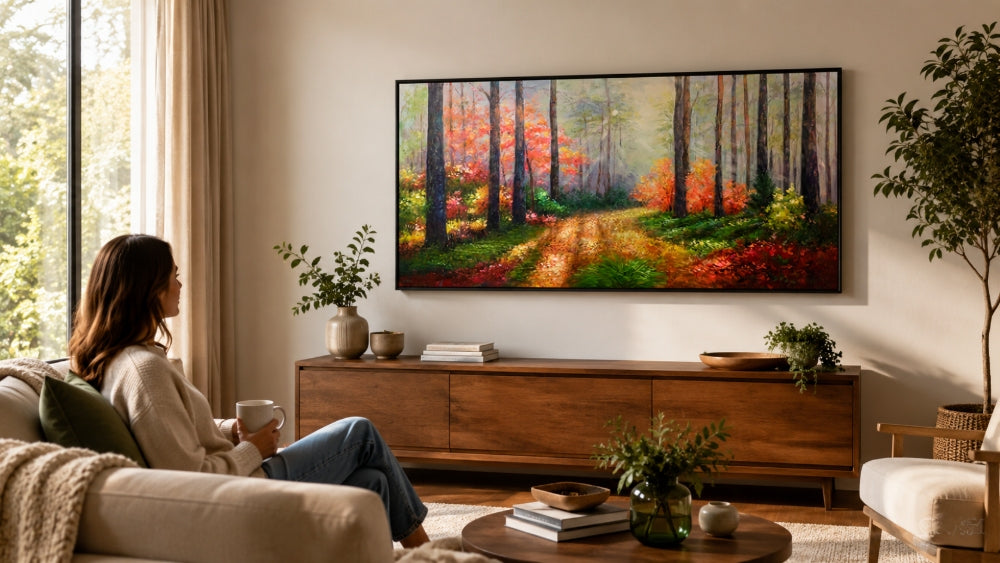
The 2/3 rule for wall art is a foundational design principle stating that a piece of art or a collection of frames should occupy approximately two-thirds (66%) to three-quarters (75%) of the width of the furniture piece it hangs over. Whether you are placing a large canvas above a sofa or a series of prints over a headboard, this ratio ensures the artwork acts as a visual anchor, creating a sense of balance and stability in the room. Without this proportion, art often appears either too small and "lost" on the wall or too large and overbearing for the furniture below.
Why the 2/3 Rule Matters
In interior design, visual weight is just as important as physical dimensions. When you walk into a living room, your eyes naturally look for a focal point. A piece of living room wall art that spans 60% to 75% of a sofa's width creates a cohesive unit. This rule prevents the common mistake of "postage stamp" decorating, where a small frame is stranded in a vast sea of empty drywall. By following this ratio, you ground the furniture, making the entire arrangement look intentional and professionally curated.
The Math Behind the 2/3 Rule: Calculating the Perfect Art Width
To achieve professional-grade balance, you need to move beyond guesswork and use a simple mathematical formula. The goal is to determine the "sweet spot" for your art width relative to the furniture sitting directly beneath it. This calculation applies to sofas, console tables, sideboards, and even fireplace mantels.
The 0.66 Multiplier Formula
The calculation is straightforward: Furniture Width x 0.66 = Ideal Art Width.
For example, if you have a standard 90-inch sofa, the calculation would be 90 x 0.66, which equals 59.4 inches. In this scenario, you should look for a single piece or a grouping that is approximately 60 inches wide. If you are choosing between two sizes of canvas wall art framed in different dimensions, it is almost always better to go slightly larger (up to 75% of the furniture width) rather than smaller.
Measuring Different Furniture Types
- Sofas and Loveseats: Measure from the outer edge of one arm to the outer edge of the other. For sectionals, measure the main section where the art will be centered.
- Console Tables: Measure the total width of the tabletop. Since console tables are often narrow, ensure the art is not so tall that it makes the arrangement feel top-heavy.
- Headboards: Measure the widest part of the headboard. For a King-sized bed, this is typically 76 to 80 inches, requiring art that is roughly 50 to 60 inches wide.
Sizing Checklist for Common Furniture
- [ ] Measure the Furniture: Use a steel tape measure to get the exact width of the item (not the wall).
- [ ] Calculate the Range: Multiply the width by 0.66 (for the minimum) and 0.75 (for the maximum).
- [ ] Account for Frames: When shopping, remember that the "art size" often excludes the frame. Always use the total framed dimensions for your calculation.
- [ ] Visualize with Tape: Use painter's tape to mark the calculated dimensions on the wall before purchasing to ensure the scale feels right in the actual light of the room.

Applying the 2/3 Sizing Rule to Gallery Walls and Collections
The 2/3 rule is not limited to single, oversized canvases. You can apply the same logic to an abstract gallery wall or a triptych (a set of three related pieces). The key is to treat the entire collection as one single visual unit.
Calculating the "Envelope"
When arranging multiple frames, the "total width" is the distance from the far-left edge of the first frame to the far-right edge of the last frame, including the gaps in between. To calculate this, add the widths of all frames and the sum of all spaces between them. If you have three 18-inch frames with 2-inch gaps between them, your total width is 58 inches (18 + 2 + 18 + 2 + 18). This would be a near-perfect fit for a 90-inch sofa.
Spacing for a Cohesive Anchor
To ensure the grouping looks like one cohesive unit rather than scattered individual pieces, keep your spacing tight. Professional designers generally recommend 2 to 3 inches between frames. If the gaps are too wide (e.g., 6 inches or more), the eye perceives them as separate items, and the "anchor" effect is lost. Consistently spaced frames create a rhythmic, structured look that enhances the room’s architecture.
Perfecting the Hanging Height: The 6-Inch Rule and Eye-Level Placement
Even a perfectly sized piece of art will look off-balance if it is hung too high or too low. A common error is hanging art based on the ceiling height rather than the furniture. To fix this, you must coordinate the relationship between the bottom of the frame and the top of the furniture.
The 3-to-6-Inch Gap
When hanging art above a sofa, headboard, or console, leave a gap of 3 to 6 inches between the bottom of the frame and the top of the furniture. This small space is enough to let the furniture "breathe" while remaining close enough to create a unified visual statement. If the art is hung 12 inches or more above the furniture, it will appear to be floating away, breaking the connection with the pieces below.
The Eye-Level Rule for Empty Walls
If you are hanging art on a wall with no furniture underneath, use the "eye-level" rule. In the gallery world, this is known as the 57-inch rule. You should aim for the center of the artwork to be 57 to 60 inches from the floor. This is the average human eye level and ensures that the art is comfortable to view.
When installing large pieces, structural safety is paramount. According to the Smithsonian Museum Conservation Institute, large panels or canvases should always be carried by two or more people to avoid structural strain or accidental drops. Furthermore, ensure you are using appropriate hanging hardware. The Canadian Conservation Institute notes that aged or inadequate hanging hardware is a leading cause of falling damage, which can result in canvas tears and frame failure.
Sizing Art for King Beds, Console Tables, and Narrow Hallway Walls
Different areas of the home present unique challenges for art placement. While the 2/3 rule is the standard, certain scenarios require specific adjustments to maintain the room's flow.
The King Size Headboard Challenge
A King-size bed is a massive piece of furniture, often dominating the bedroom. To satisfy the 2/3 rule, you need a substantial large abstract wall art piece or a wide grouping. A single 40-inch piece will look tiny above a 76-inch headboard. Instead, aim for a total width of 50 to 60 inches. Using a set of two or three large vertical frames is an excellent way to achieve this width without the expense of a single massive canvas.
Using the 2/3 Rule on Narrow Walls
In hallways or between windows, you may not have furniture to use as a reference point. In these cases, apply the 2/3 rule to the wall itself. Measure the width of the wall segment and choose art that covers roughly 60% of that width. For narrow, vertical wall sections, a single tall piece of art—often referred to as "portrait" orientation—works best. This draws the eye upward and makes the ceiling feel higher.

Comparing the 2/3 Rule vs. the 3/4 Rule: When to Scale Up
While the 2/3 rule is the "safe" professional standard, many contemporary designers are leaning toward the 3/4 rule. This involves sizing the art to be 75% of the furniture's width. Scaling up can create a more dramatic, high-end look often seen in luxury home magazines.
| Feature | 2/3 Rule (66%) | 3/4 Rule (75%) |
|---|---|---|
| Visual Effect | Balanced, classic, and stable. | Dramatic, modern, and bold. |
| Room Size | Works well in smaller or standard rooms. | Best for large rooms with high ceilings. |
| Art Type | Ideal for traditional landscapes and portraits. | Perfect for modern wall art and minimalist styles. |
When to Break the Rules
Design rules are guidelines, not laws. There are times when intentionally ignoring the 2/3 rule can yield stunning results:
- Maximalist Design: In maximalist spaces, you might cover the entire wall from corner to corner.
- Wabi-Sabi Aesthetics: Emphasizing imperfection with asymmetrical layouts.
- Small Rooms: One large piece can reduce visual clutter compared to several small ones.
Final Summary: Mastering the 2/3 Rule for Wall Art in Your Home
To summarize, the 2/3 rule is your best tool for ensuring your home decor feels balanced and professional. By measuring your furniture and multiplying the width by 0.66, you can confidently select art that anchors your room and creates a stunning focal point. Remember to keep your hanging height between 3 and 6 inches above furniture, and treat gallery wall groupings as a single unit to maintain visual weight.
Beyond aesthetics, always prioritize the physical environment of your art. The Canadian Conservation Institute suggests that environmental controls, such as avoiding direct sunlight and extreme humidity, are essential for protecting the longevity of your collection. By combining the math of the 2/3 rule with proper installation and care, you can transform any room into a beautifully balanced gallery. Understanding what is the 2 3 rule for wall art is the first step toward a more intentional and harmonious home design.
FAQs
Can wall art be wider than the sofa?
Generally, wall art should not be wider than the furniture beneath it. Art that exceeds the width of a sofa creates a top-heavy, unstable appearance that makes the room feel unbalanced.
How do I measure for art above a mantel?
Measure the total width of the mantel shelf. Apply the 2/3 rule to that width and maintain a 3-6 inch gap between the top of the mantel and the bottom of the frame.
What if my art is significantly smaller than the 2/3 recommendation?
If your art is too small, you can increase its visual footprint by using a larger mat and frame, or by flanking the piece with secondary decor like wall sconces or floating shelves.