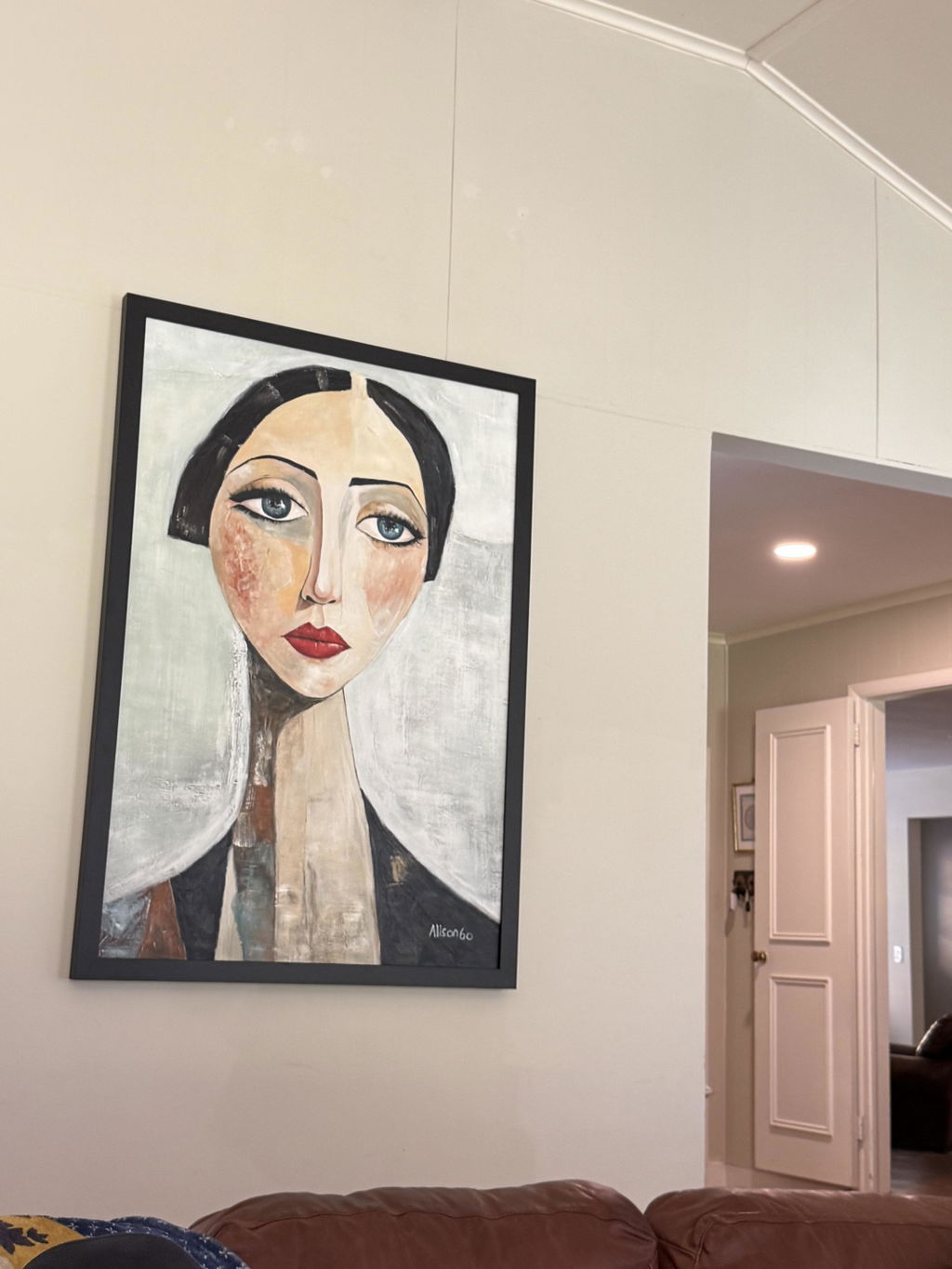
Evaluating Saturation: Why High-Grade Oils Never Look Chalky
In the shifting landscape of the global art market, a significant transition is underway. While high-end auction sales for purely financial art assets plummeted by 44% year-over-year in 2024, according to Marketplace, collectors are not abandoning art; they are redirecting their capital toward "real application value." For the modern homeowner and interior designer, this means moving away from overpriced vanity pieces and toward custom, hand-painted works that offer "performative authenticity."
However, a common frustration for those investing in custom oil paintings is the "chalky" appearance that can plague lower-grade works. To the untrained eye, it’s a feeling that the art looks "thin," "dusty," or "flat." To the expert, it is a measurable failure of material science. Understanding why high-grade oils maintain a deep, luminous "glow" while others look like dried plaster is essential for ensuring your investment remains a "camera-ready" asset.
The Physics of the "Glow" vs. The "Chalk"
The primary culprit behind a chalky appearance is an over-reliance on Titanium White ($TiO_2$) or inexpensive fillers like calcium carbonate. While Titanium White is the industry standard—accounting for 90% of the global white pigment market due to its extreme hiding power (NCBI)—it is also highly refractive.
When light hits a paint layer filled with cheap extenders or excessive Titanium White, the particles scatter the light in every direction rather than allowing it to penetrate the pigment layers. This creates a visual "haze" that desaturates colors, particularly in the shadows. High-grade oils, conversely, utilize a higher pigment-to-binder ratio and often substitute Zinc White or "Mixing White" for transitions. Zinc White is more transparent, allowing for the subtle "subsurface scattering" that gives oil paintings their characteristic depth.
Logic Summary: The Refractive Index Heuristic Our analysis of "chalkiness" assumes that visual quality is directly proportional to the refractive index balance between the pigment and the binder.
- High-Grade Approach: Uses pigments with refractive indices that allow light to travel through the film before reflecting back.
- Budget Approach: Uses high-opacity fillers that stop light at the surface, creating a "flat" or "chalky" effect.

The "Sinking In" Phenomenon: Binder Quality Matters
Even if the pigments are high-quality, the choice of oil binder—the liquid that holds the pigment—can dictate the final aesthetic. A common failure in mass-produced decorative pieces is the "sinking in" effect. This occurs when the oil binder is absorbed into an improperly primed canvas, leaving the pigment "high and dry" on the surface. The result is a matte, dead finish that lacks the "organic glow" expected of fine art.
High-quality oils typically use refined linseed or walnut oils. Linseed oil, with its high iodine value (~170), is preferred for its ability to form a durable, flexible film through oxidative cross-linking (ChemicalBook). This process ensures that the pigment remains encapsulated in a glossy matrix. Furthermore, advanced technical bulletins from Golden Artist Colors warn against "Support Induced Discoloration" (SID), where water-soluble impurities from the canvas are drawn into the paint layer, causing yellowing—a risk mitigated by the superior priming found in professional-grade custom works.
| Parameter | High-Grade Oil | Budget/Decorative Paint | Rationale |
|---|---|---|---|
| Pigment Load | 60–75% | 20–40% | Higher load ensures color "glow" |
| Primary White | Zinc/Mixing White | Titanium White/Calcium Carbonate | Transparency vs. Opacity |
| Binder Type | Refined Linseed/Walnut | Synthetic/Unrefined Oils | Durability and "Sinking" prevention |
| Texture (Impasto) | High-Viscosity | Thinned/Filler-heavy | Maintains "3D" relief |
| VOC Profile | Low/Zero VOC compliant | Variable/High | Indoor Air Quality (IAQ) safety |
Performance Authenticity: Human-Made vs. AI
As AI-generated prints flood the market, the value of "100% human hand-painted" art has reached a commercial premium. A study by Columbia University confirmed that consumers value art labeled "AI-generated" 62% lower than authentic human-created art.
This psychological preference is rooted in what researchers at the University of Chicago call "essential identity." Digital replicas lack the physical "soul" of the artist's hand—the micro-physical textures and mm-scale relief that optical microprofilometry proves are crucial to aesthetics (MDPI). When you view a hand-painted mural or canvas, your brain’s medial prefrontal cortex (mPFC) and amygdala activate, optimizing emotional regulation circuits (NCBI). A flat print simply cannot replicate this neurological engagement.

The Economic Catalyst: Art and Property Value
Investing in high-grade, hand-painted art is not merely an aesthetic choice; it is a strategic financial move. Research from the Royal Society found a direct correlation between "art" geo-tags and property price gains. In commercial sectors, the impact is even more pronounced. The NCREALTORS reported that public art projects in Chicago’s Millennium Park drove $1.4 billion in real estate growth.
For the homeowner, a custom mural or large-scale oil painting serves as a "permanent physical billboard" that elevates the home’s status. For commercial developers, commissioning murals is a "lowest-cost physical foot traffic generator" (University of Cincinnati).
Health and Safety: The Non-Toxic Guarantee
A critical, often overlooked aspect of high-grade art is the safety of the pigments used. Lower-end paints may contain heavy metals that pose significant health risks. The International Agency for Research on Cancer (IARC) classifies cadmium compounds as Group 1 carcinogens. Chronic inhalation of low-level volatile compounds in certain paints can lead to central nervous system neuropathy (CDC NIOSH).
Professional mural services and high-end art brands prioritize Indoor Air Quality (IAQ). By utilizing low-VOC paints and eco-friendly alternatives—such as walnut oil, which replaces toxic solvents like turpentine—artists can achieve LEED or WELL certification points for commercial buildings. This makes hand-painted art a viable "public health infrastructure" rather than just décor, a sentiment echoed by the World Health Organization (WHO).
2026 Design Trends: Texture as the Soul
Looking toward 2026, the interior design world is moving away from "assembly-line" minimalism and toward "whimsical artisan craftsmanship." Zillow search data shows a 21% rise in mentions of "artisan craftsmanship." A dominant trend highlighted at KBIS 2025 is the "panoramic mural," where hand-painted art wraps entirely around a room (like a powder room) to create immersive escapism.
This "biophilic design"—incorporating natural landscapes—is proven to reduce stress and cognitive fatigue by 30% in high-density environments (University of Hawaii). For the modern consumer, the ultimate luxury is the fusion of avant-garde contemporary design with authentic handcrafting techniques (European Crafts Alliance).
Choosing the Right Investment
When evaluating a potential art purchase, look for the "depth of field" in the shadows. In low-grade art, shadows look flat and greyish (desaturated). In high-saturation oils, the shadows maintain a transparent depth. This is the hallmark of a painter who understands Color Stability and the technical nuances of Blending Mastery.
By selecting works that prioritize pigment purity and binder quality, you are not just buying a decoration; you are investing in a cultural heritage asset that supports the creative economy—an industry that added $1.2 trillion to the U.S. GDP in 2023 (NEA).
Modeling Note: Reproducible Quality Check To verify the "non-chalky" status of a piece, we recommend the 60-Degree Gloss Test:
- View the painting from a 60-degree angle under natural light.
- Observe the transition from light to shadow.
- Pass: The shadow area maintains a "wet" look or deep transparency.
- Fail: The shadow looks "foggy," "dusty," or light-grey despite the pigment being dark. This heuristic is based on common patterns observed in museum-grade conservation audits.

References
- Marketplace: The expensive art market continues to struggle
- WHO Scoping Review on Arts and Health
- Royal Society: Quantifying the link between art and property prices
- Columbia Business School: Human-Made vs. AI Art Study
- NCBI: Neurological mechanisms of creative arts
- IARC: Cadmium and Cadmium Compounds
- EPA: Indoor Air Quality and Low-VOC Paints
Disclaimer: This article is for informational purposes only and does not constitute professional health, legal, or financial advice. Always consult with a qualified professional regarding indoor air quality standards or investment strategies.