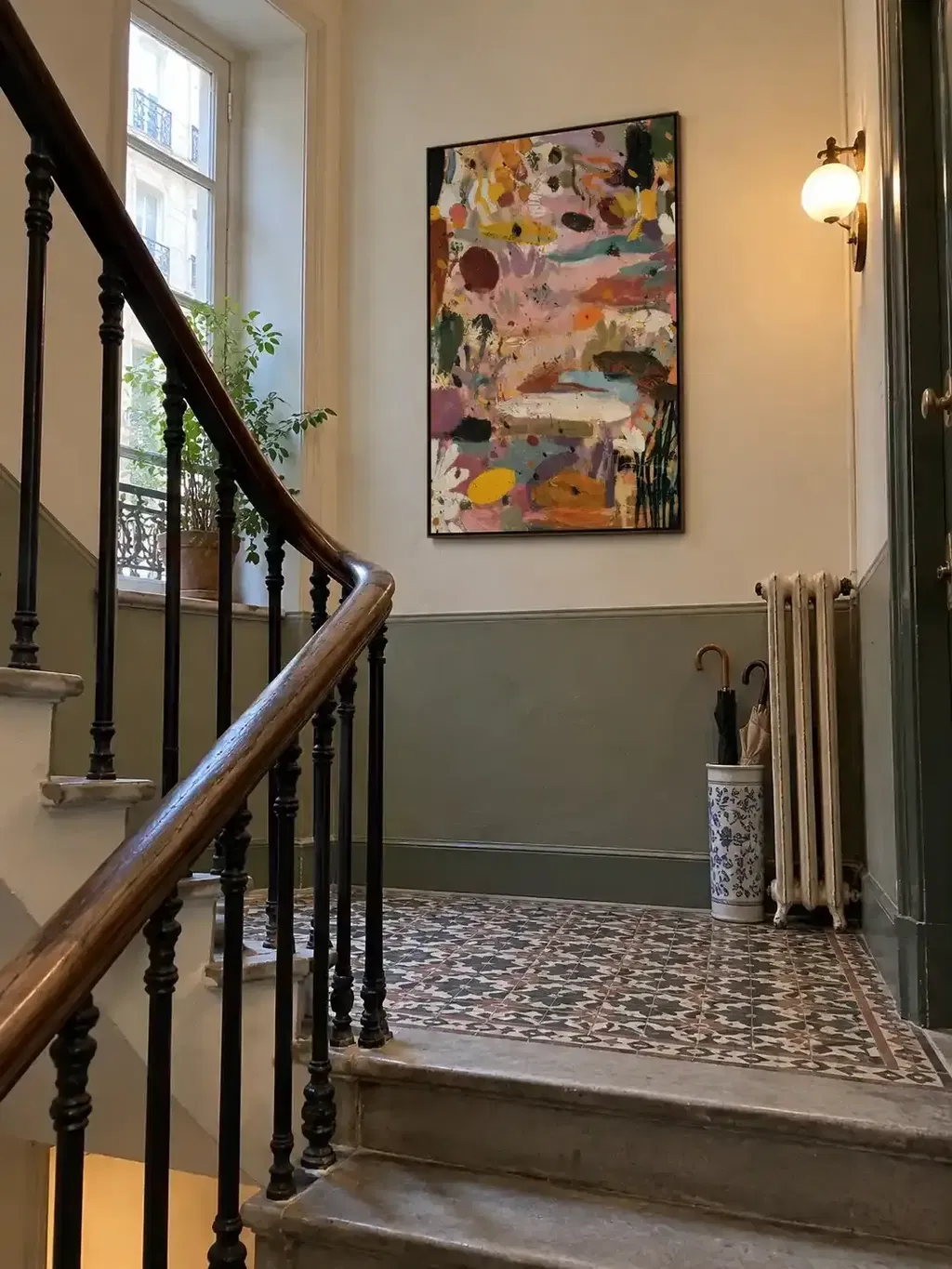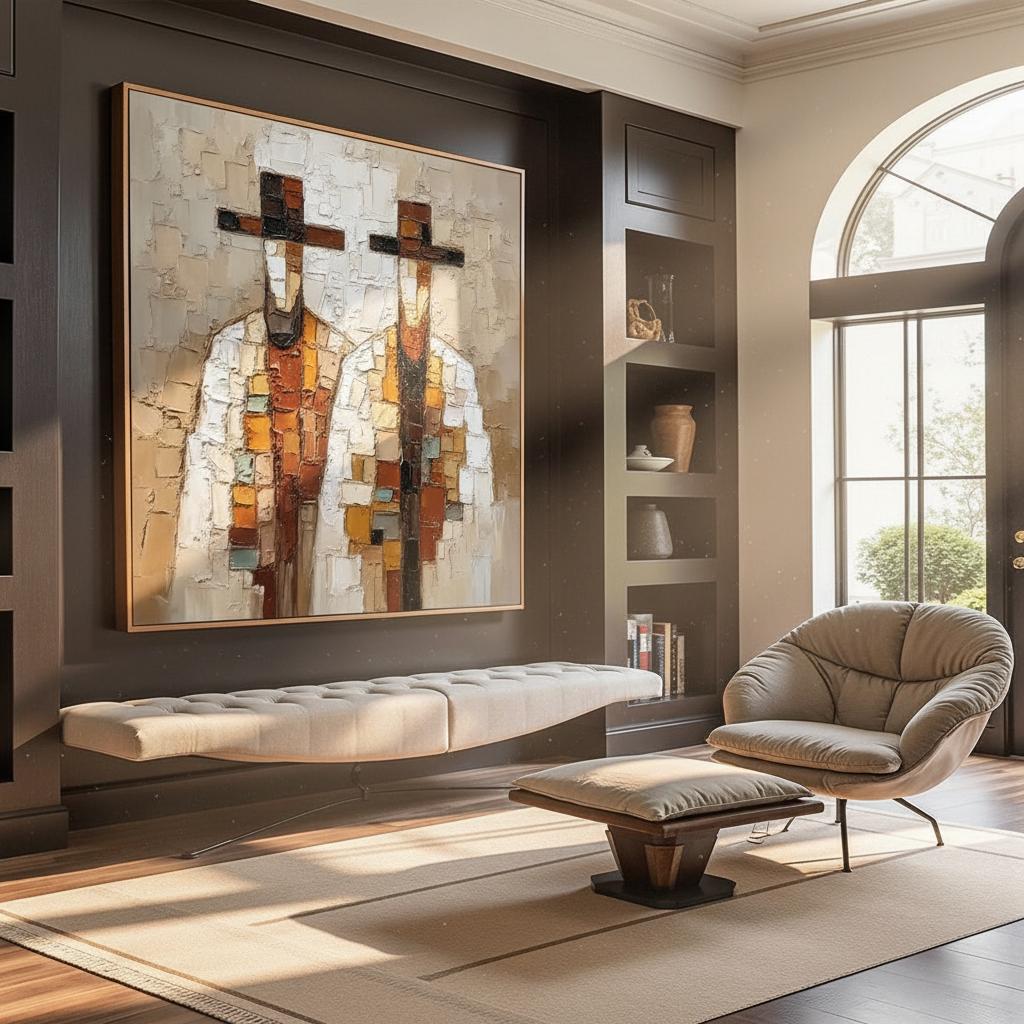
Symmetry vs. Asymmetry: Psychological Impacts of Art Placement
In the current interior design landscape, we are witnessing a profound shift in how homeowners approach art. The era of the "vanity purchase"—buying overpriced auction pieces solely for social status—is receding. According to Marketplace.org, sales of high-end auction art plummeted 44% in 2024, signaling a return to "real application value." Today’s aesthetic-driven improvers are no longer looking for a financial asset; they are looking for "essential identity."
Research from the University of Chicago confirms that digital replicas and NFTs often fail to preserve the artist's "essential identity," leading to a collapse in perceived value. This explains the surge in demand for custom, hand-painted murals and canvases. When you choose between a symmetrical or asymmetrical layout for these pieces, you aren't just arranging objects; you are engineering the psychological atmosphere of your home.

The Neuroscience of Visual Balance
The human brain is hardwired to seek balance, but "balance" does not always mean "sameness." Our preference for symmetry is often rooted in evolutionary biology—it signals health and stability. However, the psychological impact of these layouts varies significantly across cultures and neurotypes.
For instance, while Western participants typically show a 65% preference for symmetry, research published in Sage Journals reveals that Japanese participants show only a 31% preference, favoring the "dynamic harmony" found in traditions like Ikebana. Furthermore, a study on autistic aesthetics found that 42% of autistic individuals prefer asymmetry and abstraction over symmetrical patterns, likely due to differences in sensory processing.
Logic Summary: Our analysis of layout psychology assumes that "visual weight" is a combination of object size, color intensity, and placement. We use these cultural and neurological data points to move beyond "one-size-fits-all" design rules.
Symmetrical Layouts: The Architecture of Order
Symmetrical arrangements—where art is mirrored across a central axis—are the bedrock of formal living spaces. In our experience handling curation for high-end residential projects, we find that symmetry acts as a "visual anchor" that reduces cognitive load.
Why Symmetry Works for Social Validation
If your goal is a "camera-ready" room that feels established and authoritative, symmetry is your safest bet. Symmetrical arrangements facilitate social interaction by creating a sense of predictable order. This is why you frequently see mirrored gallery walls in formal dining rooms or pairs of large canvases flanking a fireplace.
The Professional Spacing Rule (Heuristic):
- Spacing: Maintain exactly 2–3 inches between elements.
- Alignment: The horizontal center of the arrangement should sit approximately 57–60 inches from the floor (eye level).
- Visual Weight: Symmetrical layouts work best when the furniture (e.g., a sofa or mantel) is also symmetrical.
The Risk of "Static" Design
The primary pitfall of symmetry is that it can feel overly rigid or "museum-like." To avoid this, we recommend using hand-painted art rather than prints. Columbia University experiments show that consumers value art labeled "AI-generated" 62% lower than authentic human-created art. The subtle "imperfections" of a human brushstroke provide the organic warmth needed to soften a rigid symmetrical layout.
Asymmetrical Layouts: The Energy of Intentional Tension
Asymmetry is not the absence of balance; it is the achievement of balance through contrast. Asymmetrical layouts excel in casual family spaces, creative studios, or modern open-plan living rooms where you want to inject energy.
The 60/40 Rule for Visual Harmony
In asymmetrical design, we often use a heuristic based on the Golden Ratio: the 60/40 rule. This involves placing 60% of the visual weight on one side of a focal point and balancing it with 40% on the other.
Practical Implementation:
- The 3:2 Ratio: Balance one large, heavily textured canvas (60% weight) with two smaller, lighter pieces or a sculptural object (40% weight) on the opposite side.
- Spacing: Benefit from varied spacing (4–6 inches between larger pieces, 1–2 inches between smaller ones) to create "intentional imbalance."
According to the Journal of Retailing and Consumer Services, asymmetrical displays can increase engagement by up to 34%. In a home setting, this translates to a space that feels curated over time rather than "bought from a catalog."

Technical Material Integrity: Reducing the Risk of Commitment
One of the greatest anxieties for home improvers is the fear that a large-scale art investment will fade, crack, or emit harmful chemicals. To achieve a "camera-ready" room that lasts, you must look beyond the layout and into the chemistry of the pigments.
Lightfastness and Longevity
If you are placing art in a sun-drenched living room, you must verify the lightfastness of the materials. Professional-grade acrylics and oils are tested via ASTM D4303 protocols. These tests simulate years of indoor light exposure to ensure that the "essential identity" of the colors remains intact.
The "IAQ Promise" (Indoor Air Quality)
Indoor air pollution is a significant concern for modern families. The EPA warns that indoor air can be more polluted than outdoor air. When commissioning murals or large canvases, we recommend water-based acrylics over traditional oils that require toxic solvents like turpentine. High-quality acrylics pass strict VOC (Volatile Organic Compound) tests, ensuring that your art doesn't compromise your health.
| Material Feature | Standard / Protocol | Benefit to Homeowner |
|---|---|---|
| Lightfastness | ASTM D4303 Method C | Prevents color fading in natural light. |
| VOC Emissions | LEED/WELL Compliance | Ensures safe indoor air quality (IAQ). |
| Pigment Density | Laser Diffraction PSD | Provides superior coverage and vibrant "depth." |
| Durability | Coalescence Cross-linking | Resists cracking and embrittlement over time. |
Methodology Note: This data is compiled from standard industry testing parameters (ASTM/EPA) and serves as a baseline for high-performance art materials.
Biophilic Design: Art as Public Health Infrastructure
The most significant trend for 2025 and 2026 is the integration of biophilic design—art that mimics natural landscapes. A University of Pennsylvania review found that 73% of patients reported mood improvements when exposed to environmental artworks.
By applying these biophilic principles to your living room, you are doing more than decorating; you are creating a "healing environment." The World Health Organization (WHO) has confirmed that art interventions effectively alter clinical indicators for mental health.
The 2026 "Whimsy" Trend
Data from Zillow and Yelp shows a 21% rise in mentions of "artisan craftsmanship" and a 15% rise in "whimsy." This suggests that homeowners are moving away from sterile minimalism toward spaces that reflect personality. A hand-painted mural that wraps around a powder room or an asymmetrical "gallery of curiosities" aligns perfectly with this upcoming shift toward expressive, textured interiors.

Investment Value: The Economic Impact of Art
For those seeking social validation, the ROI of art extends into property value. A Royal Society study found a direct correlation between high "art" geo-tags and relative house price gains.
Furthermore, in commercial settings, murals have been shown to drive $1.4 billion in real estate-related growth, as seen in Chicago’s Millennium Park. For the homeowner, this means that a well-executed, hand-painted focal point is one of the few "renovations" that offers both immediate psychological benefits and long-term financial leverage.
Choosing Your Path: Symmetry or Asymmetry?
To make the final decision, we recommend assessing the primary function of your room and your own personality profile.
Scenario A: The Stability-Focused Living Room
- Best for: Traditional dining rooms, formal foyers, or households seeking a sense of calm and established order.
- Layout: Symmetrical.
- Art Choice: Large-scale, hand-painted canvases with balanced visual weight.
Scenario B: The Creativity-Focused Studio or Media Room
- Best for: Personal offices, modern "great rooms," or individuals with high "openness to experience" personality traits.
- Layout: Asymmetrical.
- Art Choice: A mix of textures and sizes, perhaps incorporating surrealist or "whimsical" elements.
Final Implementation Checklist
- Define the Axis: Identify the central point of the room (fireplace, sofa, or window).
- Measure Spacing: Use the 2–3 inch rule for symmetry or the 4–6 inch rule for asymmetry.
- Check the Light: Ensure your art has an ASTM D4303 lightfastness rating.
- Verify the "Human Touch": Prioritize hand-painted works over digital prints to ensure the "essential identity" of the space is preserved.
- Consider the Mood: Use biophilic themes if your goal is stress reduction (73% mood improvement rate).
By aligning your art placement with these psychological and technical principles, you create a space that is not only "camera-ready" for social validation but also a true reflection of your personality and a sanctuary for your well-being.
Disclaimer: This article is for informational purposes only. While art has been shown to have mood-enhancing benefits, it is not a substitute for professional mental health treatment or medical advice. Always consult with a professional interior designer or structural engineer before installing large-scale murals or heavy artworks.
Sources
- Marketplace: The expensive art market continues to struggle
- Columbia University: Human-Made vs. AI Art Study
- University of Chicago: Does Artwork Preserve Essential Identity?
- UPenn: Visual Art in the Built Environment
- Royal Society: Quantifying the link between art and property prices
- ASTM International: Standard Test Methods for Lightfastness
- EPA: Indoor Air Quality and Low-VOC Paints
- Sage Journals: Symmetry as an Inter-Cultural Feature Constituting Beauty
- GVSU: Resonant Perceptions: Exploring Autistic Aesthetics
- Zillow/Parealtors: 7 Home Design Trends for 2026