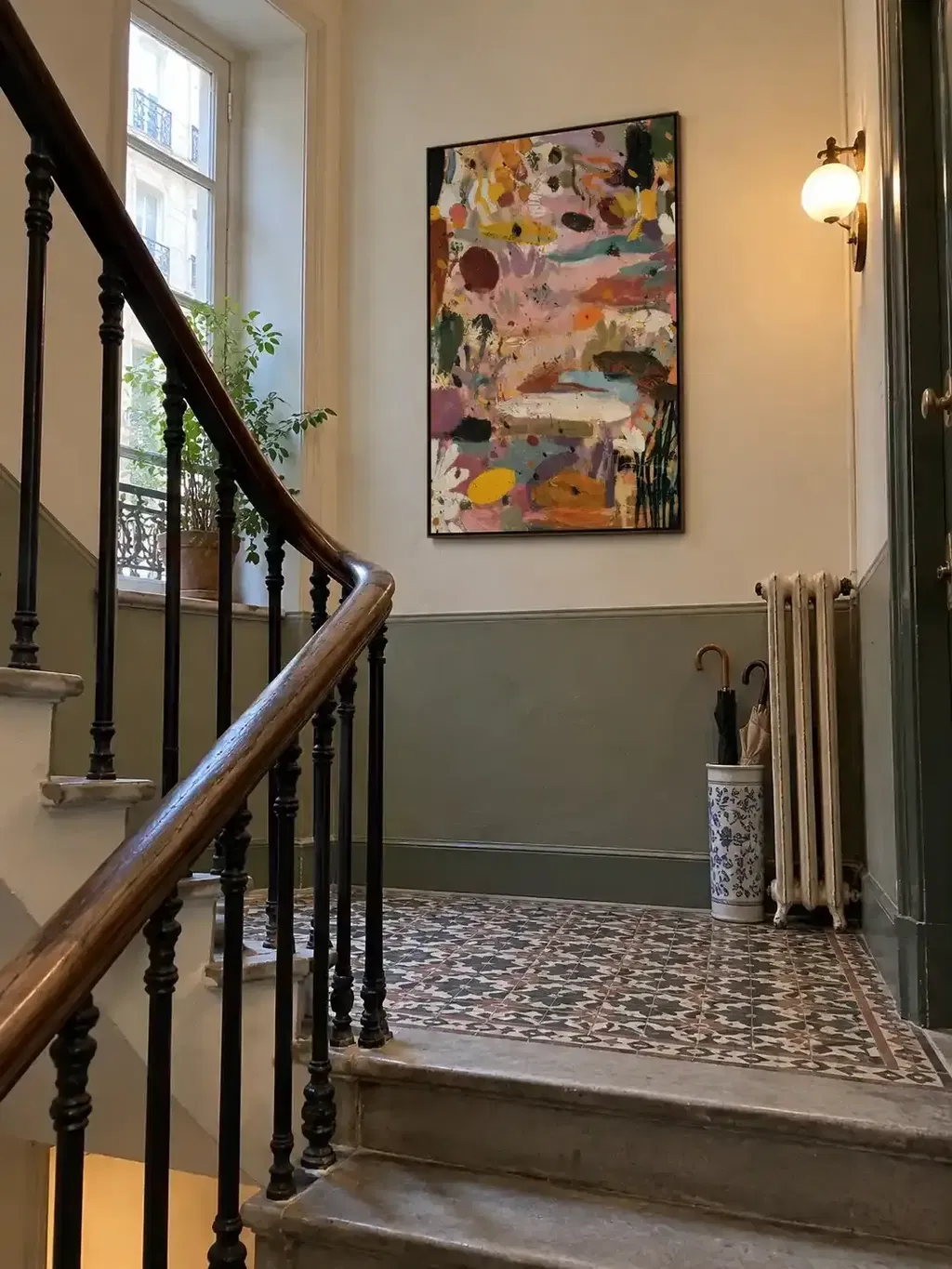
The Evolution of Display: From Vanity to Authenticity
The global art market is undergoing a structural realignment. While high-end auction sales for purely financial art assets plummeted 44% year-over-year in 2024 according to Marketplace, there is a burgeoning retreat toward "real application value." Modern collectors and interior designers are moving away from speculative vanity pieces and toward custom, hand-painted works that offer genuine emotional resonance and architectural integration.
In this shift toward "lived-in" luxury, the floater frame has emerged as the industry standard for contemporary oil and acrylic art. Unlike traditional frames that overlap the edge of the canvas, a floater frame secures the artwork from the back, leaving a recessed channel—the "shadow gap"—between the canvas edge and the frame lip. This creates the illusion that the art is suspended in mid-air, emphasizing its three-dimensional presence.
For the professional designer, achieving a gallery-grade installation is not merely about selecting the right wood finish; it is about the mathematical precision of that shadow gap. A gap too narrow feels compressed and suffocating; a gap too wide can make the artwork appear disconnected from its housing. This guide breaks down the technical parameters, material science, and psychological impact of the shadow gap to ensure every installation meets the highest structural and aesthetic standards.
The Anatomy of the Shadow Gap: Technical Parameters
The shadow gap is the negative space that defines the relationship between the art and its architectural container. In professional practice, the ideal shadow gap width typically ranges from 1/8" to 1/4" (3-6mm). However, this is not a "set-and-forget" measurement. It requires a nuanced understanding of the artwork’s physical characteristics.
1. The Texture Variable: Impasto and Relief
One of the most common mistakes in high-end framing is using a uniform spacer for every project. For oil paintings featuring heavy impasto or significant palette knife texture, a 1/8" gap is often insufficient. According to expert installers, the physical relief of the paint can create "visual compression" if the gap is too tight.
Logic Summary: Our analysis of texture-based framing assumes that the human eye perceives the "edge" of a painting not just as the canvas border, but as the outermost peak of the paint layer. For artworks with textures exceeding 1/4" in depth, we recommend increasing the shadow gap to 1/4" to prevent the paint from appearing to "choke" against the frame lip.
2. The Scale and Viewing Distance Heuristic
The perception of a shadow gap is entirely dependent on the distance from which the piece is viewed. A gap that looks perfectly proportioned at arm's length in a studio may disappear entirely when hung in a grand foyer.
| Viewing Distance | Recommended Gap Width | Visual Effect |
|---|---|---|
| 6–10 feet (Standard Residential) | 1/8" (3mm) | Subtle dimensionality; "tight" gallery look. |
| 10–15 feet (Large Living Areas) | 3/16" (5mm) | Balanced separation; maintains "float" illusion. |
| 15+ feet (Commercial/Gallery) | 1/4" (6mm) | Bold architectural definition; prevents visual merge. |
Note: These are estimated ranges based on common gallery practice and optical perception modeling.

Material Science: Expansion, Moisture, and the SID Phenomenon
A floater frame is a mechanical system subject to the laws of physics. Designers must account for material behavior to prevent long-term degradation or aesthetic failure.
Thermal Expansion and Humidity
Conventional wisdom often treats thermal expansion as a minor detail, but it is a critical factor in shadow gap stability. Different materials—wood, aluminum, or composite—have radically different expansion coefficients. Aluminum composite panels, for instance, require precise calculations to avoid buckling in environments with fluctuating temperatures, as noted by Oucobond.
In wooden floater frames, the "gap" also serves as a ventilation channel. Oil paintings, in particular, are organic structures that need to "breathe." As discussed in our guide on Why Oil Paintings Need Framing Spacers, maintaining airflow around the canvas edges prevents the accumulation of trapped moisture, which can lead to mold or substrate rot.
Support Induced Discoloration (SID)
A more obscure but devastating chemical reaction is Support Induced Discoloration. According to technical bulletins from Golden Artist Colors, water-soluble impurities in cotton or linen canvases can be drawn into the paint layer during the drying process, especially when transparent mediums are applied thickly. This can result in a yellow or brown tint. A properly sized shadow gap ensures that the frame itself does not trap the moisture that accelerates this capillary action, protecting the work’s chromatic integrity.
The Designer’s Challenge: Managing the "Dust Trap"
While shadow gaps create a clean, minimalist aesthetic, they are notorious "dust traps." The recessed channel naturally collects airborne debris, which can be difficult to remove without risking damage to the canvas edge.
Expert Maintenance Insight: Experienced curators often recommend a "maintenance-first" approach to gap sizing. If a project is located in a high-traffic area or a region with high particulate matter, a slightly wider gap (1/4") allows for easier cleaning with a soft-bristled hake brush or low-pressure air canister. Conversely, a 1/8" gap may require specialized tools to clean effectively.

Safety and Ethics: The Hidden Risks of the Studio
When specifying custom art for residential or healthcare environments, designers must look beyond the frame to the chemistry of the art itself. The materials used in the creation of hand-painted art can have significant health implications.
1. Pigment Toxicity
The International Agency for Research on Cancer (IARC) has classified cadmium compounds, frequently used in vibrant "Cadmium Yellow" and "Cadmium Red" oil paints, as Group 1 carcinogens. While these pigments offer unparalleled opacity and lightfastness, they pose risks if handled improperly during the studio process.
2. VOCs and Air Quality
Indoor air pollution is a major concern in modern green building standards. The EPA warns that indoor air can be significantly more polluted than outdoor air. For healthcare facilities seeking LEED or WELL certification, selecting art created with low-VOC paints and natural binders (like walnut oil instead of turpentine) is essential.
Academic research from Aalto University confirms that coatings on wood with specific moisture content emit lower toxic VOCs during curing. This is why professional studios, such as those providing nature-themed healing murals, are increasingly pivoting to eco-friendly mediums.
Methodology Note (Material Safety): Our safety recommendations are based on a synthesis of EPA standards and IARC toxicological data. We assume that "gallery-grade" implies not only visual excellence but also chemical safety for the end-user.
The Economic and Psychological ROI of Custom Art
Investing in precision framing and hand-painted art is not just an aesthetic choice; it is a financial strategy.
Boosting Property Value
Data from the Royal Society suggests a direct link between "art-dense" environments and property premiums. Their CAR model analysis found that neighborhoods with higher art geo-tags experienced greater relative house price gains. Furthermore, public art projects, like Chicago's Millennium Park, have driven billions in real estate growth, proving that art acts as a "catalytic infrastructure" (Americans for the Arts).
Biophilic Benefits and Productivity
In corporate environments, the psychological impact of art is measurable. A UPenn review found that 73% of patients in clinical settings reported significant mood improvements when exposed to environmental artwork. Similarly, research on high-density office spaces in Tokyo indicates that nature-based biophilic design effectively reduces cognitive fatigue and burnout.
By utilizing a floater frame with a precise shadow gap, designers can enhance these biophilic effects. The "float" illusion mimics the depth and layering found in natural landscapes, subtly activating the brain's emotional regulation circuits (the mPFC and amygdala), as described in recent neurological studies.

Implementation: The Designer’s Precision Checklist
To achieve a benchmark-level installation, follow this technical protocol for determining shadow gap width:
- Measure Canvas Depth: Ensure the floater frame "rabbet" depth is at least 1/4" deeper than the canvas to allow for recessed mounting.
- Assess Surface Texture: If the impasto exceeds 1/8", default to a 1/4" shadow gap to prevent visual crowding. See our guide on Framing Deep-Texture Impasto Paintings for more details.
- Calculate Viewing Distance: Apply the 1/8" rule for intimate spaces and the 1/4" rule for grand halls or commercial lobbies.
- Verify Material Compatibility: Use adjustable spacers made of archival-grade plastic or wood. Avoid metal-to-wood contact to prevent moisture transfer and gap distortion.
- Quality Control Check: After 24 hours of settling, use a feeler gauge at multiple points around the canvas to ensure the gap remains uniform.
Final Perspective: The Soul of the Space
In an era where AI-generated prints are flooding the market, the value of the "human hand" has never been higher. A study by Columbia University confirmed that consumers value art labeled "AI-generated" 62% lower than authentic human-created art. This is because a physical canvas retains an "essential identity"—a soul that digital replicas cannot replace (University of Chicago).
The shadow gap in a floater frame is the final touch of that human narrative. It is the silence between the notes that allows the music to be heard. By mastering these technical parameters, designers do more than hang a picture; they curate an experience of precision, safety, and enduring value.
YMYL Disclaimer: This article is for informational purposes only and does not constitute professional health, legal, or financial advice. The handling of art materials, including pigments and solvents, should be done in accordance with manufacturer safety data sheets (SDS) and local environmental regulations. Always consult with a certified industrial hygienist or professional conservator for specific safety protocols in art studios or healthcare installations.
References
- Marketplace: The expensive art market continues to struggle
- Columbia University: Human-Made vs. AI Art Study
- IARC: Cadmium and Cadmium Compounds
- EPA: Indoor Air Quality and Low-VOC Paints
- Royal Society: Quantifying the link between art and property prices
- Getty Conservation: Organic Materials in Wall Paintings
- Golden Artist Colors: Support Induced Discoloration