The Evolution of the Art Investment: Beyond the Auction Block
The landscape of high-end art acquisition is undergoing a fundamental structural shift. Recent data indicates that sales of "vanity assets"—pieces exceeding $10 million at major auctions—plummeted by 44% year-over-year in 2024 (Marketplace). This retreat from purely financial speculation suggests that collectors and interior designers are returning to the "real application value" of art. There is a growing preference for works that possess what researchers at the University of Chicago call "essential identity"—an irreplicable soul found in human-created, physical canvases that digital replicas and AI-generated prints simply cannot mimic (University of Chicago).
For the modern art buyer, a purchase is rarely a temporary decoration; it is a multi-generational investment. However, the longevity of that investment depends entirely on archival care. One of the most critical, yet frequently misunderstood, components of this care is the use of framing spacers. Often referred to as "breathing room," spacers are the silent guardians of an oil painting’s physical integrity.
Why Surface Separation is Non-Negotiable
The primary purpose of a framing spacer is to create a physical gap between the surface of the artwork and the protective glazing (glass or acrylic). While it might seem intuitive to press a painting firmly against the glass for a "clean" look, this is a recipe for catastrophic degradation.
The Micro-Climate Conflict
Inside a frame, a miniature ecosystem exists. When temperature and humidity fluctuate, the air trapped inside the frame reacts. According to the Canadian Conservation Institute, without a spacer, moisture can become trapped between the paint film and the glass. This leads to several critical failures:
- Condensation and Mold: If the glass cools faster than the air inside, water droplets form on the inner surface. If the paint is in direct contact, this moisture is absorbed directly into the binder, sparking fungal growth and mold.
- Adhesion (Blocking): Over time, the organic binders in oil paint—even when seemingly dry—can undergo chemical softening. If pressed against glass, the paint can "bond" to the glazing. Attempting to remove the glass later often results in the paint film tearing away from the canvas.
- Surfactant Migration: In modern mixed-media or acrylic-heavy works, PEG-type surfactants can migrate to the surface when humidity rises, forming water-soluble microcrystals that cause a "hazy" appearance (Tate). A spacer ensures these chemical transitions don't result in a permanent bond with the glass.
Logic Summary: Our preservation model assumes that the frame acts as a semi-sealed buffer. We prioritize airflow over absolute sealing to prevent localized "humidity pockets" that accelerate organic decay.

The 1/2-Inch Rule: Sizing Spacers for Scale
In our experience assisting collectors with large-scale installations, the most common mistake is underestimating the required spacer depth. While a standard 1/8-inch or 1/4-inch gap might suffice for a small sketch, it is often insufficient for substantial canvases.
For paintings exceeding 24 inches in any direction, we recommend a minimum of 1/2-inch spacing.
Why the Extra Depth?
Larger canvases act like sails; they move and "breathe" in response to atmospheric pressure and humidity. A shallow spacer provides no margin of safety if the canvas bows forward. Furthermore, the Royal Society has noted that high-quality art infrastructure (including proper framing) directly correlates with the perceived value of a property. Cutting corners on spacer depth not only risks the art but also the "premium" aesthetic that drives real estate valuation.
| Parameter | Recommended Value | Unit | Rationale |
|---|---|---|---|
| Minimum Gap (Small Works) | 1/4 | Inch | Prevents glass-to-paint contact |
| Minimum Gap (Works >24") | 1/2 | Inch | Accommodates canvas "sailing" and air circulation |
| Spacer Placement | Continuous | Perimeter | Prevents localized condensation points |
| Adhesive Type | Archival Strips | N/A | Prevents chemical off-gassing and adhesive failure |
| Ventilation Gap | 1/16 | Inch (Bottom) | Allows minimal air exchange without dust entry |
Note: These ranges are heuristics based on common conservation patterns and the Canadian Conservation Institute guidelines.
Material Science: Oil vs. Acrylic Longevity
Understanding the chemistry of your medium is essential for choosing the right framing strategy. Research shows that oil and acrylic paints react very differently to their environment.
The Embrittlement Factor
Oil paintings undergo oxidative cross-linking, a process that continues for decades. This makes the paint film increasingly brittle over time. Conversely, acrylics remain relatively soft but are highly susceptible to moisture. Accelerated aging data reveals that under 83% humidity, acrylic pigments can swell by over 7% in mass, while oil films are more prone to binder separation under extreme heat (ResearchGate).
Spacers provide a buffer for these physical shifts. Without them, the mechanical stress of the paint expanding against a rigid glass surface can cause micro-cracking (craquelure).
The "Breathing Room" Paradox
A critical insight from the Canadian Conservation Institute is that spacers cannot prevent the natural shrinkage of canvas fibers at relative humidity levels above 75%. This is a fundamental physical response. However, the spacer's role is not to stop the canvas from moving, but to ensure that when it does move, it doesn't collide with the glazing.
The Health and Safety of the Studio Environment
Preservation isn't just about the art; it’s about the environment it lives in. We advocate for the use of low-VOC paints and non-toxic pigments to ensure both the longevity of the work and the safety of the home.
The EPA warns that indoor air pollution can be more significant than outdoor pollution, and choosing materials that meet LEED or WELL certification standards is a prerequisite for high-end healthcare and commercial developments (EPA). For residential collectors, this means ensuring your framer uses archival-grade, acid-free spacers that won't off-gas harmful chemicals into your living space.
Avoiding the "Toxic Palette"
Historically, pigments like lead white and cadmium were standard. Today, we know that chronic inhalation of even low-level volatile compounds in certain paints can lead to central nervous system issues (CDC NIOSH). Modern, hand-painted works prioritize titanium dioxide—which now captures 90% of the white pigment market due to its safety and superior hiding power (NCBI)—to ensure the artwork remains a healthy addition to your home.

Expert Checklist: Evaluating Your Framer’s Work
When you commission a frame for a high-value piece, you are hiring a conservator as much as a craftsman. Use this checklist to ensure your investment is protected:
- Continuous Perimeter: Is the spacer a solid line around the entire frame? Any break can create a "cold bridge" where condensation will aggregate.
- Archival Adhesives: Did the framer use standard double-sided tape or archival-quality adhesive strips? Non-archival tapes fail within 5-10 years, causing spacers to sag and touch the art.
- The "Breathing" Bottom Gap: Is there a microscopic gap at the bottom of the assembly? Experienced professionals leave a slight opening to allow for air exchange while maintaining a dust seal.
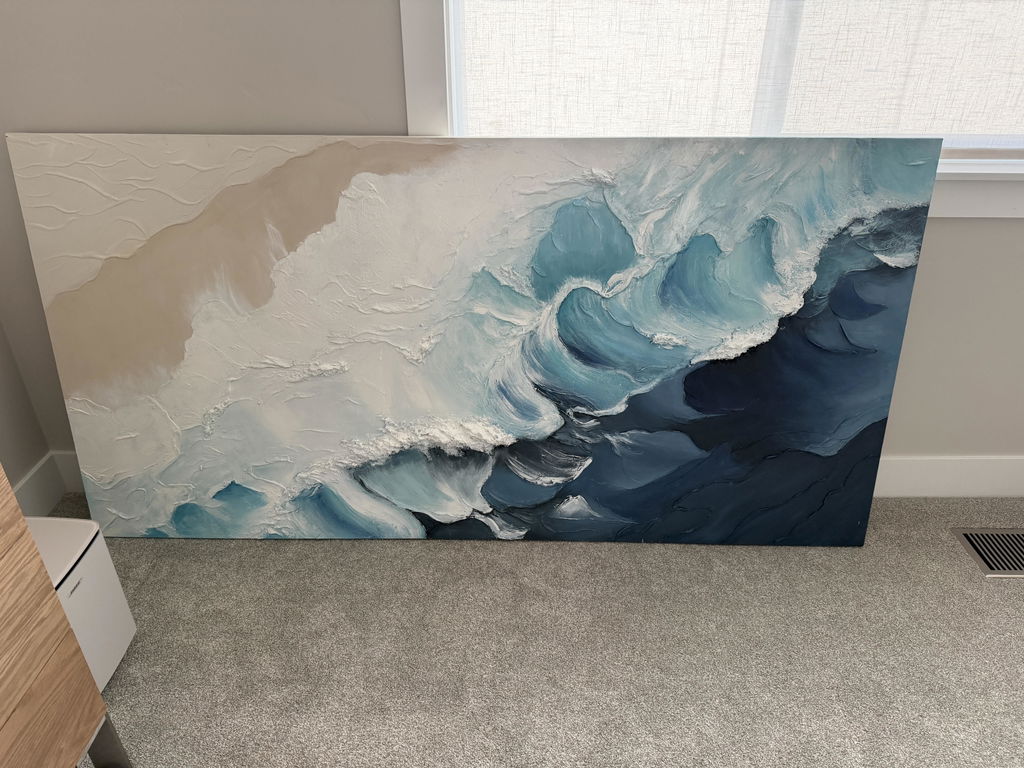
- Depth Verification: For heavily textured impasto works, the spacer must be deep enough that the highest peaks of paint are at least 1/8-inch away from the glass.
- Glazing Choice: For bright spaces, ensure the glazing is UV-protective. You can learn more about this in our guide on choosing oil art for bright spaces.
The Psychological and Economic ROI of Authenticity
Investing in hand-painted art and its proper preservation yields dividends beyond simple aesthetics. Columbia University research confirms that consumers value authentic human-created art 62% higher than AI-generated alternatives (Columbia University). This "human premium" is rooted in the tactile relief and micro-topography of the paint—the very features that spacers are designed to protect.
Furthermore, the integration of original art into the built environment has profound health benefits. A review by the University of Pennsylvania noted that 73% of patients in clinical settings reported significant mood improvements when exposed to high-quality environmental art. By using spacers to prevent mold and decay, you ensure that your art continues to provide these neurological benefits—optimizing emotional regulation circuits in the brain (NCBI)—for decades to come.
Final Considerations for Collectors
Framing is not merely the "jewelry" of a painting; it is its life-support system. By insisting on proper spacers, you are choosing to respect the chemical and physical needs of the medium. Whether you are managing a growing collection or selecting a focal piece for a new home, remember that "breathing room" is the difference between a temporary decoration and a multi-generational legacy.
For more technical insights on maintaining your collection, explore our deep dive into oil painting curing timelines or our guide on preventing canvas rot.
Disclaimer: This article is for informational purposes only and does not constitute professional conservation, legal, or financial advice. Art preservation requirements can vary significantly based on local climate and specific material compositions. Always consult with a certified member of the American Institute for Conservation (AIC) or your local equivalent for high-value assets.
References
- The Expensive Art Market Struggles - Marketplace
- Human-Made vs. AI Art Perception - Columbia University
- Environmental Guidelines for Paintings - Canadian Conservation Institute
- Visual Art in the Built Environment - UPenn Neuroaesthetics
- Neurological Mechanisms of Creative Arts - NCBI
- Paint and Coating Hazards - CDC NIOSH
- Titanium Dioxide Market & Toxicity - NCBI