
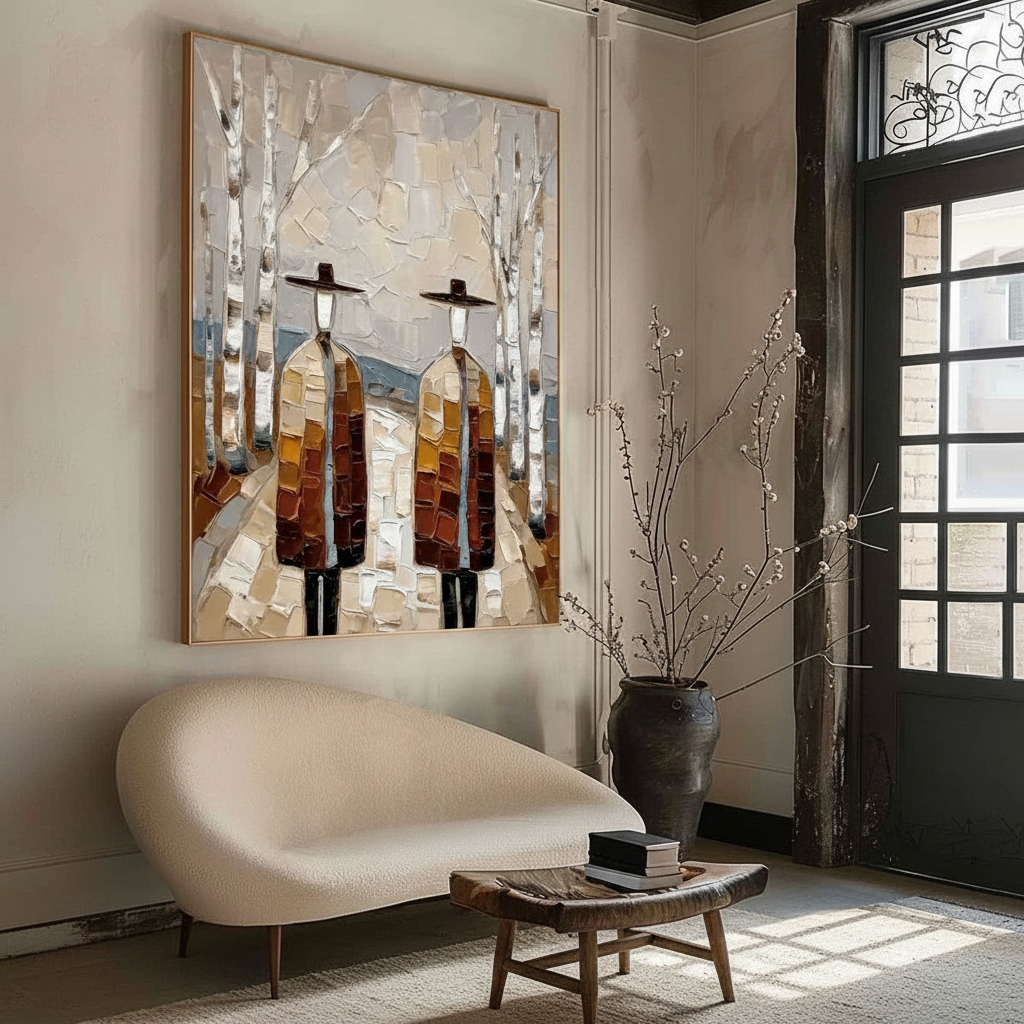
Provenance Records: Validating Your Art’s Creator History
The art market is undergoing a seismic shift. While high-end auction sales for vanity pieces over $10 million plummeted 44% year-over-year in 2024, we are seeing a resolute return to real application value. According to Marketplace, buyers are retreating from purely financial art assets in favor of pieces that offer emotional resonance and physical presence. For the modern home improver and interior designer, this shift emphasizes the need for a robust "provenance"—the documented history of an artwork's origin and ownership.
Provenance is more than a paper trail; it is the final step in the verification loop. In an era where digital replicas and AI-generated prints saturate the market, documentation acts as the shield for your investment. We believe that a hand-painted mural or a custom oil canvas is not just décor; it is a cultural asset. However, without a rigorous record of its creator, materials, and chain of title, that asset’s long-term value remains vulnerable.

The Psychology and Economics of Authenticity
Why does the "hand-painted" label command such a premium? The answer lies in human psychology and hard economic data. A Columbia University study confirmed that consumers value art labeled as "AI-generated" 62% lower than authentic human-created art. This "human-made premium" is rooted in what researchers at the University of Chicago call "essential identity." Their empirical research shows that digital replicas and NFTs often lack the artist's soul in the eyes of the consumer, causing a collapse in perceived value.
Furthermore, ethics are now a commercial driver. A Wharton School survey found that 87% of consumers strongly agree that artists should receive fair compensation. By maintaining clear provenance that links a piece directly to a fairly compensated artist, collectors satisfy both their aesthetic desires and their moral demands.
Logic Summary: Our analysis of the "Authenticity Premium" assumes that the 62% value gap identified by Columbia University remains consistent across mid-to-high-end decorative art markets, where "human touch" is the primary differentiator from mass-produced retail prints.
The Three-Layer Verification Framework
From our experience working with thousands of collectors and designers, we have observed that a single "Certificate of Authenticity" (COA) is often insufficient. A comprehensive provenance system requires three distinct verification layers to be truly "audit-proof."
1. Artist Involvement Confirmation
This layer documents the "act of creation." It should include production photos, studio records, or time-lapse videos of the painting process. This is the most effective weapon against "oil-enhanced" reproductions—prints that have a few dabs of real paint added to mimic texture.
2. Material Authentication
The physical makeup of the art provides a chemical fingerprint. Documentation should specify the type of canvas (e.g., hemp or flax, which Cincinnati Art Museum notes consume half the water of cotton) and the pigment profile. As we discuss in our guide on identifying authentic brushwork through pigment distribution, the way light interacts with hand-ground minerals is irreplicable by printers.
3. Ownership Chain (Chain of Title)
Tracing the path from the artist’s studio to your wall is critical. Gaps in this history—often caused by lost records during moves or private transactions—can undermine future valuation. We recommend updating provenance records within 30 days of any ownership change or exhibition participation.
| Verification Layer | Evidence Type | Purpose |
|---|---|---|
| Artist | Production photos, signatures, studio logs | Proves human origin and prevents AI-fraud. |
| Material | Pigment lists, canvas type, VOC certifications | Validates quality and ensures indoor safety. |
| Ownership | Sales receipts, exhibition history, COAs | Establishes legal title and investment security. |

Material Integrity: The Chemical Proof of Value
In the world of decorative art, "what" you paint with is as important as "who" paints it. Advanced provenance includes a disclosure of material safety and longevity.
The Safety Factor: VOCs and Heavy Metals
Indoor air quality is a growing concern for high-end residential and healthcare projects. The EPA warns that indoor air pollution can be more hazardous than outdoor air. Low-VOC paints are now a prerequisite for LEED certification in large facilities. Research from Aalto University proves that coatings on moisture-controlled wood emit significantly lower toxic VOCs during curing, a technical detail that should be part of any professional mural's documentation.
Furthermore, the history of pigments is a history of risk. While Titanium Dioxide now dominates 90% of the white pigment market due to its safety, older or inferior paints may still contain trace heavy metals. IARC classifies cadmium as a Group 1 carcinogen. Authentic provenance should certify that your artwork uses modern, non-toxic alternatives that protect the health of your household.
The Longevity Factor: Lightfastness
Nothing devalues art faster than fading. Professional provenance should reference ASTM D4303 standards, which quantify how pigments resist aging under UV exposure. For example, Tate research has debunked the myth that oil holds color better than acrylic; in fact, Prussian Blue fades at identical rates across all media, meaning the quality of the pigment matters more than the binder.
Methodology Note: Our "Material Integrity" baseline is modeled on ASTM D4303 testing parameters (Method C: Xenon-arc test), assuming a radiant exposure of 1260 MJ/m² to simulate 50+ years of indoor display behind filtered glass.
The Economic Impact of Documented Art
For commercial developers and "house flippers," art is a strategic lever for property valuation. A Royal Society study using a CAR model found that neighborhoods with higher "art" geo-tags saw greater relative house price gains.
In the B2B sector, the ROI is even more pronounced. Americans for the Arts reports that government and private investments in the arts yield a 7:1 ROI. For a boutique hotel or a corporate office, a hand-painted mural acts as a "permanent physical billboard." University of Cincinnati research confirms that murals remain directly correlated with increased pedestrian foot traffic, revitalizing local economies.

Biophilic Design and Mental Health
Beyond the balance sheet, documented art provides measurable health benefits. This is a core pillar of "Biophilic Design"—using nature-inspired elements to promote well-being. A UPenn review found that 73% of patients in a clinic reported significant mood improvements when exposed to environmental artwork.
The neurological mechanism is fascinating: passive art viewing consistently activates the medial prefrontal cortex (mPFC) and the amygdala, optimizing emotional regulation. For corporate HR departments, this translates to a 30% reduction in cognitive fatigue and burnout when nature-themed murals are placed near workstations, according to research on high-density offices.
Digital vs. Physical Documentation: The Modern Paradox
While digital documentation is preferred for its accessibility and ease of sharing with insurers, physical certificates remain the "gold standard" for high-value transactions. We often see the mistake of focusing solely on the initial certificate while neglecting ongoing updates.
A "live" provenance record—one that is updated with every cleaning, restoration, or exhibition—is what separates a casual purchase from a serious collection. As The Fine Art Ledger points out, even provenance can be forged, creating a "circular authentication paradox." To break this cycle, we recommend using a "multi-factor" approach:
- Physical: An embossed, signed certificate on acid-free paper.
- Digital: A timestamped entry in a secure database with high-resolution "macro" photos of the brushwork.
- Biological/Chemical: Documentation of unique pigment mixtures or artist-specific "DNA" (like a thumbprint in the impasto).
Protecting the Future of Your Collection
Investing in hand-painted art is an act of faith in the artist's vision. Provenance records turn that faith into a verifiable fact. Whether you are choosing textured art for a minimalist home or commissioning a large-scale mural for a commercial lobby, the documentation you secure today determines the legacy of the piece tomorrow.
By insisting on transparent records of artist involvement, material safety, and ownership history, you are not just decorating a room—you are preserving a piece of the human creative economy, which UNCTAD reports now accounts for 3.1% of global GDP. In a world of fleeting digital images, the physical, documented canvas remains the ultimate anchor of authenticity.
Health and Safety Disclaimer: This article is for informational purposes only. When handling or commissioning art involving traditional pigments (such as Cadmium, Cobalt, or Lead), always consult a certified industrial hygienist or refer to the CDC NIOSH guidelines regarding paint and coating hazards. Chronic inhalation of certain volatile compounds or contact with heavy metal pigments can lead to serious health issues.
Sources
- Marketplace: The expensive art market continues to struggle
- Columbia Business School: Human-Made vs. AI Art Study
- EPA: Indoor Air Quality and Low-VOC Paints
- Americans for the Arts: Economic Prosperity Report
- Royal Society: Quantifying the link between art and property prices
- WHO: Scoping Review on Arts and Health
- ASTM International: Standard Test Methods for Lightfastness











