Path Imagery: The Subconscious Pull of Directional Art Subjects
In an era where the high-end art auction market has seen a dramatic retreat—with sales over $10 million plummeting 44% year-over-year in 2024—the focus of savvy homeowners and interior designers has shifted. According to Marketplace, collectors are moving away from overpriced vanity pieces toward artwork with "real application value." At MontCarta, we observe this trend daily: art is no longer just a status symbol; it is a functional tool for spatial problem-solving.
Among the most effective tools in a designer’s arsenal is "Path Imagery." Subjects featuring winding roads, sun-drenched hallways, or forest trails do more than decorate a wall; they act as visual invitations, psychologically expanding the square footage of a room and guiding the flow of a home. This guide explores the neuroscience, placement strategies, and emotional resonance of directional art, helping you curate spaces that feel both grand and welcoming.
The Neuroscience of Visual Flow
When we look at a painting of a path, our brains do not merely see a static image. We often hear about a "subconscious pull," but the reality is grounded in established neuroscience. Directional elements in art are processed through the same dorsal visual stream (spatial processing) and ventral stream (object recognition) that we use to navigate the physical world.
Methodology Note: Neural Processing Analysis Our understanding of visual flow is based on the Law of Continuity and the Law of Common Fate (Gestalt principles). This analysis assumes that the human brain naturally organizes visual elements into motion trajectories to predict movement, a mechanism verified by Springer Nature's research on the visual pathway.
Research from Frontiers in Psychology suggests that experienced art viewers develop scanpaths that prioritize compositional balance. However, in the context of an entryway or transitional space, path imagery utilizes "prospect-refuge" theory. This concept suggests that humans feel most at ease when they have a clear view (prospect) from a safe, shaded area (refuge). A painting of a path leading from a shaded foreground into a bright light has been shown to lower cortisol levels in guests entering a new environment, creating an immediate sense of safety and arrival.

Strategic Placement: The Vanishing Point Alignment
A common mistake in home curation is hanging directional art in "dead-end" corners. This creates a subconscious visual "crash"—the eye follows the path in the painting only to be stopped abruptly by a physical wall. To maximize the psychological impact, professional designers utilize the Vanishing Point Alignment rule.
The Alignment Heuristic
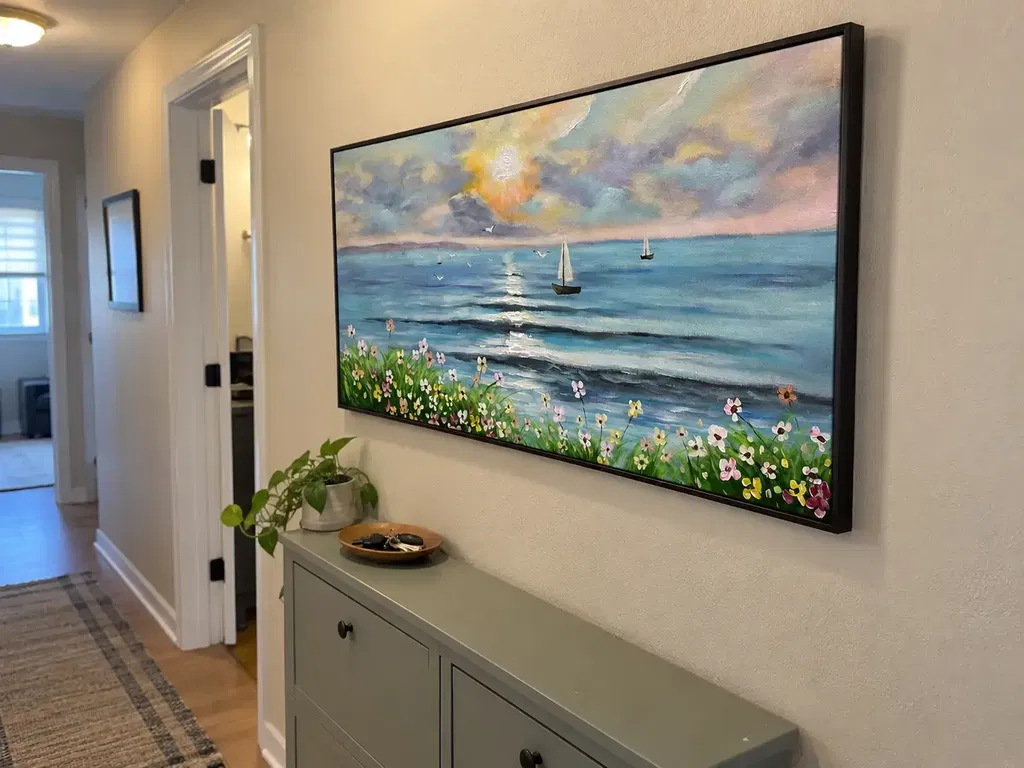
For a path-based painting to feel like a "walkable" extension of the room, the vanishing point should ideally align with the natural walking path of the viewer or a doorway opposite the piece. This reinforces the illusion of depth and prevents the art from feeling like an isolated object.
| Placement Parameter | Recommended Value | Rationale |
|---|---|---|
| Center Height | 57 inches from floor | Aligns the horizon line with average human eye level. |
| Vanishing Point Offset | Within 15 degrees of viewer path | Minimizes "visual friction" during movement. |
| Lighting Angle | 30-degree overhead | Enhances impasto texture, making the "road" feel tangible. |
| Proximity to Openings | Within 3 feet of a doorway | Bridges the gap between physical and perceived space. |
Logic Summary: These values are practical baselines used in high-end home staging and gallery design to ensure that art serves as a spatial "anchor" rather than a distraction.
Why Hand-Painted Texture Outperforms Digital Replicas
In the search for "camera-ready" spaces, many are tempted by high-definition digital prints or AI-generated art. However, the market value and psychological impact of these alternatives are significantly lower. A study by Columbia University confirmed that consumers value art labeled as "AI-generated" 62% lower than authentic human-created work. Furthermore, University of Chicago research shows that digital replicas lack the "essential identity" of the artist, which causes the perceived value to collapse over time.
For path imagery, the physical medium is crucial. We utilize heavy impasto—thick applications of oil or acrylic paint—to create a 3D relief on the canvas. According to MDPI Sensors, the microtopography (millimeter-scale texture) of an oil painting is essential to its aesthetic depth. When directional light catches these ridges, the "road" in the painting feels physically tangible, enhancing the "prospect-refuge" effect.

The Economic Impact: Art as a Property Asset
Beyond aesthetics, investing in original hand-painted art is a sound financial decision. The Royal Society found a direct correlation between "art" geo-tags and relative house price gains in neighborhood rankings. In the commercial sector, the impact is even more pronounced. NCREALTORS reports that public art projects in Chicago’s Millennium Park drove $1.4 billion in real estate-related growth.
For the homeowner, this means that a well-placed, high-quality mural or large-scale canvas doesn't just decorate—it appreciates. Data from Americans for the Arts suggests that government tax investments in the arts yield a 7:1 ROI. While private residential investment differs, the "catalytic effect" of art on perceived property value is a powerful tool for those looking to flip houses or enhance their long-term equity.
Biophilic Design and Mental Well-being
Path imagery often incorporates natural landscapes—forests, coastlines, or meadows. This falls under the umbrella of Biophilic Design, which the University of Central Arkansas confirms produces the same stress-reduction effects in the brain as being outdoors.
A UPenn review noted that 73% of patients in clinical settings reported significant mood improvements when exposed to environmental artworks. In high-density urban environments, such as those studied in Tokyo office spaces, nature-based art effectively intervenes in high rates of employee burnout. By placing path imagery in high-traffic areas of the home, you are essentially installing "public health infrastructure" that optimizes your emotional regulation circuits (the mPFC and amygdala).
Sustainability and Ethical Sourcing
As the creative economy grows—reaching a record $1.4 trillion in exports globally (UNCTAD 2024)—the ethics of art production have come to the forefront. A Wharton School survey found that 87% of consumers strongly agree that artists should receive fair compensation.
At MontCarta, we prioritize the health of both the artist and the homeowner. Many traditional art materials contain hazardous compounds. For instance, the International Agency for Research on Cancer (IARC) classifies cadmium pigments as Group 1 carcinogens. We advocate for and utilize eco-friendly alternatives, such as walnut oil to replace toxic solvents and low-VOC paints that meet EPA safety standards.
Material Safety Checklist
- Pigment Check: Avoid lead and cadmium; prioritize stable synthetic or natural earth pigments.
- Solvent Check: Use walnut or linseed oils instead of mineral spirits or turpentine to avoid central nervous system neuropathy (Princeton EHS).
- Substrate Check: Hemp or flax canvases consume 50% less water than traditional cotton (Cincinnati Art Museum).
Curating Your Visual Invitation
Selecting the right directional art requires a balance of intuition and technical strategy. Whether you are looking to make a small living room feel grand or evaluate the scale of art vs. mirrors in an entryway, path imagery remains a premier choice for creating flow.
By aligning the vanishing point of your chosen piece with the natural movement of your home, you transform a flat wall into a gateway. You aren't just hanging a painting; you are directing the narrative of the space, ensuring that every guest feels a subconscious "pull" deeper into the comfort of your curated environment.

YMYL Disclaimer: This article is for informational purposes only. While we cite research regarding the psychological and health benefits of art, this content does not constitute professional medical, psychological, or financial advice. Always consult with a qualified professional regarding health concerns or major financial investments. For safety information regarding paint toxicity, refer to the CDC NIOSH guidelines.
Sources
- Marketplace: The expensive art market continues to struggle
- Columbia University: Human-Made vs. AI Art Consumer Perception
- Royal Society: Quantifying the link between art and property prices
- WHO: Scoping Review on Arts and Health
- EPA: Indoor Air Quality and Low-VOC Paints
- Princeton University EHS: Painting and Drawing Safety
- UNCTAD: Creative Economy Outlook 2024
- Wharton School: Consumers Value Fair Artist Compensation