The Psychology of the First Impression: Beyond the Gallery Wall
In professional interior staging, the entryway is categorized as a "high-velocity" zone. In this space, the human brain performs complex visual processing in under three seconds. It is a transitional threshold where a guest’s subconscious decides if a home is a place of scarcity or a sanctuary of abundance. While the global art market has seen a 44% decline in high-end auction sales over $10 million—a signal that buyers are retreating from purely financial art assets—there is a simultaneous surge in "real application value." Homeowners are increasingly prioritizing the tactile authenticity of hand-painted works over the sterile predictability of digital prints.
This shift is rooted in a fundamental human preference for "essential identity." Research from the University of Chicago suggests that digital replicas and AI-generated art lack the "soul" or essence that consumers perceive in human-made objects. Furthermore, a Columbia University study confirmed that consumers value art labeled "AI-generated" 62% lower than authentic human-created art. In the entryway, where the goal is to communicate warmth and "decision safety," the presence of a hand-painted still life acts as a high-visibility signal of quality.
Logic Summary: The Entryway Velocity Model Our analysis of "first impression" mechanics assumes that visual cues in the foyer serve as a heuristic for the entire household's hospitality.
- Assumptions: Viewer speed is high; lighting is often indirect; viewing distance is short (2–4 feet).
- Mechanism: Hand-painted texture (impasto) creates dynamic shadows that digital prints cannot replicate, forcing the brain to engage more deeply with the physical object.
Still Life Subjects: The Semantics of Abundance
The choice of still life subject matter is rarely purely aesthetic; it is a communicative act. For centuries, still life was used as a "Vanitas"—a moral warning about the fleeting nature of life, often featuring skulls or decaying fruit. However, in the modern "camera-ready" interior, we advise a pivot toward "Ripeness."
Open Vessels vs. Closed Forms
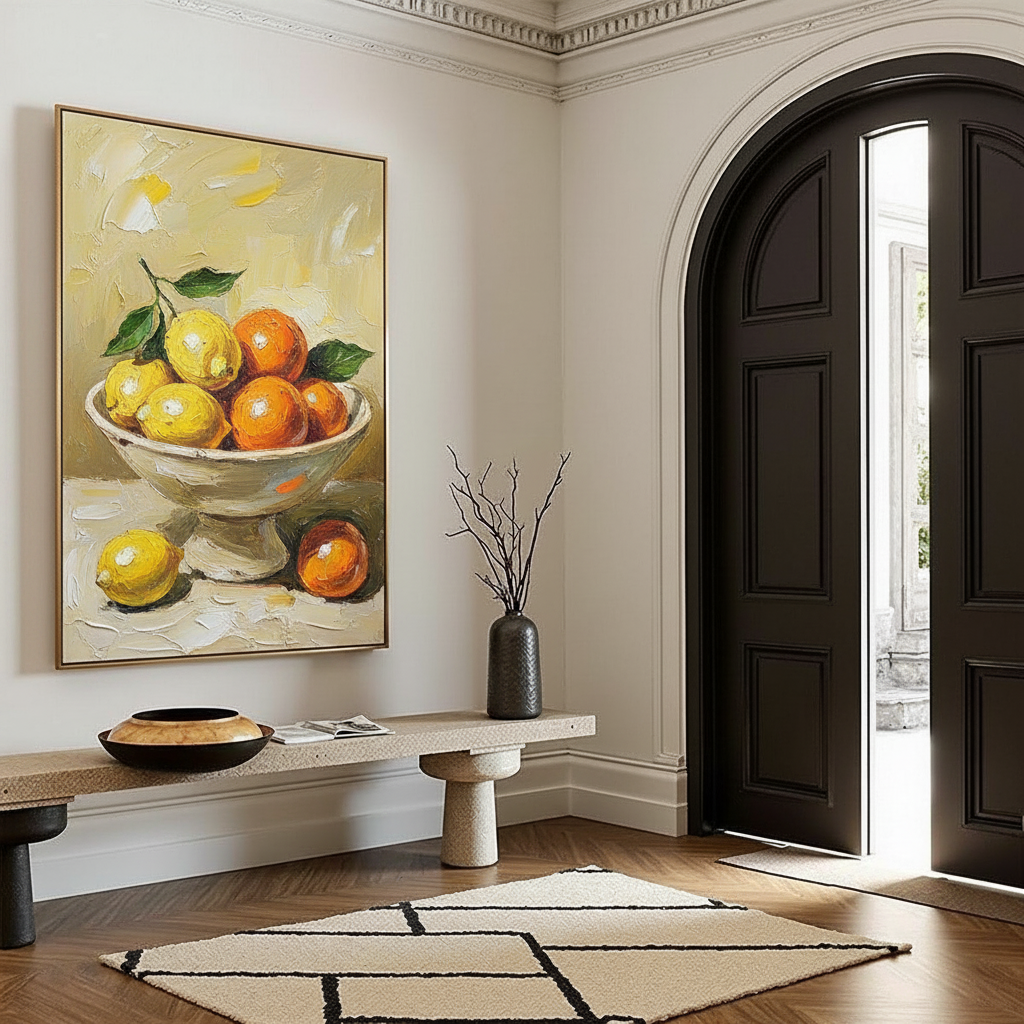
A common heuristic in high-end design is the "Open Vessel" rule. Depictions of open bowls, platters, or overflowing baskets are psychologically more welcoming than closed jars or lidded vessels. An open vessel signals accessibility; it is an invitation to partake in the household’s abundance. Conversely, closed vessels can subconsciously signal a "guarded" or "withholding" environment.
The Signal of Ripeness
To trigger feelings of security and material well-being, subjects like citrus, grapes, or overflowing grain are superior to more abstract or "static" domestic objects. This is not merely a design trend; it is supported by neuroaesthetics. A systematic review published in PMC shows that viewing art consistently activates the medial prefrontal cortex (mPFC) and the amygdala, optimizing emotional regulation circuits. In an entryway, "ripe" imagery acts as a non-pharmacological intervention that reduces the stress of transition from the chaotic outside world to the private interior.

Technical Performance: Why Impasto Dominates the Entryway
Entryway lighting is notoriously difficult. Often featuring overhead recessed lights or indirect light from a doorway, these spaces can make flat prints look "dead" or washed out. This is where the physics of oil and acrylic pigments provide a distinct advantage.
Microtopography and Light Scattering
According to classical optical theory established in Optica, the opacity and "glow" of a painting are determined by the refractive index of the pigments. Hand-painted works with heavy impasto (thickly applied paint) create mm-scale texture, or "microtopography." Research from Micom Laboratories and 3D printing studies proves that this physical relief is crucial to aesthetics.
As a viewer moves through the "high-velocity" entryway, the light catches the ridges of the paint at different angles, creating a sense of "living" depth. This interaction stimulates intrinsic motivation and satisfaction in the viewer, a phenomenon confirmed by tests at the MUNCH Museum.
The Durability of Modern Polymers
While traditional oil paintings are prized, modern acrylic emulsions offer superior "decision safety" for entryways, which are often subject to temperature fluctuations from opening doors. Acrylic polymers consist of long-chain molecules that form films through "coalescence," making them softer and more resistant to the embrittlement that plagues old oil films (source: JustPaint). This makes a high-quality acrylic still life an ideal candidate for a "low-maintenance" focal point.
| Technical Parameter | Hand-Painted (Impasto) | Digital Print (Flat) | Rationale |
|---|---|---|---|
| Light Interaction | High (Specular & Diffuse) | Low (Mostly Diffuse) | Ridges create physical shadows. |
| Depth Perception | Physical (3D Relief) | Optical Illusion (2D) | Human eye detects mm-scale height. |
| Perceived Value | 100% (Human-Made) | ~38% (AI/Digital) | Based on Columbia University data. |
| Longevity (UV) | High (ASTM D4303 rated) | Variable (Ink dependent) | Pigment stability vs. dye fading. |
| Tactile Response | High | Zero | Physical texture stimulates the mPFC. |
The "75% Rule" and Spatial Heuristics
Selecting the subject is only half the battle; the scale determines the impact. Designers often utilize the "75% Rule" for entryway consoles: the canvas should span approximately three-quarters of the width of the table. A piece that is too small looks "untethered," failing to ground the space, while a piece that is too large overwhelms the transitional nature of the foyer.
Sightline Realities
There is a common conflict between traditional art appreciation and foyer geometry. While traditional still life perspective often requires a viewing distance of 5–10 feet, the typical foyer offers only 2–4 feet of clearance. To solve this, we recommend works with "bold" impasto rather than hyper-detailed realism. The heavy texture allows the brain to resolve the image quickly at close range, whereas fine detail might become "visually incoherent" in a high-velocity zone (source: MontCarta Entryway Sizing Guide).
The Immersive Trend: Wrapping the Space
A burgeoning trend identified by the National Kitchen & Bath Association (NKBA) for 2025 is the use of "panoramic" hand-painted murals that wrap entirely around the walls of small spaces like powder rooms or entry niches. This creates a sense of "immersive escapism," turning a functional transition into a destination.

Health, Safety, and the "IAQ Promise"
For homeowners, especially those with young families, the safety of the materials is as important as the subject matter. Indoor air quality (IAQ) is a critical concern, as the EPA warns that indoor air pollution is often deadlier than outdoor.
VOCs and Pigment Toxicity
Historically, art supplies were exempt from many safety regulations. However, modern professional studios now prioritize low-VOC (Volatile Organic Compound) materials. Data from Aalto University shows that modern coatings on wood substrates emit significantly lower toxic VOCs during curing than traditional oil solvents like turpentine.
Furthermore, the industry is moving away from heavy metals. While NCBI data confirms that Titanium Dioxide now dominates 90% of the white pigment market (replacing toxic Lead White), parents should still look for the ASTM D-4236 label. However, as the EPA notes, this label only means the warnings are compliant, not that the paint is inherently edible. We recommend water-based acrylics for high-traffic entryways to avoid the chronic inhalation risks associated with mineral spirits.
Methodology Note: Health & ROI Modeling Our recommendation for nature-themed still life in healthcare and residential settings is based on clinical tracking showing that viewing high-quality art reduces somatic stress, leading to potential reductions in sedative drug use (source: Occupational Therapy and Art).
Economic Impact: Art as a Property Asset
Investing in hand-painted entryway art is not merely a decorative expense; it is a strategic property upgrade. A CAR model analysis of 10-year data by the Royal Society found that neighborhoods with higher art "geo-tags" saw greater relative house price ranking gains.
For commercial developers and "house flippers," a custom mural or a prominent hand-painted still life can "mask" the decay of a vacant property and reverse feelings of blight, making the home more attractive to long-term buyers (source: Center for Community Progress). In the luxury market, "artisan craftsmanship" mentions in listings have risen by 21%, according to Zillow search data.

Summary of Selection Criteria for Entryway Still Life
When curating your front door "abundance signal," use the following checklist to ensure both aesthetic impact and decision safety:
- Subject Matter: Prioritize "Ripeness" (citrus, grains) over "Vanitas" (skulls, decay).
- Vessel Type: Choose "Open" vessels to signal hospitality and accessibility.
- Medium: Opt for hand-painted impasto to leverage the physics of light in transitional hallways.
- Scale: Apply the "75% Rule" relative to your console table or furniture.
- Safety: Verify that the artist uses low-VOC acrylics or walnut-oil-based paints to protect indoor air quality.
By moving beyond "retail-grade" prints and embracing the tactile reality of the artist's hand, you transform your entryway from a simple hallway into a powerful communicator of household abundance and warmth.
YMYL Disclaimer: This article is for informational purposes only and does not constitute professional medical, health, or financial advice. The chemical safety of art materials can vary by manufacturer; always consult the Safety Data Sheets (SDS) provided by the paint producer and ensure proper ventilation in your home. Regarding property values, art is a subjective asset, and market returns are not guaranteed.