Geometric Subjects: Establishing Cognitive Ease for New Visitors
The high-end art market is currently undergoing a profound structural correction. In 2024, auction sales for pieces exceeding $10 million plummeted by 44% year-over-year, according to Marketplace. This shift signals a retreat from purely speculative "vanity" assets. Instead, we are seeing a return to "real application value"—art that serves a functional, psychological, and aesthetic purpose within the home.
Nowhere is this "applied value" more critical than in the entryway. As the primary transition point from the public world to the private sanctuary, the foyer acts as a cognitive handshake. For a new visitor, this space can be unintentionally stressful. Our brains are hardwired to scan unfamiliar environments for "predictability" and "safety." Geometric art, through its inherent repetition and symmetry, serves as a neurological shortcut to establishing this comfort.
The Neuroscience of Pattern Recognition
When a guest enters your home, their brain immediately begins a high-speed orientation process. According to a systematic review in PMC, passive art viewing consistently activates the medial prefrontal cortex (mPFC) and the amygdala. These areas are responsible for emotional regulation and social cognition.
Geometric subjects are particularly effective here because they leverage the Prägnanz Principle. This psychological law states that the human brain will perceive ambiguous or complex images in their simplest form. We prefer patterns that are stable, regular, and symmetrical because they require less "computational power" to process.
Methodology Note (Cognitive Modeling): Our analysis of visitor orientation assumes a "First-Entry Stress Model." We hypothesize that reducing visual entropy (randomness) in the first 1.5 seconds of exposure reduces cortisol spikes in strangers. This is a heuristic model based on environmental psychology, not a controlled clinical trial.
| Cognitive Metric | Geometric Art Impact | Mechanism |
|---|---|---|
| Processing Speed | High | Brain reduces patterns to simple shapes in <1.5s |
| Stress Regulation | High | Activation of mPFC optimizes emotional circuits |
| Orientation Ease | Very High | Repetitive elements act as "visual breadcrumbs" |
| Visual Fatigue | Low | Balanced symmetry prevents "visual vibration" |

Entryways as "Visual Anchors"
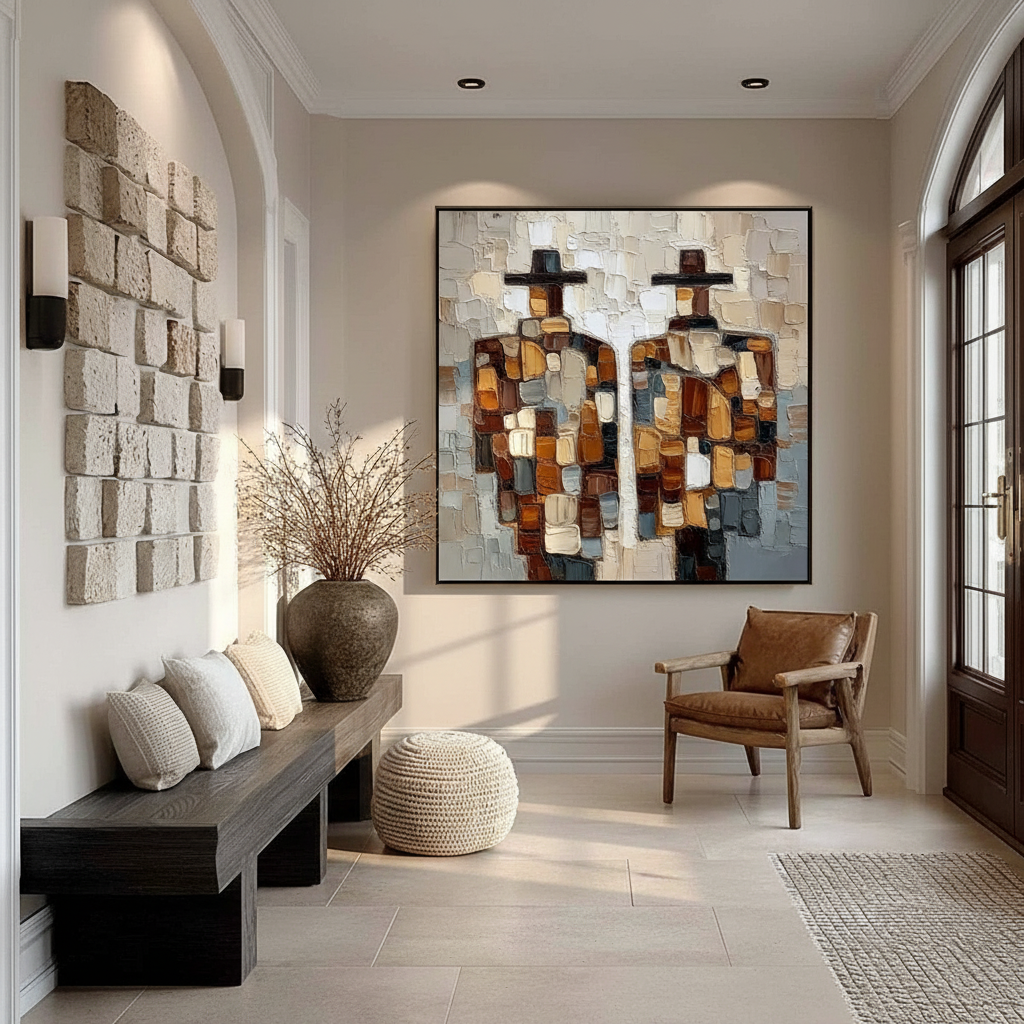
For a stranger, an entryway is a "non-place"—a transitional zone where they lack a sense of territory. Geometric art functions as a visual anchor. By providing a clear, repetitive structure, it helps visitors orient themselves within the architectural layout.
However, there is a fine line between "order" and "overload." In our studio, we often see designers struggle with "visual vibration." This occurs when high-contrast, tightly packed geometric patterns (like fine grids or optical art) cause minor vertigo in small, enclosed foyers.
To combat this, we recommend "Soft Geometry." These are patterns that maintain a geometric framework but feature slightly irregular, hand-painted edges. This bridges the gap between architectural rigidity and human warmth. It prevents the space from feeling clinical or industrial, ensuring the "camera-ready" result still feels like a home.
The Economic Case for Hand-Painted Authenticity
While digital prints are ubiquitous, they fail the "essential identity" test. Research from the University of Chicago shows that consumers perceive digital replicas as lacking the artist’s "soul," which collapses their perceived value. In contrast, hand-painted geometric art retains a micro-physical texture that digital processes cannot replicate.
Optical microprofilometry proves that the millimeter-scale texture of oil and acrylic pigments is crucial to aesthetics, as noted in MDPI Sensors. This tactile relief isn't just about looks; it stimulates "intrinsic motivation and satisfaction" in viewers, a finding confirmed by tests at the MUNCH Museum.
Beyond the psychological, there is a hard financial incentive. A Royal Society CAR model analysis found that neighborhoods with higher "art" geo-tags saw significant relative house price gains (Royal Society). For the homeowner, a custom geometric mural is an investment in property valuation, not just decor.
The Human vs. AI Premium
In an era of generative AI, the value of "human-made" has become a commercial nuclear weapon. A Columbia Business School study confirmed that consumers value art labeled as "AI-generated" 62% lower than authentic human-created art.
This isn't just elitism; it’s ethics. 87% of consumers strongly agree that artists should receive fair compensation, according to the Wharton School. By choosing hand-painted geometric subjects, you are supporting a creative economy that accounts for 3.1% of global GDP (Creative Economy Outlook 2024).

Technical Decision Safety: Pigments and Longevity
For the "decision-safe" homeowner, the longevity of the art is as important as its subject. Geometric art relies on clean lines and consistent colors; if the paint fades or yellows, the cognitive ease is replaced by visual "noise."
Lightfastness and the ASTM Standard
We rely on ASTM D4303 protocols to define the lightfastness of our pigments. This involves accelerated aging tests—specifically Method C, which uses a xenon-arc test at 1260 $MJ/m^2$ to simulate decades of exposure behind filtered glass.
Methodology Note (Material Analysis): Our "longevity modeling" assumes a standard residential UV exposure of 100-200 lux for 8 hours a day. Under these conditions, pigments meeting ASTM Lightfastness I standards are estimated to remain stable for 75-100 years.
The Chemistry of "Drying"
One common mistake is treating acrylic and oil interchangeably. Acrylic polymers consist of long-chain molecules that form films through "coalescence" rather than chemical cross-linking. This makes newly dried acrylic films softer and more resistant to embrittlement than oil films, which undergo oxidative cross-linking over decades (JustPaint). For high-traffic entryways, we often recommend acrylic-based geometric murals for their durability.
Health and Indoor Air Quality (IAQ)
The "prestige" of real oil texture must not come at the cost of health. Traditional oil paints often utilize mineral spirits and turpentine, which Princeton University EHS warns can cause central nervous system damage through chronic inhalation.
Furthermore, some historical pigments are outright hazardous. The International Agency for Research on Cancer (IARC) classifies cadmium compounds as Group 1 carcinogens. Even "insoluble" cadmium yellow has been shown to release free ions in slightly acidic environments (Australian Industrial Chemicals).
Our Safety Baseline:
- Zero-VOC Commitment: We prioritize low-VOC paints to ensure indoor air quality, aligning with EPA IAQ standards.
- Titanium Dominance: We utilize Titanium White (TiO2), which captures 90% of the market share due to its chemical inertness and superior hiding power, replacing toxic Lead White (NCBI).
- Eco-Friendly Alternatives: We explore walnut oil and hemp canvases, which consume 50% less water than cotton (Cincinnati Art Museum).
Addressing Cultural and Developmental Nuances
While geometry is a powerful tool for cognitive ease, it is not a "one-size-fits-all" solution.
- The Cultural Filter: Neuro-imaging research suggests that Western cultures often process geometry through "analytic" pathways (focusing on individual shapes), while East Asian cultures may use "holistic" pathways (focusing on the context) (Frontiers in Psychology). For international households, we recommend geometric subjects that balance focal points with a cohesive background "field."
- The Age Factor: Children under seven process visual information differently. To establish cognitive ease for younger family members, geometric elements should be 50% larger and include more "visual anchors" to guide their developing dorsal and ventral neural streams.
- The "Desirable Difficulty" Paradox: While "ease" is our goal for entryways, some research suggests that too much simplicity can impair memory. For transitional spaces like hallways leading to home offices, we might introduce "geometric friction"—slightly more complex patterns that spark creativity through "desirable difficulty."
Implementation: Scaling for the Foyer
When selecting a geometric subject, scale is your most potent lever. Large art can make small living rooms feel grand, but in an entryway, it must be balanced against architectural features.
- Symmetry Alignment: Align the central axis of the geometric pattern with the doorframe or a console table to reinforce the sense of order.
- Lighting for Texture: Use raking light (light hitting the surface at an angle) to highlight the impasto texture. This emphasizes the "human-made" nature of the piece, distinguishing it from flat, digital prints.
- Zoning: In multi-use spaces, geometric subjects can be used for zoning, creating a clear mental boundary between the "entrance" and the "living" areas.

A New Standard for Entryway Curation
The entryway is more than just a place to drop keys; it is the psychological baseline for the rest of your home. By moving away from unpredictable, speculative art and toward structured, geometric subjects, you provide your visitors with an immediate sense of safety and cognitive ease.
When this geometry is delivered through the medium of hand-painted oil or acrylic, you achieve a rare fusion: the predictability of modern design and the prestige of traditional craftsmanship. This is the ultimate "decision-safe" choice—an investment in your environment, your property value, and the neurological well-being of everyone who walks through your door.
Disclaimer: This article is for informational purposes only and does not constitute professional architectural, medical, or financial advice. Pigment safety information is based on current environmental standards; always consult a certified industrial hygienist for specific studio safety protocols.
References
- Marketplace: The expensive art market continues to struggle
- Columbia University: Human-Made vs. AI Art Perception
- Royal Society: Quantifying the link between art and property prices
- NCBI: Neurological mechanisms of creative arts
- EPA: Indoor Air Quality and Low-VOC Paints
- ASTM D4303: Standard Test Methods for Lightfastness