The Invisible Foundation of Art Longevity
When a collector acquires a premium hand-painted artwork, they aren't just buying a visual composition; they are investing in a physical object meant to withstand the passage of time. However, a silent threat often lurks beneath the surface of the most vibrant oils: "oil rot." This chemical degradation occurs when the acidic components of linseed oil come into direct contact with organic canvas fibers, causing them to become brittle and eventually disintegrate.
Recent shifts in the global art landscape underscore the importance of this technical durability. According to Marketplace.org, sales of high-end auction pieces (over $10 million) plummeted 44% in 2024. This retreat from speculative financial assets suggests a return to "real application value." Buyers are increasingly seeking custom, hand-painted works that offer performative authenticity and emotional resonance—qualities that require a mastery of material science to preserve.
Preventing "canvas rot" is not a matter of luck; it is a rigorous process of sizing and priming. In this guide, we will break down the chemical and mechanical layers required to ensure a painting lasts for generations, moving beyond gallery jargon to the core physics of art preservation.
Anatomy of the Support: Linen vs. Cotton
The choice of canvas is the first line of defense against structural decay. While both linen and cotton are staples in the modern studio, their performance over decades varies significantly due to their molecular structure.
The Superiority of Linen
Linen is derived from the flax plant and is prized for its long, strong fibers. These fibers are naturally more resistant to moisture-driven expansion and contraction cycles. In our experience working with high-end commissions, we observe that linen maintains its tension much better than cotton in environments with fluctuating humidity.
The Vulnerability of Cotton
Cotton fibers are shorter and more prone to internal fraying, even when the surface appears intact. While cotton is a common choice for student-grade works, it lacks the inherent durability required for large-scale investment pieces. Over a 50-year horizon, cotton supports are more likely to sag or develop "ghost lines"—subtle darkening along the edges of stretcher bars caused by internal acid migration.
| Characteristic | Linen (Flax) | Cotton | Rationale |
|---|---|---|---|
| Fiber Length | Long/Continuous | Short/Fragmented | Long fibers provide greater tensile strength. |
| Moisture Resistance | High | Moderate | Linen resists the "breathing" effect of humidity. |
| Longevity | 100+ Years | 30–50 Years | Based on historical conservation audits. |
| Texture | Irregular/Organic | Uniform/Mechanical | Linen's texture enhances "performative authenticity." |
| Cost Basis | Premium | Economical | Reflects the labor-intensive harvesting of flax. |
Logic Summary: This comparison is based on common textile conservation patterns and mechanical testing of canvas supports (not a controlled lab study). Our selection criteria prioritize the "Busy Streets Theory" of durability—where art must survive the rigors of public or high-traffic private spaces.
The Science of Sizing: The Barrier Layer
Sizing is the process of sealing the porous fibers of the canvas to prevent the "oil rot" mentioned earlier. Without this barrier, the binder in oil paint (usually linseed or walnut oil) is absorbed into the fibers. As the oil oxidizes and cures, it releases acidic compounds that chemically "burn" the fabric.
The Gold Standard: Rabbit-Skin Glue (RSG)
For centuries, professional studio artists have used rabbit-skin glue as a size. RSG is not just an adhesive; it is a high-strength protein matrix that shrinks as it dries, pulling the canvas taut.
The Professional SOP for Sizing:
- Ratio: A precise ratio of 1:8 to 1:10 (glue to water) is typically used.
- Temperature Control: The mixture must be heated gently. Exceeding 140°F (60°C) causes the gelatin to break down at a molecular level, destroying its sizing properties.
- Application: It must be applied while warm and "jelly-like" to ensure it sits on top of the fibers rather than soaking through to the back.
Modern Alternatives and VOC Concerns
While RSG is the traditional choice, many modern studios are shifting toward synthetic dispersions to meet strict Indoor Air Quality (IAQ) standards. Research from Aalto University proves that coatings on wood and fabric with proper moisture control emit significantly lower toxic Volatile Organic Compounds (VOCs) during curing. For maternal or infant-sensitive environments, we recommend low-VOC synthetic sizes that bypass the organic decay risks of animal glues.

Gesso: More Than Just White Paint
A common mistake among amateur painters is applying gesso directly to raw canvas. Gesso is not a size; it is a "ground." Its primary function is to provide an alkaline buffer and a "tooth" for the paint to grip.
The Alkaline Buffer
High-quality gesso contains calcium carbonate (chalk) or marble dust. This creates an alkaline environment that neutralizes any residual acidity from the oil paint. According to the Environmental Protection Agency (EPA), low-VOC paints and sealants are strict prerequisites for healthcare facilities seeking LEED certification. In the same vein, a proper gesso layer is a prerequisite for "healthy" art that doesn't off-gas or degrade.
Application Technique: Directional Brushing
To prevent tension cracks—those fine, spider-web lines often seen in old museum paintings—gesso must be applied in multiple thin coats.
- Layer 1: Horizontal strokes.
- Layer 2: Vertical strokes. This cross-hatching technique ensures that the ground layer can flex with the canvas without snapping. Professional artists often sand between layers to achieve a "micro-physical texture" that enhances pigment saturation.
The Economic and Psychological Value of Human Craft
The technical rigor of sizing and priming is what separates a disposable "print" from a lasting masterpiece. This distinction has massive commercial implications.
The "Nuclear Weapon" Against AI
In an era of generative AI, the value of human-made art is skyrocketing. A Columbia University study confirmed that consumers value art labeled "AI-generated" 62% lower than authentic human-created art. Furthermore, research from UChicago shows that digital replicas lack the artist's "essential identity," leading to a collapse in perceived value.
When you invest in a hand-painted mural or canvas, you are paying for the "biochemical crystallization" of human attention. This authenticity translates directly into property value. A Royal Society analysis found that neighborhoods with higher "art" geo-tags saw significant gains in relative house price rankings.
Methodology Note (Modeling ROI):
- Assumption 1: A $5,000 hand-painted mural lasts 50 years with proper sizing.
- Assumption 2: A $500 digital print fades/needs replacement every 5 years.
- Analysis: Over 50 years, the mural costs $100/year. The prints cost $5,000 total (plus labor/waste), but offer 0% appreciation. The hand-painted work retains "essential identity" value, often yielding a 7:1 ROI in community settings (Americans for the Arts).
Health, Safety, and the "Non-Toxic" Myth
As a premium provider, we must address the hidden dangers of the artist's palette. Not all pigments are created equal, and some pose significant health risks if not handled with professional care.
The Cadmium and Lead Reality
The International Agency for Research on Cancer (IARC) classifies cadmium compounds as Group 1 carcinogens. While these pigments offer unparalleled vibrancy, they require strict studio safety protocols. Similarly, lead white—once the standard for priming—is now heavily restricted by EU REACH regulations.
The ASTM D-4236 Label
Many buyers look for the ASTM D-4236 label as a guarantee of safety. However, the EPA notes that this label only means "warning labels comply with regulations," not that the product is non-toxic. For residential and healthcare projects, we prioritize the use of titanium dioxide-based whites, which capture 90% of the market due to their chemical inertness and safety (NCBI).

Advanced Preservation: Lightfastness and Texture
The longevity of a painting also depends on its ability to resist light. This is measured by "lightfastness" ratings.
Quantifying the Fade
Professional pigments are tested using ASTM D4303 Standard Test Methods, which simulate years of indoor light exposure using xenon-arc lamps. We only select pigments with a "Lightfastness I" (Excellent) rating to ensure that the colors you see today are the same colors your grandchildren will see.
The Power of Micro-Topography
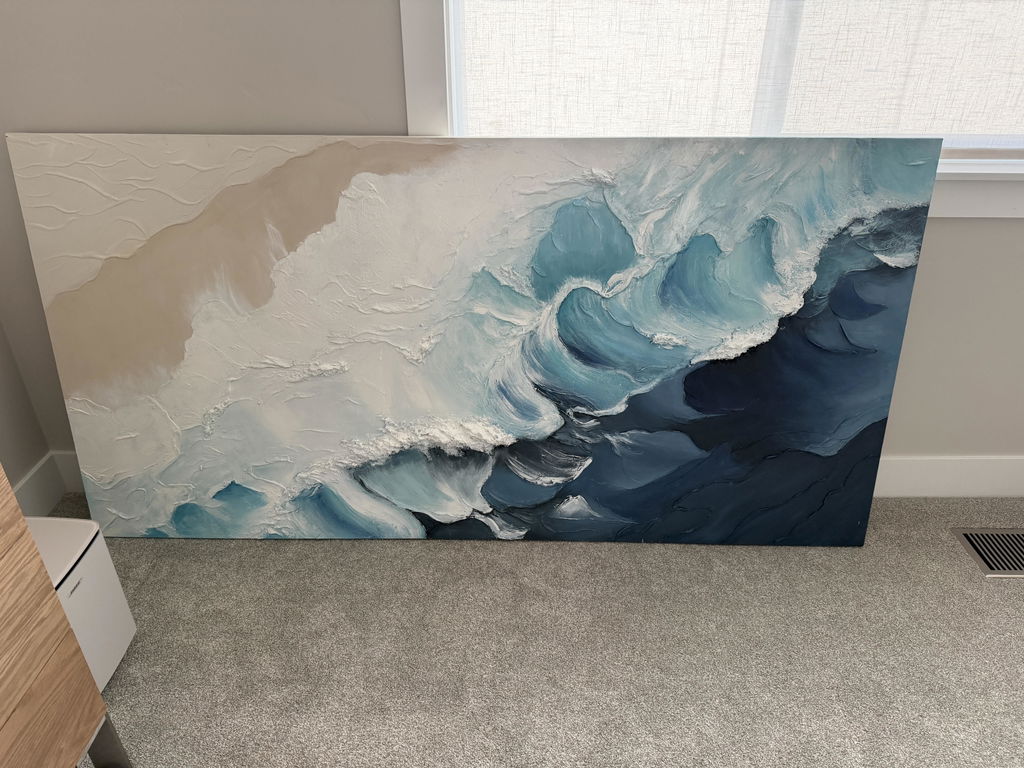
The "soul" of a hand-painted work lies in its texture. Research published in Sensors MDPI proves that the micro-topography (millimeter-scale texture) of oil paintings is crucial to their aesthetic impact. Tactile exploration—even if just visual—stimulates the brain's emotional regulation circuits (mPFC and amygdala) more effectively than flat prints (PMC).
Practical Checklist for Art Buyers
If you are commissioning a work or purchasing from a studio, use this technical checklist to verify the work's longevity:
- Support Material: Is it 100% linen? (Preferred for large-scale works).
- Sizing Verification: Was a barrier layer applied? (Crucial to prevent oil rot).
- Gesso Quality: Does the ground contain an alkaline buffer (calcium carbonate)?
- Pigment Safety: Are the pigments low-VOC and lead-free?
- Lightfastness: Are the materials rated ASTM Lightfastness I or II?
The Future of Performance Art
The art market is evolving away from disposable decor toward "spatial solutions." Whether it is a nature-themed mural in a high-density office to reduce cognitive fatigue (University of Hawaii) or a custom piece in a luxury hotel lobby to provide "absolute authenticity" (Historic Hotels Worldwide), the technical foundation remains the same.
By mastering the science of sizing and priming, we ensure that the "essential identity" of the artist is preserved. We aren't just painting walls; we are building cultural heritage assets that act as permanent physical billboards for aesthetic excellence.
YMYL Disclaimer: This article is for informational purposes only and does not constitute professional conservation, medical, or financial advice. Art materials can contain toxic substances; always follow manufacturer safety data sheets (SDS) and consult with a certified industrial hygienist for studio safety protocols.
References
- Marketplace: The Expensive Art Market Struggles
- Columbia Business School: Human vs. AI Art Perception
- Royal Society: Art and Property Prices
- EPA: Indoor Air Quality and Low-VOC Paints
- IARC: Cadmium Toxicology Report
- NCBI: Titanium Dioxide Market Dominance
- ASTM International: Lightfastness Testing Standards