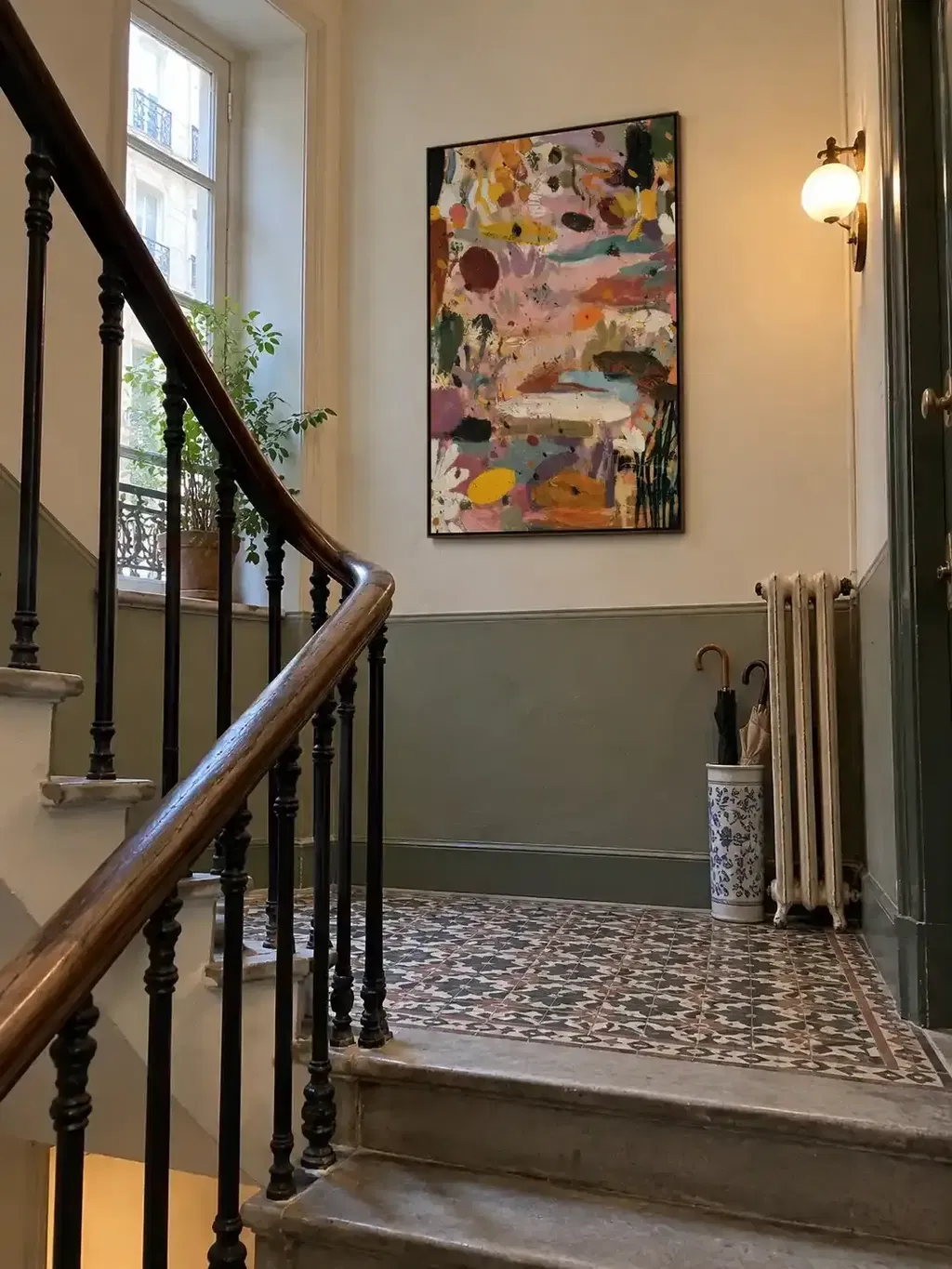
Understanding the Allure and Risk of Heavy Impasto
The tactile presence of heavy impasto—where paint is applied so thickly that it stands out from the surface—has long been the hallmark of premium, hand-painted artistry. For many home decorators and collectors, this sculptural quality is what distinguishes a "real" painting from a flat, mass-produced digital print. However, the very thickness that provides this aesthetic depth also introduces significant mechanical risks.
In the current art market, we are seeing a structural shift in consumer behavior. High-end auction sales for purely financial "vanity" assets plummeted 44% year-over-year in 2024, as reported by Marketplace.org. Instead, collectors are returning to "real application value," prioritizing custom, hand-painted works that offer emotional resonance and physical permanence. Yet, for a piece to retain its value, it must survive the test of time.
The primary concern for collectors investing in textured oils is "craquelure"—the network of fine cracks that can develop as paint ages. When paint is applied in heavy ridges, it doesn't just dry; it undergoes a complex chemical and physical transformation. This guide explores the science of impasto stability, helping you understand how professional-grade materials and techniques ensure that your investment remains as vibrant and intact as the day it was painted.

The Physics of the "Fat over Lean" Rule in Impasto
Most collectors are familiar with the traditional "fat over lean" rule—the idea that each successive layer of paint should have more oil (fat) than the one below it to prevent cracking. While this is a foundational principle, modern conservation science reveals that heavy impasto creates unique challenges that layering alone cannot solve.
According to research published by Painting Best Practices, thick oil paint layers create internal curing mismatches. Unlike water-based paints that dry by evaporation, oil paint cures through oxidation. In a heavy impasto stroke, the surface "skins over" quickly as it comes into contact with oxygen. This outer skin then acts as a barrier, limiting oxygen diffusion to the paint underneath.
The result is a "micro-climate" of incomplete drying. The interior of a thick paint ridge may remain soft or even liquid for years, while the exterior becomes brittle. When the environment shifts—due to temperature or humidity—the brittle outer shell and the soft interior expand and contract at different rates, leading to "cleavage" or deep structural cracks.
Logic Summary: Our analysis of impasto longevity assumes that physical thickness creates internal stress differentials that often exceed the oil paint film’s strain capacity (~1-2% elongation) during the 3-5% shrinkage observed in long-term drying. This mechanical mismatch is a primary driver of restoration needs in contemporary textured works.
Modeling Curing Stress in Heavy Textures
To visualize the risks associated with impasto, we can model the relationship between thickness and structural integrity based on common industry heuristics and conservation data.
| Parameter | Estimated Range | Unit | Rationale / Source Category |
|---|---|---|---|
| Strain-at-break | 1–2% | Elongation | Molecular limit of aged oil film |
| Drying Shrinkage | 3–5% | Volume | Long-term oxidation/evaporation (Heuristic) |
| Critical Thickness | >5mm | mm | Threshold where oxygen diffusion is significantly limited |
| Curing Interval | 24–48 | Hours | Recommended wait time between heavy applications |
| Strain Capacity | ~1.5% | % | Average threshold before visible cracking occurs |
Note: This is a scenario model based on standard oil paint parameters, not a controlled lab study of a specific brand.
Material Science: Binders and the "Alkyd" Advantage
One of the most effective ways to mitigate the risks of heavy impasto is through the choice of binder. While traditional linseed oil is the standard, many professional artists now utilize alkyd-based mediums to enhance stability.
Alkyd resins are oil-modified polyesters that polymerize more uniformly and completely than traditional oils. Scientific characterization, as noted by Will Kemp Art School, shows that alkyd mediums can achieve 50% faster drying times. More importantly, they create a more consistent cross-linking throughout the entire thickness of the paint layer. This uniformity reduces the internal curing mismatches that lead to surface cracking.
For the collector, this means that a painting created with high-quality Premium Oil Binders is significantly more resilient to the environmental stresses of a modern home.

The Role of Pigment Choice in Stability
Not all pigments are created equal when it comes to structural integrity. Some pigments, like Zinc White, are known to create more brittle paint films over time. Conversely, Titanium Dioxide, which dominates 90% of the white pigment market due to its chemical inertness, provides superior hiding power and flexibility (NCBI).
In professional studio practices, we often see that the most stable impasto works utilize a balanced mix of pigments and stabilizers. For example, Mineral Pigments often provide a more robust physical "tooth" that helps the paint layers bond more effectively to the substrate.
Environmental Stewardship and Indoor Air Quality
For many high-end home decorators, the beauty of a painting is secondary to the health of the home environment. Traditional oil painting has a reputation for high VOC (Volatile Organic Compound) emissions, primarily from solvents like turpentine.
However, modern professional studios are increasingly adopting eco-friendly alternatives. According to the EPA, low-VOC paints and sealants are now prerequisites for healthcare facilities and "Green Building" certifications. For a residential client, this means that a hand-painted mural or canvas can be safer than a mass-produced item that may have been "off-gassing" in a warehouse for months.
Research from Aalto University has even shown that coatings on properly seasoned wood or canvas can actually emit lower toxic VOCs than dry, untreated wood, especially once the curing process is complete. By choosing artists who use walnut oil (a non-toxic alternative to turpentine) or hemp/flax canvases, collectors can support Eco-Friendly Art Making while ensuring their home remains a healthy sanctuary.
Why Hand-Painted Texture Outclasses Digital Replicas
The rise of AI-generated art and high-definition prints has led some to wonder if "the look" of texture can be replicated digitally. However, psychological and physical research suggests otherwise.
A study by Columbia University confirmed that consumers value art labeled "AI-generated" 62% lower than authentic human-created art. Beyond the "soul" of the piece, there is a physical reality that digital printing cannot touch: microtopography.
Optical microprofilometry proves that the mm-scale texture of a real painting is crucial to its aesthetic impact. As noted in MDPI Sensors, the way light scatters off the physical ridges of paint creates "geometric metamerism"—a phenomenon where the color and depth of the painting change as you move around the room. A flat print, no matter how high the resolution, cannot replicate this interactive experience.
Furthermore, University of Chicago research suggests that digital replicas lack the "essential identity" of the artist. The physical brushstroke is a record of a human moment, a biochemical crystallization of apex human visual attention (Stockton University). This is why hand-painted art continues to hold its value even as digital technology evolves.

Protecting Your Investment: A Buyer’s Checklist
If you are considering a heavy impasto work, use this checklist to ensure you are purchasing a piece built for longevity:
- Inquire About the Binder: Ask if the artist uses alkyd-modified oils or professional-grade mediums designed for impasto. These are generally more flexible than pure linseed oil in thick applications.
- Check for "SID" (Support Induced Discoloration): In some cases, water-soluble impurities from the canvas can bleed into thick paint, causing yellowing. Ensure the artist uses high-quality Sizing and Priming to block these impurities.
- Evaluate the Substrate: For very heavy impasto, a rigid support (like a wood panel) is often more stable than a flexible canvas. If the work is on canvas, check that it is a heavy-weight material, such as 12oz Cotton, which can support the weight of the paint without sagging.
- Observe the Surface: Look closely at the thickest areas. Are there tiny "pinholes" or bubbles? This can indicate the paint was dried too quickly or with too much heat, which can lead to future brittleness.
- Placement Matters: Even the best-made painting can fail if placed in an unstable environment. Avoid hanging heavy impasto works on sun-facing walls or near HVAC vents, where frequent temperature swings can stress the paint film.
The Psychological ROI of Authentic Artistry
Beyond the technical stability, there is a profound "health ROI" to investing in original hand-painted art. A critical review by the University of Pennsylvania found that 73% of patients in clinical environments reported significant mood improvements when exposed to original artworks.
This isn't just a subjective feeling; passive art viewing consistently activates the medial prefrontal cortex (mPFC) and the amygdala, optimizing the brain's emotional regulation circuits (PMC11480958). When you choose a hand-painted work with real texture, you aren't just decorating a wall; you are installing a piece of "public health infrastructure" in your own home.
Scenario Analysis: The Collector's Dilemma
-
Scenario A (The Living Room Focal Point): You want a large, 60-inch textured abstract.
- Advice: Prioritize a work on a gallery-wrapped, Hand-Stretched Canvas. The hand-stretching process allows for better tension control, which is vital for supporting heavy paint. Ensure the artist has used a UV-protective varnish to prevent the "chalking" that can occur in bright rooms.
-
Scenario B (The High-Traffic Entryway): You want a smaller, highly tactile piece that people might be tempted to touch.
- Advice: Look for "Relief Textures" that have been fully cured. Research from the MUNCH Museum suggests that tactile interaction with art increases satisfaction, but for oil paintings, this can transfer skin oils. A professional-grade, non-yellowing varnish is essential here to allow for light cleaning without damaging the paint film.
Final Thoughts on Longevity
Ensuring the long-term stability of heavy impasto is a collaborative effort between the artist’s technical rigor and the collector’s environmental stewardship. By understanding the chemical mechanisms of curing and the physical limits of oil paint, you can move past the fear of deterioration and embrace the unparalleled beauty of textured art.
In a world increasingly dominated by the ephemeral and the digital, a hand-painted oil painting stands as a "non-renewable cultural heritage" (PMC10040258). It is a physical asset that, when correctly executed, will not only preserve its aesthetic power but will likely appreciate in value as the market continues to favor authenticity over mass production.
Disclaimer: This article is for informational purposes only and does not constitute professional art conservation or medical advice. Always consult with a qualified art restorer or conservation specialist regarding the maintenance of high-value artworks. If you have sensitivities to paint fumes or chemicals, consult a healthcare professional before setting up a home studio.
References
- Marketplace.org - The Expensive Art Market Struggles
- Painting Best Practices - Impasto Degradation Phenomena
- Columbia University - Human vs. AI Art Perception
- EPA - Indoor Air Quality and Low-VOC Paints
- NCBI - Titanium Dioxide Pigment Toxicity & Market
- Tate - Modern Paints Project Research Summary
- UPenn - Visual Art in the Built Environment Review