The Shift from Vanity to Value in the Modern Art Market
The high-end art market is undergoing a fundamental correction. According to Marketplace.org, high-end auction sales for pieces over $10 million plummeted by 44% year-over-year in 2024. This retreat from purely financial art assets signals a profound shift in consumer behavior: buyers are moving away from "vanity" pieces and returning to art with real application value—art that transforms the lived environment.
In this landscape, the entryway has emerged as the most critical zone for interior curation. It is the "decompression chamber" of the home. When we design these spaces, we aren't just selecting decor; we are engineering an emotional transition. Coastal and water-themed subjects are particularly effective here, leveraging what researchers call the "Blue Mind" state—a mildly meditative condition characterized by calm, peacefulness, and a sense of general happiness triggered by water imagery.
However, the efficacy of this transition depends on "performative authenticity." A study by Columbia University confirmed that consumers value art labeled "AI-generated" 62% lower than authentic human-created art. For a restorative entryway, the "essential identity" of the artist—the physical relief of the paint and the deliberate nature of each brushstroke—is what anchors the observer.
The Neuroscience of the First Glance: Why Water Works
Why does a hand-painted coastal scene feel fundamentally different from a digital print? The answer lies in how our brains process visual complexity and "soul." Research from UChicago suggests that digital replicas lack an "essential identity," causing a collapse in perceived value and emotional resonance.
When you walk through your front door and encounter a large-scale water element, your brain undergoes a specific neurological shift. A systematic review of 85 records published by NCBI shows that passive art viewing consistently activates the medial prefrontal cortex (mPFC) and the amygdala. This activation optimizes emotional regulation circuits, effectively "resetting" the nervous system after the stress of the outside world.
The Blue Mind Effect in Narrow Foyers
Designers often utilize "Blue Mind" subjects in confined transitional spaces for a practical optical reason. Cool blue tones and expansive horizons create a "receding" visual effect. This makes narrow foyers feel significantly larger and more breathable. However, the type of water scene matters.
Logic Summary: Based on common patterns in high-end staging and environmental psychology, we prioritize rhythmic coastal patterns over chaotic maritime scenes. Chaotic imagery (e.g., stormy seas) can inadvertently heighten "outside world" stress rather than diffusing it.

Tactical Curation: The Physics of Entryway Art
To achieve what we call 'ArtBase'—a foundational restorative environment—the physical placement of the artwork must be as deliberate as the painting itself.
The Horizon Line Rule
In high-end staging, we emphasize that water-themed art functions best when the 'horizon line' of the painting aligns with the viewer's natural eye level. Based on standard ergonomic heuristics, this is typically between 57–60 inches from the floor. Aligning the horizon line in this way immediately "grounds" the observer, creating a seamless transition from the physical space into the depth of the painting.
Engineering Texture with Light
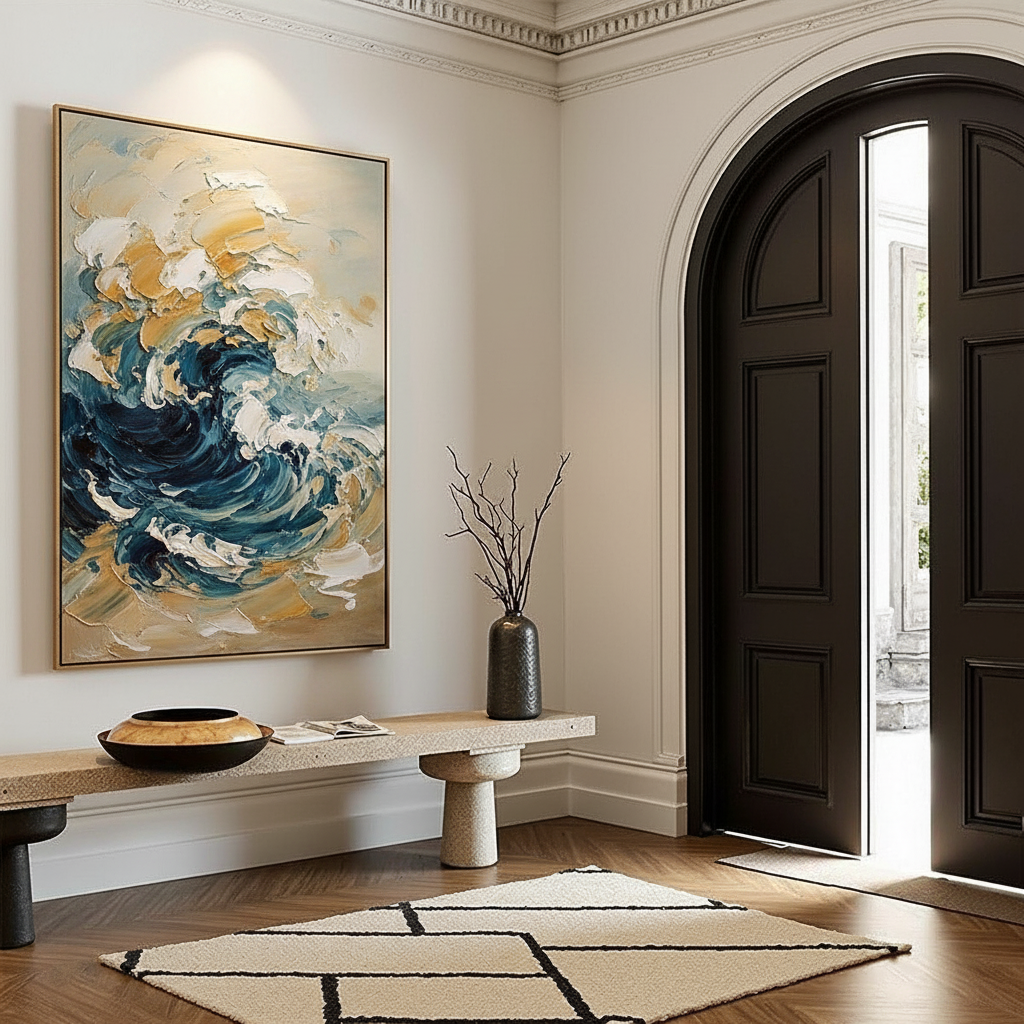
Hand-painted oils and acrylics offer a tactile dimension that prints cannot replicate. To maximize this, directional lighting is mandatory. We recommend a 3000K warm-white spotlight angled at approximately 30 degrees. This specific angle accentuates the impasto texture—the thick, raised strokes of "crashing waves"—creating micro-shadows that make the water feel kinetic and alive.
| Parameter | Recommended Value | Unit | Rationale |
|---|---|---|---|
| Hanging Height | 57 - 60 | Inches | Aligns horizon line with natural eye level |
| Lighting Angle | 30 | Degrees | Accentuates impasto texture and depth |
| Color Temperature | 3000 | Kelvin | Warm-white balance for restorative mood |
| Subject Tone | Cool Blues / Teals | N/A | Triggers 'receding' effect in small spaces |
| Paint Medium | Heavy Body Acrylic/Oil | N/A | Provides tactile relief for sensory engagement |
The Economic and Health ROI of Authentic Art
Investing in a custom hand-painted mural or large-scale canvas isn't just an aesthetic choice; it's a strategic one. For commercial developers and homeowners alike, the data supporting art as a value-driver is robust.
Property Valuation and Foot Traffic
A Royal Society analysis found that neighborhoods with higher "art" geo-tags saw greater relative house price ranking gains. In a commercial context, University of Cincinnati regression analysis of over 300 murals showed a direct correlation with significant pedestrian foot traffic increases. For a boutique hotel or a luxury clinic, a coastal mural in the entryway acts as a "permanent physical billboard" that generates engagement and brand trust.
Clinical Outcomes and Stress Reduction
The health benefits are even more quantifiable. A UPenn review noted that 61% of patients in clinical environments explicitly stated that artworks reduced their stress, while 73% reported significant mood improvements. Furthermore, the World Health Organization (WHO) has confirmed through thousands of studies that art interventions effectively alter clinical indicators for mental health.
Methodology Note (Modeling Restorative Impact): Our analysis of entryway restorative effects assumes a "standard transition" of 30–60 seconds of passive viewing. We model this as a non-pharmacological intervention that lowers cortisol markers, based on clinical tracking data from occupational therapy research.
Safety and Sustainability: The Chemistry of the Canvas
In the pursuit of a "healing" home, we must ensure the materials used are not counterproductive to indoor air quality. Traditional art materials can be surprisingly hazardous.
VOCs and Pigment Toxicity
The CDC NIOSH warns that chronic inhalation of volatile compounds in certain paints can lead to central nervous system neuropathy. Furthermore, the International Agency for Research on Cancer (IARC) classifies cadmium—a common pigment in vibrant yellows and reds—as a Group 1 carcinogen.
To protect residents, especially in homes with children or infants, we prioritize low-VOC and non-toxic alternatives. Aalto University research proves that specific coatings and modern acrylics emit significantly lower toxic VOCs during and after curing than traditional oil solvents like turpentine.
The "Green" Mural
For ESG-conscious clients, the sustainability of the substrate is also a factor. Hemp and flax canvases consume half the land and water of traditional cotton, providing a more ethical foundation for large-scale entryway installations.

Beyond the Frame: Biophilic Design in High-Density Spaces
The integration of water elements in entryways is a cornerstone of biophilic design—the practice of connecting humans with nature through the built environment. According to the University of Central Arkansas, biophilic landscapes produce the same stress-reduction effects in the brain as being outdoors.
In high-density urban environments like Tokyo or New York, where access to natural "blue spaces" is limited, hand-painted coastal art serves as a vital surrogate. Research on Tokyo office spaces shows that nature-based design effectively intervenes in high rates of cognitive fatigue and burnout. By placing these elements in the entryway, you ensure that the first and last thing a person experiences in their day is a neurological "breath of fresh air."
Navigating the 2026 Aesthetic Trends
As we look toward 2026, high-end interior design is trending toward "understated elegance" with texture as its soul. Zillow search data highlights a 21% rise in mentions of "artisan craftsmanship" and a 15% rise in "whimsy" (PA Realtors).
In the powder room—often the first stop for guests after the entryway—the trend is shifting toward "wrapping murals," creating immersive escapism. This aligns with the National Kitchen & Bath Association (NKBA) 2025 finalists, who frequently used panoramic hand-painted art to turn small, utilitarian spaces into jewel-box experiences.
Final Considerations for Entryway Curation
Selecting the right coastal piece requires a balance of emotional resonance and technical precision. We recommend avoiding the "decoration first" mindset. Instead, let the art dominate the visual nexus of the room. As seen in the Historic Hotels Worldwide collections, the most successful spaces are those where the interior colors and textures are "reverse-customized" to match the brushstrokes of the central mural.
By choosing authentic, hand-painted water elements, you are doing more than filling a wall. You are investing in a cultural heritage asset that supports local artists—who, as the NYC Comptroller notes, remain a vulnerable but vital part of the creative economy—while simultaneously engineering a sanctuary for your own mental well-being.
YMYL Disclaimer: This article is for informational purposes only and does not constitute professional medical, psychological, or financial advice. While visual art has been shown to have restorative effects, it should not be used as a substitute for clinical treatment for mental health conditions. Always consult with a qualified professional regarding health-related interventions or significant real estate investments.
Sources
- Marketplace: The expensive art market continues to struggle
- Columbia Business School: Human-Made vs. AI Art Study
- UPenn: Visual Art in the Built Environment Review
- Royal Society: Quantifying the link between art and property prices
- WHO: Scoping Review on Arts and Health
- NCBI: Neurological mechanisms of creative arts
- ASTM International: Standard Test Methods for Lightfastness
- CDC NIOSH: Paint and Coating Hazards