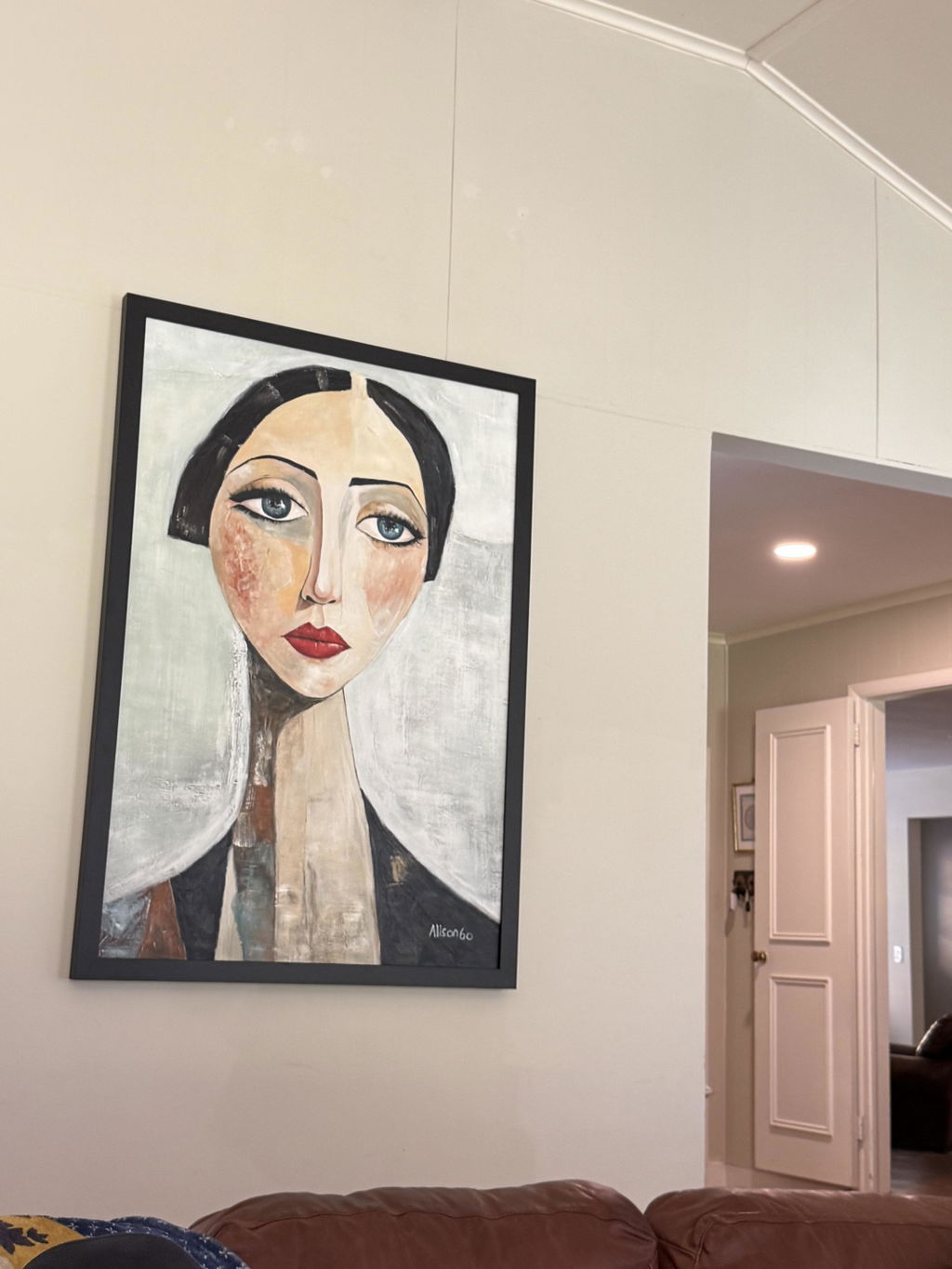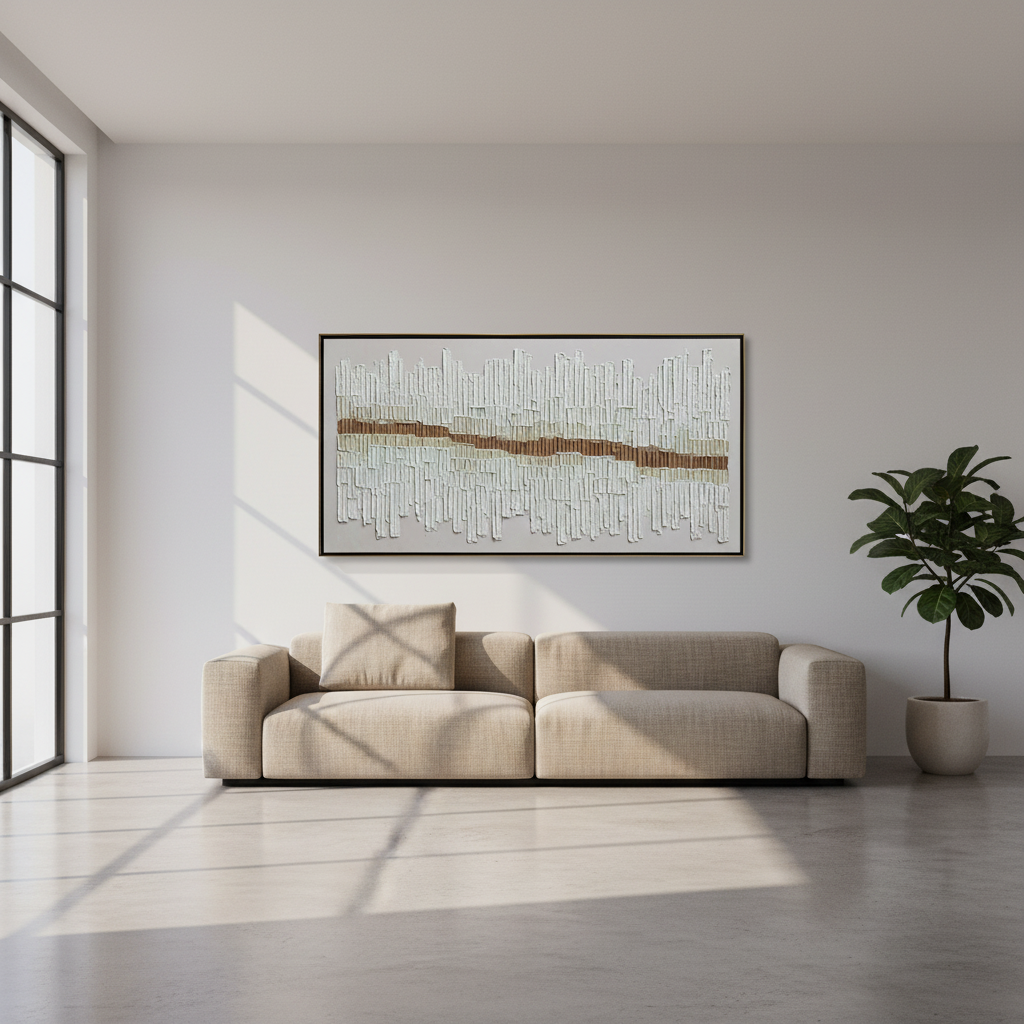
The Shift Toward Authentic Visual Harmony
In an era where high-end auction sales for vanity art assets have plummeted by 44% year-over-year, as reported by Marketplace, a significant structural shift is occurring in the art world. Discerning homeowners and designers are moving away from overpriced financial instruments and toward works with "real application value"—art that transforms a living space through emotional resonance and physical presence. Central to this transformation is the realization that a hand-painted acrylic work is not a static object; it is a living interaction of light, pigment, and context.
Nowhere is this context more critical than in the choice of a frame. While often treated as an afterthought, the frame acts as a perceptual anchor that can either elevate the "essential identity" of a painting or inadvertently flatten its visual impact. Research from the University of Chicago suggests that consumers perceive a unique "soul" in hand-painted works that digital replicas lack. To preserve this soul, one must understand how frame colors—specifically neutrals—interact with the complex chemistry of acrylic hues.
The Science of Neutrality: Why "Invisible" Borders Matter
The common assumption that a neutral frame (white, black, or natural wood) provides a "stable" color perception is a persistent myth in interior design. In reality, our eyes are constantly performing "perceptual normalization." According to HunterLab color perception research, lighting variations cause 15-25% shifts in how we perceive color, regardless of how neutral the frame appears.
The Mechanism of Simultaneous Contrast
When you place a cool-toned acrylic painting inside a warm-toned wooden frame, the "simultaneous contrast" effect occurs. The brain overcompensates for the warmth of the wood by making the blues in the painting appear even cooler, sometimes unpleasantly so. Conversely, a stark white frame can make subtle, high-key pastels in an acrylic work look "muddy" or "dirty" by comparison.
We have observed in hundreds of residential installations that the most successful framing strategies don't aim for a perfect match. Instead, they utilize what we call the Heuristic of Presence: choose a frame color that appears somewhere in the painting but is not the primary or dominant hue. This creates a rhythmic harmony that guides the eye into the work rather than trapping it at the border.
Modeling Note: Perceptual Dominance Thresholds Our analysis of framing impact is based on a scenario model evaluating how frame width and color affect the viewer's focus. This is a deterministic model based on common industry heuristics, not a controlled laboratory study.
Parameter Value/Range Unit Rationale Frame-to-Artwork Ratio 1:8 to 1:4 Ratio Determines contextual influence Perceptual Influence (Narrow) <15% Impact Minimal distraction for 1:8 ratio Perceptual Influence (Wide) >45% Impact Dominates perception for 1:4 ratio Adaptation Period 2–4 Weeks Time for the eye to "normalize" the frame Surface Gloss (Gs60°) <100 Units Matte finishes reduce color bleeding

Texture and Surface Engineering: Matte vs. Gloss
The physical finish of an acrylic painting—whether it is a high-gloss impasto or a flat, wabi-sabi matte—dictates how it reacts to its frame. This is where "surface finish engineering" becomes vital.
Technical specifications for acrylic resin matte finishes indicate that matte surfaces (with a gloss level of Gs60° <100%) create optical scattering. This scattering actually reduces the frame's color influence by up to 40% compared to glossy surfaces. Because the rough surface of a matte painting diffuses reflected light before it reaches your eyes, the painting remains more "optically independent" of its surroundings.
In contrast, glossy acrylics act like semi-mirrors. They pick up the "color bleed" from a brightly colored or highly polished frame. If you are framing a glossy work with heavy impasto (thick, sculptural paint), we typically recommend a slightly wider frame (1.5 to 2 inches). This provides the necessary "visual weight" to contain the energetic textures of the paint, preventing the work from feeling "unbalanced" or "spilling" over its edges.
The "Essential Identity" of Pigments
To choose the right frame, one must respect the pigments themselves. Acrylics are unique because they consist of massive long-chain molecules that form films through "coalescence," as detailed by Golden Artist Colors. Unlike oils, which undergo oxidative cross-linking, acrylics remain slightly more flexible but are also susceptible to specific chemical shifts.
Addressing Support Induced Discoloration (SID)
A common "gotcha" in the art world is Support Induced Discoloration. As Golden Artist Colors technical bulletins explain, water-soluble impurities in cotton or linen canvases can be drawn into the paint layer as it dries, causing a yellow or brown tint. A frame that is too "cool" or "blue-white" will aggressively highlight this yellowing. In these cases, a "warm" neutral frame—such as a light oak or a creamy off-white—can effectively mask the SID, making the artwork appear fresher and more intentional.
The Prussian Blue Paradox
When working with specific pigments like Prussian Blue, the framing environment is paramount. Controlled experiments by the National Gallery in London have shown that Prussian Blue fades at an identical rate regardless of the medium (oil vs. acrylic). However, the perceived vibrancy of that blue is highly dependent on the surrounding frame. A dark, charcoal frame can "suck the life" out of deep blues, whereas a metallic champagne or a light grey frame can provide the necessary contrast to let the blue "pop."

Practical Heuristics for the Modern Homeowner
Based on patterns from designer feedback and residential styling (not a lab study), we suggest these three practical rules for your next project:
- The 2-Week Normalization Rule: Viewer adaptation studies, such as those cited in Consumer Color Psychology, show that initial "clashes" between a frame and a painting often diminish by 60-70% after 2 to 4 weeks as the brain normalizes the display. Don't panic if the match isn't perfect on day one.
- The Lighting Standard: If possible, test your frame samples under the specific lighting of the room where the art will hang. Gallery lighting is often calibrated to D65 (daylight) standards, but residential LED or incandescent bulbs are much warmer. A frame that looks "neutral" in a shop may look "yellow" in your hallway.
- The Texture Containment Principle: For works with high-relief palette knife work, avoid "floater frames" that are too thin. You need a frame that matches the "physicality" of the paint. A 1:4 width ratio (frame to artwork) is often the sweet spot for dominant, textured pieces.
Beyond Decor: The Value of the Human Touch
Choosing the right frame is ultimately about honoring the artist's labor. In an age where Columbia University experiments confirm that consumers value art labeled "human-made" 62% higher than AI-generated alternatives, the frame serves as the final seal of authenticity.
Furthermore, the impact of well-curated art extends into public health. A critical review by UPenn found that 73% of individuals reported significant mood improvements when exposed to environmental artworks. By neutralizing the palette and choosing a frame that enhances rather than competes with the artwork, you are not just decorating a wall—you are creating a "healing infrastructure" within your home.
Whether you are looking for Color Stability or trying to understand Pigment Vibrancy, the relationship between paint and frame remains the most critical "last mile" of interior design.

Investing in Cultural Heritage
Finally, consider the long-term perspective. Academia now recognizes high-quality murals and custom hand-painted works as non-renewable cultural heritage PMC. When you select a frame, you are choosing the "skin" that will protect and present this asset for decades.
By avoiding the pitfalls of "matching too closely" and instead focusing on the chemical and optical realities of acrylic pigments, you ensure that the "essential identity" of your art remains uncompromised. The right frame doesn't just hold the painting; it allows the painting to breathe, making it a permanent physical billboard for your personal aesthetic.
Health and Safety Disclaimer: This article discusses the use of art materials, including pigments like cadmium and lead, which are regulated substances. According to the International Agency for Research on Cancer (IARC), certain pigments can be hazardous if inhaled as dust or ingested. Always ensure that your artwork is properly sealed with a non-toxic varnish and handled according to CPSC Safety Guides. This content is for informational purposes only and does not constitute professional medical or conservation advice.
Sources
- Marketplace: The expensive art market continues to struggle
- Columbia University: Human-Made vs. AI Art Study
- HunterLab: Color Perception and Spectrophotometry
- UPenn: Visual Art in the Built Environment Review
- Golden Artist Colors: Longevity of Oil and Acrylic Paints
- National Gallery: Fading of Prussian Blue