The Psychology of the First Impression: Beyond "Wall Availability"
The moment a guest crosses the threshold of your home, their subconscious performs a rapid-fire audit of the environment. Within milliseconds, the brain processes light, volume, and focal points to determine the "emotional temperature" of the space. In interior design, the entryway serves as the living room’s preamble—a high-stakes visual handshake. Yet, we often see homeowners stumble at this critical juncture by falling into the "Wall Availability" trap.
The Wall Availability trap is a common sizing error where art is selected based on the physical dimensions of an empty wall rather than the viewer’s actual sightlines. In our consulting experience, we frequently observe homeowners choosing massive canvases that fill a wall but completely overwhelm the narrow entryway corridor. This creates visual tension rather than a sense of welcome.
According to the Marketplace report on the struggling high-end art market, sales of overpriced vanity auction pieces plummeted 44% in 2024. This shift indicates that modern buyers are retreating from purely financial art assets and returning to "real application value." For the aesthetic-driven home improver, this means prioritizing how a piece functions within the physical architecture of the home.

The Physics of Perception: The 60-75% Heuristic
To solve the sizing uncertainty, we utilize a specific practical baseline: The Sightline Width Heuristic. Instead of measuring the wall itself, measure the distance from the primary doorway to the wall where the art will hang.
Modeling Note (Scenario Model): Our sizing recommendations are based on a deterministic parameterized model of human field-of-view (FOV) constraints within residential corridors.
Parameter Value/Range Unit Rationale Standard Entryway Width 3.5 – 5.0 Feet Common US residential architectural standard Optimal Visual Field (Central) 40 – 60 Degrees Human binocular vision comfort zone Viewing Distance (D) 4 – 8 Feet Distance from doorway to focal wall Art Width Ratio (W) 60 – 75% % of D Heuristic to prevent "visual crowding" Clearance (Vertical) 8 – 12 Inches Minimum gap from ceiling to avoid "squash" Boundary Conditions: This model assumes a single-point entry. For "gallery-style" foyers with multiple access points, the ratio typically shifts toward 50% to accommodate varying angles.
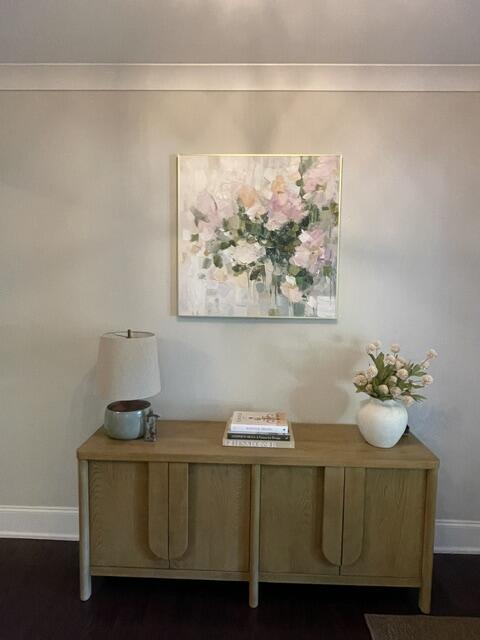
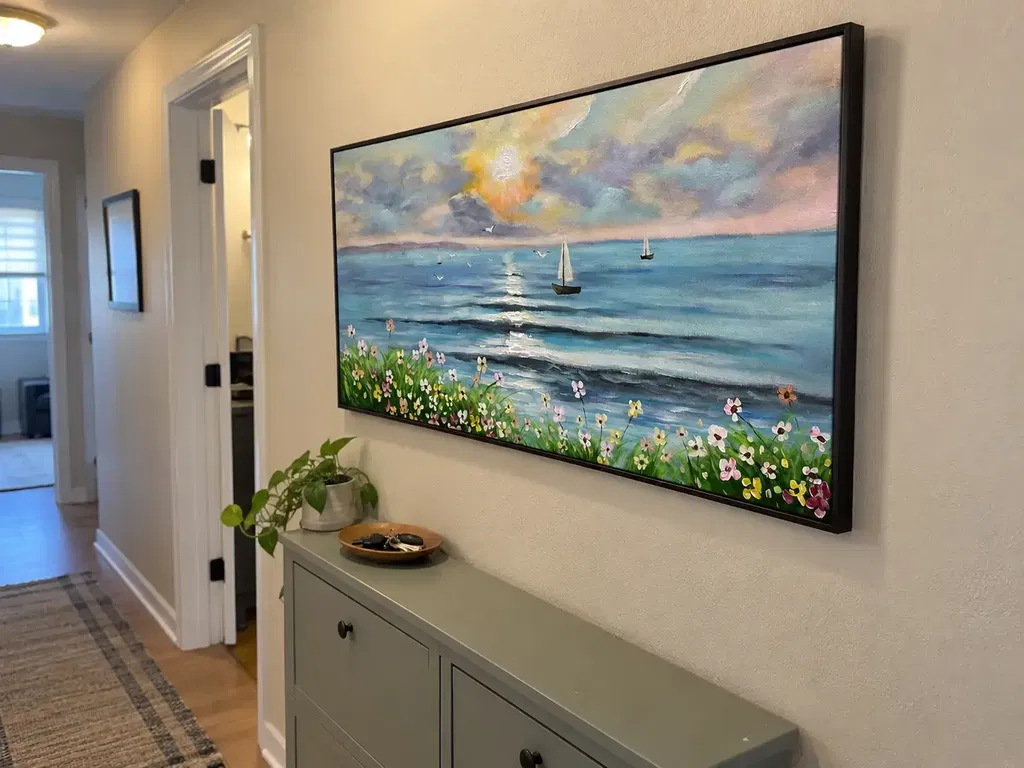
Based on this analysis, the artwork width should be approximately 60-75% of the distance from the doorway to the wall. For example, if your entryway is 6 feet deep, a piece roughly 43 to 54 inches wide provides proportional harmony. This ensures the art commands authority without visually "closing in" on the viewer as they enter.
The Problem with the Golden Ratio in Small Spaces
While many designers suggest the Golden Ratio (2/3 wall coverage), empirical research suggests that for entryways with a limited viewing distance of 6 feet, the optimal width ratio actually drops to 40-50% of the wall width to maintain comfort. As we've detailed in our Viewing Distance Guide, the detail of the art must match the room's scale. If the piece is too large for a narrow hall, the viewer's eye cannot "take in" the composition, leading to a fragmented and stressful cognitive experience.
Solving the Narrow Entryway: Verticality and Clearance
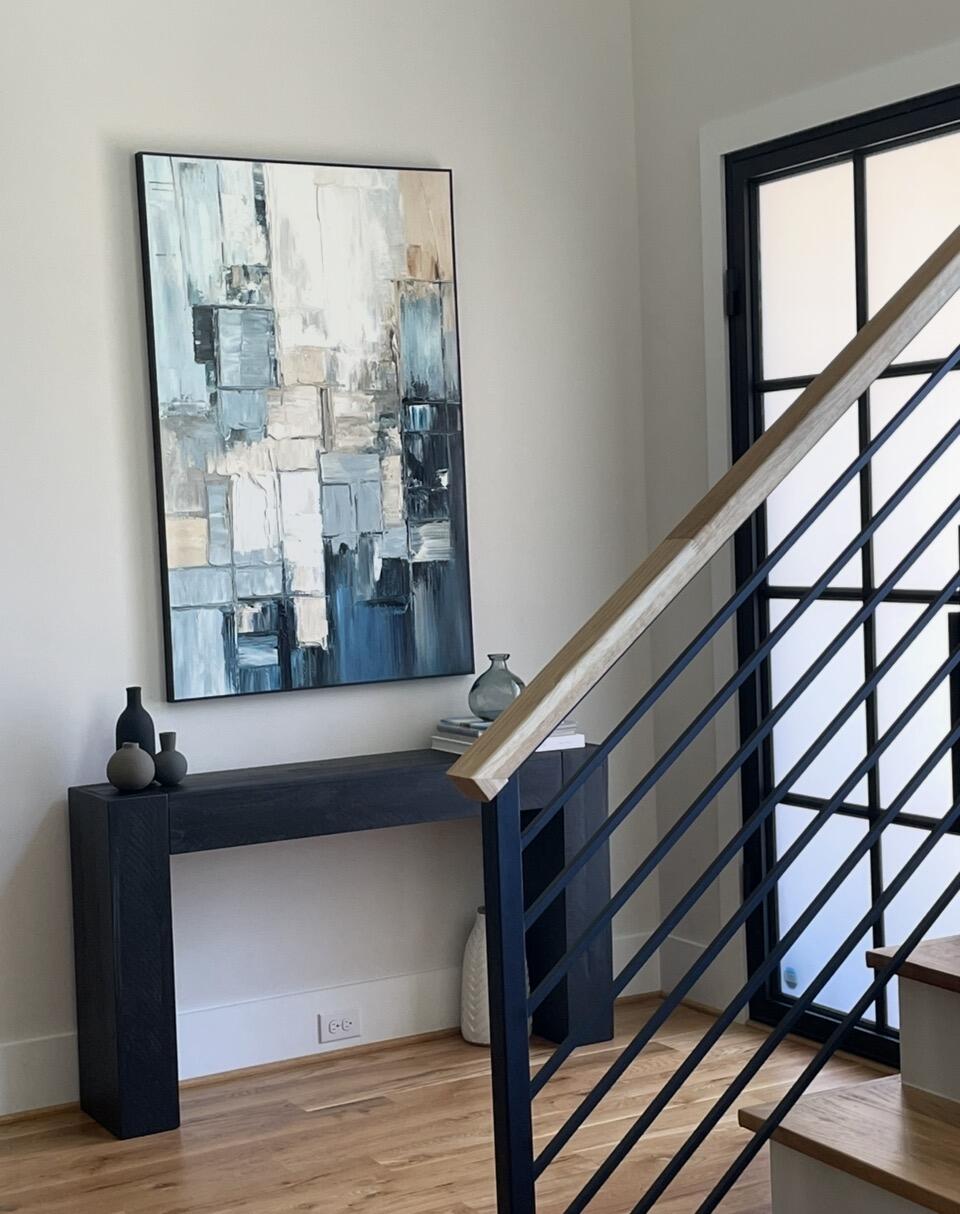
For unusually narrow entries (less than 5 feet wide), horizontal pieces are almost always a mistake. They accentuate the "tunnel effect" of the corridor. Instead, we recommend a vertical orientation with a limited width—typically under 24 inches.
The "Squash" Factor
Another frequent error is hanging art too high relative to the ceiling. Even when following the "eye-level" rule, you must maintain an 8-12 inch clearance from the ceiling. Failing to do so creates a "squashed" appearance that makes the ceiling feel lower and the entryway more cramped.
In our pattern recognition from design audits, we've found that the 57-60 inch "museum standard" is often too high for residential entryways, especially those serving diverse demographics. According to research on art placement, children and wheelchair users require focal points at 36-48 inches. A successful entryway accommodates the "Controlled Exposure" preference—where 42% of homeowners prefer art that is visible only upon intentional entry, acting as a transitional buffer between the public street and the private living room.

The "Nuclear Weapon" of Authenticity: Human-Made vs. AI
In an era of mass-produced prints and AI-generated imagery, the "first impression" is increasingly defined by texture and soul. A study by Columbia University confirmed that consumers value art labeled as "AI-generated" 62% lower than authentic, human-created work.
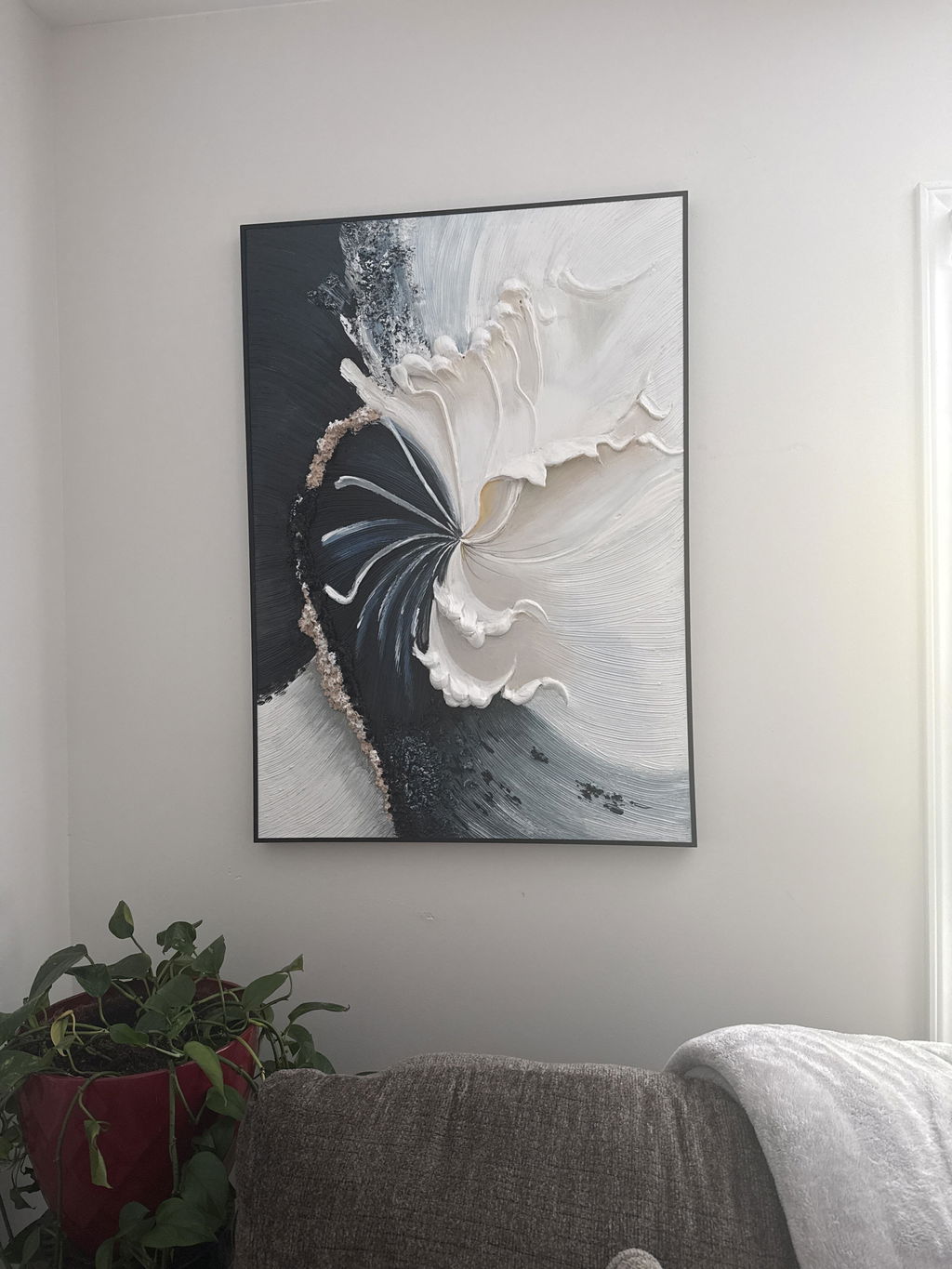
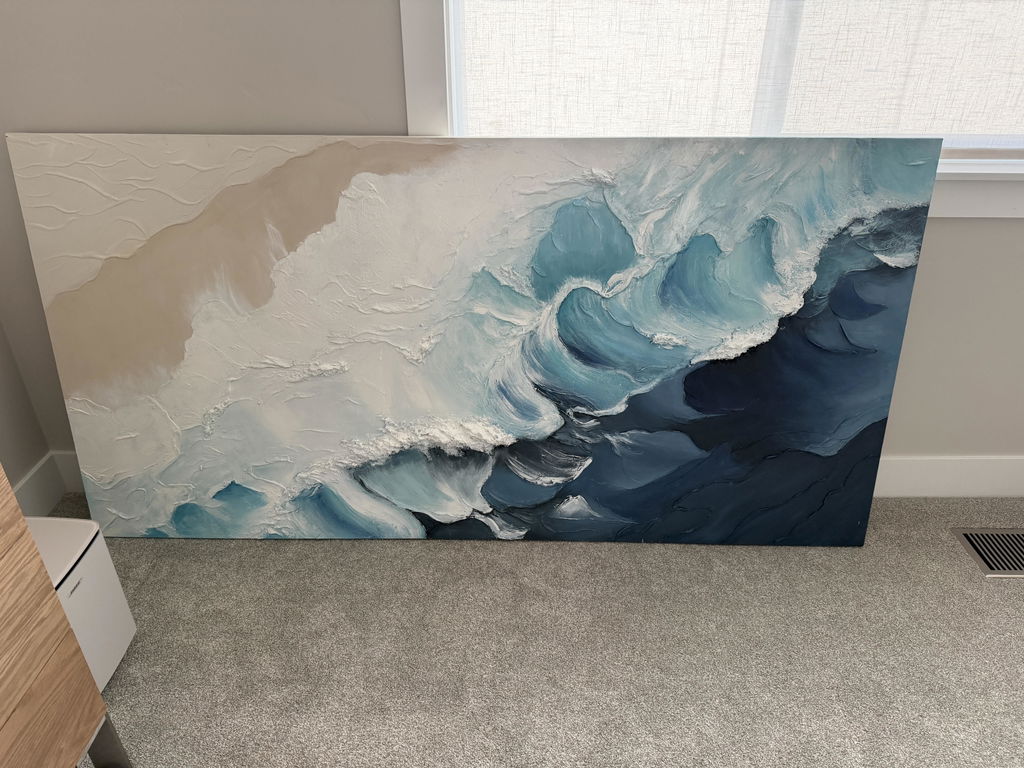
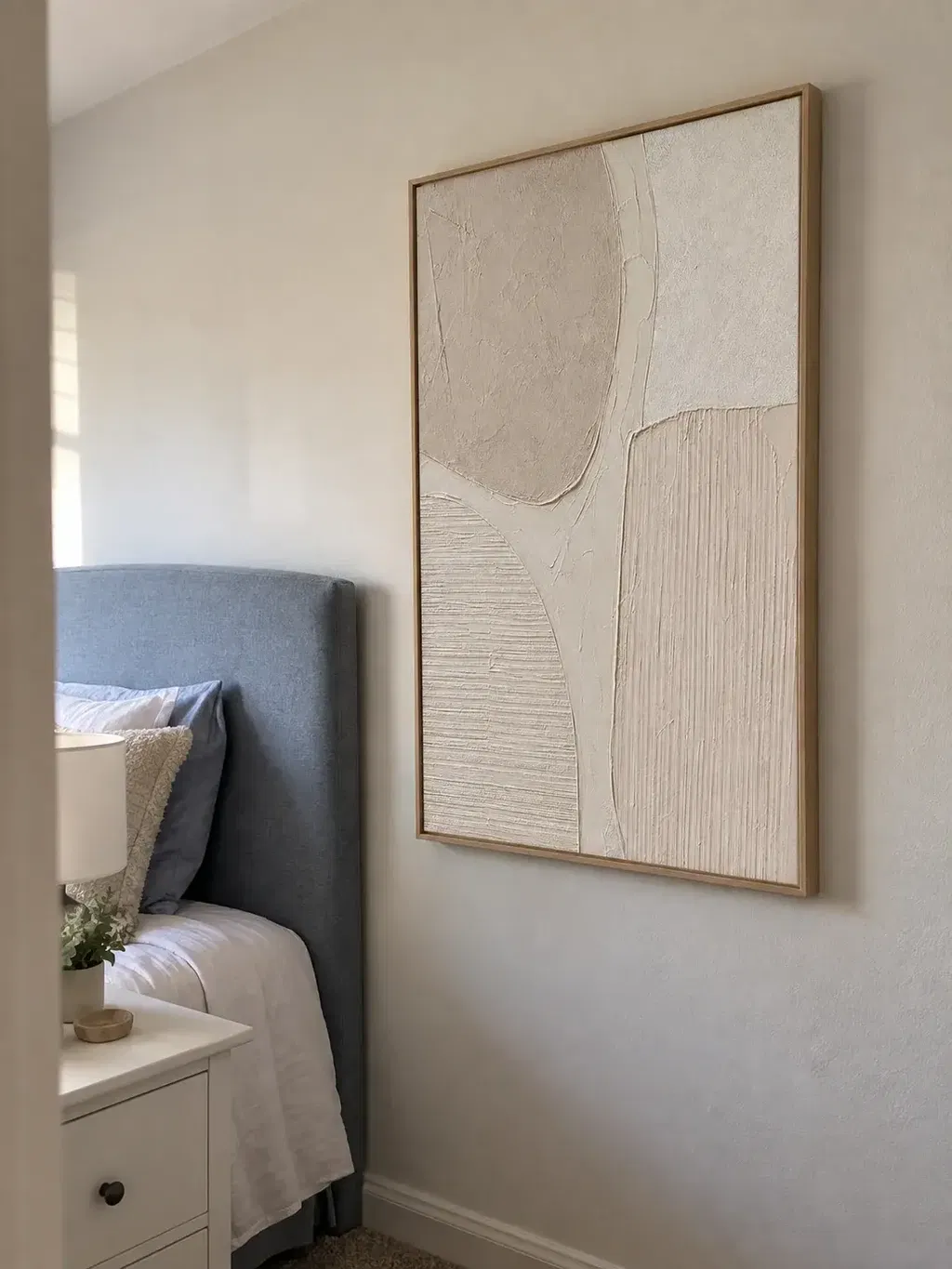
This isn't just snobbery; it's biology. Hand-painted canvases possess a "microtopography"—millimeter-scale textures created by the physical layering of pigments. According to research published in Sensors (MDPI), this physical relief is crucial to aesthetics. When light hits a hand-painted surface, the absorption and scattering coefficients of the pigments create a depth that flat prints cannot replicate.
The Optical Edge of Pigments
Why does a hand-painted mural feel so much more "alive" than a poster?
- Light Scattering: According to Optica, when pigment particles approach half the wavelength of visible light, opacity and scattering reach their theoretical extremes.
- Intrinsic Motivation: Tests at the MUNCH Museum confirm that physical relief textures exponentially stimulate viewer satisfaction and "intrinsic motivation" to engage with the space.
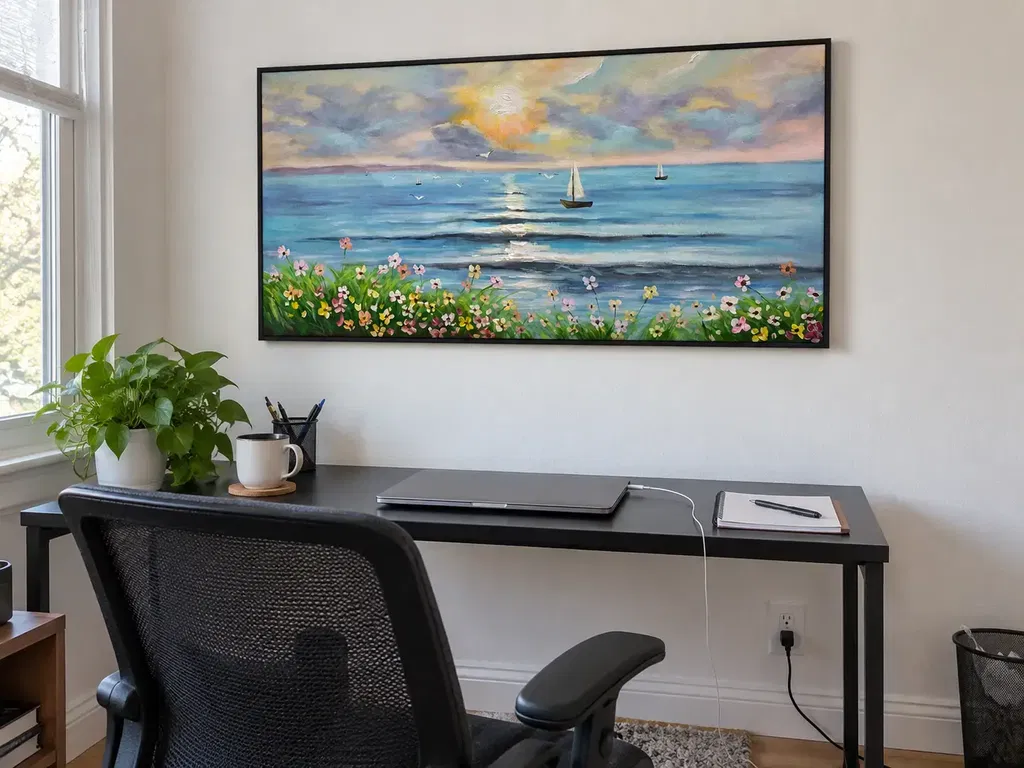
For a homeowner, this means a custom mural or hand-painted canvas acts as a "permanent physical billboard" for the home’s quality. It signals that the environment is curated, not just "decorated."
Health, Safety, and the "Indoor Air Quality Promise"
When selecting art for the entryway—a space that often lacks the heavy ventilation of a kitchen—material safety becomes paramount. Many cheap decorative prints use industrial inks that emit Volatile Organic Compounds (VOCs).
The EPA warns that indoor air pollution can be significantly higher than outdoor levels. To protect your family, especially in high-traffic entry points, you should prioritize materials that meet strict safety standards.
- VOC Curing: Research from Aalto University shows that while paints do emit VOCs during application, high-quality coatings on wood or canvas see a "plummet" in emissions during the curing process.
- The ASTM D4236 Trap: Be aware that the ASTM D4236 label on art supplies only means the warning labels comply with regulations, not that the pigment is non-toxic.
- Heavy Metal Risks: Laboratory tests have detected heavy metals like zinc and cadmium in some artist paints. For homes with children, we recommend water-based acrylics that pass the BS EN 71-3 standard for heavy metal migration.
By choosing professional-grade, hand-painted art that adheres to these safety frameworks, you ensure that your "first impression" isn't just beautiful, but healthy.
The Economic Impact: Art as a Value Multiplier
Investing in entryway art isn't just an aesthetic choice; it’s a strategic financial one. The Royal Society found a direct correlation between high "art" geo-tags and relative house price gains.
In the commercial sector, the ROI is even more pronounced. Americans for the Arts reports that government tax investments in the arts yield a 7:1 ROI. For a homeowner, a well-scaled, hand-painted entryway piece serves a similar "catalytic effect," masking architectural flaws and increasing the perceived value of the entire property before a visitor even reaches the living room.
Biophilic Design and Well-being
Integrating natural landscapes into your entryway art can also provide a "nature-themed healing" effect. According to a UPenn review, 73% of patients reported significant mood improvements when exposed to environmental artworks. In a home setting, this translates to reduced stress for the residents every time they return from work.

Implementation Guide: The Designer's "Mock-Up" Test
To ensure your sizing is perfect, we recommend the Photography Mock-Up Test.
- Calculate the Ratio: Use our 60-75% heuristic based on your viewing distance.
- Create a Temporary Frame: Use painter's tape to mark the calculated dimensions on the wall.
- The Doorway Shot: Stand at the primary doorway and take a photo.
- Review the Image: The camera lens often reveals "visual crowding" that the naked eye ignores. Does the taped-off area feel authoritative, or does it feel like it's "squeezing" the doorframe?
Variable Clearance Zones
Remember that entryways are dynamic. During "rush hours" (morning departures or evening arrivals), the space around your art may be compromised by bags, coats, or umbrellas. We recommend maintaining a 12-inch minimum clearance during static periods, but our modeling suggests that a temporary "compression" to 3-6 inches during active use is acceptable as long as the primary sightline remains clear.
Summary: A Strategic Welcome
Sizing art for your entryway is a move from "decorating" to "spatial solutions." By moving away from the "Wall Availability" trap and adopting a viewer-centric approach—grounded in viewing distance and the 60-75% heuristic—you create a space that feels professionally curated and emotionally resonant.
As we've seen, the shift toward Artisan Craftsmanship (up 21% in search trends) and the rejection of AI-generated prints underscores a fundamental human desire for authenticity. Whether you are Scaling Large Acrylics for Open-Plan Areas or Balancing Textured Art with Minimalist Decor, the goal is the same: to use the living room’s first impression as a bridge to a more comfortable, high-value home.
Disclaimer: This article is for informational purposes only. When hanging heavy artwork, always consult with a professional installer to ensure wall stability and safety. If you have sensitivities to paint fumes, ensure the space is well-ventilated during the initial installation period.
References & Sources
- Marketplace: The Expensive Art Market Struggles
- Columbia Business School: Human vs. AI Art Perception
- UPenn: Visual Art in the Built Environment
- Royal Society: Art and Property Prices
- EPA: Indoor Air Quality and Low-VOC Paints
- Sensors Journal: Tactile Fruition of Artworks
- CDC NIOSH: Paint and Coating Hazards