Competing with the Screen: Sizing Art Near Large Televisions
The modern living room often centers around a "black hole"—the large, dormant television screen. As screens grow to 75 inches and beyond, they exert a massive gravitational pull on a room's aesthetic. Without a strategic counterweight, the technology doesn't just inhabit the space; it dominates it.
We often see a recurring frustration in our design consultations: a beautifully curated room that feels "off" because a small piece of art is trying, and failing, to compete with a high-definition screen. This isn't just an aesthetic whim; it is a matter of visual weight and neurological attention. To restore harmony, we must look at art not as a decorative accessory, but as an architectural partner capable of balancing the digital void.
The Rise of Physical Value in a Digital Age
Recent shifts in the art market suggest a return to tangible, emotional value over purely financial or digital assets. While high-end auction sales for vanity pieces plummeted 44% in 2024, according to Marketplace, there is a growing retreat toward art with "real application value." Consumers are increasingly choosing custom, hand-painted works that provide a physical presence—something a flat-screen pixels cannot replicate.
This preference is backed by a Columbia University study which found that consumers value art labeled as "AI-generated" 62% lower than authentic human-created work. In a living room dominated by a machine, the human touch of a hand-painted canvas provides the necessary "essential identity" that University of Chicago research suggests is missing from digital replicas.

The Heuristics of Scale: The 2/3 Rule and Beyond
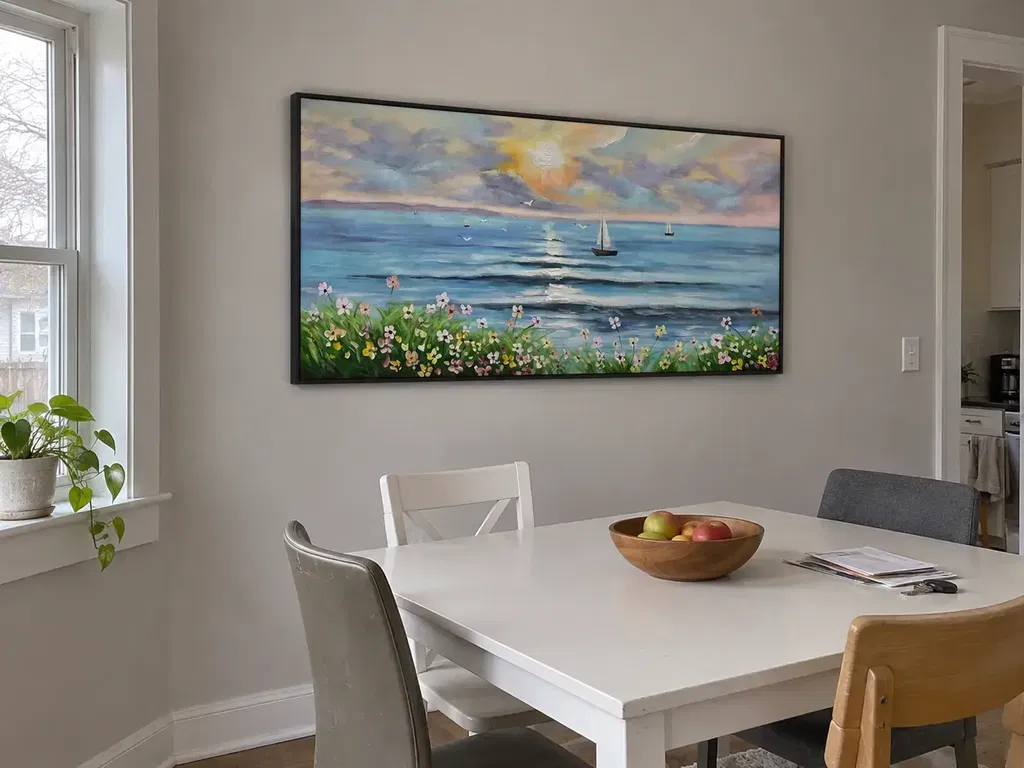
The most common mistake we observe is the "floating postage stamp" effect—placing a medium-sized canvas directly above a large TV. This makes the art look like a secondary accessory. To create a focal point that holds its own, we rely on specific sizing heuristics.
The Width Ratio
In most cases, art width should be at least 2/3 to 3/4 of the TV's width. If your TV is 65 inches wide (roughly a 75-inch screen), your art or art grouping should span at least 43 to 48 inches. Anything smaller appears visually insignificant because screens automatically capture attention due to their inherent brightness and contrast.
The Impossible Proportion Zone
Our analysis of spatial harmony suggests that once a TV exceeds 75 inches, a "proportion zone" is created where standard art sizes fail. Research published in NCBI indicates that motion and brightness capture attention so effectively that art smaller than 60% of the TV's width essentially disappears from the viewer's subconscious hierarchy.
Logic Summary: Our sizing recommendations are based on common patterns from interior design practice and visual weight heuristics, not a controlled laboratory study. These ratios are intended as a self-check for quick selection.
| Parameter | Value or Range | Unit | Rationale / Source Category |
|---|---|---|---|
| Minimum Art Width | 60 - 75 | % of TV Width | Visual Weight Heuristic |
| Mounting Height | 60 - 70 | Inches from Floor | Seated Eye-Level Standard |
| Brightness Compensation | 3:1 | Ratio | Attention Zone Modeling |
| Contrast Ratio Target | 70+ | % Saturation | Neurological Competition |
| Texture Depth | 2 - 5 | Millimeters | Light Diffraction Baseline |
Neurological Dominance: Why Screens "Win"
To understand why art must be sized aggressively, we must look at the Colavita visual dominance effect. This neurological mechanism explains how certain stimuli—specifically those with high brightness and motion—automatically suppress other visual inputs. A TV, even when off, represents a high-contrast "event" in the room.
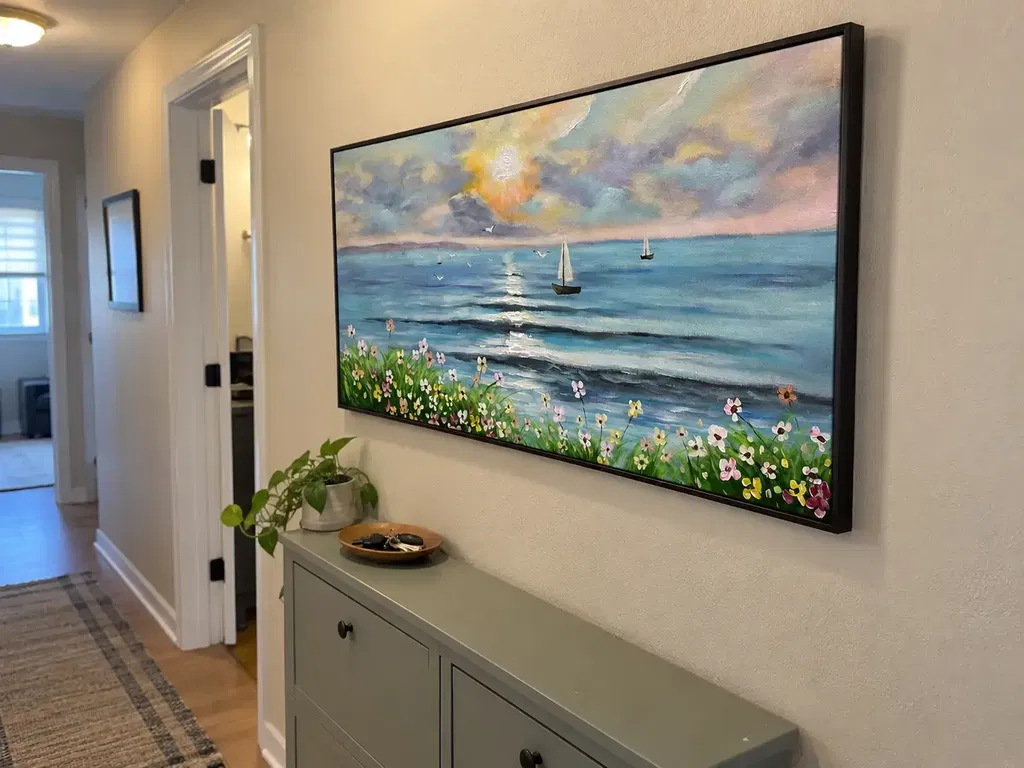
When the TV is on, it typically operates with a 1000:1 contrast ratio and 400+ nits of brightness. To compete, adjacent art requires high color saturation (minimum 70%) and physical texture. Hand-painted canvases with physical depth catch ambient light differently than flat prints, allowing the art to "shimmer" and hold its own against the glossy screen.
Creating Attention Windows
If a TV is used for more than 8 hours daily, we recommend placing art outside the 30-degree viewing cone. This prevents the art from becoming "visual noise" that contributes to cognitive fatigue. Instead, position art on an adjacent wall or anchor it opposite the TV to create a balanced visual weight across the entire room. This is particularly effective in scaling large acrylic canvases for open-plan living rooms.

The Texture Advantage: Physics vs. Pixels
The irreplaceability of hand-painted pigments lies in their microtopography. Optical microprofilometry proves that the mm-scale texture of oil and acrylic paintings is crucial to their aesthetic impact. According to a study in Sensors, tactile exploration and the way light hits physical relief reveal data that the human eye misses in flat digital prints.
This physical relief—the "soul" of the canvas—is what allows art to feel "alive." It is why nature-themed healing murals produce the same stress-reduction effects in the brain as being outdoors, a phenomenon that flat screens often struggle to replicate without causing eye strain.
Technical Insight: The SID Phenomenon
When selecting large canvases, technical quality matters. A common issue we see in high-volume, low-quality art is Support Induced Discoloration (SID). As noted by Golden Artist Colors, water-soluble impurities in cheap cotton substrates can be drawn into the paint film, causing yellowing over time. For a living room art piece intended to last decades, ensuring a high-quality, properly primed substrate is essential for maintaining the "99.9% match" and visual purity that sophisticated home improvers demand.
Scenario Analysis: Choosing Your Strategy
How you size your art depends heavily on your room's layout and how you use your technology.
Scenario A: The Media-Centric Living Room
- The Setup: A large 85-inch TV is the primary focus, used daily for cinema and gaming.
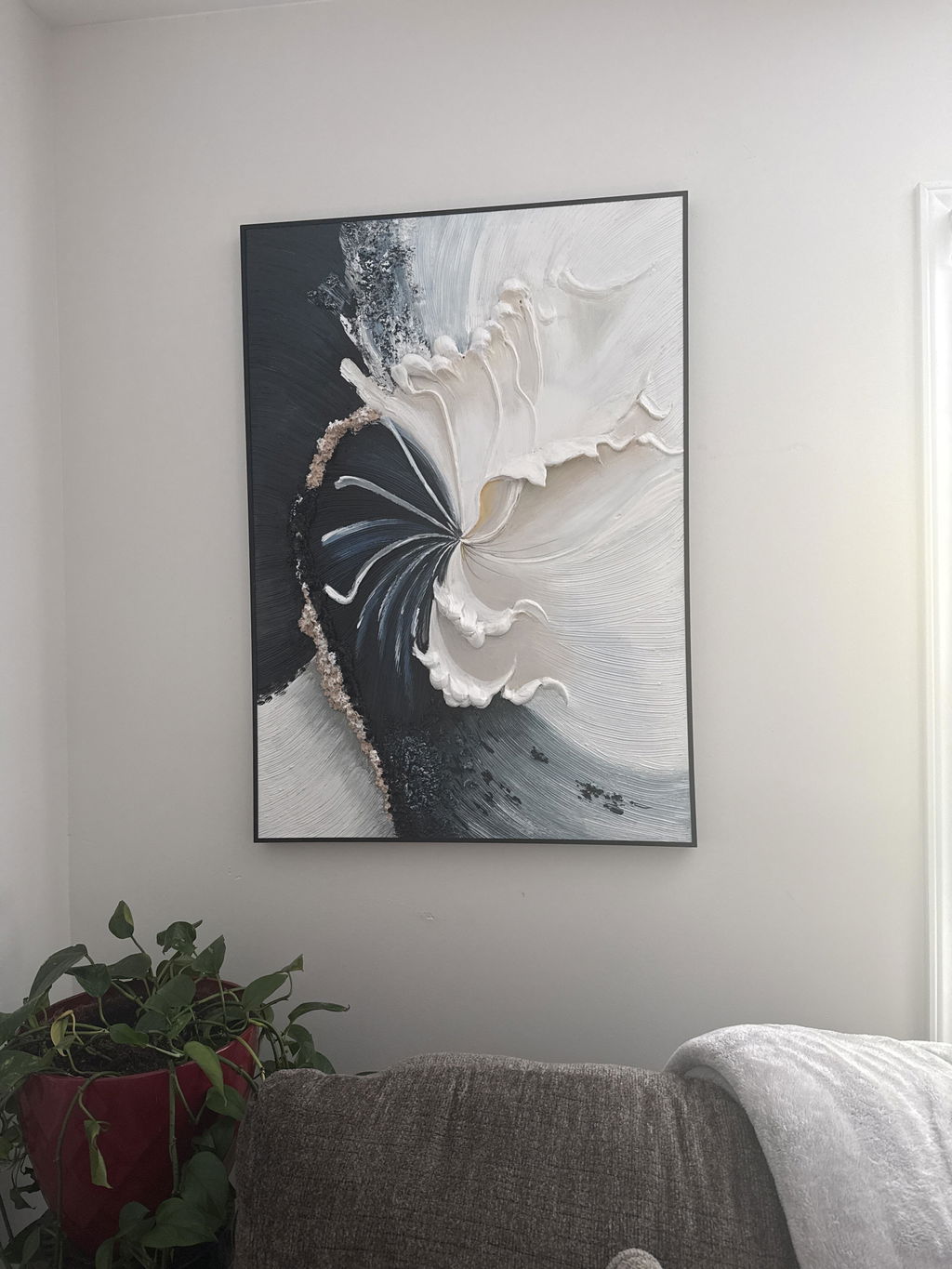
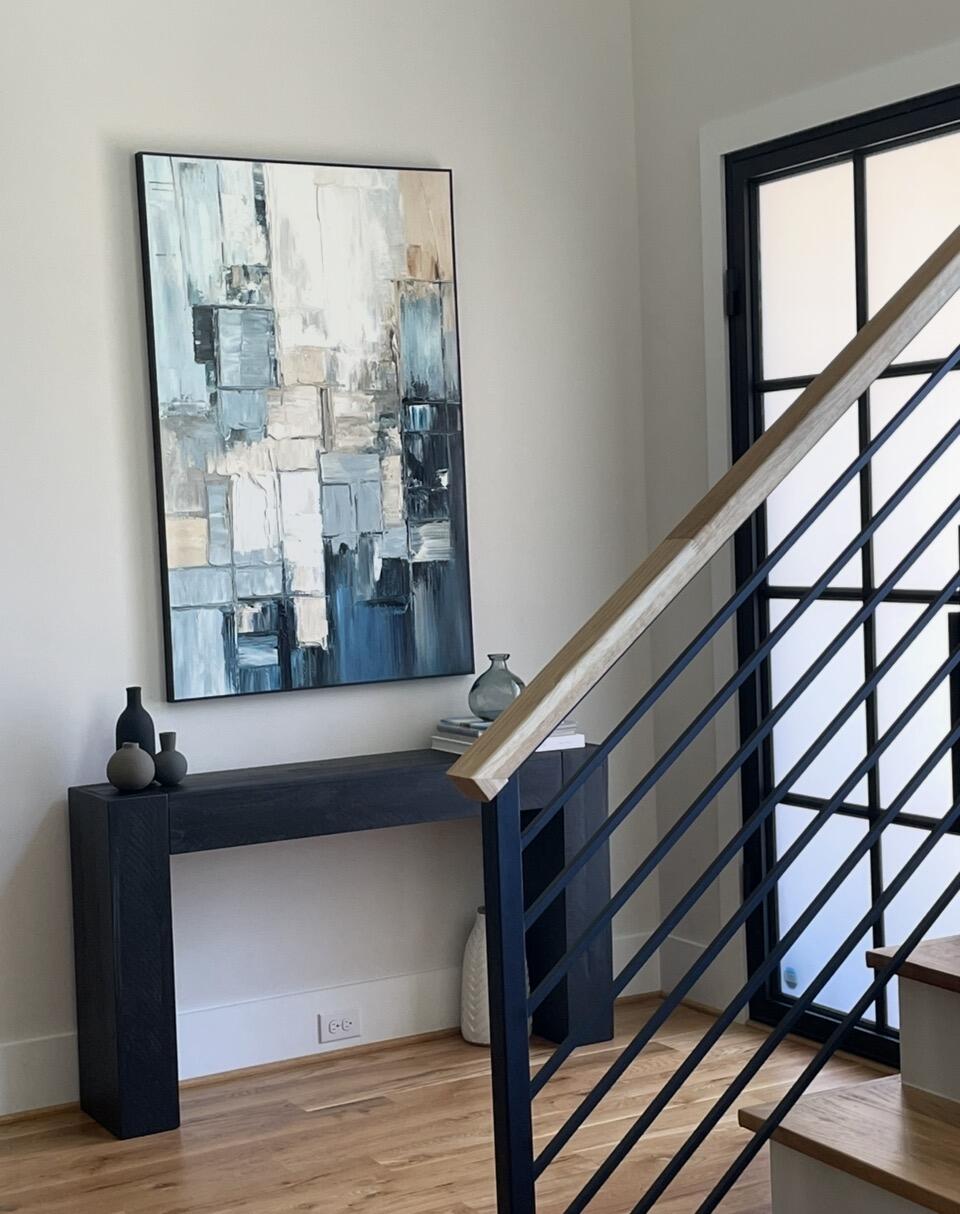
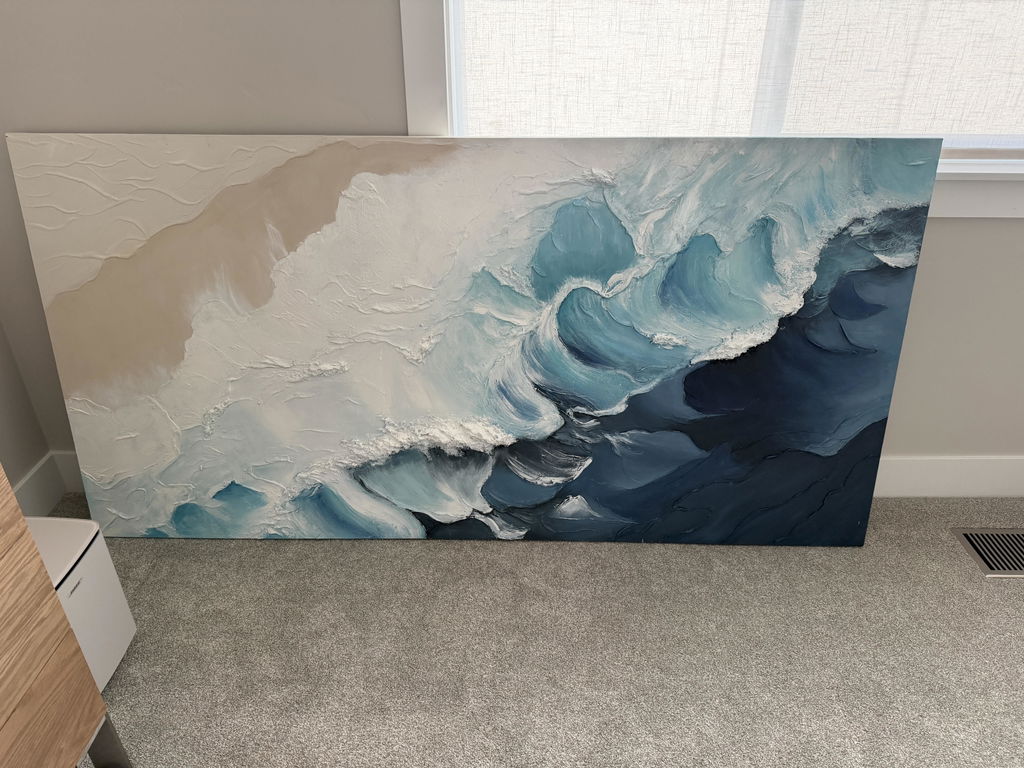
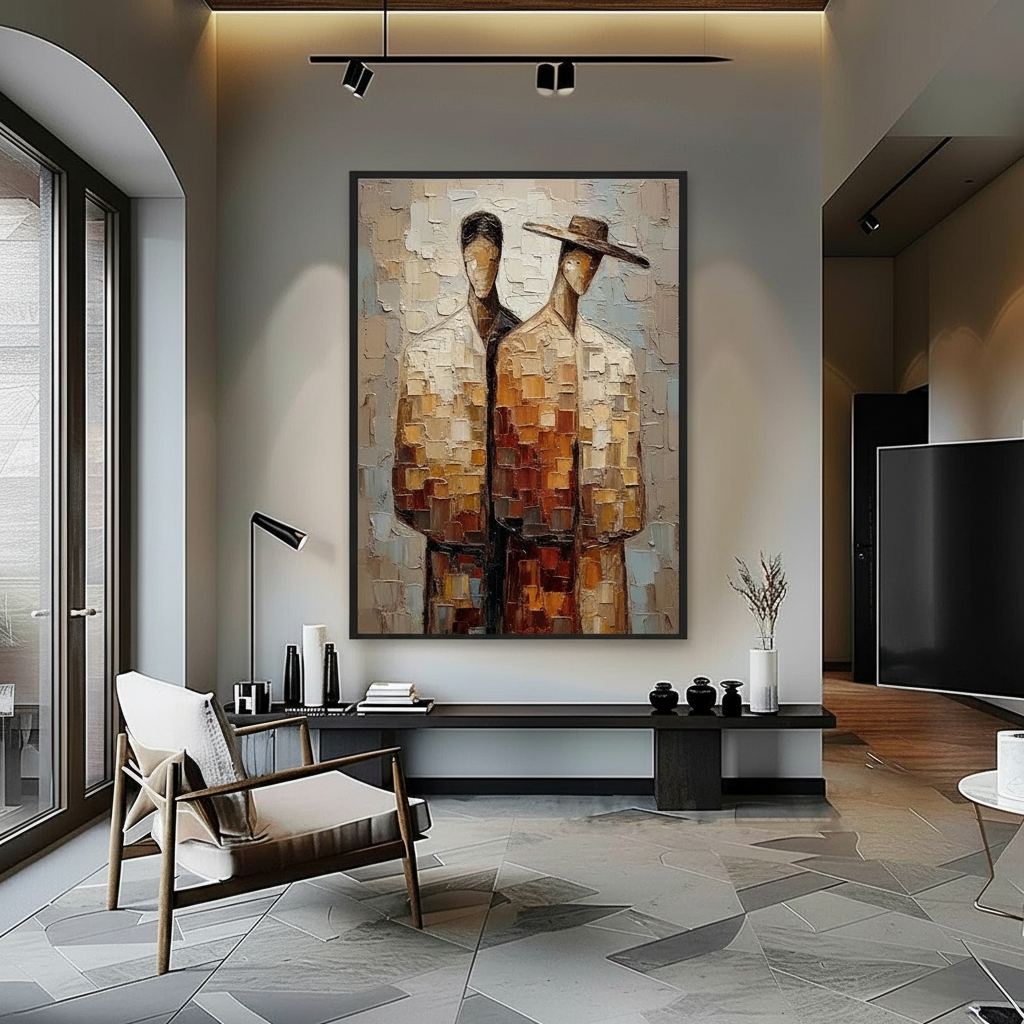
- The Art Strategy: Avoid placing art directly above or below the screen. Instead, use an asymmetrical arrangement. Place a single, oversized vertical canvas on the wall adjacent to the TV. This creates a secondary "attention window" that doesn't compete for the same vertical axis as the screen.
- Why it works: It respects the TV's primary attention zone while providing a resting place for the eyes during breaks.
Scenario B: The Formal Gallery Lounge
- The Setup: The TV is hidden (e.g., a "Frame" TV or behind cabinetry) or used infrequently.
- The Art Strategy: Use a gallery wall grouping that spans 1.2 to 1.5 times the width of the TV. By surrounding the screen with varied textures and frames, you "absorb" the technology into the art display.
- Why it works: It de-emphasizes the machine and prioritizes the curation strategies for small-space apartment living rooms that value "whimsy" and artisan craftsmanship.
Safety and Sustainability: The Indoor Environment
When placing large-scale art in the home, health is as important as harmony. Many traditional oil paints contain toxic pigments, such as cadmium or lead carbonates. The International Agency for Research on Cancer (IARC) classifies cadmium compounds as Group 1 carcinogens, which can be hazardous if handled improperly or if dust is inhaled during restoration.
For indoor living spaces, we advocate for low-VOC (Volatile Organic Compound) acrylics or water-based oils. Research from Aalto University confirms that modern coatings on moisture-controlled substrates emit significantly lower toxins than older industrial alternatives. Furthermore, choosing sustainable materials—such as hemp or flax canvases which consume half the water of cotton, as noted by the Cincinnati Art Museum—aligns with the values of the modern, eco-conscious consumer.

The Economic and Social Impact of Authentic Art
Investing in hand-painted art isn't just a design choice; it is a property value strategy. A Royal Society analysis found a direct link between "art-dense" environments and relative house price gains. In commercial settings, the impact is even more pronounced: public art projects in Chicago's Millennium Park drove $1.4 billion in real estate-related growth.
On a personal level, the World Health Organization (WHO) has confirmed through over 3,000 studies that art interventions effectively alter clinical indicators for stress and mental health. A hand-painted mural or large canvas in your living room acts as "public health infrastructure" for your family, reducing somatic stress and improving mood by up to 73%, according to Cleveland Clinic data.
Summary of Best Practices for Sizing
To ensure your art holds its own against the screen, follow this checklist:
- Measure the TV Width: Not the screen size, but the actual physical width of the frame.
- Apply the 2/3 Rule: Ensure your art or grouping is at least 66% as wide as the TV.
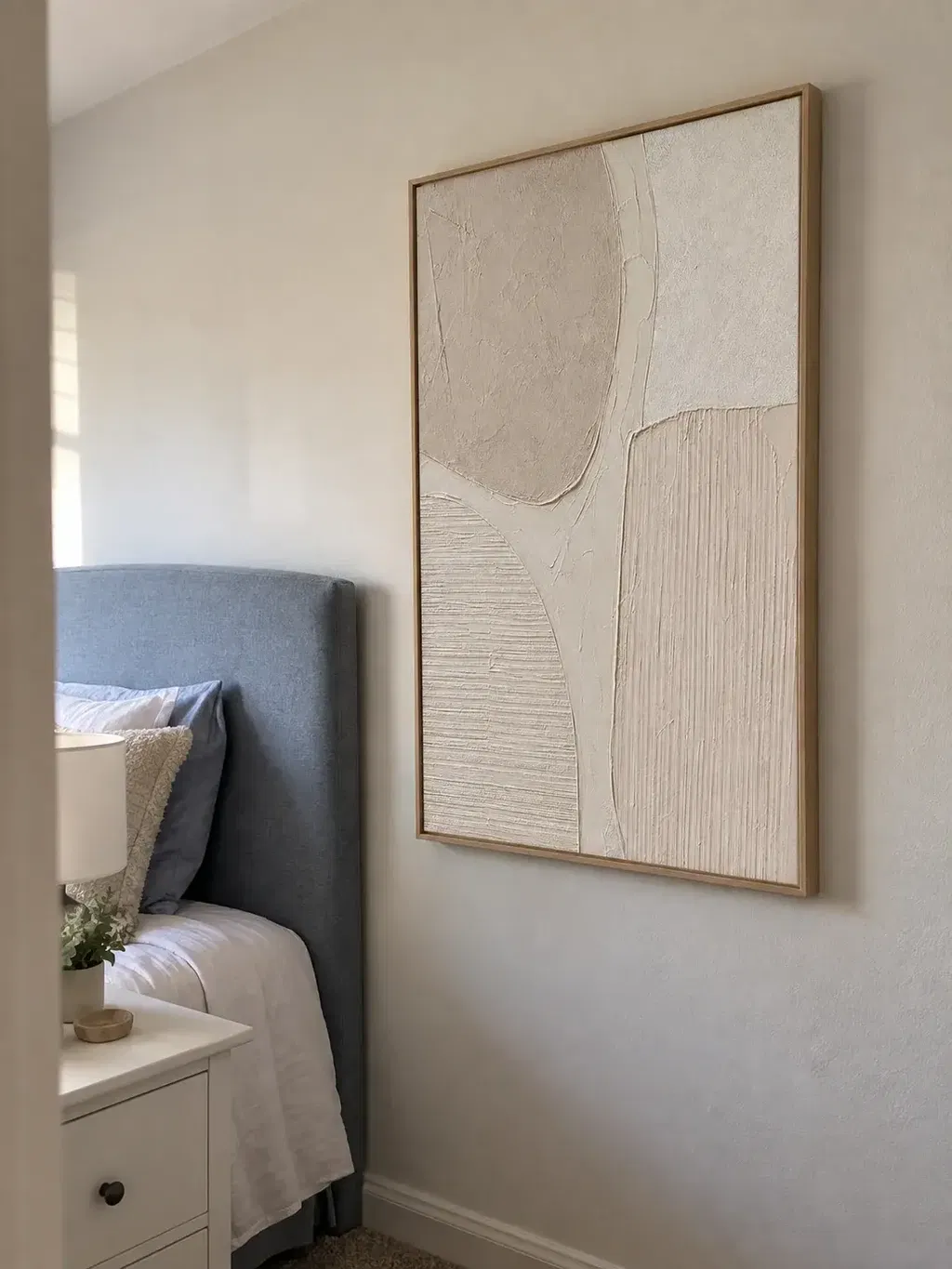
- Prioritize Texture: Choose hand-painted works with visible brushstrokes to create optical depth that "breaks" the flat reflection of the TV.
- Align with Eye Level: Mount the center of the art at 60–70 inches from the floor (eye level when seated), rather than aligning it with the TV's height, which is often mounted too high for comfort.
- Compensate for Brightness: Use art with higher color saturation if it is placed in a room with a high-performance, bright screen.
By treating art as a structural necessity rather than a finishing touch, you move beyond simple decoration. You create a space where technology serves the lifestyle, rather than dictating the soul of the home. This approach provides the "decision safety" and risk reduction that modern homeowners crave—knowing that their investment in authenticity will provide a lifetime of visual and emotional harmony.
Disclaimer: This article is for informational purposes only. When mounting large artworks or televisions, always consult with a professional installer to ensure structural safety. For health concerns regarding historical pigments, consult a certified art conservator.
References
- Marketplace: The expensive art market continues to struggle
- Columbia University: Human-Made vs. AI Art Study
- WHO: Scoping Review on Arts and Health
- NCBI: Attention Biases Competition for Visual Representation
- UPenn: Visual Art in the Built Environment Review
- Royal Society: Quantifying the link between art and property prices