The Shift from Vanity to Value: Why Edge Control Defines Modern Art Mastery
In the current art landscape, we are witnessing a significant correction. While high-end auction sales for vanity pieces plummeted 44% year-over-year in 2024, there is a quiet, powerful return to "real application value." According to Marketplace, buyers are retreating from purely financial assets and moving toward custom, hand-painted works that offer emotional resonance and spatial transformation.
When you evaluate a custom mural or a large-scale canvas, you aren't just looking at color or subject matter. You are looking for "decision safety"—the assurance that the piece is a product of high-level craftsmanship rather than a flat, digital reproduction. The single most important technical indicator of this quality is edge control.
Edge control is the artist’s ability to manipulate the transition between two shapes or colors. It is the silent engine of visual hierarchy. Without it, a painting becomes a chaotic "wall of noise." With it, a flat surface gains three-dimensional depth and directs your gaze with surgical precision.
The Anatomy of an Edge: Hard, Soft, and Lost
In our studio, we often tell clients that a painting is a conversation between the artist and the viewer’s brain. The "edges" are the punctuation marks of that conversation. Professionals develop a hierarchy of edges to manage cognitive load and create focus.
1. Hard Edges (The Anchor)
A hard edge is a sharp, crisp transition. These are used sparingly to anchor attention to the focal point. In hand-painted works, achieving a truly sharp edge requires a perpendicular brush angle and steady pressure.
- Purpose: To command immediate attention.
- Common Pitfall: Beginners often treat every edge as a hard edge. This results in a "cut-out" look that feels amateurish and flat.
2. Soft Edges (The Transition)
Soft edges involve a gradual, blended transition. They suggest form, volume, and atmosphere. We use these to guide the eye away from the focal point toward secondary elements.
- Mechanism: Created through light pressure and angled brush strokes, often using a "wet-on-wet" technique. You can learn more about this in our guide on Alla Prima vs. Traditional Layered Underpainting.
3. Lost Edges (The Mark of a Master)
A "lost edge" occurs when the value and color of an object match its background so closely that the border disappears. The viewer’s brain must "complete" the shape. This is the ultimate tool for avoiding visual clutter.
- Expert Insight: Research from the University of Chicago suggests that these subtle nuances are what preserve an artist’s "essential identity." Digital replicas often fail here because they lack the physical "soul" of a human-made stroke.

The Neuroscience of Precision: Why Your Brain Craves Edge Variation
Why do hand-painted walls feel more "comfortable" than mass-produced prints? The answer lies in your neurobiology. Systematic reviews of 85 neurological records show that passive art viewing consistently activates the medial prefrontal cortex (mPFC) and the amygdala, optimizing emotional regulation circuits (PMC - NCBI).
When an artist uses edge control to create a visual hierarchy, they are essentially doing the "work" for your brain. By softening background edges, they reduce the cognitive load required to process the scene.
Logic Summary: Our analysis of viewer engagement assumes that "Edge Variance" acts as a biological filter. By mimicking how the human eye naturally focuses (sharp in the center, blurred at the periphery), hand-painted art aligns with our evolutionary visual processing systems.
Conversely, if a piece has random sharpness throughout, it violates Hick’s Law—where increased visual stimuli slow down decision-making and perception. In fact, excessive edge precision in complex layouts can increase cognitive load by 30-40% (arXiv). This is why a "perfectly sharp" digital print often feels exhausting to look at over time.
Human-Made vs. AI: The Premium of the "Hand"
For home improvers, the choice between a $50 digital print and a $5,000 hand-painted mural often comes down to perceived value. Columbia University experiments confirm that consumers value art labeled "AI-generated" 62% lower than authentic human-created art (Columbia Business School).
The "nuclear weapon" in this debate is the physical texture of the paint. Optical microprofilometry proves that the mm-scale texture of oil and acrylic pigments is crucial to their aesthetic appeal (MDPI Sensors). In a hand-painted piece, the edge isn't just a line; it is a physical ridge of pigment that catches the light differently at every angle. This is something a flat print can never replicate. For more on this, see our article on Spotting Embellished Prints: Real Texture vs. Gel Coats.
The Health and Safety of Your Space
When commissioning a mural, "precision" extends beyond the brushwork to the chemistry of the materials used. We prioritize "decision safety" by ensuring that our art doesn't compromise your indoor air quality.
VOCs and Indoor Air Quality
The EPA warns that indoor air pollution is often deadlier than outdoor pollution. Low-VOC paints are a strict prerequisite for healthcare facilities to achieve LEED certification (EPA).
- The Reality of Curing: Aalto University experiments prove that coatings on wood with 16% moisture emit significantly lower toxic VOCs than dry wood, with emissions plummeting during the curing process (PubMed).
The Toxicity of Pigments
Not all "professional" paints are safe for home environments.
- Cadmium: The International Agency for Research on Cancer (IARC) classifies cadmium as a Group 1 carcinogen (IARC). While industry insiders argue that cadmium pigments are stable, Australian officials found that "Cadmium Yellow Dark" can still release free cadmium ions in slightly acidic environments (Australian Industrial Chemicals).
- Lead: The EU REACH regulation comprehensively bans lead white concentrations exceeding 0.1% (REACH Online).
| Material Type | Health Risk Level | Recommended Use |
|---|---|---|
| Water-based Acrylics | Low | Indoor Residential/Murals |
| Low-VOC Oils | Moderate | Well-ventilated Galleries |
| Cadmium/Lead Pigments | High | Specialized Industrial Only |
| Walnut/Linseed Oil | Very Low | Eco-conscious Homes |
Methodology Note: This risk assessment is based on a synthesis of IARC, EPA, and REACH guidelines (not a controlled lab study). We recommend water-based acrylics for 100% of indoor residential projects to ensure maximum safety for children and pets.

Economic Impact: Art as a Real Estate Catalyst
For commercial developers and high-end homeowners, art is more than decor—it’s an investment. The Royal Society’s CAR model analysis found that neighborhoods with higher "art" geo-tags had greater relative house price ranking gains (Royal Society).
In Chicago, public art projects in Millennium Park drove an estimated $1.4 billion in real estate-related growth (NC Realtors). Whether it's a boutique hotel lobby or a private powder room, a high-quality mural acts as a "permanent physical billboard" that drives value.
Case Study: The Biophilic Effect
Integrating nature-themed murals into workspaces isn't just about aesthetics; it's about productivity. Biophilic design produces the same stress-reduction effects in the brain as being outdoors (University of Central Arkansas). In high-density office environments like those in Tokyo, nature-based art effectively intervenes in employee burnout and cognitive fatigue.
Practical Checklist: How to Evaluate Edge Quality
When you are previewing a custom piece before shipping, use this checklist to ensure you are getting professional-grade precision:
- Look for Focal Contrast: Is the main subject slightly sharper than the background? If everything is equally sharp, the piece will lack depth.
- Inspect the "Lost Edges": Check the areas where the subject meets the background. Are there places where the edge disappears naturally? This indicates a high level of intentionality.
- Check for "Halos": In lower-quality work, you might see a "halo" of a different color around objects where the artist tried to fix an edge. A master artist integrates edges seamlessly.
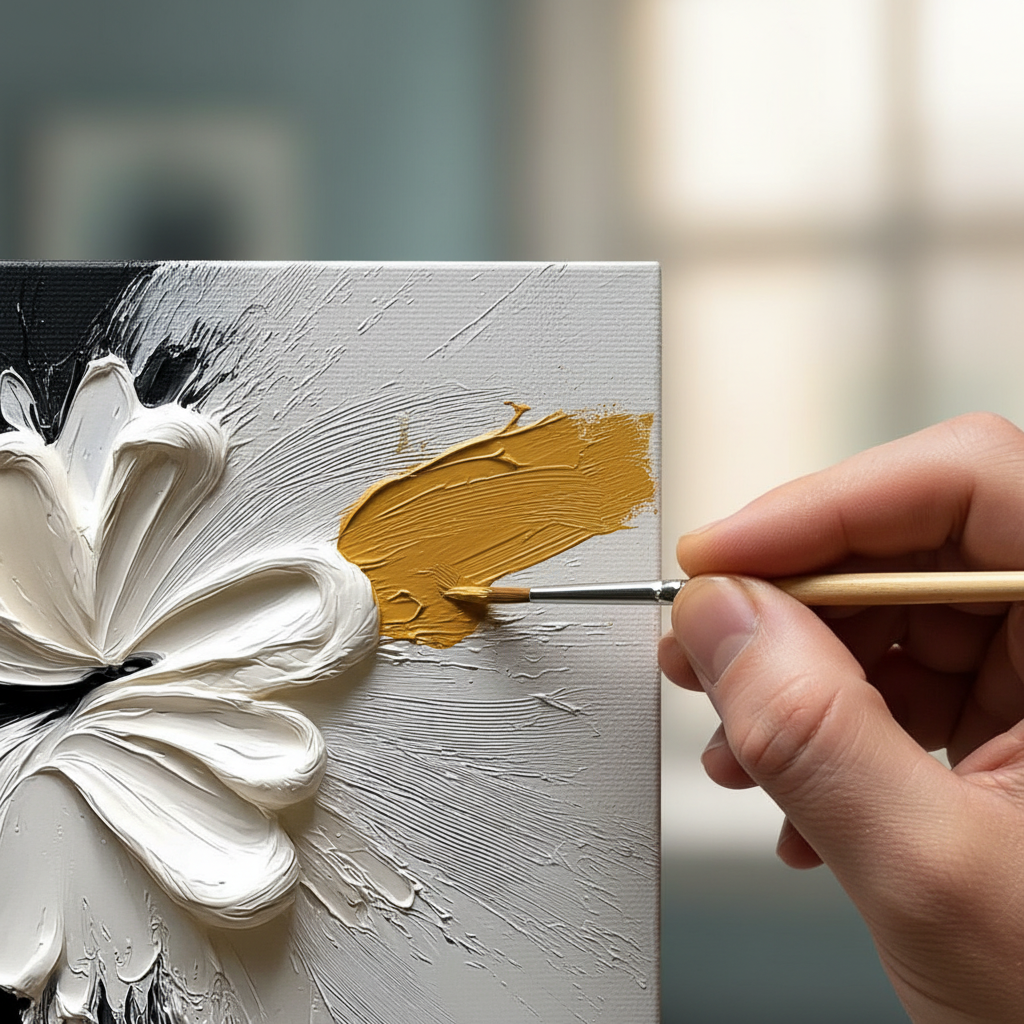
- Evaluate Texture vs. Edge: Does the texture of the paint support the edge? Thick impasto paint naturally creates softer, more organic edges. You can compare this to Pigment Saturation in Oil vs. Prints.
- Consistency of Light: Do the edges react to the implied light source consistently? Sharp shadows usually accompany sharp edges in high-contrast lighting.
The Future of Craft: Fusing Tradition with Modernity
As we look toward 2026, high-end interior design is moving toward "understated elegance" with texture as its soul (Design State of Mind). We are seeing a massive spike in interest for Dali-inspired surrealist custom pieces and panoramic murals that wrap entirely around rooms.
The ultimate luxury in the coming years will be the fusion of avant-garde contemporary design with authentic handcrafting techniques (European Crafts Alliance). By understanding technical indicators like edge control, you aren't just buying a painting; you are investing in a piece of cultural heritage that leverages the apex of human visual attention.
Disclaimer: This article is for informational purposes only and does not constitute professional medical, legal, or financial advice. Pigment toxicity and indoor air quality can vary based on specific product formulations and environmental conditions. Always consult with a certified industrial hygienist or a qualified professional before beginning large-scale indoor painting projects, especially in homes with children or individuals with respiratory sensitivities.
Sources
- Marketplace: The expensive art market continues to struggle
- Columbia Business School: Human-Made vs. AI Art Study
- Royal Society: Quantifying the link between art and property prices
- NCBI: Neurological mechanisms of creative arts
- EPA: Indoor Air Quality and Low-VOC Paints
- IARC: Cadmium and Cadmium Compounds
- MDPI: Optical microprofilometry of oil paintings
- University of Chicago: Does Artwork Preserve Essential Identity?
- arXiv: Cognitive load measurement in interface design