The Evolution of Multi-Panel Art: Beyond the Auction House
For decades, the peak of art acquisition was defined by the high-stakes theater of auction houses. However, recent shifts in the global landscape suggest a profound retreat from purely financial art assets. According to Marketplace, high-end auction sales for pieces over $10 million plummeted by 44% Year-over-Year in 2024. This trend signals a return to "real application value," where collectors and homeowners prioritize custom, hand-painted works that offer emotional resonance and spatial harmony over vanity investments.
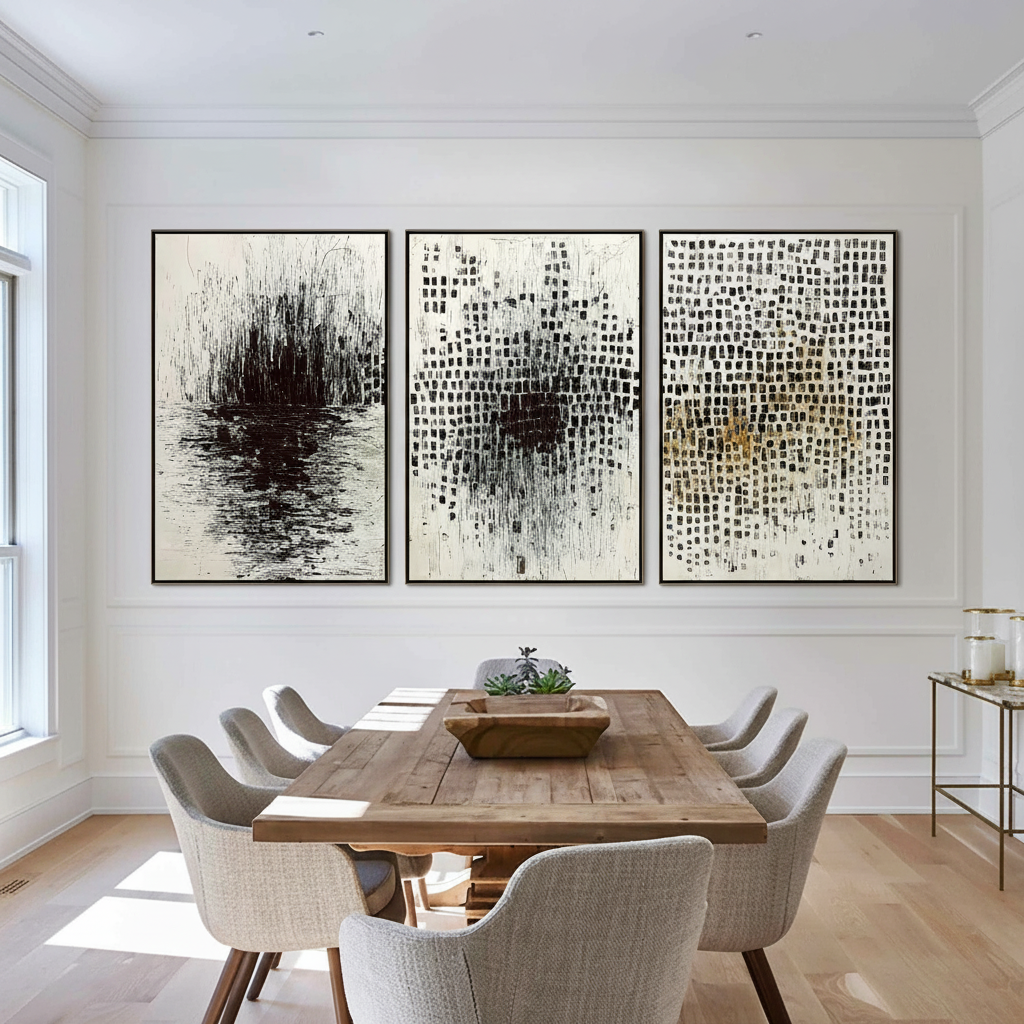
As we move toward 2026, the demand for expansive, multi-panel installations—diptychs and triptychs—has surged. These formats allow for a "panoramic" storytelling experience that single canvases often struggle to achieve. Yet, the transition from an artistic vision to a technically flawless installation is where most projects falter. The challenge lies in coordinating frames and ensuring micro-precise alignment across separate surfaces to maintain the "essential identity" of the work. Research from the University of Chicago suggests that consumers perceive significantly higher value in authentic hand-painted art because the physical canvas retains the artist's "soul," a quality that digital replicas and NFTs fail to replicate.
In this guide, we will break down the professional mechanics of diptych and triptych alignment, from the "Golden Ratio of Spacing" to the chemical stability of modern acrylics.
The Geometry of Spacing: The 5-10% Heuristic
One of the most frequent questions we encounter in our consultation sessions involves the "correct" distance between panels. While many retail guides suggest a flat 2-inch rule, professional installers recognize that spacing is a function of scale, not a static number.
We utilize a visual perception heuristic known as the Golden Ratio of Gestalt Grouping. To ensure the human eye perceives multiple panels as a unified narrative rather than fragmented objects, the gap should typically represent 5% to 10% of the individual panel width.
Spacing Calculation Model (Scenario Analysis)
| Panel Width (inches) | Spacing Range (5% - 10%) | Rationale |
|---|---|---|
| 24" | 1.2" – 2.4" | Standard residential scale; tighter gaps maintain intimacy. |
| 36" | 1.8" – 3.6" | Common for over-sofa placements; allows for visual "breath." |
| 48" | 2.4" – 4.8" | Large-scale gallery format; wider gaps prevent visual crowding. |
| 60"+ | 3.0" – 6.0" | Commercial or high-ceiling foyer; requires significant separation. |
Logic Summary: This model assumes that the human eye requires a specific "void-to-solid" ratio to process continuity. If the gap is too narrow (<5%), the frames appear to clash; if too wide (>10%), the "Gestalt" effect breaks, and the panels appear disconnected.

Navigating the "ArtBase" Misconception
In the world of professional art management, the term "ArtBase" is frequently searched by those looking for alignment solutions. It is important to clarify a common industry "gotcha": ArtBase is a premiere gallery management software used by over 500 institutions for inventory, invoicing, and client tracking. It does not contain automated alignment or physical spacing calculators.
For homeowners and decorators, this means that while digital tools can catalog your dimensions, the physical execution remains a technical craft. Relying on software for installation logic is a mistake; instead, the focus must be on physical precision tools and "center-out" installation strategies.
Professional Installation SOPs: Precision over Intuition
When hanging a multi-panel set, the margin for error is remarkably slim. The human eye can detect variations as small as 1/16 of an inch in spacing or levelness. To achieve museum-quality results, we recommend moving away from visual estimation and adopting a structured Standard Operating Procedure (SOP).
1. The Center-Out Strategy
For triptychs, always establish the center panel first. This acts as your visual anchor and the "datum point" for all subsequent measurements. For diptychs, mark the exact center of the total wall span and work outward. This minimizes cumulative error, a phenomenon where a 1/8-inch mistake on the first panel becomes a 1/2-inch disaster by the third.
2. Eliminating Wall Bias
A common mistake is assuming that walls, ceilings, or corners are perfectly plumb. They rarely are. Professionals never use the corner of a room as a reference point. Instead, we utilize self-leveling cross-line laser levels. These tools project a perfectly level horizontal line and a plumb vertical line across the entire installation area, ensuring that the panels are level relative to gravity, not the floor.
3. The Spacer Block Technique
To maintain consistent gaps, we often use custom-cut spacer blocks. If your calculated spacing is 2.25 inches, cut two small blocks of wood to that exact thickness. Placing these between panels during the mounting process ensures that the panels cannot shift closer or further apart as you tighten the hardware.
4. The 48-Hour Settling Period
Heavy canvas stretchers are organic materials. According to experienced installers, frames can slightly warp or settle after being hung due to changes in humidity or the tension of the hanging wire. We recommend a "final check" 24 to 48 hours after installation to make micro-adjustments once the materials have settled into their environment. This is especially critical for Planning for Installation in new constructions where walls may still be releasing moisture.
Modern Framing Aesthetics for Acrylics
The frame serves as the "bridge" between the raw, textured edge of an acrylic painting and the architecture of the room. For multi-panel works, the frame must provide visual continuity without creating a heavy barrier between the panels.
The Rise of the Floater Frame
Floater frames are the gold standard for modern acrylics. Unlike traditional frames that overlap the edge of the canvas, floater frames leave a small gap (the "reveal") between the art and the frame. This highlights the hand-painted edges and preserves the three-dimensional texture of the impasto.
When coordinating frames across a diptych, ensure the "jamb depth" is identical. Research into Steelcraft and Ceco Door frame specifications—though often applied to architecture—highlights that even a 1/16-inch variance in profile depth can cause a shadow line that breaks the visual flow of a multi-panel set.
Material Integrity and Lightfastness
Acrylics are celebrated for their longevity, but they are not invincible. According to Tate’s Modern Paints Project, acrylic films are softer and more susceptible to dirt adhesion than older oils. Furthermore, while many believe the medium protects the pigment, National Gallery research on Prussian Blue proves that the fading rate of certain pigments remains identical regardless of whether they are suspended in oil or acrylic. This underscores the need for museum-grade UV-protective glazing if the installation is in a Low Natural Light Bedroom or a sun-drenched foyer.

The ROI of Hand-Painted Murals and Multi-Panel Art
Beyond aesthetics, the integration of high-quality art has a measurable impact on property value and human health. This transition from "decor" to "infrastructure" is backed by rigorous data.
1. Property Valuation
A Royal Society CAR model analysis found that neighborhoods with higher "art" geo-tags experienced greater relative house price ranking gains. Specifically, public art projects like Chicago’s Millennium Park drove $1.4 billion in real estate-related growth. For commercial developers, commissioning large-scale murals or multi-panel installations acts as a "physical billboard," increasing foot traffic and leasing rates.
2. Therapeutic and Cognitive Benefits
The World Health Organization (WHO) has confirmed that art interventions effectively alter clinical indicators for mental illness and brain injuries. In high-density environments, such as those studied in Tokyo office spaces, biophilic design (art featuring natural landscapes) significantly reduces employee burnout and cognitive fatigue.
Methodology Note: These findings are based on a review of over 3,000 studies. While individual responses vary, the neurological mechanism involves the activation of the medial prefrontal cortex (mPFC), which optimizes emotional regulation.
Health and Safety: The Invisible Chemistry of Art
When installing art in homes, especially in Guest Bedrooms or nurseries, air quality is a primary concern. The EPA warns that indoor air pollution is often higher than outdoor levels, making low-VOC (Volatile Organic Compound) materials essential.
Pigment Toxicity Awareness
While modern acrylics are generally safer than historic lead-based paints, certain high-end pigments still carry risks. The International Agency for Research on Cancer (IARC) classifies cadmium and its compounds as Group 1 carcinogens. Even "insoluble" cadmium pigments can release free ions over time; Australian Industrial Chemicals tests showed releases of 5.75 $\mu g/L$ in slightly acidic environments.
For decision safety, we recommend:
- Checking for ASTM D-4236 compliance: This indicates that the materials have been reviewed by a toxicologist.
- Prioritizing Water-Based Acrylics: These avoid the narcosis risks associated with mineral spirits and turpentine used in oil painting (Princeton University EHS).
- Verifying Heavy Metal Migration: For children's environments, ensure paints pass the BS EN 71-3 standard, which limits the leaching of toxic elements into saliva or gastric acid models.
Strategic Misalignment: When to Break the Rules
While technical precision is the baseline, professional curation sometimes involves "strategic misalignment." Major institutions like the Tate Modern have been known to use variable spacing (3-7mm) to create visual tension or emphasize psychological disjunction in specific contemporary works.
However, for most home decorators, this is a high-risk maneuver. We suggest mastering the "Golden Ratio" of spacing first. If you choose to deviate, do so with intention—perhaps by staggering the heights of panels to follow a staircase or to echo the Transition of Themes Between Living and Dining areas.
Long-Term Stewardship and Cultural Value
Investing in a hand-painted diptych is more than a design choice; it is the acquisition of a cultural asset. As the Creative Economy Outlook 2024 notes, creative services now account for 3.1% of global GDP. By choosing authentic human-made art over AI-generated prints—which consumers value 62% lower—you are supporting an ecosystem that values fair artist compensation and artisanal craftsmanship.
To ensure your installation remains a centerpiece for decades:
- Avoid Heat Sources: Oil and acrylic films can undergo catastrophic binder separation if exposed to extreme heat (ResearchGate).
- Monitor Humidity: Acrylics are prone to swelling (up to 7% mass increase) in high-humidity environments.
- Gentle Cleaning: Use water-based cotton swabs for acrylics to remove surfactants that can cause a "hazy" appearance over time.
By bridging the gap between artistic vision and technical execution, you transform a set of canvases into a singular, breathtaking narrative that anchors your home with both beauty and precision.
Disclaimer: This article is for informational purposes only. When handling heavy artworks or using power tools, always follow manufacturer safety guidelines. If you have concerns regarding indoor air quality or chemical sensitivities, consult a certified industrial hygienist or medical professional.