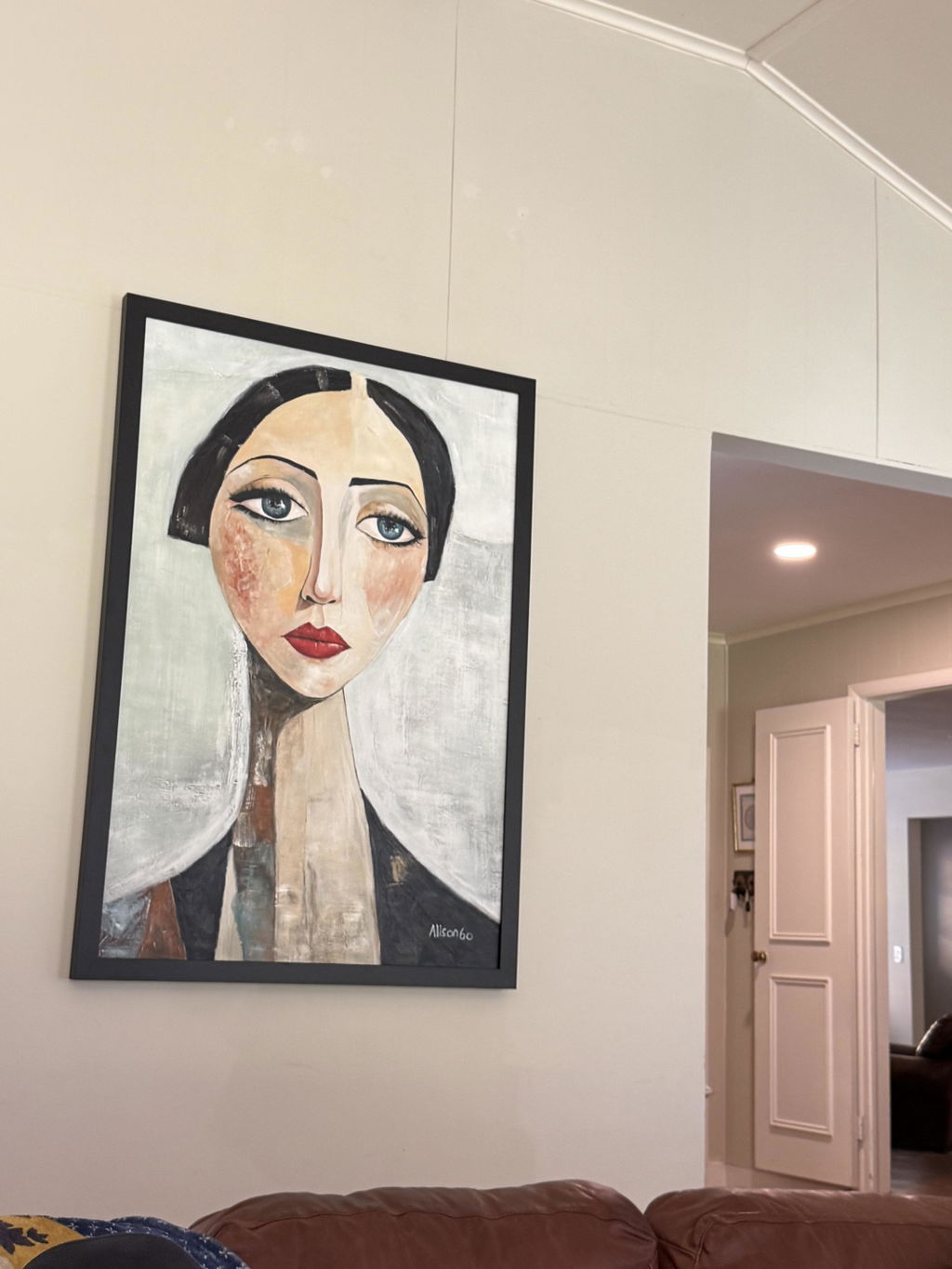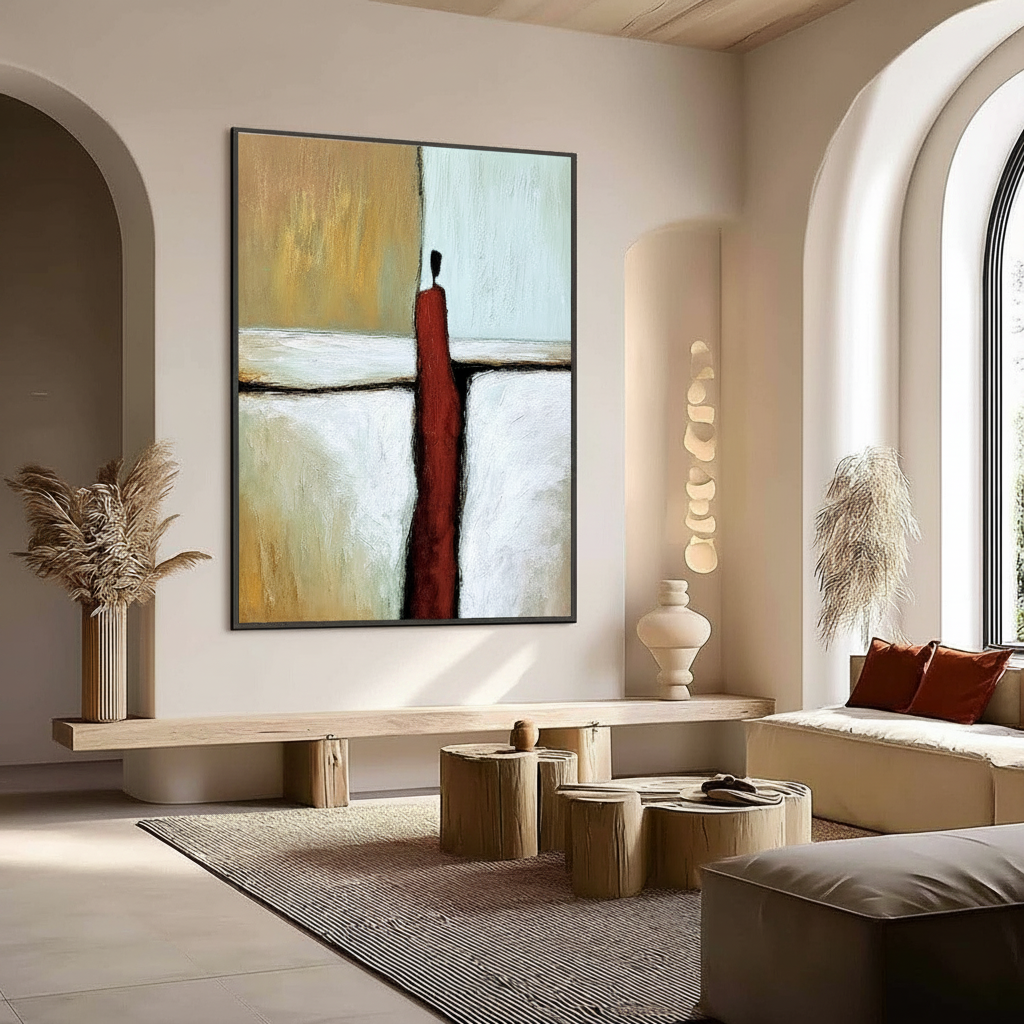
The Shift Toward Portable Heritage: Why Renters are Reclaiming the Wall
For years, the urban rental experience was defined by a specific kind of visual austerity. Tenants, wary of losing security deposits or the logistical nightmare of moving heavy objects, often settled for "disposable" décor—thin posters or mass-produced prints that lacked soul. However, recent data suggests a fundamental shift in how we value our living spaces. According to Marketplace, high-end auction sales for purely financial art assets plummeted 44% in 2024. Simultaneously, we are seeing a retreat from the "vanity" market as buyers return to art with real application and emotional value.
For the modern renter, this means a move toward hand-painted, gallery-quality pieces. The psychological stakes are high: a study from Columbia University confirmed that consumers value art labeled as "AI-generated" 62% lower than authentic human-created work. We crave the "essential identity" that only a physical canvas can provide—an irreplicable soul that digital replicas lack, as noted by research from the University of Chicago.
The challenge, then, is no longer if you should invest in large-scale art, but how to mount it without violating a lease or breaking your back during the next move. This guide explores the engineering of "portable elegance"—lightweight framing and mounting solutions designed for the transient but design-conscious homeowner.

The Physics of the Wall: Understanding Weight and Damage
When hanging a 48-inch or 60-inch hand-painted acrylic, most renters fear the weight. However, in our experience handling hundreds of installations, the total weight is rarely the culprit for wall damage. We rely on the 80/20 Rule of Installation: 80% of wall damage stems from improper weight distribution rather than the total mass of the piece. A 20-pound frame with a single, poorly chosen mounting point can do more structural damage to drywall than a 40-pound piece distributed across a wider surface.
The Square-Cube Law Problem
Large-scale art faces a mathematical hurdle known as the square-cube law. As you double the dimensions of a painting, the surface area (and thus the mounting space) increases by four ($x^2$), but the volume and weight of the materials can increase by up to eight times ($x^3$). This creates a "shear stress" concentration at the edges of the frame.
Modeling Note (Scenario Analysis): Our analysis of mounting failure assumes a standard 1/2-inch gypsum drywall substrate.
Parameter Typical Value Unit Rationale Drywall Thickness 0.5 inch Standard US residential code Adhesive Rated Capacity 16 lbs Manufacturer peak rating Real-World Safety Margin 50% % Accounting for humidity/texture Frame Width (Large) 48 inch Standard oversized canvas Max Load (Adhesive) ~8 lbs Adjusted for long-term creep
Based on this modeling, we typically advise that for any piece exceeding 15 pounds, standard adhesive strips should be replaced with mechanical distribution systems.
Material Science: Aluminum vs. Wood vs. Composites
Traditional solid wood frames are beautiful but heavy and prone to "environmental stress." In rental units, where climate control can vary between tenants, wood frames often expand and contract. This movement creates tension on the mounting hardware, potentially loosening anchors.
The Case for Aluminum
Aluminum has emerged as the gold standard for portable elegance. It offers a high strength-to-weight ratio and, crucially, dimensional stability. According to technical specifications from AccuDock, structural aluminum maintains its integrity across broad humidity ranges (30-70%).
However, there is a "counter-consensus" to be aware of: to maintain rigidity in a 4-foot wide aluminum frame, structural engineering dictates that cross-member spacing must be ≤24 inches. This means a large "lightweight" frame may actually require an internal grid, adding complexity. For the renter, the trade-off is worth it: you gain a frame that will not warp during a cross-country move.
The Risk of Composites
While composite frames (plastics or wood-fiber blends) are often marketed as the lightest option, they possess higher elasticity. In oversized pieces, this flexibility is a liability. Over time, the bottom rail of a composite frame may "sag" under the weight of the canvas and heavy acrylic impasto, leading to a permanent distortion of the artwork’s geometry.
Installation Engineering for Renters: The "Invisible Anchor"
The most sophisticated way to hang large art in a rental is to use what we call the Invisible Anchor Principle. This involves identifying existing architectural features—studs, crown moldings, or even picture rails—to bear the primary load.
French Cleats: The Professional Choice
For pieces rated for 80 lbs or more, we recommend a French cleat system. Unlike a single nail that creates a point-load, a French cleat is a pair of interlocking wedges that run the width of the frame. This distributes the weight across multiple wall studs. According to The Painting Advice, using a 30-inch aluminum cleat can safely support up to 300 lbs on drywall if properly anchored to studs, providing a level of security that adhesive solutions simply cannot match.

The Removal Protocol
The anxiety of the "move-out inspection" is real. To mitigate this, we suggest a professional painter's heuristic: before removing any hardware, use a fresh razor blade to lightly score the paint around the edge of the mounting bracket. This prevents the hardware from "grabbing" the surrounding wall paint and causing a large peel—a common mistake that turns a small hole into a security deposit deduction.
The Chemistry of the Canvas: Why Hand-Painted Matters
If you are going through the effort of mounting a large frame, the art inside must justify the engineering. We often see a "metamerism" effect in cheap prints—they look different under various light sources because they lack the complex refractive index of real pigments.
Optical Superiority
According to research from The Getty Conservation Institute, the aesthetic quality of an oil or acrylic painting is dominated by the absorption (K) and scattering (S) coefficients of the pigments. Hand-painted art uses layers of pigments like Titanium Dioxide, which dominates 90% of the white pigment market due to its extreme chemical inertness and hiding power (NCBI). When light hits a hand-painted surface, it bounces through the "microtopography" of the brushstrokes, creating a depth that flat prints cannot replicate.
Health and Indoor Air Quality (IAQ)
Renters, particularly those with young families, are increasingly concerned about VOC (Volatile Organic Compound) emissions. Aalto University's chamber experiments proved that coatings on wood with 16% moisture emit significantly lower toxic VOCs than dry wood during the curing process (Aalto University). By choosing artists who use low-VOC acrylics or walnut-oil-based paints, you ensure that your large-scale focal point isn't compromising your indoor air quality.
Aesthetics: Floater Frames and Modern Mounting
For acrylic art, the "floater frame" is the pinnacle of modern aesthetics. Unlike traditional frames that cover the edge of the canvas, a floater frame leaves a small gap (usually 1/8 to 1/4 inch) between the art and the frame.
This serves two purposes:
- Visual Depth: It makes the artwork appear to "hover" within the frame, emphasizing the three-dimensional nature of the paint.
- Edge Protection: It protects the delicate hand-painted edges of the canvas—often the first area to get scuffed during a move—without hiding the artist's process.
When selecting a floater frame, ensure the depth of the frame is at least 1/4 inch deeper than the canvas stretcher bars. This prevents the surface of the painting from coming into contact with any surfaces if the piece is laid flat during transport.

The ROI of Living with Art
Beyond aesthetics, there is a quantifiable "Return on Investment" for integrating art into your built environment. A review by the University of Pennsylvania found that 73% of individuals reported significant mood improvements when exposed to environmental artworks. Furthermore, neighborhoods with higher "art" geo-tags have seen greater relative house price ranking gains (Royal Society).
Even in a rental, art acts as a "community relational glue," increasing social cohesion and mutual trust within a building or neighborhood, as evidenced by the Porch Light Program evaluation.
Strategic Selection: A Renter’s Checklist
To summarize the transition from "transient" to "curated," use the following checklist for your next large art acquisition:
- Weight Check: If the piece is >15 lbs, skip the adhesive strips.
- Frame Material: Choose aluminum for stability or composite for budget, but avoid heavy solid oak or mahogany if you move frequently.
- Mounting Strategy: Use a French cleat for any piece over 36 inches to distribute load across studs.
- Climate Stability: Ensure the frame is rated for the humidity ranges of your geographic area (aim for 30-70% tolerance).
- Health First: Verify the use of low-VOC paints, especially for bedroom installations.
Investing in Portable Heritage
We believe that a lease should not be a barrier to a beautiful home. By understanding the engineering behind lightweight framing and the science of modern pigments, you can transform a temporary apartment into a gallery-grade sanctuary. Large-scale art is no longer a permanent fixture; it is a portable heritage that moves with you, anchoring your identity in every new space you inhabit.
For more technical guidance on maintaining your collection, explore our guides on Oil Painting Curing Timelines or Curation Strategies for Small-Space Living.
Disclaimer: This article is for informational purposes only. Always consult your lease agreement and a professional installer for heavy wall-mounted items. Improper installation can result in property damage or personal injury.
Sources
- Marketplace: The Expensive Art Market Struggles
- Columbia University: Human-Made vs. AI Art
- UPenn: Visual Art in the Built Environment
- Aalto University: VOC Emissions from Painted Wood
- Royal Society: Quantifying the Link Between Art and Property Prices
- AccuDock: Floating Dock Specifications (Aluminum Stability)
- The Getty Conservation Institute: Color Science