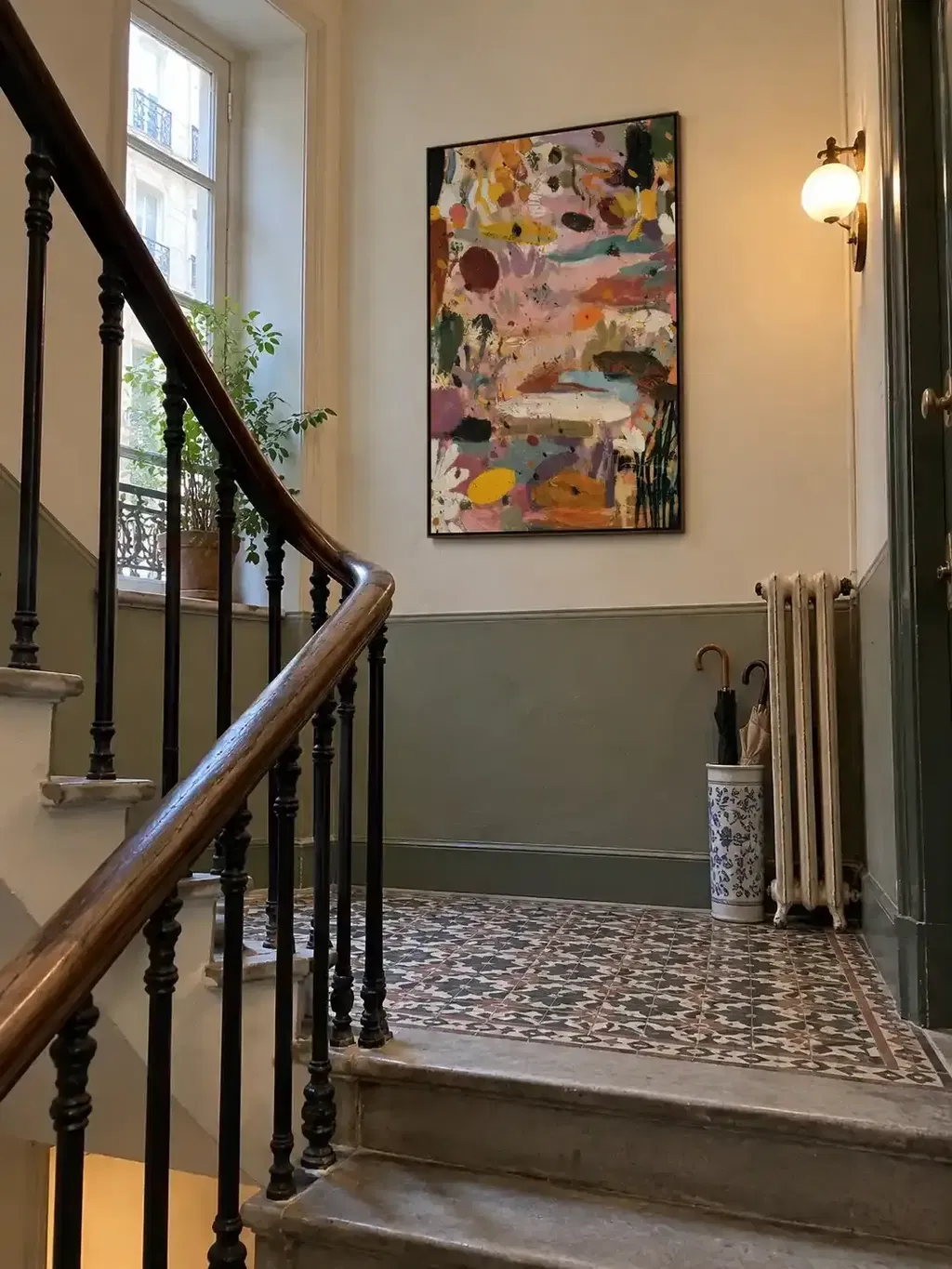
Engineering the Fit: Custom Sizing for Recessed Wall Niches
The high-end art market is undergoing a structural shift. While auction sales for financial-asset art (pieces over $10 million) plummeted 44% year-over-year in 2024, there is a resurgent demand for "real application value." According to Marketplace.org, buyers are retreating from vanity assets and moving toward custom, hand-painted works that integrate seamlessly into the architectural fabric of their homes.
For architects and interior designers, this shift brings a technical challenge: the recessed wall niche. Unlike a standard wall hanging, a recessed installation requires precision engineering. A canvas that is a fraction of an inch too large won't fit; one that is too small looks like an afterthought. We have observed through years of professional installation that the difference between a "good" fit and a "museum-grade" fit lies in the math of clearance, light physics, and material behavior.
The Structural Foundation of Large-Scale Canvas
When engineering art for a fixed architectural recess, we must first address the substrate. Large-format works (those exceeding 60 inches) are subject to internal and external mechanical stresses. A common mistake is using standard-grade stretcher bars for oversized niches. In our experience with high-end residential projects, we recommend heavy-duty, kiln-dried finger-jointed bars with a minimum depth of 1.5 to 2 inches to prevent warping.
The tension of the canvas is equally critical. For large-scale acrylic works, the physical properties of the polymer film provide a distinct advantage. Unlike oil films, which undergo oxidative cross-linking and can become brittle over decades, acrylic polymers form films through "coalescence." This results in a more flexible, resilient surface that resists the embrittlement often seen in older oil paintings, as noted by Golden Artist Colors. However, this flexibility means the canvas is more susceptible to environmental "breathing."
Modeling Note: Niche Installation Parameters We have developed a deterministic model for calculating niche clearances based on standard residential humidity fluctuations (30%–60% RH). This is a scenario model, not a controlled lab study.
Parameter Value/Range Unit Rationale Max Canvas Expansion 0.125 (~1/8) Inch Observed behavior of heavy-weight cotton duck in 60%+ RH Recommended Shadow Gap 0.25 (1/4) Inch Visual aesthetic + functional breathing room Minimum Recess Depth 2.0 Inch Necessary to prevent harsh shadow compression Optimized Recess Depth 4.0+ Inch Allows for nuanced LED grazing and surface protection Stretcher Bar Depth 1.5 - 2.0 Inch Required for structural rigidity in spans >60" Boundary Conditions: This model assumes the use of 12oz triple-primed cotton canvas and kiln-dried wood frames. It may not apply to metal-stretcher systems or linen substrates, which have different hygroscopic coefficients.
For a deeper dive into how scale affects structural integrity, see our guide on Maximum Canvas Size Without Sagging.

The Precision Fit: Measuring for Architectural Niches
The most frequent failure point in custom installations is the "tight fit." Designers often provide the exact dimensions of the niche as the requested canvas size. This is a recipe for disaster.
1. The Expansion Coefficient
Based on our professional installation patterns, acrylic-primed canvases can expand up to 1/8 inch in humid environments. If a canvas is fitted flush into a niche, this expansion leads to "buckling" or "corner pinching," where the canvas loses its planar tension and develops unsightly waves.
2. The 1/4-Inch Shadow Gap Rule
We advocate for a consistent 1/4-inch clearance on all four sides. This serves two purposes:
- Functional: It provides the necessary "breathing room" for the material to expand and contract without contacting the niche walls.
- Aesthetic: It creates a "shadow gap" (or "reveal"), which is a hallmark of high-end architectural detailing. This gap defines the artwork as an independent element within the structure, rather than a piece of stuck-on wallpaper. For projects requiring an even more elevated look, designers can specify Premium Shadow Gap Profiles to line the niche.
3. Recess Depth and Lighting Physics
The depth of the niche matters more than most realize. Shallow niches (under 2 inches) create harsh, high-contrast shadows at the edges that can visually "crush" the composition of the art. Conversely, deeper recesses (4+ inches) allow for "nuanced lighting." By placing LED strips at the top or sides of a deep niche, you can achieve a grazing light effect that highlights the microtopography of the paint surface. This tactile relief is what distinguishes a hand-painted work from a flat, 2D digital print.
Aesthetic Engineering: Why "Human-Made" Matters
In the era of AI-generated imagery, the "soul" of the artwork has become a measurable commercial premium. A study by Columbia University confirmed that consumers value art labeled "AI-generated" 62% lower than authentic human-created work. In architectural spaces, this valuation is tied to the physical presence of the medium.
Digital prints lack the "essential identity" of the artist. Research from the University of Chicago suggests that consumers perceive a collapse in value when art lacks the physical "imprint" of its creator. When we provide hand-painted acrylics for niches, we are delivering a three-dimensional object. The way light interacts with the scattering and absorption coefficients of the pigments—governed by the Kubelka-Munk equation—creates a depth of color that no inkjet printer can replicate.

Health, Safety, and LEED Compliance
For high-end residential and commercial projects, Indoor Air Quality (IAQ) is a non-negotiable specification. The EPA warns that indoor air pollution can be significantly higher than outdoor levels, making low-VOC (Volatile Organic Compound) materials a prerequisite for LEED and WELL certifications.
Pigment Safety and VOCs
We strictly utilize water-based acrylic systems which, according to Aalto University, emit significantly lower VOCs than traditional oil-based systems using mineral spirits or turpentine. Furthermore, professional-grade acrylics must comply with the LHAMA act (ASTM D4236), ensuring that any chronic health hazards are clearly labeled.
However, "non-toxic" labeling can be misleading. We avoid pigments containing heavy metals like Cadmium, which the IARC classifies as a Group 1 carcinogen. Even "insoluble" cadmium pigments can release free ions in certain conditions, as demonstrated by Australian Industrial Chemicals. By opting for modern organic alternatives, we ensure the safety of the household without sacrificing lightfastness.
Preventing Support Induced Discoloration (SID)
A technical "gotcha" in niche installations is Support Induced Discoloration. When transparent acrylic mediums are applied thickly over cotton canvas, water-soluble impurities in the substrate can be drawn into the paint film, causing yellowing. We prevent this by following rigorous sizing and priming protocols, often using an acrylic gloss medium as a barrier before the Gesso layer to lock in impurities.
The Economic and Psychological ROI of Architectural Art
Commissioning custom art for architectural niches is not merely a decorative choice; it is a strategic investment in property value and occupant well-being.
- Real Estate Appreciation: A Royal Society CAR model analysis found that neighborhoods and properties with higher "art" geo-tags experienced greater relative price gains (Royal Society). In the commercial sector, public art projects have been shown to drive billions in real estate-related growth.
- Biophilic Benefits: Integrating nature-themed art into built environments—known as biophilic design—has been clinically proven to reduce stress. A University of Pennsylvania review noted that 73% of patients reported significant mood improvements when exposed to environmental artworks.
- Fiscal Leverage: For public or corporate projects, the Americans for the Arts reports that tax investments in the arts yield a 7:1 ROI, supporting millions of jobs and generating massive economic activity.
The Professional Installation Workflow
For large-scale pieces (over 60 inches), the physics of weight distribution changes. We often recommend a "temporary support system" during placement. Because a recessed niche offers limited hand-room, installers should use suction-cup handles (for glass-protected pieces) or bottom-mounted temporary cleats to slide the artwork into place without damaging the niche edges or the canvas tension.
When the fit is engineered correctly—accounting for the 1/8-inch expansion, the 1/4-inch shadow gap, and the 4-inch recess depth—the result is an installation that feels like a permanent, intentional part of the architecture. It transforms a simple wall into a "commercial landmark" or a "healing sanctuary," providing the "absolute authenticity" that modern travelers and homeowners crave (Hospitality Design Trends 2025).
YMYL Disclaimer: This article provides technical guidance for art installation and material safety for informational purposes only. It does not constitute professional structural engineering, medical, or financial advice. Always consult with a licensed contractor for structural installations and a certified industrial hygienist for specific chemical safety concerns in your environment.
Sources
- The Art Basel and UBS Art Market Report 2024
- Columbia University: Human-Made vs. AI Art Study
- Royal Society: Quantifying the link between art and property prices
- WHO Scoping Review on Arts and Health
- EPA: Indoor Air Quality and Low-VOC Paints
- Golden Artist Colors: Longevity of Acrylics
- IARC: Cadmium Compounds Toxicology
- Americans for the Arts: Economic Prosperity III