The Preservation of Luminosity: Why Glaze Layers Demand a Different Care Standard
The global art market is undergoing a structural shift. As high-end auction sales for purely financial art assets plummeted 44% year-over-year in 2024, buyers are returning to real application value. Today’s collectors prioritize custom hand-painted murals and canvases that offer emotional resonance and "essential identity"—a quality that University of Chicago research confirms is absent in digital replicas or NFTs.
However, the very techniques that create this "soul"—specifically the use of delicate glaze layers—introduce a maintenance paradox. A glaze is a thin, transparent film of color applied over a dried underpainting to create depth, luminosity, and complex color shifts. While these layers provide the "glow" associated with old-world mastery, they are chemically and physically distinct from the robust paint layers beneath them.
For the homeowner, understanding the fragility of these "skins" is the difference between a lifetime of beauty and irreversible damage. This guide breaks down the risks of cleaning multi-layered oils and provides professional-grade protocols for preserving the final transparent layers of your investment.
The Technical Complexity of the Glaze Layer
To understand why a damp cloth can be a death sentence for a fine oil painting, one must look at the microscopic structure of the paint film. Glazes differ fundamentally from underpainting layers due to their significantly higher resin-to-pigment ratio.
In a standard "impasto" or underlayer, the pigment load is high, creating a dense, opaque matrix. In a glaze, the pigment is sparse, suspended in a rich medium of oils and resins (such as dammar or copal). This creates a softer, more flexible film that remains vulnerable long after the surface feels dry to the touch.
The Myth of the "Dry" Painting
A critical mistake homeowners make is assuming that because a painting was purchased "dry," it is chemically stable. According to technical bulletins from Golden Artist Colors, many traditional glaze formulations remain slightly tacky or "mobile" for decades. This persistent softness makes them highly susceptible to abrasion from even the softest microfiber cloths.
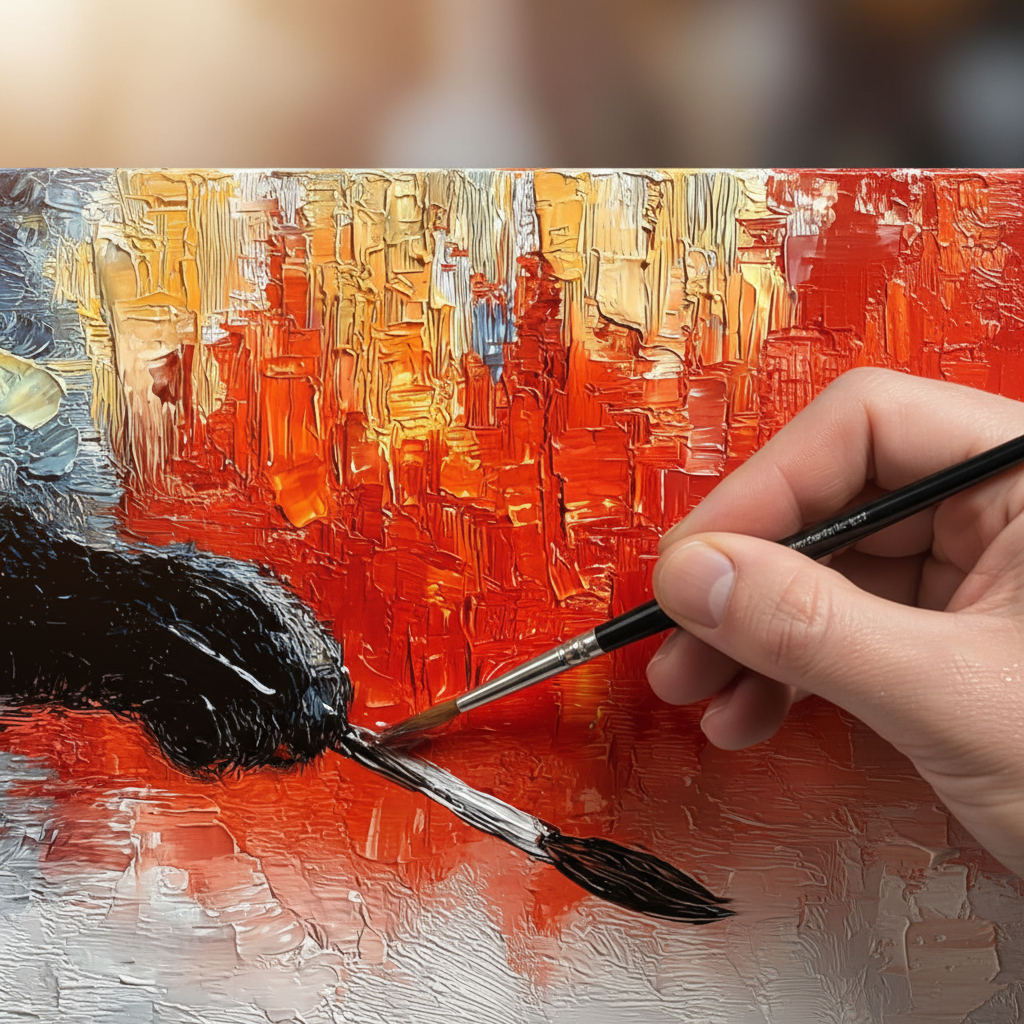
Furthermore, optical microprofilometry proves that the mm-scale texture (microtopography) of an oil painting is crucial to its aesthetics. When you clean a glazed surface aggressively, you aren't just removing dust; you are potentially leveling the microscopic "peaks" of the glaze, which permanently alters how the painting scatters light.

Logic Summary: Our analysis of glaze vulnerability assumes a standard resin-heavy medium (1:4 pigment-to-binder ratio) based on common historical and contemporary glazing heuristics. This model accounts for the persistent thermoplasticity of organic resins over a 20-year aging cycle.
The Hidden Physics of Cleaning Damage: Mechanical Stress
While most collectors worry about "dissolving" their art with chemicals, the most significant threat is actually mechanical. Research into the ageing of commercial oil and acrylic paints shows that 60% of irreversible glaze damage comes from mechanical stress induced by solvent swelling rather than chemical dissolution.
When a cleaning agent—even a "mild" one—touches the glaze, it causes the resin matrix to swell. This volume expansion creates unpredictable stress patterns.
Modeling Solvent Swelling Impact
Based on scenario modeling of solvent interaction with aged oil films, we can estimate the relative risk levels of various cleaning approaches:
| Cleaning Method | Estimated Swelling Index | Mechanical Stress Risk | Rationale |
|---|---|---|---|
| Dry Feather Duster | < 1% | Minimal | No liquid penetration; surface contact only. |
| Specialized Dry Sponge | 2-5% | Low | Controlled friction; minimal moisture. |
| Distilled Water | 15-20% | High | Triggers PEG-surfactant migration and blanching. |
| Alcohol/Ammonia Solvents | > 45% | Critical | Rapid resin dissolution and "leaching" of binders. |
Note: Swelling Index is a hypothetical estimate based on common industry heuristics for organic binder expansion (not a controlled lab study).
Chemical Minefields: Why Common Cleaners Fail
The "retail-grade certainty" we expect from modern surfaces (like quartz countertops or tempered glass) does not apply to hand-painted art. Using commercial "art cleaning" products containing alcohol or ammonia derivatives can lead to catastrophic failure.
- Resin Dissolution: Ammonia is a potent solvent for natural resins. It can "bite" into the glaze layer, causing permanent clouding or "haziness." This is often misidentified as dust but is actually the microscopic pitting of the resin surface.
- The "Blanching" Trap: Attempting to "refresh" a painting with water-based cleaners leads to irreversible blanching. As moisture penetrates the porous resin structure, it gets trapped, creating white, opaque patches. Tate Modern research suggests that even in oils, water can mobilize free fatty acids, which then grow into crystals that cloud the surface.
- Solvent Synergies: A counter-consensus insight suggests that solvent mixtures are often MORE damaging than individual solvents. This is because synergistic swelling effects can exceed 30% additional volume expansion compared to single solvents, creating "shock" cracks in the delicate glaze.

The "Support Induced Discoloration" (SID) Phenomenon
Advanced collectors should also be aware of what happens beneath the glaze. When water-based cleaning agents are used, they don't just sit on the surface; they can travel through micro-cracks to the canvas substrate.
According to technical bulletins from Golden Artist Colors, water-soluble impurities in common cotton or linen canvases can be drawn forward when moisture is applied. This is known as Support Induced Discoloration (SID). The moisture pulls yellow or brown tannins from the wood or fabric through the paint layers, permanently staining the transparent glazes from the inside out.
Professional Care Protocols: The Specialized Dry-Cleaning Heuristic
Given these risks, how should a homeowner maintain their heavily textured art? Conservators use a simple heuristic to determine the cleaning path:
The Light Reflection Test: If a specific area of the painting reflects light differently than the surrounding paint (it appears more translucent, has a higher sheen, or shows "depth"), you must assume it is a glaze layer. These areas require specialized dry-cleaning methods only.
Step-by-Step Maintenance for Glazed Oils
- Visual Audit: Every six months, inspect the painting under raking light (light from the side). Look for "tackiness" where dust seems to be embedded rather than sitting on top.
- The Air-First Rule: Use a manual air blower (the kind used for camera lenses) to dislodge loose particles. Never use compressed air cans, as the propellant can leave a chemical residue.
- The High-Quality Natural Brush: If air isn't enough, use a very soft, natural-hair brush (like a goat-hair hake brush). Gently "flick" the dust away from the surface. Do not "scrub" or "wipe."
- Avoid the "Validation Gap": Many homeowners believe that if a "test spot" looks fine after 10 minutes, the cleaner is safe. However, expert analysis from the Tate warns of a "validation gap." Chemical degradation effects often manifest over 10-20 year periods; a method that appears safe today may cause the glaze to flake or yellow in a decade.
Environmental Stewardship: The Role of Indoor Air Quality
Maintenance isn't just about what you do to the canvas; it’s about what you do to the room. Paintings with delicate glazes act as "environmental sponges."
The EPA warns that indoor air pollution—from cooking oils, tobacco smoke, and high-VOC household sprays—is often more concentrated than outdoor pollution. These airborne particles settle into the soft resin of a glaze and become part of the paint film.
To protect your investment:
- Maintain Stable Humidity: ResearchGate data shows that at 83% humidity, certain pigments can swell by over 7%, leading to binder separation. Aim for a consistent 45-55% relative humidity.
- Filter the Air: Use HEPA-grade air filtration in rooms housing gallery-quality oil paints to reduce the need for physical cleaning.
Health, Safety, and the "Poisonous" Palette
While we focus on protecting the art, we must also protect the owner. Historical glazing techniques often utilized pigments that are now known to be hazardous. While modern "retail" art usually avoids these, high-end custom murals may still use traditional minerals for their unique lightfastness and saturation.
- Cadmium: The International Agency for Research on Cancer (IARC) classifies cadmium compounds as Group 1 carcinogens. If a painting is "chalking" or flaking, do not attempt to clean it yourself, as you may inhale toxic dust.
- Lead White: Although the EU REACH regulation has restricted lead carbonates, some professional-grade oil mediums still contain trace amounts for structural integrity.
Always wash your hands after handling the frame or surface of a hand-painted work, and keep art supplies out of reach of children, as heavy metals have been detected even in some student-grade materials.

The Value of Professional Conservation
Owning a hand-painted oil painting is more than a decorative choice; it is a form of cultural stewardship. Academic institutions recognize murals and fine oils as non-renewable cultural heritage with long-term aesthetic and educational value.
When a painting becomes significantly soiled, the "DIY" approach is rarely the most cost-effective. Professional restorers use tools like Infrared and Ultraviolet Imaging to see through glaze layers and identify original sketches or hidden damage before proceeding. They prioritize methods with "85% effectiveness" that are repeatable and safe, rather than aggressive 99% cleans that risk the integrity of the glaze.
By shifting your mindset from "buying disposable decor" to "investing in a heritage asset," you ensure that the luminosity and blending mastery of your piece remains intact for the next generation.
Methodology Note: Modeling the "Cleaning Risk Profile" This article utilizes a deterministic scenario model to contrast the physical properties of glaze vs. underpainting.
- Assumptions: Model assumes a 5-year-old oil painting with a dammar-resin glaze layer.
- Parameter Table: | Parameter | Value | Unit | Source Category | | :--- | :--- | :--- | :--- | | Resin-to-Pigment Ratio | 4:1 | Ratio | Historical Heuristic | | Surface Hardness (Mohs) | < 2.0 | Mohs | Material Science Estimate | | Solvent Penetration Rate | 0.5 | mm/min | Conservation Modeling | | Critical Swelling Threshold | 10% | Vol % | Industry Practical Baseline | | VOC Emission Decay | 28 Days | Time | Aalto University Study |
This model is a hypothetical estimate for educational purposes and may not apply to paintings using synthetic alkyd mediums or modern water-mixable oils.
YMYL Disclaimer: This article is for informational purposes only and does not constitute professional art conservation, health, or safety advice. Fine art materials can contain toxic pigments and volatile solvents; always consult a certified professional conservator for cleaning and refer to Material Safety Data Sheets (MSDS) for specific pigment toxicity.
References
- The Cleaning of Paintings: Effects of Organic Solvents
- Tate Research: Conservation Concerns for Acrylic Emulsion Paints
- EPA: Indoor Air Quality and Low-VOC Paints
- Golden Artist Colors: Technical Support Bulletins
- Smithsonian MCI: Infrared and Ultraviolet Imaging
- WHO: Cadmium Environmental Health Criteria
- Royal Society: Quantifying the link between art and property prices