
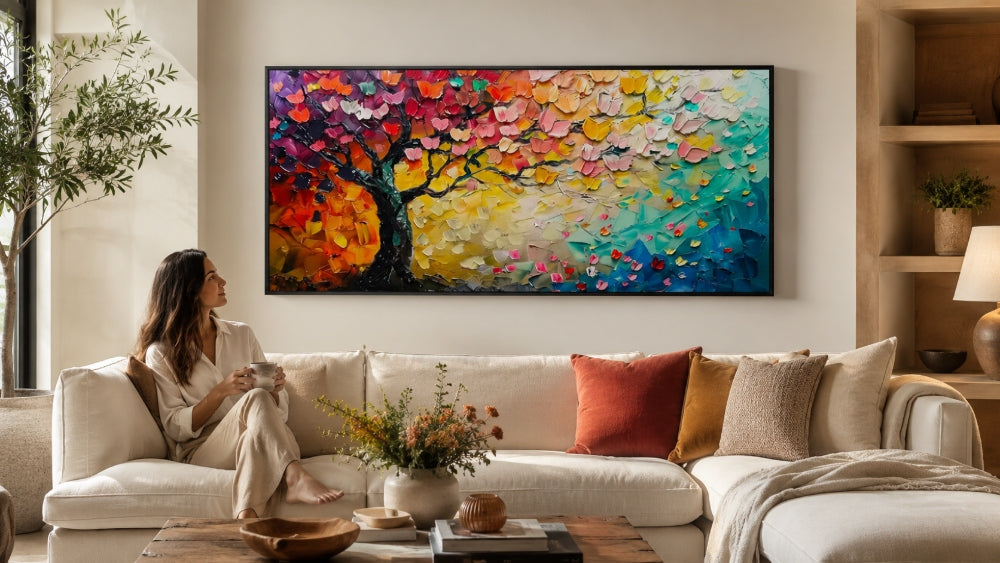
Finding the right art for your home is only half the battle; knowing how to scale it for your furniture determines whether the room feels professionally designed or haphazardly assembled. When choosing a set of 2 or 3 paintings for above a sofa or bed, the immediate goal is to create a single, unified focal point. The most effective way to achieve this balance is by following the "2/3 rule," ensuring the total width of the art set spans roughly 66% to 75% of the furniture's width.
The Golden Rule for Multi-Piece Wall Art Sets
The most common mistake in interior design is hanging art that is too small for the space it occupies. To avoid this, designers use the 2/3 to 3/4 rule. This principle dictates that your art collection—whether it is a pair of frames or a trio of canvases—should occupy a significant portion of the wall space directly above your furniture. If you are decorating above an 84-inch sofa, your set of paintings (including the gaps between them) should measure between 56 and 63 inches wide. For the basics of two- and three-piece formats, start with the diptych and triptych painting sets guide.
Beyond width, the vertical placement is equally critical. For general wall art, the "eye level" standard is to place the center of the artwork approximately 57 to 60 inches from the floor. However, when art is anchored to a specific piece of furniture like a sofa or a bed, that furniture piece takes priority over the general floor-to-ceiling measurement. The connection between the top of the headboard or the back of the sofa and the bottom of the art must feel intentional and tight.
To ensure your paintings for home remain in top condition, experts from the Canadian Conservation Institute recommend using protective backing boards for framed works to reduce exposure to dust, pollutants, and humidity fluctuations. This is particularly important if your sofa is placed against an exterior wall or near a window where temperature shifts are more common.
Diptych vs Triptych: Choosing the Right Number of Pieces

Deciding between two paintings (a diptych) or three (a triptych) depends on the visual rhythm you want to establish. A diptych is often associated with modern simplicity and clean lines, making it an excellent choice for minimalist spaces or when you want to showcase a single continuous image split in half. Triptychs, on the other hand, provide a sense of movement and can make a room feel wider by creating a "window effect." If you are comparing sets with one large focal piece, review art sets vs statement paintings.
| Feature | Diptych (Set of 2) | Triptych (Set of 3) |
|---|---|---|
| Visual Vibe | Modern, symmetrical, calm | Rhythmic, dynamic, expansive |
| Complexity | Easy to align; high focus | Requires precise spacing; fills more wall |
| Best For | Modern abstract art, pairs of portraits | Landscape canvas wall art, wide abstracts |
| Room Effect | Vertical emphasis; feels grounded | Horizontal emphasis; makes walls feel wider |
Diptychs for Modern Simplicity
A diptych is a cohesive set of 2 paintings that share a theme, color palette, or a single subject. It is often the preferred choice for narrow bedrooms or when hanging art above a loveseat. Because there are only two pieces, the eye focuses on the central gap, which creates a sharp, architectural look that works well with contemporary furniture.
Triptychs for Rhythm and Symmetry
A triptych is a cohesive set of 3 paintings. This arrangement is highly traditional but translates beautifully into modern abstract art styles. The presence of a center piece provides a strong anchor, while the flanking pieces provide balance. This is especially effective above a King-sized bed or a standard three-seat sofa, where the furniture is wide enough to support the visual weight of three separate frames.
Calculating Width for 2 and 3 Piece Sets
When calculating the size of large abstract wall art, you must include the "negative space" or the gaps between the frames in your total width measurement. Large canvas paintings often create structural and handling challenges, so precise planning is required to avoid a heavy, unbalanced appearance.
To find your target width, follow these steps:
- Measure your furniture: Take the total width of the sofa or headboard in inches.
- Multiply by 0.66 and 0.75: This gives you your minimum and maximum target width range.
- Divide by the number of pieces: Subtract the cumulative width of the gaps (usually 2 to 4 inches each) from your target total, then divide the remainder by 2 or 3 to find the width of each individual painting.
Example: Sizing for a 7-Foot (84-inch) Sofa
- Target Total Width: 56" to 63".
- Calculation for a Triptych: If you aim for 60 inches total width and plan for two 3-inch gaps (6 inches total gap space), you are left with 54 inches for the art. Divide 54 by 3, and you will need three paintings that are each 18 inches wide.
Precise Height and Spacing for Sofas and Beds
The gap between the furniture and the art is the most vital measurement for creating a cohesive look. If the art is too high, it will appear to be "floating" away from the furniture; if it is too low, it can make the seating area feel cramped or at risk of being bumped.
Living Room Placement (Above a Sofa)
Hang the bottom edge of your artwork 6 to 8 inches above the top of the sofa back. This allows the art to be part of the seating arrangement without being obscured by people’s heads when they sit back.
Bedroom Placement (Above a Headboard)
For a bedroom wall decor project, hang the lowest point of the paintings 4 to 6 inches above the headboard. Because beds are lower-profile furniture, the art can sit slightly closer to the frame than it would above a sofa. Ensure that any large panel or canvas is securely attached, as loose fasteners or poor hanging hardware significantly increase the risk of structural damage.
Spacing Between Individual Pieces
To maintain the illusion of a single unit, keep the space between your 2 or 3 paintings narrow. A gap of 2 to 4 inches is the industry standard. If you are using frames with thick, heavy molding, a 4-inch gap helps the pieces breathe. For unframed gallery wraps or slim frames, a 2-inch gap is often better for preserving the continuity of the image. For a full installation sequence, use the guide on how to hang multi-panel paintings evenly.
Coordinating Themes and Color Palettes

Selecting a multi-piece set allows you to explore themes that might feel overwhelming in a single, massive frame. When looking for landscape canvas wall art, consider how the texture and color will play across multiple panels. Many modern artists use a palette knife to create thick, tactile surfaces that can span across a triptych, providing a sense of physical depth. To keep the surrounding room balanced, see how to style a large painting without clutter.
Continuous Landscapes and Seascapes
Landscape split-canvas sets are perfect for creating a "portal" to the outside world. Look for coastal scenes or mountain ranges where the horizon line continues perfectly across all pieces. This provides a calming, panoramic effect that is ideal for bedrooms.
Complementary Abstracts
If you prefer modern abstract art, you do not necessarily need a single image split into three parts. You can choose three separate paintings that share a common color palette—for instance, a series of "blue and green abstract" pieces. As long as the framing and the intensity of the colors are similar, they will read as a set.
Botanical and Nature Series
A botanical triptych often features three different but related plants. This is a classic choice for traditional or transitional decor. To keep it modern, look for minimalist botanical prints with a clean "white canvas artwork" background and uniform framing.
Installation Checklist for Multi-Piece Art
Hanging a set of three paintings perfectly straight requires more than just a hammer and a nail. Follow this checklist for a professional result:
- Create Paper Templates: Trace each painting onto kraft paper and cut it out. Tape these to the wall using painter's tape. This allows you to visualize the 2/3 rule and adjust the 6-8 inch height before putting holes in the wall.
- Find the Center Point: Mark the center of your sofa or bed. Use this as the center point for your middle painting (for a triptych) or the center gap (for a diptych).
- Use a Level: Never eyeball the alignment. Use a bubble level or a laser level to ensure all pieces sit on the same horizontal plane.
- Check Hardware Stability: Use two hooks per painting if the pieces are large. Aged hanging hardware or worn wires are common causes of falling damage, which can lead to canvas tears or paint loss.
Choosing the Perfect 2 or 3 Piece Set of Paintings
Whether you are selecting a diptych for a sleek apartment or a grand triptych for a master suite, the success of the installation depends on your commitment to scale and spacing. By applying the 2/3 width rule and maintaining consistent heights above your furniture, you ensure that your paintings for home serve as the anchor for the entire room. Remember that art is a long-term investment in your home's atmosphere; taking the time to measure precisely and choosing a theme that resonates with your personal style will result in a space that feels balanced, intentional, and beautifully curated.
Safety Notice
This article provides general guidance only. Always follow the manufacturer's instructions, applicable local requirements, and appropriate safety practices. For installations involving heavy artworks, structural loads, or mounting on specialized wall types (such as plaster or masonry), consult a qualified professional to ensure the pieces are securely fastened to prevent injury or damage.
FAQs
How much space should be between two paintings?
The standard gap between paintings in a set is 2 to 4 inches. This maintains visual cohesion without making the arrangement look cluttered or disconnected.
Can I use 2 or 3 paintings that aren't a matching set?
Yes, provided they share a common element like similar frame styles, a shared color palette, or related subject matter (e.g., three different botanical prints) to ensure visual balance.
Is it better to have art that is wider than the sofa?
No. Art that is wider than the furniture beneath it creates a top-heavy, unbalanced feel. Stick to a maximum width of 3/4 (75%) of the furniture width.











