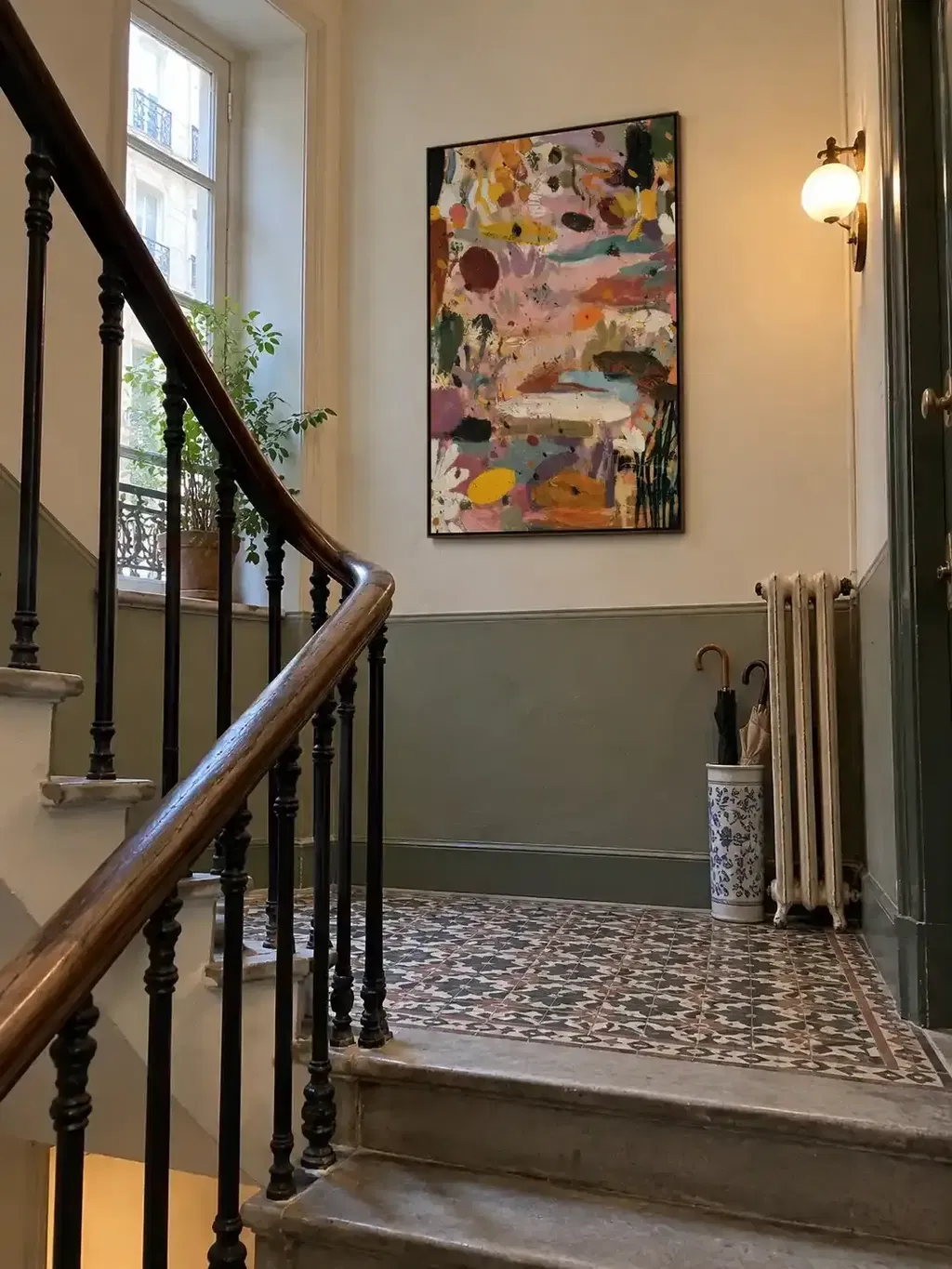
The Shift from Vanity Assets to Performative Authenticity
The global art market is undergoing a fundamental correction. While high-end auction sales for pieces exceeding $10 million plummeted 44% year-over-year in 2024, the underlying demand for art has not vanished; it has matured. According to Marketplace, buyers are retreating from purely financial art assets and returning to "real application value." For the modern homeowner and interior designer, this means moving away from the "vanity" of the name-brand print and toward the "performative authenticity" of hand-painted work.
Despite the volatility at the top of the market, the Art Basel and UBS Art Market Report 2024 confirms that global art sales reached $65 billion in 2023, with the US holding a dominant share. This stability suggests that art remains a central pillar of the built environment. However, the rise of AI-generated imagery and mass-produced digital prints has created a "decision safety" crisis. How does a buyer ensure their investment translates into a high-perceived-value room?
The answer lies in strategic budgeting—knowing exactly where the human hand is required to "anchor" a space and where high-quality digital reproductions can safely fill the gaps.
The Psychology of the "Tell": Why Human Art Commands a Premium
To understand where to splurge, one must first understand the psychological "nuclear weapon" of hand-painted art: human effort. A study by Columbia University revealed that consumers value art labeled as "AI-generated" 62% lower than authentic human-created art. This is not merely bias; it is a response to what researchers at the University of Chicago call "essential identity."
Digital replicas, no matter how high the resolution, lack the artist’s essential identity. The canvas retains an irreplicable "soul" because it is a physical record of time and neural control. Stockton University research indicates that the skill of a master painter involves a robust bottom-up neural control to suppress "perceptual constancy illusions"—essentially, the brain’s ability to see and translate light more accurately than a camera or a prompt-based algorithm.
Logic Summary: Our "Authenticity Premium" model assumes that the 62% value gap identified by Columbia University is driven by the "essential identity" theory. We apply this to interior design by recommending hand-painted work in areas where the viewer’s proximity allows for the detection of "human life-time" within the brushstrokes.

The 3-Foot Rule: The Physics of Texture and Specular Highlights
In the world of professional staging and high-end interior design, we often utilize the "3-Foot Rule." This is a heuristic based on common patterns in customer support and home staging feedback (not a controlled lab study).
The rule is simple: if a guest will stand within three feet of the artwork—such as in an entryway, a powder room, or directly above a sofa—the lack of physical texture in a print becomes a "tell." At this distance, the human eye detects the "specular highlights" of oil paint. These are the points where light catches the physical ridges of the pigment, creating a dynamic depth that changes as the viewer moves.
Technical analysis via optical microprofilometry proves that the mm-scale texture of oil paintings is crucial to their aesthetic impact. When you replace this with a flat matte print, the room’s perceived value often drops because the "tactile fruition" of the work is lost. MUNCH Museum tests have confirmed that physical relief textures exponentially stimulate intrinsic motivation and satisfaction in viewers.
The Contrast Mistake
A common error is mixing a heavily textured oil painting and a digital print on the same wall or in the same immediate sightline. The flat surface of the print makes the oil look "too busy," while the depth of the oil makes the print look "cheap." To maintain an expensive aesthetic, keep these mediums in separate sightlines.
The Texture Gradient: A Room-by-Room Strategy
To optimize a decor budget, we recommend a "Texture Gradient" approach. This matches the medium to the viewing distance and dwell time of each specific zone.
| Zone Type | Viewing Distance | Recommended Medium | Rationale |
|---|---|---|---|
| Hero Spots (Entry, Living Room) | < 3 Feet | Hand-Painted Oil/Mural | High dwell time; texture is visible and tactile. |
| Transitional (Hallways, Stairwells) | 5–10 Feet | High-Quality Prints | Movement-based viewing; texture is less critical. |
| Architectural Voids (High Ceilings) | > 10 Feet | Large-Scale Prints | Distance renders pigment ridges indistinguishable from flat ink. |
| Intimate Spaces (Powder Rooms) | < 2 Feet | Panoramic Murals | Immersive "escapism" is a 2025 design trend. |
Splurge: The Living Room and Entryway
These are "social validation" zones. A large-scale, hand-painted piece here functions as a permanent physical billboard of your taste. Zillow search data shows that mentions of "artisan craftsmanship" rose 21% recently, suggesting that "low-regret" buyers are increasingly looking for the texture of original art to finalize a room’s look.
Save: High-Ceiling Voids and Secondary Hallways
In areas where the viewing distance exceeds 10 feet, the eye cannot distinguish between the pigment saturation of an oil painting and a high-end archival print. Here, you can safely allocate funds toward framing or lighting rather than the medium itself.

The ROI of Originality: Property Value and Commercial Impact
Investing in hand-painted art is not just an aesthetic choice; it is a documented financial strategy. A Royal Society CAR model analysis of 10-year data found that neighborhoods with higher "art" geo-tags had greater relative house price ranking gains.
For commercial developers and "house flippers," the data is even more compelling. Chicago’s Millennium Park public art projects drove $1.4 billion in real estate-related growth. In a smaller residential context, creative placemaking on vacant properties—such as adding a custom mural—can instantly reverse feelings of blight, making them more attractive to long-term buyers.
Methodology Note: The "7:1 ROI" often cited in arts advocacy is based on Americans for the Arts data regarding government tax investments. In a private residential context, we estimate a more conservative but significant "aesthetic equity" gain, where original art can reduce time-on-market for high-end listings by creating a unique emotional hook.
Biophilic Design: Art as Public Health Infrastructure
The "why" behind hand-painted art often goes deeper than economics—it reaches into neurology. UPenn’s Center for Neuroaesthetics found that 73% of patients reported significant mood improvements when exposed to environmental artworks.
Nature-themed, hand-painted murals (Biophilic design) produce the same stress-reduction effects in the brain as being outdoors. A WHO scoping review confirms that art interventions effectively alter clinical indicators for mental health. For the homeowner, this means a "healing mural" in a home office is not just decor; it is a tool to reduce cognitive fatigue and burnout, which research on Tokyo office spaces suggests can be effectively mitigated by nature-based design.
The Technical Reality: Health, Safety, and Longevity
When splurging on hand-painted work, the "spec-compliant" outcome depends on the materials used. This is a YMYL (Your Money Your Life) concern, as indoor air quality is a critical health factor.
VOCs and Pigment Toxicity
The EPA warns that indoor air pollution can be deadlier than outdoor. Traditional oil painting often involves volatile organic compounds (VOCs) from solvents like turpentine. However, modern professional murals often utilize low-VOC acrylics or walnut-oil-based paints. Aalto University experiments prove that coatings on wood emit significantly lower VOCs during the curing process than once thought, provided the right binders are used.
Furthermore, buyers should be aware of pigment history. While Titanium Dioxide now dominates 90% of the white pigment market due to its safety and hiding power, older or "budget" art supplies may still contain heavy metals. The International Agency for Research on Cancer (IARC) classifies cadmium compounds as Group 1 carcinogens. Ensuring your artist uses fade-resistant, non-toxic pigments is essential for long-term safety in the home.
Lightfastness and Longevity
One reason for the "oil splurge" is longevity. ASTM D4303 is the standard for measuring lightfastness. While digital prints can fade within a decade if not archival, acrylic polymers consist of long-chain molecules that are highly resistant to embrittlement. However, be wary of "haziness" in acrylics; Tate research shows that surfactants can migrate to the surface in high humidity, a phenomenon called Support Induced Discoloration (SID).
Modeling Note (Reproducible Parameters):
Parameter Value Unit Rationale Light Exposure 1260 MJ/m² ASTM D4303 Method C (Xenon-arc) Relative Humidity 55% ±5% Standard indoor simulation VOC Threshold < 50 g/L LEED/WELL Green Building standard Viewing Angle 45 Degrees Optimal for specular highlight detection Binder Ratio 0.1% Min % Critical for pigment stability (Getty)
Ethics and the New Consumer of Craft
Finally, the decision to splurge on original art is often a moral one. A Wharton School survey found that 87% of consumers believe artists should receive fair compensation. By choosing hand-painted murals over AI-generated prints, you are supporting a creative economy that adds $1.2 trillion to the US GDP.
The European Crafts Alliance notes that top-tier luxury is now defined by the fusion of avant-garde design with authentic handcrafting. For the "low-regret" buyer, this means that every inch of brushstroke texture contains "uncompressible human life-time"—a value that digital reproductions simply cannot match.

Strategic Summary for Homeowners
When budgeting for your next project, follow this hierarchy of impact:
- Prioritize the "Entry Experience": Spend 60% of your art budget on a single, hand-painted "hero" piece for the foyer or main living area. This sets the "authenticity tone" for the rest of the home.
- Use Prints for "Atmospheric Fill": Allocate the remaining 40% to high-quality archival prints in transitional spaces like hallways or guest bedrooms.
- Verify Material Safety: Ensure that any indoor mural or large-scale oil painting uses low-VOC binders and pigments that comply with ASTM D-4236 standards.
- Separate Sightlines: Never place an oil and a print on the same wall. The smooth gradients of oils will always make the digital halftone of a print look inferior when viewed side-by-side.
By treating art as a "spatial solution" rather than just decoration, you move from buying disposable items to investing in cultural heritage assets that provide long-term aesthetic, psychological, and financial ROI.
Disclaimer: This article is for informational purposes only and does not constitute professional medical, legal, or financial advice. Always consult with a qualified professional regarding indoor air quality, property investments, or health-related interventions.
Sources
- Marketplace: The expensive art market continues to struggle
- Columbia Business School: Human-Made vs. AI Art Study
- Royal Society: Quantifying the link between art and property prices
- WHO: Scoping Review on Arts and Health
- Tate: Conservation Concerns for Acrylic Emulsion Paints
- National Endowment for the Arts: Arts & Economic Prosperity