The Hero and the Sidekick: Mastering Asymmetrical Diptychs
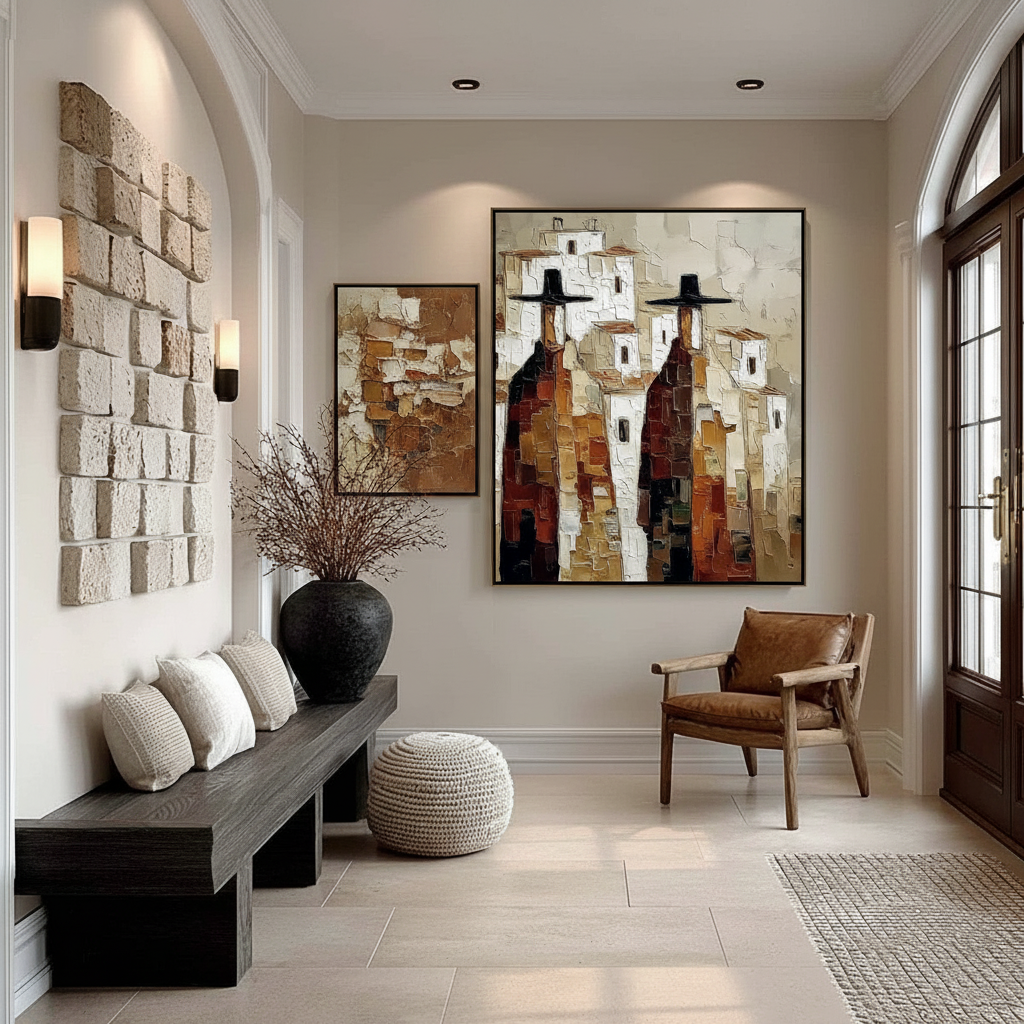
Moving beyond the rigid constraints of identical panels, the modern aesthetic is shifting toward "performative authenticity"—a design philosophy that prioritizes real artistic impact and visual uniqueness over safe, assembly-line symmetry. In our assessment of high-dominance art arrangements, we’ve observed that the most compelling focal points often arise from intentional imbalance. This is the realm of the asymmetrical diptych: a "Hero and Sidekick" pairing that uses uneven canvas sizes to create dynamic tension and a sophisticated, modern narrative.
The retreat from traditional symmetry isn't just a matter of taste; it’s reflected in the broader economic landscape. While high-end auction sales for purely financial art assets plummeted 44% YoY in 2024, as noted by Marketplace, there is a significant return to art with real application value. Consumers are increasingly abandoning overpriced vanity pieces in favor of custom, hand-painted works that offer emotional resonance and spatial integration. By mastering the asymmetrical diptych, you can achieve a gallery-level installation that feels deeply personal yet professionally curated.

The Neuroscience of Visual Dissonance
Why does an asymmetrical arrangement often feel more "memorable" than a perfectly mirrored set? The answer lies in how our brains process visual information. Conventional wisdom suggests that asymmetry creates unease, but research indicates the opposite for high-engagement spaces.
According to a study on Visual Dissonance and Dynamic Harmony, asymmetrical balance triggers novelty and surprise responses in the brain. Unlike symmetry, which the brain can "solve" and dismiss quickly, asymmetry requires more cognitive processing, making the design more impactful and enduring. This "dynamic tension" is a hallmark of sophisticated curation.
Furthermore, the "essential identity" of the artist is crucial for this impact. Empirical research from the University of Chicago shows that digital replicas and AI art lack the "soul" or essential identity that consumers perceive in authentic, human-created works. This is why a hand-painted asymmetrical diptych—where every brushstroke is unique—commands a massive commercial premium. In fact, Columbia University experiments confirm that consumers value art labeled as "AI-generated" 62% lower than authentic human-created art. For a visually dominant piece, the physical relief of oil or acrylic paint is irreplaceable.
Proportional Guardrails: The 2:1 Rule and Structured Asymmetry
The primary anxiety for home improvers is that asymmetry will look like an accident rather than a choice. To mitigate this risk, successful diptychs follow structured mathematical ratios rather than random sizing.
In our pattern recognition from professional installations, we recommend the 2:1 Rule. This heuristic suggests that the larger "Hero" canvas should be approximately twice the area of the smaller "Sidekick." This creates a clear hierarchy that guides the viewer's eye through the space.
Logic Summary: The 2:1 ratio is a scenario-modeling heuristic designed to ensure intentionality. It draws from the 60:40 proportion systems and the Golden Ratio (1:1.618), which have been used since the Renaissance to guide viewer attention through visual storytelling.
| Parameter | Recommended Value | Unit | Rationale |
|---|---|---|---|
| Area Ratio (Hero:Sidekick) | ~2:1 | Ratio | Establishes clear visual hierarchy |
| Panel Spacing | ~1/3 | Smaller Canvas Width | Maintains connection while allowing "breath" |
| Spacing Consistency | Uniform | - | Prevents the arrangement from feeling disjointed |
| Texture Consistency | High | - | Bridges the size gap through medium/style |
To maintain a cohesive look, texture consistency is the "glue." Even with different sizes, using the same painting medium and brushstroke style prevents the arrangement from feeling like two unrelated pieces. This is particularly important when balancing heavily textured art with minimalist decor, where the physical "relief" of the paint becomes the unifying element.
Technical Implementation and Installation Mechanics
Asymmetrical diptychs require more than just a hammer and a nail. Because the weight distribution is uneven, specialized hardware is often necessary to ensure the panels hang correctly and don't damage the wall.
According to specialty hardware catalogs like Systematic Art, professional installations often utilize adjustable tensioners and panel hooks. These systems, which can cost between $50 and $200, allow for micro-adjustments in height and tension, which is critical when pairing canvases of different masses.
Lighting Strategy
Lighting is the final step in securing the "Hero and Sidekick" relationship. We often observe that uniform lighting washes out the intentional imbalance. Instead:
- The Hero: Requires stronger directional lighting (e.g., a dedicated picture light or a focused ceiling spot) to emphasize its dominance and texture.
- The Sidekick: Benefits from softer ambient illumination. This prevents the smaller piece from "fighting" for attention while still highlighting its detail.
When scaling large canvases for open-plan living rooms, consider how the furniture placement affects the art's scale. Experienced designers always map furniture positions first to avoid visual competition between the art and high-backed seating or tall lamps.
Material Integrity: Safety, VOCs, and Longevity
For many home improvers, the health impact of large-scale art is a significant concern. Large canvases mean a larger surface area for potential chemical off-gassing.
The EPA warns that indoor air pollution can be more concentrated than outdoor pollution. This makes the choice of pigments and binders a health priority. In our studio practices, we prioritize low-VOC (Volatile Organic Compound) paints. Research from Aalto University shows that coatings on wood with specific moisture levels emit significantly lower VOCs during the curing process, a crucial factor for indoor air quality (IAQ).
The Toxicity of Traditional Pigments
It is vital to distinguish between "artist grade" and "safe grade." Certain traditional pigments, such as Cadmium Red or Lead White, carry severe health risks. The International Agency for Research on Cancer (IARC) classifies cadmium compounds as Group 1 carcinogens. While these pigments offer incredible vibrancy, modern alternatives like Titanium Dioxide now dominate 90% of the market due to their chemical inertness and safety (NCBI).
Furthermore, the environmental impact of art materials is gaining scrutiny. Stanford University scholars warn that coatings and pigment breakdowns are a core source of microplastics. Choosing high-quality acrylics that utilize stable polymer emulsions can reduce the shedding of microplastic fragments compared to cheaper, low-bind alternatives.

Economic Impact and Real Estate Value
Beyond personal enjoyment, asymmetrical diptychs and large-scale murals serve as powerful "capitalized assets." For commercial developers and homeowners alike, art is a proven driver of property value.
A Royal Society CAR model analysis found a direct correlation between neighborhoods with high "art" geo-tags and relative house price gains. In the B2B sector, NCREALTORS reports that public art projects, such as those in Chicago’s Millennium Park, have driven billions in real estate-related growth.
For business owners, a custom hand-painted wall acts as a "permanent physical billboard." University of Cincinnati research shows that large-scale murals are the lowest-cost physical generators of pedestrian foot traffic, revitalizing neighborhood economies and increasing commercial revenue streams.
Healing Spaces: Biophilic Design and Mental Health
The trend toward "nature-themed" asymmetrical diptychs isn't just an aesthetic preference—it’s a health intervention. Biophilic design, which incorporates natural landscapes and textures, has been shown to produce the same stress-reduction effects in the brain as being outdoors (University of Central Arkansas).
A WHO scoping review of over 3,000 studies confirms that art interventions effectively alter clinical indicators for mental illness and stress. In high-density environments, such as those studied in Tokyo office spaces, nature-based art effectively intervenes in employee burnout and cognitive fatigue. By choosing an asymmetrical diptych with biophilic themes, you aren't just decorating a wall; you are installing "public health infrastructure" within your home or office.
Supporting the Creative Economy
Finally, the decision to invest in hand-painted art has a profound social impact. The U.S. Bureau of Economic Analysis reports that arts and cultural industries added $1.2 trillion to the U.S. GDP in 2023, surpassing sectors like agriculture and transportation.
However, many freelance artists remain financially vulnerable. Ethical curation involves ensuring fair artist compensation. A Wharton School survey found that 87% of consumers strongly agree that artists should receive fair pay. By sourcing from platforms that prioritize artist equity and gender pay parity—addressing the fact that women still face a severe gender pay gap in the arts (NMWA)—you contribute to a sustainable and just creative ecosystem.
Summary of Best Practices
To successfully implement an asymmetrical diptych, keep these expert takeaways in mind:
- Embrace the 2:1 Ratio: Use a clear size disparity to signal intentionality.
- Prioritize Texture: Ensure the "Hero" and "Sidekick" share a common tactile language.
- Invest in Hardware: Use adjustable tensioners to handle uneven weight loads safely.
- Verify Material Safety: Opt for low-VOC, Titanium-based pigments to protect your indoor air quality.
- Think Long-Term: View the installation as a cultural heritage asset that boosts property value and mental well-being.
Whether you are zoning with art in a multi-use rental or curating for a shared living and workspace, the asymmetrical diptych offers a path to "performative authenticity." It is a sophisticated rejection of the ordinary, turning your walls into a dynamic narrative of human creativity.
Disclaimer: This article is for informational purposes only and does not constitute professional medical, legal, or financial advice. Always consult with a qualified professional regarding indoor air quality, structural wall safety, or investment strategies.
Sources: