The Shift Toward Performative Authenticity in Modern Entryways
The high-end art market is undergoing a structural transformation. According to data from Marketplace, sales of auction pieces exceeding $10 million plummeted by 44% year-over-year in 2024. This retreat from purely financial "vanity assets" signals a return to real application value. For the aesthetic-driven homeowner, the focus has shifted from the speculative "blue-chip" gallery circuit to the physical presence of human craft—specifically, the grounding power of hand-painted texture in the entryway.
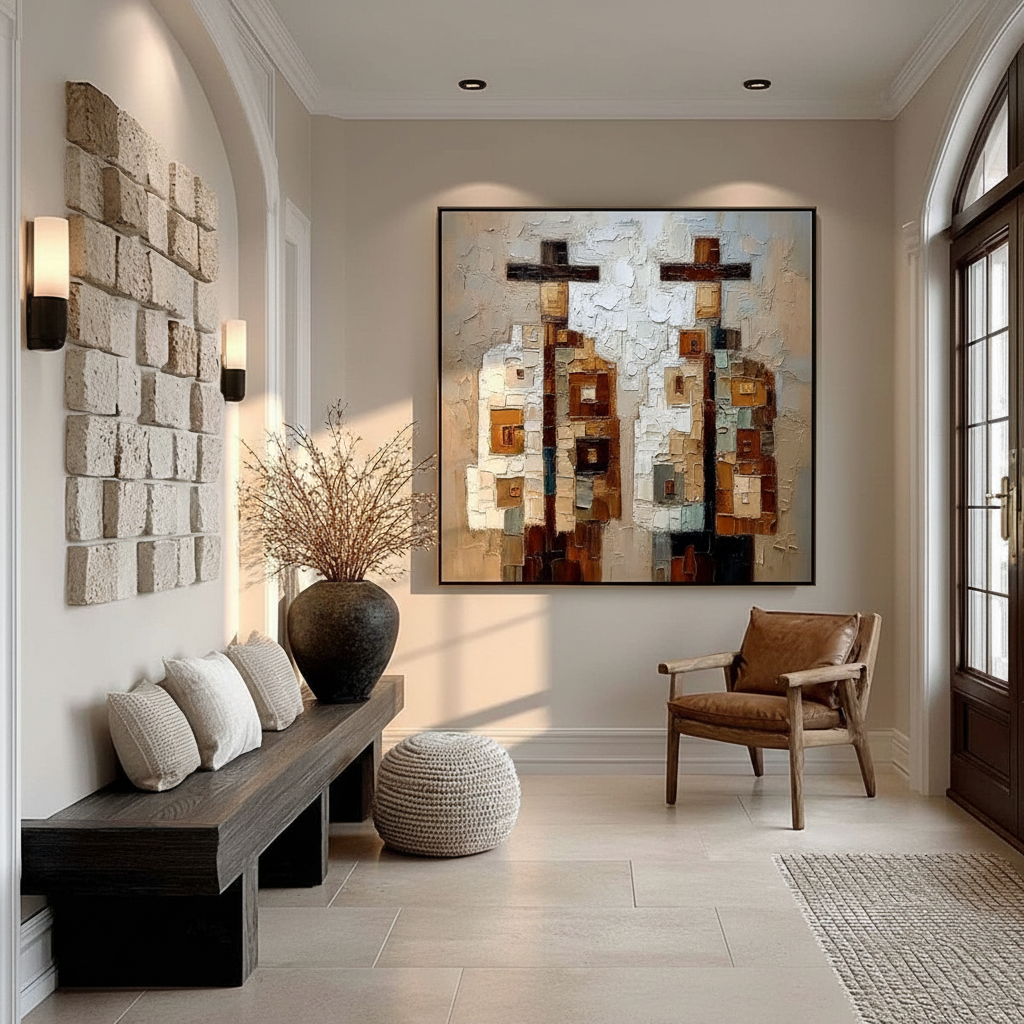
The entryway is the home’s primary psychological threshold. It is where the transition from the external world to the private sanctuary occurs. In this "camera-ready" environment, flat prints often feel thin and digital. Conversely, abstract texture—created through heavy impasto or palette knife marks—provides what we call "performative authenticity." It is the physical evidence of paint, pigment, and the artist's labor, serving as a visual anchor that signals stability and soul.
Visual-Tactile Cross-Modal Transfer: How the Brain "Feels" Art
When you walk into a foyer and see a heavily textured canvas, your brain does not just "see" the image; it simulates the tactile experience of touching it. This phenomenon, known in neuroscience as Visual-Tactile Cross-Modal Transfer, occurs because the human visual system is evolved to infer material properties from light and shadow.
Research published in Frontiers in Psychology suggests that viewing high-quality art activates emotional regulation circuits in the medial prefrontal cortex (mPFC) and the amygdala. For an entryway, this isn't just a design choice; it's a neurological intervention. The physical relief of oil or acrylic paint creates a "living" surface that changes as you move, offering a sensory richness that digital replicas cannot replicate.
The "Essential Identity" of the Human Hand
The premium placed on hand-painted work over AI-generated alternatives is not merely sentimental—it is measurable. A study conducted by Columbia University found that consumers value art labeled as "human-created" 62% higher than identical pieces labeled "AI-generated."
Furthermore, empirical research from the University of Chicago indicates that digital replicas lack "essential identity." To a viewer, a flat print is a ghost of an idea, whereas a hand-painted mural or canvas retains the "soul" of the artist's physical movements. In a world saturated by screens, the entryway serves as the first line of defense against digital fatigue, grounding the home in the tangible.

The 1:3 Ratio: Mechanics of Depth in Transitional Spaces
In transitional spaces like hallways and entryways, people are rarely stationary. They view art "on the move." This is why high-relief texture is significantly more effective than fine, flat detail. As a person walks past a textured piece, the shadows cast by the paint shift dynamically, creating a sense of movement.
Through our analysis of interior curation patterns, we have identified a practical baseline for selecting entryway art, which we call the 1:3 Texture-to-Depth Heuristic.
Logic Summary: Our modeling assumes that directional lighting in residential foyers amplifies physical texture. We estimate that for every 3mm of physical paint height (impasto), the resulting shadows create up to 1cm of perceived visual depth.
| Parameter | Value/Range | Unit | Rationale |
|---|---|---|---|
| Physical Paint Height | 3–8 | mm | Standard heavy impasto range |
| Perceived Visual Depth | 10–25 | mm | Resulting from directional shadow |
| Optimal Viewing Distance | 1.5–3 | m | Typical entryway width |
| Lighting Angle | 20–45 | degrees | Grazing light for maximum relief |
| Shadow Multiplier | ~3.3x | ratio | Heuristic for depth perception |
Note: This is a scenario model based on common residential lighting setups (not a controlled lab study). Results may vary based on pigment opacity and light source intensity.
Lighting: The Invisible Medium
The effectiveness of textured art is entirely dependent on light. Standard overhead ceiling fixtures (90-degree lighting) often "flatten" art by washing out shadows. To truly activate the 1:3 ratio, experts at The Light Room Studios recommend "grazing" light—positioning adjustable track lighting or wall sconces at a 20-45 degree angle.
While this can enhance the art significantly, homeowners should be aware that professional lighting redesigns typically range from $800 to $2,500. Without proper lighting, even the most expensive impasto piece can lose its tactile impact.

Avoiding "Texture Fatigue": Curation Strategy
A common mistake in interior design is over-stimulating the senses. If every piece of art in a home is heavily textured, the brain experiences "texture fatigue," and the impact of the individual pieces is diminished.
In a high-visibility entryway, the art should serve as the tactile anchor. This piece should be the most aggressive in terms of relief and scale. However, as guests move into adjacent hallways or transitional zones, the art should provide a "visual palate cleanser."
- The Anchor (Entryway): Large-scale, high-relief (3mm+ height), bold abstract themes.
- The Transition (Hallways): Smoother textures, perhaps focusing on color transitions or fine-line details. Zoning with art effectively requires this balance to maintain a sophisticated tone.
Health, Safety, and the "Hidden" Side of Paint
For the discerning homeowner, authenticity also extends to what is inside the paint. As the "performative" aspect of the home becomes more important, so does the air quality within it.
The VOC and Heavy Metal Challenge
The EPA warns that indoor air pollution can often be more concentrated than outdoor pollution. In the context of large-scale murals or oversized canvases, the choice of pigments is a health-critical decision.
- VOCs: Traditional oil paints often require mineral spirits and turpentine, which emit Volatile Organic Compounds (VOCs). Research from Aalto University shows that low-VOC acrylics or water-based oils are far safer for indoor environments, particularly for LEED-certified luxury developments.
- Toxic Pigments: Historically, pigments like Cadmium and Lead White were industry standards. However, the International Agency for Research on Cancer (IARC) classifies cadmium compounds as Group 1 carcinogens. Modern "performative" art should prioritize safer alternatives like Titanium White, which now dominates 90% of the market due to its chemical inertness.
The Microplastic Footprint
While acrylics are favored for their low VOCs, they are essentially liquid polymers. Stanford University scholars have highlighted that coatings and pigment breakdown are significant sources of microplastics. For homeowners committed to ESG (Environmental, Social, and Governance) values, selecting artists who use eco-friendly binders—such as walnut oil or flax-based canvases—is an essential step in balancing textured art with minimalist, sustainable decor.
Maintenance: The Cost of High-Relief Art
While the "tactile" nature of impasto art is its greatest strength, it is also a vulnerability. High-traffic entryways are prone to dust, fingerprints, and accidental abrasions.
According to Fine Art Restoration, textured paintings require 3 to 5 times more frequent conservation than flat works. The "valleys" created by palette knife strokes are magnets for airborne particulates.
Pro-Tip for Entryway Preservation:
- Varnish is Non-Negotiable: Ensure the piece is sealed with a high-quality UV-protective varnish. This makes the surface less "tacky" and easier to dust with a soft, dry brush.
- The "No-Touch" Rule: While the art looks tactile, the acids and oils from human skin can permanently damage the paint film over time.
- Strategic Placement: Avoid placing high-relief art in narrow "pinch points" where bags or coats might snag on the impasto peaks.
The 2026 Trend: Texture as the "Soul" of the Home
Looking ahead to 2026, interior design is moving away from the "assembly-line" look of the past decade. Search data analyzed by Zillow and Yelp shows a 21% rise in mentions of "artisan craftsmanship" and a massive 329% spike in searches for "custom framing."
The trend for 2026 is "understated elegance," where texture—not just color—provides the room's character. We are seeing a particular interest in "Biophilic" textures—abstract patterns that mimic natural landscapes, bark, or stone. As noted by the University of Central Arkansas, biophilic design produces stress-reduction effects in the brain similar to real nature exposure.
Investing in Cultural Heritage, Not Just Decor
When you choose a hand-painted, textured piece for your entryway, you are doing more than decorating a wall. You are investing in a non-renewable cultural asset. Unlike digital prints, which can be infinitely reproduced, a hand-painted canvas is a "one-of-one" event in time and space.
This shift toward "real application value" is what will define the next decade of luxury interiors. By bridging the gap between artistic soul and retail predictability, homeowners can create spaces that are not only "camera-ready" but also deeply grounded in the human experience.
YMYL Disclaimer: This article is for informational purposes only and does not constitute professional medical, health, or safety advice. Regarding the use of specific art materials and their impact on indoor air quality or health, please consult with a certified industrial hygienist or environmental safety professional. Always follow manufacturer safety data sheets (SDS) when handling art supplies.