The Architectural Handshake: Mastering Visual Flow in Multi-Level Residences
In high-end residential design, the transition from a grand foyer to an ascending staircase is often the most overlooked visual "handshake" in the home. For owners of villas and duplexes, this space represents a significant architectural challenge: a double-height void that can feel either cavernous and cold or cluttered and disjointed. Recent shifts in the global art market suggest that discerning collectors are moving away from overpriced, purely financial vanity assets—which saw a 44% plummet in high-end auction sales in 2024—and are returning to pieces with real application value and emotional resonance, according to Marketplace.
When we consult with homeowners and interior designers, the primary frustration is "decision safety." The fear of purchasing a large-scale work only to find it feels "off" once installed is a common barrier. Solving this requires more than just a beautiful painting; it requires a technical understanding of scale, perspective, and the unique physics of transitional light. This guide breaks down the professional heuristics for scaling art that harmonizes the foyer-to-stairwell flow, ensuring your investment enhances the "camera-ready" visual narrative of your home.

Scaling for the Double-Height Void
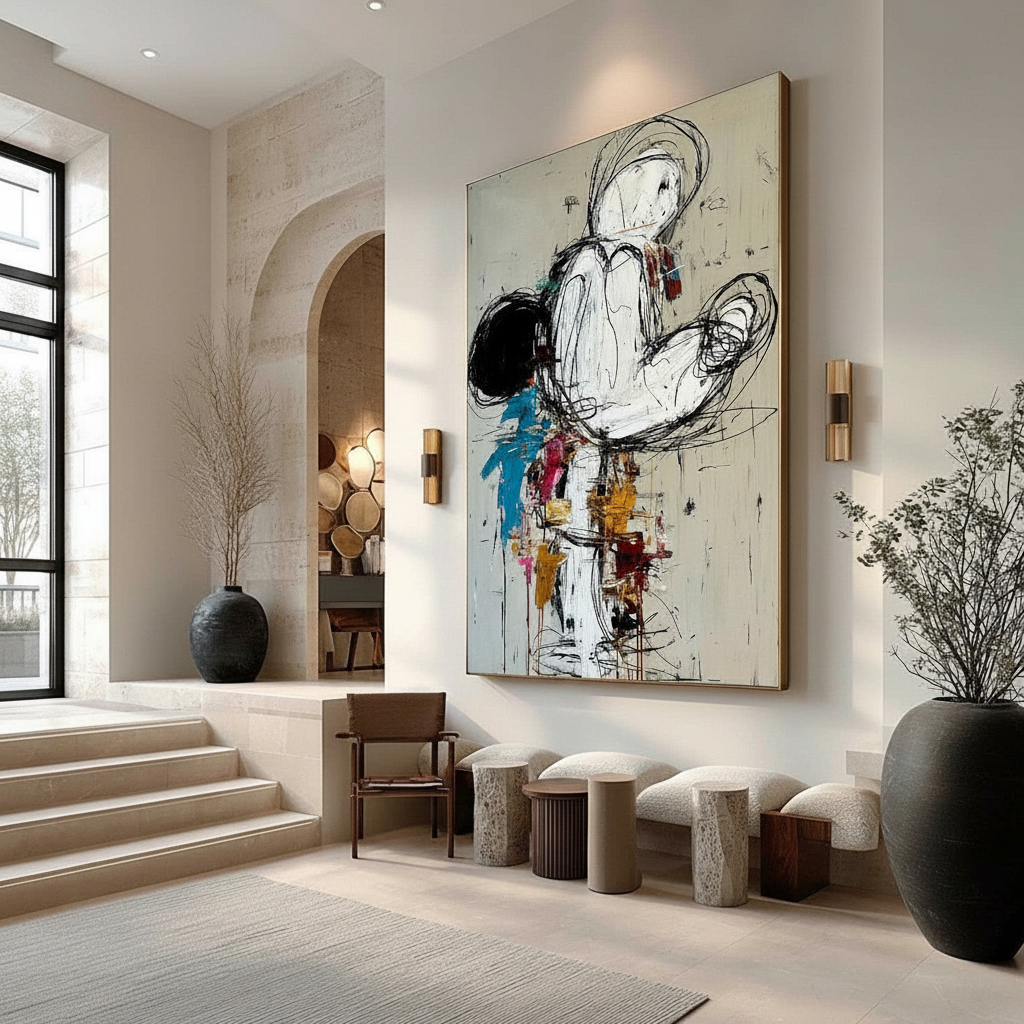
The grand foyer is defined by its verticality. In these double-height spaces, standard-sized prints often fail because they lack the physical presence to compete with the architectural volume. We typically recommend a single massive "anchor" piece rather than a gallery wall. While gallery walls work well in intimate settings, they often feel cluttered and visually "noisy" when viewed from a distance across a large entryway.
The Modified Two-Thirds Rule
In standard rooms, designers suggest art occupy two-thirds to three-quarters of the wall width. However, in high-ceiling foyers, we modify this for verticality.
- Width Heuristic: Art should occupy roughly 60–75% of the available wall width.
- Verticality Heuristic: The "anchor" piece should extend high enough to bridge the gap between the ground floor and the second-floor landing, preventing the eye from dropping into a "visual dead zone."
Modeling Note (Scenario Analysis): Our scaling model for double-height foyers assumes a standard ceiling height of 18–22 feet. The following parameters are used to determine "visual weight":
Parameter Standard Value Rationale Ceiling Height 20 ft Common villa/duplex entrance height Viewing Distance 12–15 ft Distance from front door to focal wall Wall Width 10 ft Typical foyer focal wall segment Recommended Art Width 6–7.5 ft Based on the 60–75% rule Recommended Art Height 5–6 ft To maintain vertical presence without crowding Boundary Conditions: This model may not apply to narrow "tunnel" foyers or spaces where architectural molding restricts the horizontal plane.
The Vertical Ascent: The 'Step-by-Step' Sizing Rule
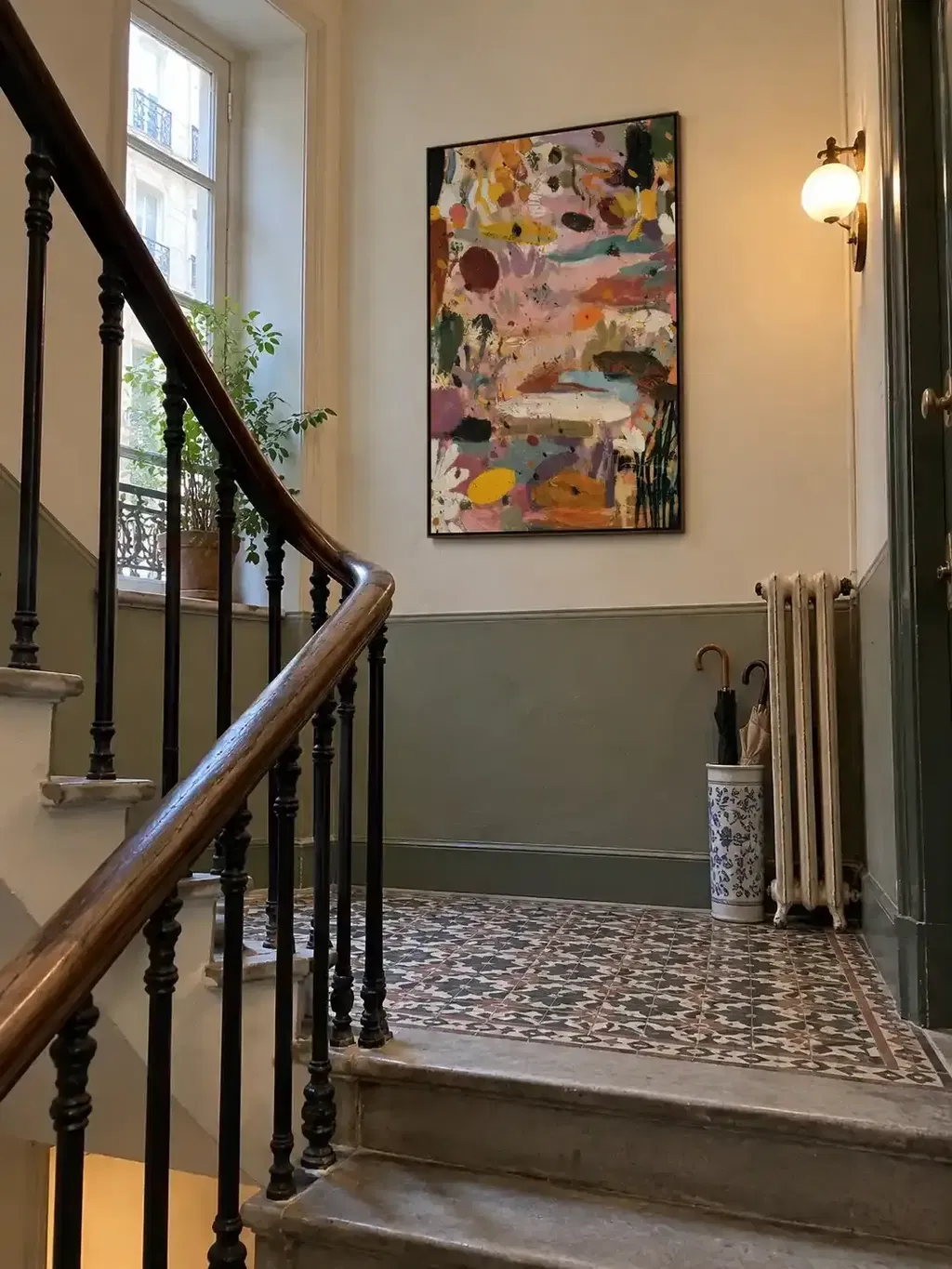
As the viewer moves from the foyer to the staircase, the perspective shifts from a static, distant view to a dynamic, close-up experience. This is where many DIY installations fail. Art hung at a standard "eye level" for the foyer floor will appear to sink as you climb the stairs.
To maintain a cohesive flow, we utilize the Step-by-Step Eye Level Rule. Art should be hung 57–60 inches from the tread of the stair directly below the center of the piece. This creates a diagonal line that mimics the incline of the staircase, guiding the eye upward in a natural, rhythmic progression.
Avoiding the "Climb Fatigue"
In institutional settings, excessive visual stimulation in corridors can increase cognitive load by 28%, according to research published in SAGE Journals. While residential spaces allow for more personality, the principle of "visual rest" remains. If you have a massive anchor piece in the foyer, the stairwell art should complement, not compete. We often suggest representational nature imagery for these transitions, as representational forms can reduce anxiety by up to 37% compared to complex abstract patterns in transitional zones, as noted in a 2024 study in Springer.

Texture vs. Glare: Why Hand-Painted Oils Outperform Prints
One of the most frequent complaints we see in our support inbox involves the "glare factor." Stairwells are often flooded with raking light from large foyer windows or skylights. When a standard print behind glass is hung in these areas, the reflection often renders the art illegible from multiple angles.
Hand-painted oils provide a tactile solution to this problem. The microtopography of an oil painting—the millimeter-scale peaks and valleys of the pigment—is crucial to its aesthetic impact. This "physical relief" not only eliminates the need for glare-prone glass but also creates a dynamic interaction with light. As you walk up the stairs, the changing angle of light across the impasto (thickly applied paint) makes the piece feel "alive."
The Psychological Premium of the Human Hand
Beyond the technical benefits, there is a measurable value in authentic craftsmanship. A study by Columbia University confirmed that consumers value art labeled "human-made" 62% higher than AI-generated alternatives. This is because canvas retains an "essential identity" and soul that digital replicas cannot replace, according to research from the University of Chicago. In a high-traffic area like a stairwell, where you are often just inches away from the surface, the depth of real brushstrokes provides a luxury experience that a flat print simply cannot mimic.
The "Landing View": Designing for the Top-Down Perspective
A common mistake in multi-level homes is ignoring the "landing view"—the perspective from the top floor looking down into the foyer. From this height, the top edge of the art becomes a prominent feature.
When selecting pieces for these voids, consider the Two-Thirds Rule for Verticality. If the wall is 20 feet high, the art should ideally occupy the middle third of that vertical space, centered around the 10-foot mark. This ensures the piece is visible and impactful both from the front door and from the second-floor railing.
Logic Summary: The "Landing View" heuristic is designed to prevent "visual drop-off." By positioning the art in the vertical center of the double-height wall, we ensure that the architectural void feels intentionally curated rather than accidentally empty.
Health, Safety, and the "Indoor Air Quality" Promise
For many of our clients, particularly those with young families, the safety of the materials is as important as the aesthetic. Large-scale murals and canvases involve significant amounts of pigment and binder, making the choice of materials a health priority.
The EPA warns that indoor air pollution can be significantly more concentrated than outdoor air. To mitigate this, we prioritize low-VOC (Volatile Organic Compound) paints. Research from Aalto University proves that coatings on wood and canvas emit significantly lower toxic VOCs during the curing process when high-quality, water-based or walnut-oil-based mediums are used.
The Science of Pigment Stability
When investing in large-scale art, longevity is key. We look for materials that pass the ASTM D4303 standard for lightfastness. This ensures that the vibrant blues and deep reds won't fade under the intense UV exposure common in sun-drenched foyers.
| Pigment Type | Lightfastness Rating | Chemical Basis | Durability Note |
|---|---|---|---|
| Titanium White | Excellent | Titanium Dioxide | Dominates 90% of the market for its hiding power. |
| Cadmium Red | Very Good | Cadmium Selenide | Extremely stable but must be handled as a heavy metal. |
| Ultramarine Blue | Excellent | Complex Silicate | Historically derived from Lapis Lazuli; now synthetic and stable. |
| Prussian Blue | Variable | Ferric Ferrocyanide | Can fade if the medium is not properly balanced. |
Ethical Craftsmanship: Supporting the Artist Economy
Choosing hand-painted art is also an investment in the creative economy. The National Endowment for the Arts (NEA) reports that arts and cultural industries now contribute over $1.2 trillion to the U.S. GDP. However, the freelance workforce remains vulnerable.
We believe in a "fair trade" approach to art. Data from Wharton shows that 87% of consumers believe artists should receive fair compensation, especially in the age of AI. Furthermore, we are committed to closing the gender pay gap in the arts, as women still face significant representation hurdles despite performing better commercially in many gallery settings, according to the National Museum of Women in the Arts.

Ensuring "Decision Safety" with the Preview Loop
To eliminate the risk of a "disjointed" purchase, we utilize a preview-and-approve loop. This allows homeowners to see the scale and color harmony of their specific piece in a digital mockup of their own foyer before the final brushstrokes are dry. This process bridges the gap between the digital world and the physical reality of hand-painted oils, aligning with modern consumer habits where online e-commerce for high-end art grew by 15% in 2024, as reported by Artsy.
By combining these technical scaling rules with a commitment to human-made quality and environmental safety, you can transform your foyer and stairwell from a mere transit zone into a cohesive, gallery-quality experience.
This article is for informational purposes only. When installing large-scale art in public or commercial spaces, please consult local ADA guidelines regarding wall protrusions and handrail clearances to ensure universal design compliance. For residential health concerns regarding pigments, always refer to the manufacturer's Safety Data Sheets (SDS).