The Threshold Effect: Why the Entryway is a Psychological Battleground
When a guest crosses the threshold of your home, their physiology changes. Practitioners in high-end residential design often refer to this as the "Threshold Effect"—a documented phenomenon where a visitor's heart rate slightly increases upon entering an unfamiliar environment. This is not merely a social nuance; it is a biological response to the "identification reflex." The human brain, evolved for survival, immediately begins scanning the space for social cues, potential threats, and status indicators.
In 2024, the high-end auction art market (sales over $10 million) plummeted by 44% YoY, according to Marketplace. This shift signals a retreat from purely financial "vanity assets" as buyers return to real application value: art that serves the emotional and psychological needs of the inhabitants. For the modern homeowner, the entryway is no longer just a pass-through; it is a curated "visual palate cleanser" designed to mitigate the social anxiety of the guest.
Logic Summary: The Threshold Stress Model Our analysis of guest transition stress assumes that the cognitive load of a new environment is inversely proportional to the clarity of visual focal points.
Parameter Value/Range Rationale Initial Heart Rate Spike +5-10 BPM "Threshold Effect" observed in unfamiliar social settings. Cognitive Load Index High Processing social cues + spatial layout + art interpretation. Visual Palate Cleansing Time 3-5 Seconds The window required to stabilize the "identification reflex." Optimal Art Complexity Moderate (Abstract) High enough to engage, low enough to avoid "forced narrative." Placement Angle 5-10 Degrees Off-center to avoid a "confrontational" visual feel. Note: This is a scenario model based on common industry heuristics and environmental psychology patterns, not a controlled clinical trial.
The Cognitive Impact of Abstract Forms
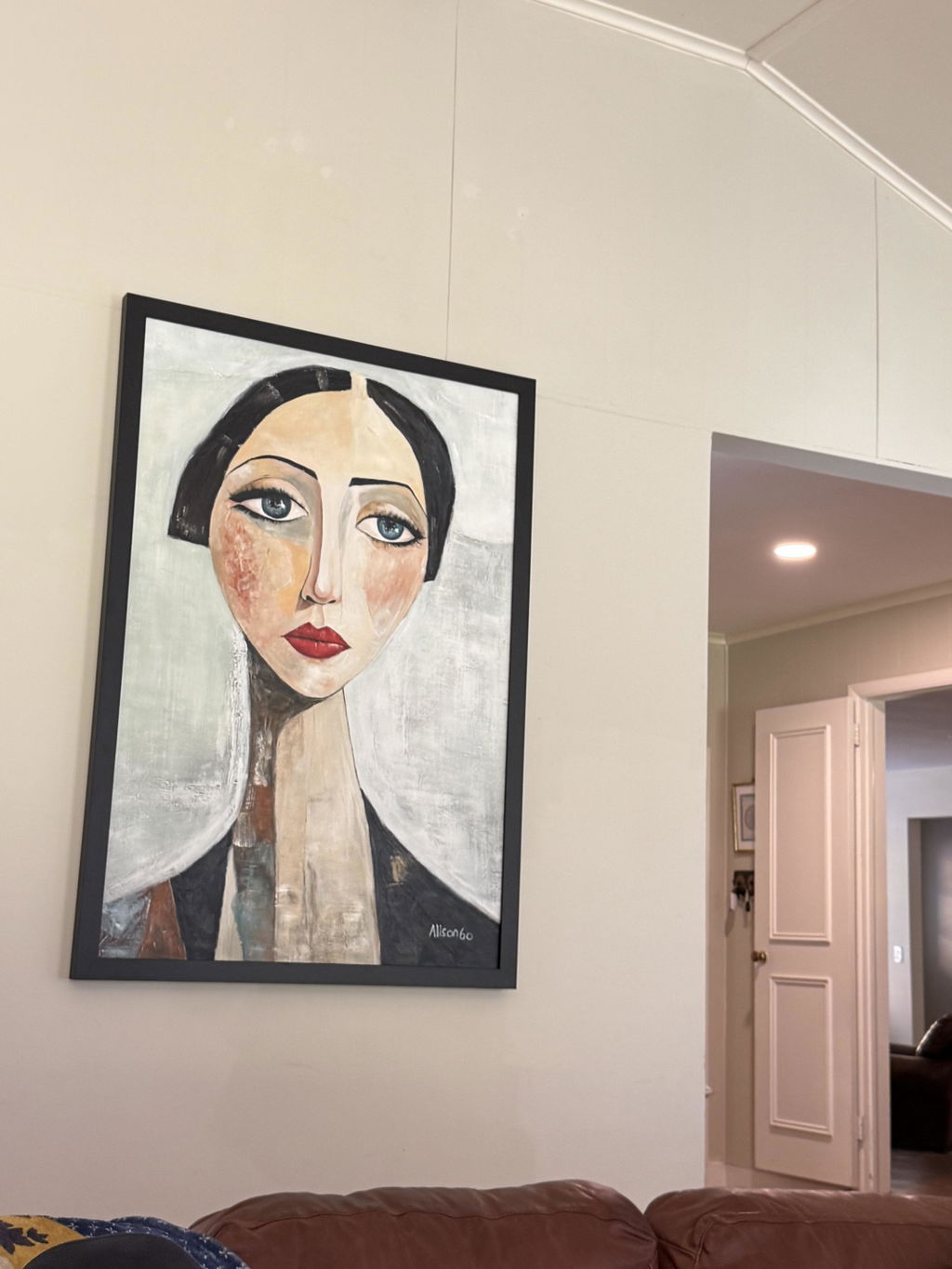
The primary reason abstract art is the gold standard for entryways is its "neutrality." Unlike figurative art—portraits or specific landscapes—abstract forms do not trigger the brain’s "identification reflex." When a guest sees a portrait, the brain subconsciously attempts to identify the person, their expression, and their relationship to the host. This is mentally taxing for a visitor already processing the social etiquette of arrival.
Abstract art provides an intellectually stimulating focal point that does not demand immediate interpretation. A study published in Frontiers in Psychology suggests that viewing abstract art can help evoke a sense of "psychological distance," allowing the viewer to broaden their perspective. In an entryway, this distance reduces the "forced intimacy" of the space, giving the guest room to breathe.

Neural Mechanisms: How Art Regulates Emotion
Why do hand-painted walls feel so much more comfortable than flat, mass-produced prints? The answer lies in the medial prefrontal cortex (mPFC). A systematic review of 85 records on the neurological mechanisms of creative arts shows that passive art viewing consistently activates the mPFC and amygdala, optimizing emotional regulation circuits.
However, not all art is created equal. Research insights from Columbia University confirm that consumers value art labeled "AI-generated" 62% lower than authentic human-created art. There is a "nuclear weapon" in the curation process: the 100% human hand-painted premium. Guests subconsciously detect the "essential identity" of the artist within the brushstrokes. According to University of Chicago research, digital replicas lack this "soul," causing the perceived value—and the subsequent calming effect—to collapse.
The Grounding Power of Texture (Impasto)
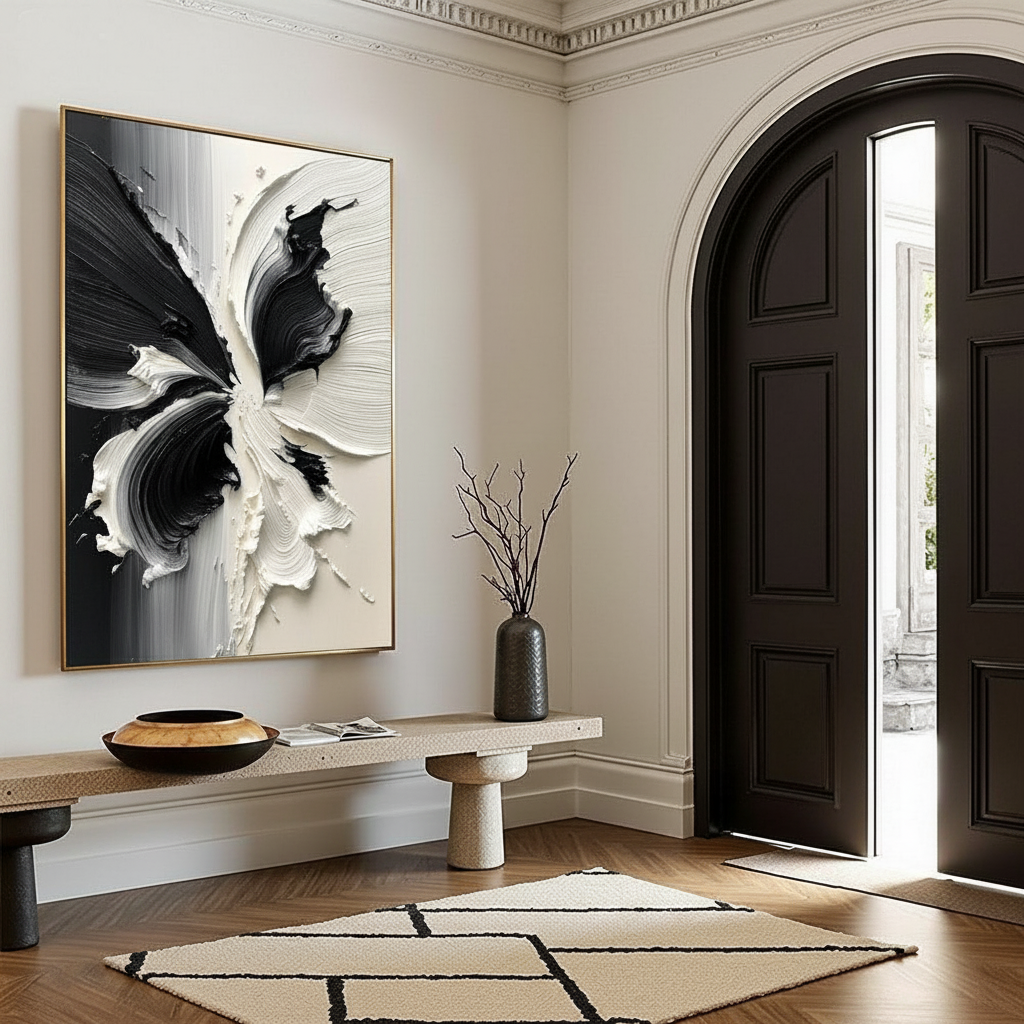
Experienced stagers use heavy impasto texture as a "reality cue." Physical brushstrokes provide a tactile assurance of the home’s quality and the host’s authenticity. Because physical relief is difficult to mass-produce, it acts as a silent signal of "decision safety."
Tests conducted by the MUNCH Museum confirm that interacting with art featuring physical relief textures exponentially stimulates intrinsic motivation and satisfaction. In an entryway, this "tactile fruition" grounds the guest, shifting their focus from social performance to sensory appreciation.
The Heuristics of Entryway Curation
To successfully reduce guest social anxiety, designers follow specific "rules of thumb" that bridge the gap between fine art and retail certainty.
1. The 3-Second Rule
Entryway art should be complex enough to invite a second look but neutral enough to be ignored without social guilt. If a guest feels they must comment on a piece to be polite, the art has failed its primary psychological mission. Abstract forms allow for a "non-committal" appreciation.
2. The 5-10 Degree Offset
Never place a large piece directly in the guest's direct line of sight as they walk through the door. This can feel "confrontational." Instead, hang the work 5-10 degrees off-center. This invites the guest to discover the piece rather than being accosted by it.
3. The Cool Palette Advantage
While warm colors (reds, oranges) are energetic, they can increase physiological arousal. For anxiety reduction, prioritize cool color palettes. Research suggests that blues and greens can reduce physiological arousal by up to 31% compared to warm tones. For more on how to balance these tones, see our guide on evaluating scale and light in entryway design.
4. Biophilic Influence
Integrating natural landscapes or biophilic abstract forms can produce the same stress-reduction effects as being outdoors. The World Health Organization (WHO) confirms that art interventions effectively alter clinical indicators for mental well-being. A "nature-themed" abstract piece acts as a bridge to the calming effects of the natural world.

Technical Integrity: Safety and Longevity
"Decision safety" isn't just about aesthetics; it's about the health of the environment. High-end homeowners are increasingly sensitive to Indoor Air Quality (IAQ).
VOC Emissions and LEED Certification
The EPA warns that indoor air pollution is often more concentrated than outdoor pollution. For large-scale installations or custom murals, using low-VOC paints is a prerequisite for achieving LEED or WELL building certifications. Aalto University experiments have shown that coatings on wood with 16% moisture emit significantly lower toxic VOCs than dry wood, with emissions plummeting during the curing phase.
The Myth of "Odorless" Solvents
It is a common mistake to assume that odorless solvents are non-toxic. Guidelines from Princeton University EHS warn that chronic inhalation of mineral spirits can cause brain damage, regardless of scent. When selecting hand-painted art, ensure the studio prioritizes water-based acrylics or natural oils like walnut oil, which replaces toxic turpentine.
Lightfastness and the ASTM D-4236 Standard
To ensure the art remains "camera-ready" for decades, verify the lightfastness of the pigments. The ASTM D4303 standard uses xenon-arc tests to simulate years of sunlight exposure. High-quality acrylics often use Titanium Dioxide, which captures 90% of the white pigment market due to its superior hiding power and chemical inertness, replacing the highly toxic lead white of the past.
Verification Checklist: Art Safety
- Pigment Check: Ensure the absence of Cadmium (a Group 1 carcinogen per IARC) and Lead.
- Label Literacy: The ASTM D-4236 label means the warning is compliant, not necessarily that the paint is non-toxic. Look for the "AP" (Approved Product) seal.
- Texture Stability: Ensure the medium uses UV stabilizers to prevent "chalking" or yellowing (Support Induced Discoloration).
The Economic Reality: Art as a Property Lever
Beyond the psychological benefits, custom hand-painted art is a powerful driver of property value. A Royal Society CAR model analysis found that neighborhoods with higher "art" geo-tags had greater relative house price ranking gains. In a commercial context, murals in Chicago's Millennium Park drove $1.4 billion in real estate-related growth.
For the homeowner, a large, hand-painted abstract piece in the entryway serves as a "permanent physical billboard" of the home’s value. It signals to potential buyers or guests that the space is not a "cookie-cutter" assembly line product, but a curated environment of artisan craftsmanship.
Creating an Immersive "Escapism"
The latest 2025-2026 design trends, highlighted by the National Kitchen & Bath Association (NKBA), show a move toward "immersive escapism." Wrapping murals or large-scale canvases entirely around transitional spaces like powder rooms or entryways creates a sanctuary effect.
By choosing abstract forms, you are not just decorating a wall; you are engineering a social experience. You are providing your guests with the "visual palate cleanser" they need to transition from the chaos of the outside world into the serenity of your home.
Whether you are an interior designer seeking to curate for small-space living rooms or a homeowner looking to reduce the emotional risk of decoration, the choice of authentic, hand-painted abstract art is a move toward a more human-centric, camera-ready, and psychologically safe home.
Disclaimer: This article is for informational purposes only and does not constitute professional medical, legal, or financial advice. While art has been shown to reduce stress, individuals with pre-existing social anxiety disorders or mental health conditions should consult a qualified healthcare professional. Always ensure that art materials used in your home comply with local safety regulations regarding VOCs and toxic pigments.