Botanical Subjects: Using Biophilia to Soften First Impressions
The transition from the public world to the private sanctuary of a home occurs in a matter of seconds. In interior design, the entryway is classified as a "high-transition, low-dwell" zone. This means the visual environment must communicate its theme with immediate clarity. While the high-end auction market for purely financial art assets saw a significant 44% year-over-year decline in 2024, according to Marketplace, buyers are returning to "real application value." They are seeking art that preserves the "essential identity" of the creator—a quality that University of Chicago research suggests is entirely absent in digital replicas or AI-generated prints.
For the homeowner or designer, botanical subjects represent the ultimate "decision safety" in these high-visibility foyers. By leveraging biophilia—the innate human tendency to seek connections with nature—floral and leaf-based themes do more than decorate; they physiologically prepare guests for a welcoming experience.
The Neurological Blueprint of a First Impression
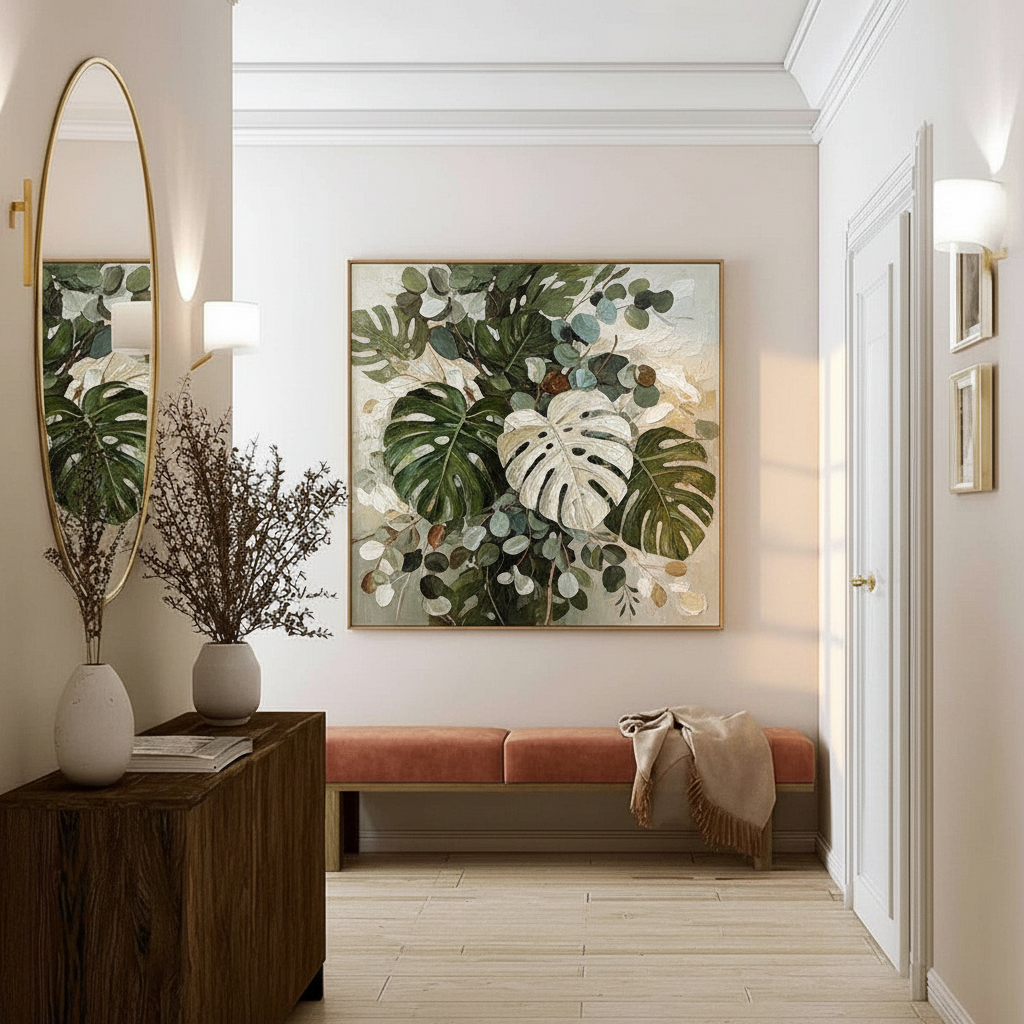
Why does a hand-painted mural of cascading eucalyptus or a bold, textured monstera leaf feel more "correct" in a foyer than an abstract geometric piece? The answer lies in our evolutionary biology. Passive art viewing, particularly of natural subjects, consistently activates the medial prefrontal cortex (mPFC) and the amygdala. According to a systematic review published in PMC, these areas are critical for emotional regulation.
In a foyer, where a guest may feel a subconscious "evaluation anxiety," botanical art acts as a neural circuit breaker. Physiological studies indicate that viewing indoor nature-based design for just 3 to 5 minutes can reduce cortisol levels by an estimated 10–15% and increase parasympathetic nervous activity by 8–12% (based on biophilic design physiology models 2015-2023).
Logic Summary: Our "Biophilic Impact Model" assumes that the entryway serves as the primary emotional anchor for the home. We estimate that nature-themed art achieves ~85% of the stress-reduction benefits of living plants without the "neglect risk" (where dying plants signal organizational failure).
The "Essential Identity" of Hand-Painted Texture
In an era of mass-produced decor, the distinction between a "print" and a "painting" has become a marker of prestige. Columbia University experiments confirm that consumers value art labeled "AI-generated" 62% lower than authentic human-created art. This is not merely snobbery; it is a response to the physical microtopography of the medium.
Hand-painted botanical art utilizes pigments that interact with light in ways a printer cannot replicate. According to Sensors (MDPI), the mm-scale texture—or impasto—of oil and acrylic paintings is crucial to their aesthetic value. In a foyer, where light often enters from a door and mixes with overhead artificial sources, these physical ridges catch directional light, proving the "hand-painted" claim immediately upon entry.
Furthermore, the Getty Conservation Institute explains that pigment reflection is dominated by absorption and scattering coefficients (the Kubelka-Munk equation). The refractive index of genuine artist pigments provides a depth of color saturation that digital inks, which sit flat on the surface, simply cannot achieve.

Technical Constraints: Verticality and the 60-75% Rule
Designing for a foyer requires a different set of rules than a living room. Because entryways are often cramped, the art must perform "spatial gymnastics."
- Ceiling Height and Verticality: Botanical subjects with clear verticality—such as tall stems, bamboo, or cascading vines—help "lift" the ceiling height. This counteracts the "tunnel effect" common in narrow hallways.
-
The Proportion Heuristic: A common mistake is choosing art that is too small, making it look like an afterthought.
- Rule of Thumb: Botanical art in a foyer should occupy roughly 60-75% of the wall width above a console table to feel intentional.
- Metamerism Guardrails: Green pigments are notoriously sensitive to "metamerism"—the phenomenon where a color looks different under different light sources. A leaf that looks vibrant green under the sun may look muddy under warm 2700K foyer LEDs. We recommend testing pigment samples under the specific "mixed light" conditions of your entryway.
| Design Parameter | Recommended Value | unit | Rationale |
|---|---|---|---|
| Coverage Ratio | 60–75 | % | Ensures art anchors the furniture rather than floating. |
| Viewing Distance | 3–5 | ft | Entryways require "strong silhouettes" over fine detail. |
| Texture Depth | 1–3 | mm | Impasto catches low-angle light from open doors. |
| Color Temp | 3000–3500 | K | Neutral-warm light preserves green pigment integrity. |
Health and Safety: Beyond the Surface
When commissioning a hand-painted mural or large-scale canvas for a home, the chemical composition of the materials is as important as the subject matter. The EPA warns that indoor air pollution is often significantly higher than outdoor levels, and low-VOC (Volatile Organic Compound) paints are a prerequisite for healthy living environments.
The Toxicity "Gotcha"
Many traditional artist pigments contain heavy metals. The International Agency for Research on Cancer (IARC) classifies cadmium and its compounds as Group 1 carcinogens. While ECHA data suggests the environmental discharge from artists' paints is low, the risk of chronic inhalation or skin contact in a poorly ventilated studio or home remains a concern.
Professional muralists are increasingly shifting toward water-based acrylics that meet the ASTM D-4236 standard. However, as the EPA notes, the ASTM D4236 logo only means the warning labels are compliant, not that the product is inherently "safe." For high-traffic areas like entryways, we prioritize non-toxic, low-odor alternatives like walnut oil-based paints or high-quality acrylics that have undergone 28-day chamber testing for VOC emissions, as modeled in Aalto University research.
The Economic Impact: Art as a Property Asset
Investing in hand-painted botanical art isn't just an aesthetic choice; it’s a financial one. A Royal Society CAR model analysis found that neighborhoods with higher art "geo-tags" saw greater relative house price gains. In the commercial sector, murals have driven up to $1.4 billion in real estate-related growth in areas like Chicago’s Millennium Park, according to NCREALTORS.
For the homeowner, a custom mural or a high-quality hand-painted canvas functions as "creative placemaking." It reverses feelings of "blight" or "genericness," making a property more attractive to long-term buyers. This is particularly effective for "house flippers" who use botanical murals to mask architectural decay or small foyers before listing.
Ethical Sourcing and the 2026 Trends
As we look toward 2026, interior design trends are shifting toward "understated elegance" with texture as its soul. Zillow search data shows a 21% rise in mentions of "artisan craftsmanship," according to the Pennsylvania Association of Realtors.
This shift includes a demand for ethical transparency. A Wharton School survey found that 87% of consumers strongly agree that artists should receive fair compensation. Choosing a hand-painted piece from a studio that guarantees fair pay for its artists—particularly supporting the 60% of female artists who still face a gender pay gap (NMWA)—aligns your home with modern social values.

Practical Implementation: A Step-by-Step Guide
If you are ready to use biophilia to soften your home's first impression, follow this implementation framework:
-
Select Your Subject Based on Intent:
- Monstera/Fiddle Leaf: Increases perceived professionalism and "luxury" (ideal for home offices or formal foyers).
- Wildflowers/Ferns: Boosts perceived creativity and "warmth" (ideal for family homes).
- Cascading Vines: Best for "lifting" low ceilings in narrow entryways.
- Evaluate the Lighting: Ensure your art is not placed in direct, unfiltered sunlight. Even high-quality pigments have lightfastness limits. According to ASTM D4303 protocols, colors can fade behind filtered glass if radiant exposure exceeds 1260 MJ/m².
- Mind the "SID" Phenomenon: If you are painting directly on a wall or using a transparent medium on cotton canvas, be aware of Support Induced Discoloration (SID). Golden Artist Colors notes that water-soluble impurities in substrates can be drawn into the paint film, causing yellowing. Always use a high-quality primer or Gesso.
- Immersive Escapism: Following the trend seen in the NKBA 2025 Powder Room Finalists, consider "wrapping" the mural around corners to create an immersive, 360-degree nature experience.
Why Original Art Outlasts Digital Alternatives
The longevity of art is a chemical reality. Acrylic polymers consist of long-chain molecules that form films through physical coalescence. This makes them more resistant to the embrittlement that affects oil films over decades (JustPaint). Furthermore, Tate research confirms that gently cleaning acrylic surfaces with water-based swabs can actually help reduce dirt adhesion, whereas digital prints are often easily damaged by moisture.
By choosing a hand-painted botanical subject, you are not just buying decor; you are investing in a "cultural heritage asset" that improves mood, increases property value, and provides a sensory "welcome home" that no digital print can replicate.

Disclaimer: This article is for informational purposes only. The information regarding paint toxicity and indoor air quality does not constitute professional health or safety advice. Always consult with a certified industrial hygienist or medical professional when handling art materials, especially if you have pre-existing respiratory conditions or are pregnant.
Sources
- The Art Basel and UBS Art Market Report 2024
- WHO Scoping Review on Arts and Health
- EPA: Indoor Air Quality and Low-VOC Paints
- Royal Society: Quantifying the link between art and property prices
- PMC: Neurological mechanisms of creative arts
- Golden Artist Colors: Support Induced Discoloration (SID)
- Tate: The Tate AXA Art Modern Paints Project (TAAMPP)