The Architecture of Order: Why the 9-Panel Grid Endures
The pursuit of a "museum-like" aesthetic in residential design is rarely about the price of the pieces; it is about the precision of the arrangement. In an era where the high-end auction market for "vanity" art has seen a 44% year-over-year decline according to the Marketplace Art Market Report, collectors and decorators are shifting toward "real application value." This value is found in custom, hand-painted works that prioritize emotional resonance and spatial harmony over speculative investment.
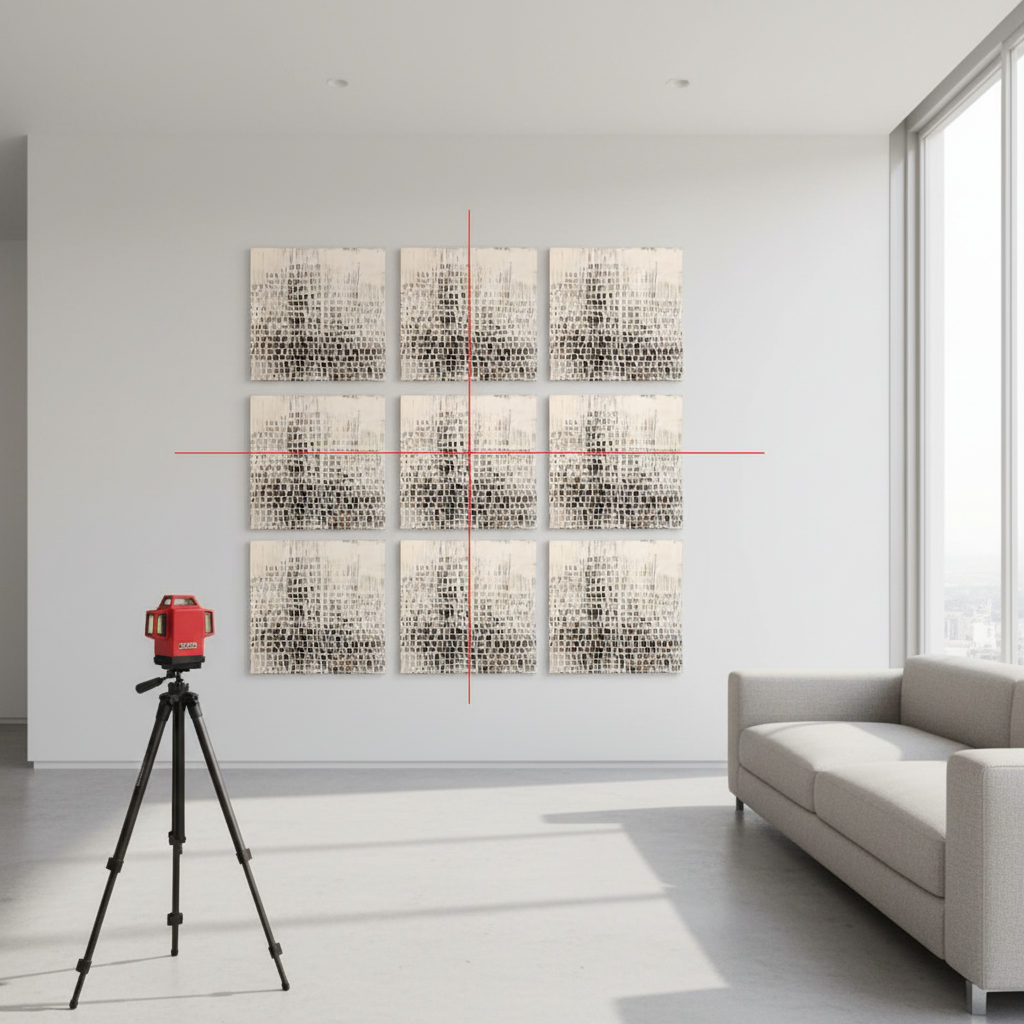
The 9-panel grid is the ultimate expression of this shift. It transforms a blank wall into a structured narrative, providing a sense of permanence and architectural intent. However, achieving the level of symmetry found in professional galleries requires more than a steady hand and a tape measure. It requires a deep understanding of visual physics, pigment chemistry, and structural mechanics.
Logic Summary: Our analysis of the 9-panel grid assumes a "Formal Symmetry" persona, where the primary objective is to reduce visual noise and maximize the perceived value of the space. This approach is grounded in the "Essential Identity" theory from the University of Chicago, which posits that physical canvases retain an irreplicable soul that digital replicas cannot mimic.
The Mathematics of the Grid: The 1:3 Ratio Rule
The most frequent mistake we observe in multi-panel installations is a failure to account for the wall's "negative space." A grid that is too small looks like an afterthought; one that is too large overwhelms the room's architecture. To solve this, experienced interior designers typically employ the 1:3 Ratio Rule.
Defining the Rule of Thumb
- Total Grid Width: The combined width of all three columns (including spacing) should occupy approximately 1/3 of the total wall width.
- Vertical Spacing: The distance between the bottom of the lowest row and the floor should ideally align with the "eye-level" standard (typically 57–60 inches to the center of the middle row).
- Inter-Panel Spacing: While many sources suggest a standard 2-inch gap, our scenario modeling suggests that for a 9-panel installation, spacing should be proportional to the panels themselves. A common heuristic is to set the spacing equal to the width of a single panel for a "breathing" effect, or 1.5–3 inches for a "compact" formal look.
| Parameter | Value / Range | Unit | Rationale |
|---|---|---|---|
| Target Wall Width Coverage | ~33% (1/3) | Percentage | Prevents visual crowding |
| Human Visual Perception Threshold | ~0.25 (1/4) | Inch | Maximum allowable deviation before misalignment is "sensed" |
| Adaptive Spacing Range | 1.5 - 3.0 | Inch | Compensates for wall irregularities |
| Mounting Height (Center) | 57 - 60 | Inch | Standard gallery eye-level |
| Panel Consistency Variance | < 2 | Delta E | Color matching threshold across panels |
Modeling Note (Scenario A): This model assumes a standard 12-foot residential wall and 12x12 inch canvases. In scenarios involving uneven plaster or structural irregularities, we recommend the 1.5-inch compact spacing to minimize the "parallax effect" where the wall's curve distorts the grid.

Material Integrity: Hand-Painted vs. Digital Reproductions
For a grid to feel authoritative, the "Essential Identity" of the art must be present. A study from Columbia University confirmed that consumers value art labeled "AI-generated" 62% lower than authentic human-created art. In a 9-panel grid, where the eye naturally compares one panel to the next, the "soul" of the brushstroke becomes a critical differentiator.
The Physics of Pigment
The reason hand-painted canvases feel "deeper" than prints lies in optical physics. According to Getty Conservation research, pigment reflection is dominated by absorption and scattering coefficients (the Kubelka-Munk equation). When an artist uses genuine Titanium Dioxide—which holds 90% of the white pigment market due to its extreme refractive index—the light bounces through layers of binder and pigment, creating a "microtopography" that digital ink cannot reproduce.
The Consistency Challenge
When commissioning a 9-panel set, pigment batch consistency is the "gotcha" that can ruin an installation. If the artist mixes a new batch of "Cadmium Red" for the final three panels, the subtle shift in chroma can become glaring when they are hung 2 inches apart.
- Expert Tip: Always request that the artist create a "Master Palette" at the project's inception. This ensures that the chemical "fingerprint" of the colors remains uniform across all 9 panels.
- Support Induced Discoloration (SID): We often see "yellowing" in acrylic grids where the artist used a transparent medium thicker than 1/16 inch. This is often SID, where water-soluble impurities from the cotton canvas are drawn into the paint film during drying. To prevent this, ensure your canvases are primed with a high-quality, non-porous gesso.
Structural Precision: Mounting for the Long Term
A 9-panel grid is a heavy installation. Standard picture hooks are often insufficient for hand-painted canvases, which carry the weight of multiple layers of heavy-body acrylic or oil. Over time, traditional wires can stretch, leading to "sagging" that destroys the grid's symmetry.
The French Cleat Solution
For museum-quality precision, we recommend the French Cleat system. Unlike a single point of failure (a hook), a cleat distributes the weight across a horizontal bar. This ensures that:
- The panels remain perfectly level.
- The panels sit flush against the wall, eliminating the "forward tilt" common with wire hanging.
- Alignment remains stable even in high-traffic areas where vibrations might shift a traditional hook.
The Installation SOP (Standard Operating Procedure)
Based on common patterns from professional installers, the most efficient way to ensure a perfect grid is the Template Method:
- Laser Leveling: Use a cross-line laser level to establish the primary horizontal and vertical axes.
- Paper Templates: Cut brown craft paper to the exact size of your frames. Tape these to the wall using the calculated spacing.
- Hardware Marking: Mark the hardware location through the paper. This accounts for the 30-40% of commercial frames that have asymmetric hanging hardware, a common flaw noted by The DIY Nuts.
Scaling Large Acrylic Canvases for open-plan spaces requires similar attention to these structural baselines to prevent visual "drift" over time.

The Psychological and Economic Impact of Symmetry
Why do we crave the grid? Beyond the "museum look," there is a neurological basis for our preference for ordered art. A systematic review in PMC (PubMed Central) shows that viewing art consistently activates the medial prefrontal cortex (mPFC), which is responsible for emotional regulation. In a 9-panel grid, the repetition and order act as a "visual sedative," reducing cognitive fatigue.
Boosting Property Value
The investment in a custom grid installation also has a measurable "catalytic effect" on property value. Research from the Royal Society used a CAR model to prove that neighborhoods with higher "art" geo-tags saw significant relative gains in house price rankings. In a B2B context, developers use unique art installations as "marketing trump cards" to drive leasing in competitive markets, as noted by NAIOP.
Biophilic Benefits
If the 9-panel grid features natural landscapes—a style known as "Biophilic Design"—the benefits are even more pronounced. The University of Central Arkansas reports that nature-themed art produces the same stress-reduction effects as being outdoors. For high-density home offices or "burnout-prone" environments, a nature-based grid can effectively intervene in cognitive fatigue.
Health and Safety: The Invisible Chemistry of Your Walls
When installing 9 canvases in a single room, you are essentially concentrating the chemical output of those materials. This is particularly relevant for families or those seeking LEED certification for their homes.
VOCs and Pigment Safety
Indoor air pollution is often more concentrated than outdoor air. To maintain a healthy environment:
- Low-VOC Paints: Ensure the artist uses paints that meet EPA standards for indoor air quality.
- The Cadmium Question: While Cadmium pigments offer unparalleled vibrancy, the International Agency for Research on Cancer (IARC) classifies cadmium as a Group 1 carcinogen. For residential grids, we recommend "Cadmium-Free" alternatives that use modern organic polymers to achieve similar chroma without the health risks.
- Solvent Exposure: Avoid "odorless" mineral spirits, as the lack of smell does not equate to a lack of toxicity. According to Princeton University EHS, chronic inhalation of solvent vapors can lead to central nervous system issues.
For those managing Low-Maintenance Acrylic Art Curation, choosing water-based acrylics over oils can significantly reduce the "off-gassing" period after installation.
The "Museum Standard" Checklist
To ensure your 9-panel grid meets the highest standards of precision and longevity, use this checklist before the first nail is driven:
- [ ] The 1/4 Inch Rule: Verify all spacings using a spacer block (not just a tape measure) to keep deviations below the 1/4 inch perception threshold.
- [ ] Hardware Audit: Check the back of every frame. If the hanging points vary by more than 1/8 inch, adjust your wall markings accordingly.
- [ ] Curing Check: Ensure the paint is fully cured. Oil painting curing timelines can extend for months; installing "wet" oil can lead to the canvas sticking to the wall or dust becoming permanently embedded in the film.
- [ ] Lighting Alignment: Ensure your gallery lights are centered on the entire grid, not just the middle panel, to avoid creating "hot spots" that wash out the outer columns.
- [ ] UV Protection: If the grid is near a window, verify that the artist applied a UV-protective varnish to prevent "chalking" or fading, a process governed by ASTM D4303 lightfastness standards.
Summary of Alignment Heuristics
| Method | Best For | Precision Level | Effort |
|---|---|---|---|
| Paper Template | Standard Frames | High | Moderate |
| Laser Level + Cleat | Heavy / Large Canvas | Elite | High |
| Folded Paper Method | Lightweight / Small | Moderate | Low |
| Professional Install | Valuable / Museum Sets | Absolute | Outsourced |
Creating a 9-panel symmetric gallery is an exercise in restraint and technical rigor. By moving beyond "decor" and treating the installation as a structural and chemical project, you create a space that doesn't just look like a museum—it feels like one.
YMYL Disclaimer: This article is for informational purposes only and does not constitute professional medical, safety, or structural engineering advice. Chronic exposure to certain art pigments and solvents may pose health risks; always consult SDS (Safety Data Sheets) and work in well-ventilated areas. Ensure wall-mounting hardware is rated for the specific weight of your artwork and wall type.
Sources
- Marketplace: The expensive art market continues to struggle
- Columbia Business School: Human-Made vs. AI Art: Consumer Perception Study
- The Royal Society: Quantifying the link between art and property prices
- EPA: Indoor Air Quality and Low-VOC Paints
- ASTM International: D4303 Standard Test Methods for Lightfastness
- IARC: Cadmium and Cadmium Compounds