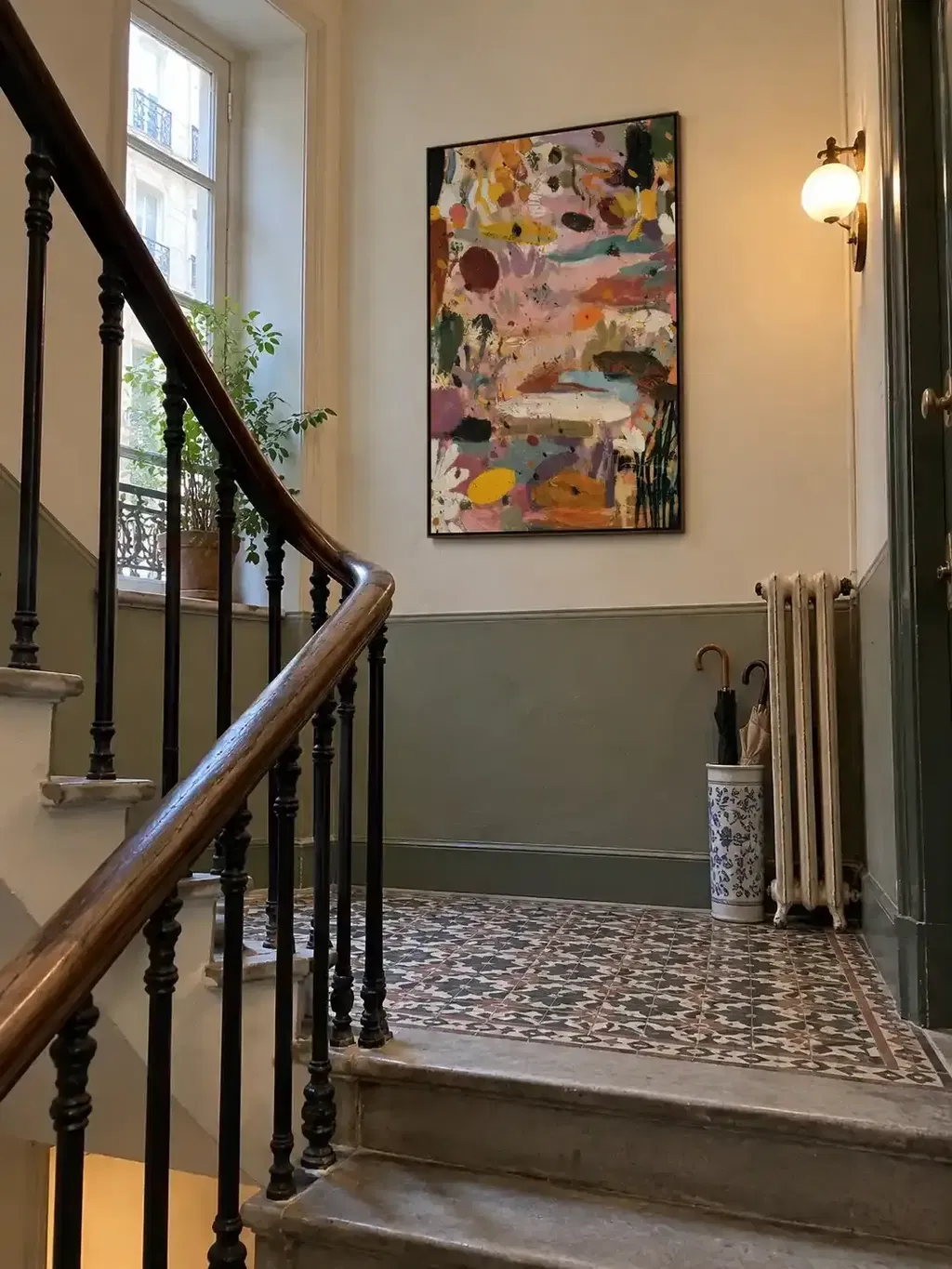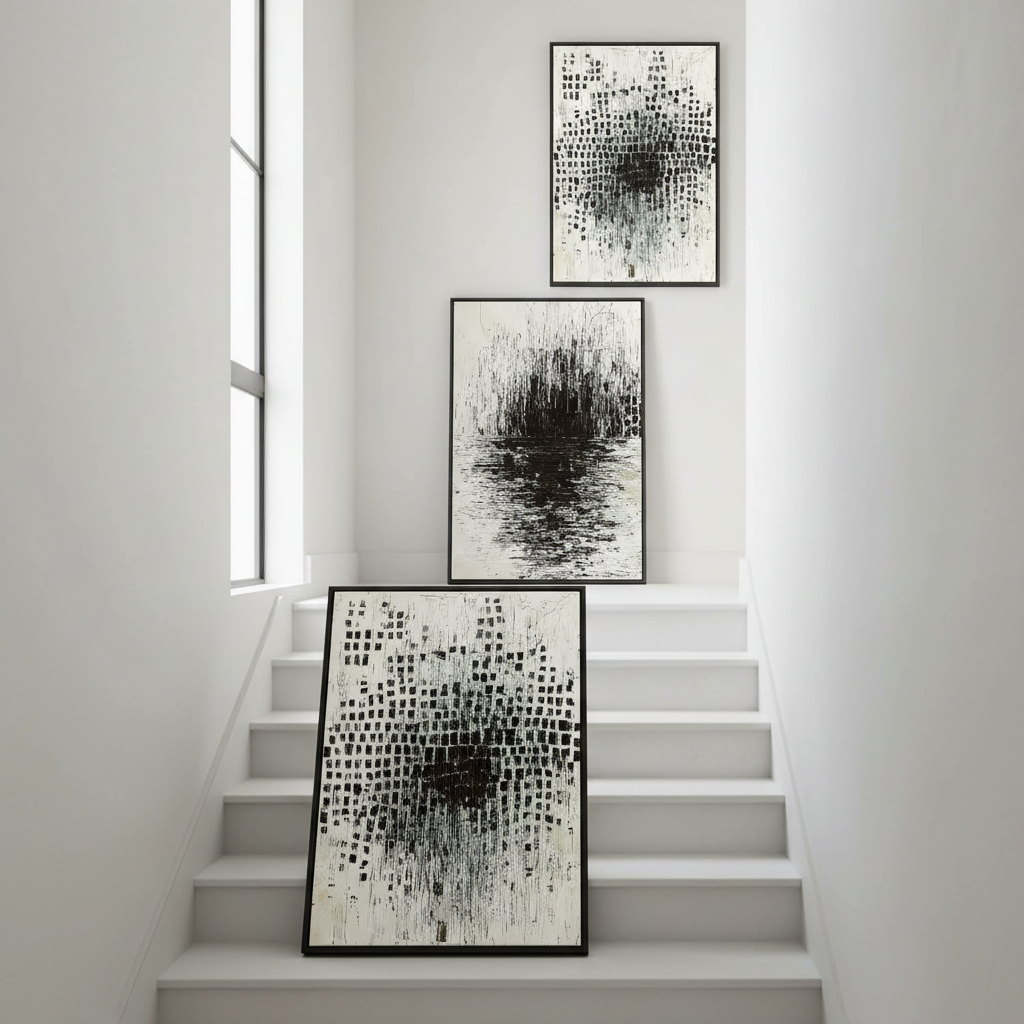
Staircase Cascades: Arranging Art on Sloped Walls
The high-end art market is undergoing a seismic shift. Recent data indicates that sales of purely financial art assets—those vanity auction pieces exceeding $10 million—plummeted by 44% year-over-year in 2024 (Marketplace). In their place, we are seeing a return to "real application value." Homeowners and designers are moving away from speculative investments and toward custom, hand-painted works that offer emotional resonance and architectural integration.
Nowhere is this architectural integration more challenging—or more rewarding—than the staircase. Often treated as a mere transitional zone, the staircase wall is a high-visibility canvas that demands a sophisticated approach. Standard horizontal hanging rules fail here. To create a "staircase cascade" with segmented art, one must navigate complex geometry, varying sightlines, and the unique physics of sloped surfaces.
The Psychology of the "Essential Identity"
When we choose art for a home’s central artery, the medium matters as much as the composition. Research from the University of Chicago suggests that consumers perceive a collapse in value when viewing digital replicas or NFTs because they lack the artist’s "essential identity." This is why a hand-painted triptych feels fundamentally different than a series of prints.
Furthermore, Columbia University found that consumers value art labeled as "human-created" 62% higher than AI-generated alternatives. In a staircase, where you are often just inches away from the canvas as you ascend, the tactile relief of oil paint or the "microtopography" of acrylic layers becomes a sensory experience. Optical microprofilometry has proven that this mm-scale texture is crucial to aesthetics (Sensors MDPI). Buying hand-painted art is, in essence, consuming the biochemical crystallization of human visual attention.
Technical Planning: The Ratio-Based Spacing Heuristic
The most common mistake we see in staircase installations is attempting to maintain perfectly equal spacing between canvases. On a flat wall, 2-3 inches of separation is standard. On a sloped wall, however, your perspective changes with every step. If spacing is uniform, the art often appears "cramped" or "stretched" depending on whether you are looking up from the foyer or down from the landing.
Professionals utilize a Ratio-Based Spacing Approach. As you ascend the staircase, the viewing distance between the eye and the wall typically decreases. To compensate for this changing parallax, we recommend a heuristic where spacing increases slightly as you move up the cascade.
Modeling Note: The Spacing & Scale Heuristic
Logic Summary: This model assumes a standard residential staircase angle (approx. 30–37 degrees) and aims to equalize perceived visual weight. This is a scenario model based on common design heuristics, not a controlled laboratory study.
| Parameter | Base of Stairs (Landing) | Mid-Staircase | Top of Stairs | Rationale |
|---|---|---|---|---|
| Canvas Size | Large (e.g., 36"x36") | Medium (e.g., 24"x24") | Small (e.g., 18"x18") | Viewing distance is greatest at the base. |
| Spacing Gap | 2.0 inches | 2.5 inches | 3.0 inches | Offsets the "crowding" effect of closer proximity. |
| Hanging Height | 58" from floor | 58" from stair nose | 58" from stair nose | Maintains a consistent "gallery center" line. |
| Hardware Type | Heavy-duty cleat | Adjustable bracket | Security lock | Resists gravitational pull on the slope. |
| Viewing Angle | ~15 degrees up | Level | ~15 degrees down | Ensures the "cascade" follows the natural eye path. |

Material Science: Why Medium Choice Affects Longevity
Staircases are often high-traffic areas subject to fluctuating temperatures and light exposure (especially in homes with two-story foyers and large windows). Choosing between oil and acrylic isn't just an aesthetic choice; it’s a chemical one.
The Acrylic "Haziness" Phenomenon
Advanced research from the Tate Modern identifies a specific issue with acrylics: surfactants. PEG-type surfactants can migrate to the surface when humidity rises, forming water-soluble microcrystals that cause a "hazy" or cloudy appearance. However, the same study confirms that gently wiping the surface with water-based cotton swabs can actually help reduce dirt adhesion over time.
The Lightfastness Standard
For staircases bathed in natural light, the lightfastness rating is your lifeline. The ASTM D4303 standard uses xenon-arc tests to simulate years of fading behind glass. While many believe oil holds color better, National Gallery experiments show that for certain pigments like Prussian Blue, the fading rate is virtually identical across oil, acrylic, and egg tempera. The key is the pigment quality, not just the binder.
Health and Safety: Navigating the "Toxic Palette"
When installing art in the heart of a home, air quality is a non-negotiable priority. The EPA warns that indoor air pollution can be significantly more concentrated than outdoor air.
- VOC Emissions: While industrial paints are high-VOC, high-quality artist pigments on cured wood or canvas emit significantly lower levels during the curing process (Aalto University).
- Heavy Metal Risks: The International Agency for Research on Cancer (IARC) classifies cadmium compounds—common in bright yellows and reds—as Group 1 carcinogens. While modern "hue" alternatives are safe, authentic cadmium pigments should be handled with caution and kept out of reach of children.
- The Titanium White Revolution: It is worth noting that the global market is now 90% dominated by Titanium Dioxide (NCBI), which replaced the highly toxic Lead White of previous centuries. This shift has made modern hand-painted art safer for residential environments than ever before.

Installation SOP: Securing Art on an Angle
Hanging substantial artwork on a standard flat wall is straightforward, but a diagonal slope introduces "gravitational shear." Standard wire-and-hook systems are insufficient; the art will eventually shift or tilt.
- Step 1: The Paper Template. Before drilling, use paper templates to map the diagonal wall length (Coohom). Align the templates using the stair angle as your baseline.
- Step 2: Specialized Hardware. Use security kits or lock-in brackets. These systems "lock" the canvas to the wall at three or four points, preventing the bottom of the frame from pulling away due to the wall's angle.
- Step 3: The Leveling Myth. Do not use a standard spirit level to align the frames to each other. Instead, measure a consistent distance from the "stair nose" (the edge of the step) to the bottom of each frame. This ensures the art follows the architectural rise of the home perfectly.
Biophilic Design: The Healing Power of the Ascent
Beyond aesthetics, a staircase cascade can serve as a "health intervention." The World Health Organization (WHO) has reviewed over 3,000 studies confirming that art interventions alter clinical indicators for stress and mental health.
By choosing nature-themed, biophilic hand-painted works, you can trigger the "mPFC" (medial prefrontal cortex) and amygdala, optimizing emotional regulation circuits (PMC - NIH). Research at the Cleveland Clinic found that 73% of patients reported significant mood improvements when exposed to environmental artworks. For a homeowner, this means the simple act of walking upstairs can become a micro-moment of neurological recovery.
The Economic Catalyst: Art as a Value Multiplier
For those considering the long-term ROI of their home, the "Busy Streets Theory" offers a compelling parallel. Transforming neglected spaces with murals has been shown to reduce neighborhood crime by 40% (University of Michigan). On a private scale, the Royal Society found that neighborhoods with higher "art" geo-tags saw greater relative house price gains.
A well-executed staircase cascade doesn't just decorate a wall; it signals "artisan craftsmanship," a search term that has risen 21% in recent years (Zillow/PA Realtors). It masks the "decay" of transitional spaces and turns a functional necessity into a commercial landmark within the home.

Summary of Best Practices
To ensure your staircase cascade meets premium aesthetic and safety standards, follow this final checklist:
- Planning: Use ratio-based spacing (increasing gaps as you ascend).
- Material: Verify ASTM D-4236 compliance and prioritize low-VOC pigments.
- Lighting: Use LED strips along the cascade or individual spotlights to eliminate "shadow zones" (WAC Lighting).
- Hardware: Abandon wire hooks for security locks or adjustable brackets to combat slope gravity.
- Thematic Continuity: Ensure the "essential identity" of the hand-painted work remains consistent across all panels in the triptych or series.
By treating the staircase as a curated gallery rather than a hallway, you elevate the entire architectural experience of the home. You aren't just hanging art; you are installing a permanent physical billboard for your personal aesthetic and well-being.
YMYL Disclaimer: This article is for informational purposes only and does not constitute professional medical, health, or safety advice. Chronic inhalation of certain paint vapors or contact with toxic pigments can lead to serious health issues. Always consult the Safety Data Sheets (SDS) for your specific art materials and ensure proper ventilation during installation. If you have pre-existing respiratory conditions, consult a physician before engaging in DIY art projects.
References
- The Art Basel and UBS Art Market Report 2024: Link
- Columbia University Consumer Perception Study: Link
- Royal Society - Quantifying the link between art and property prices: Link
- WHO Scoping Review on Arts and Health: Link
- CDC NIOSH: Paint and Coating Hazards: Link
- ASTM D4303 Standard Test Methods for Lightfastness: Link
- Tate Modern - Conservation Concerns for Acrylics: Link
- EPA - Indoor Air Quality and Low-VOC Paints: Link