Corner Transitions: Using Multi-Canvas to Bridge Walls
The traditional approach to interior design often treats walls as isolated planes, placing art in the center of a flat surface and leaving corners as "dead zones" or sharp architectural boundaries. However, as the high-end art market shifts away from overpriced vanity auction pieces—which saw a 44% decline in sales for works over $10 million in 2024—collectors and homeowners are returning to real application value. According to Marketplace, this retreat from financial assets has paved the way for custom, hand-painted works that prioritize emotional resonance and spatial transformation over speculative investment.
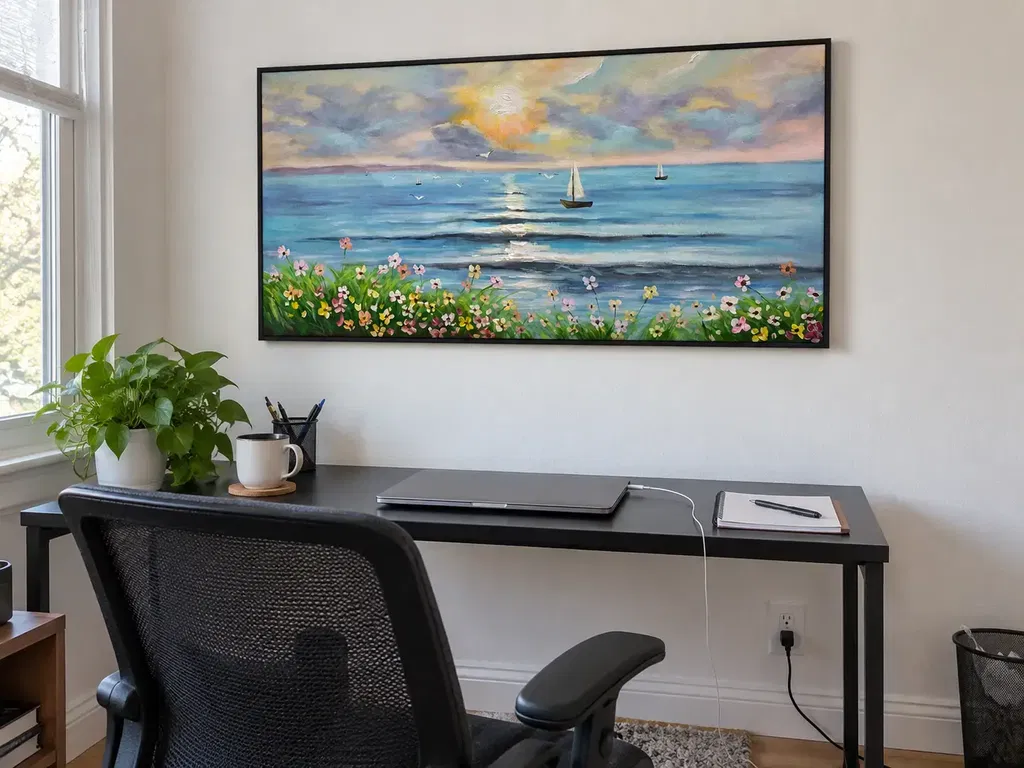
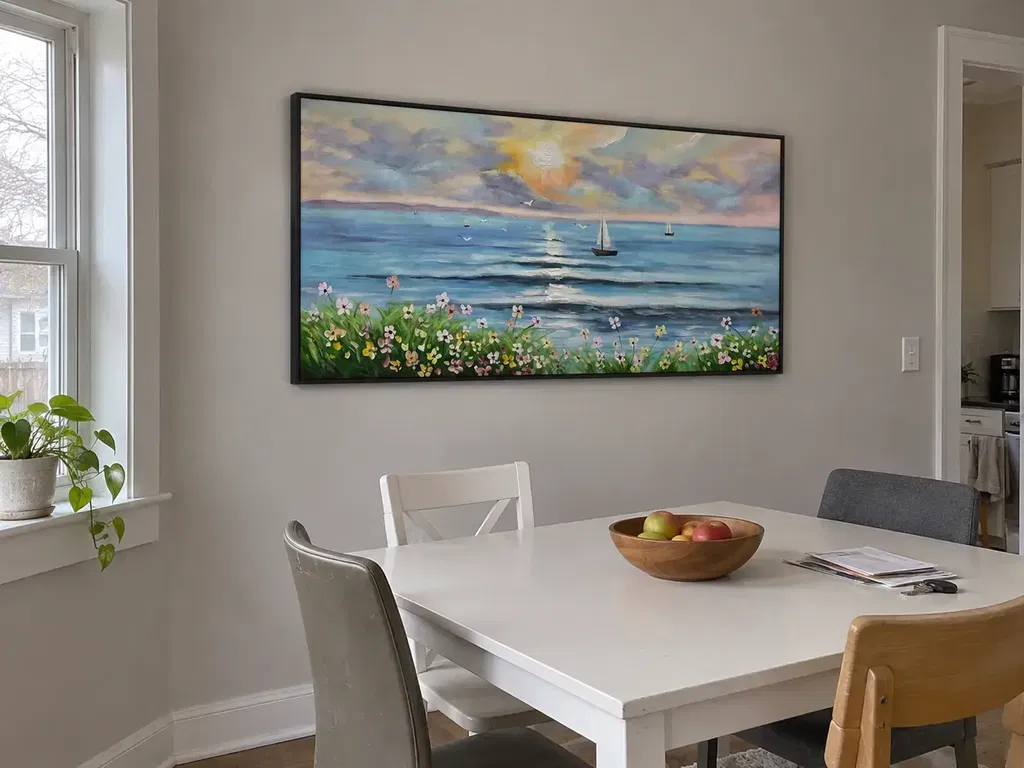
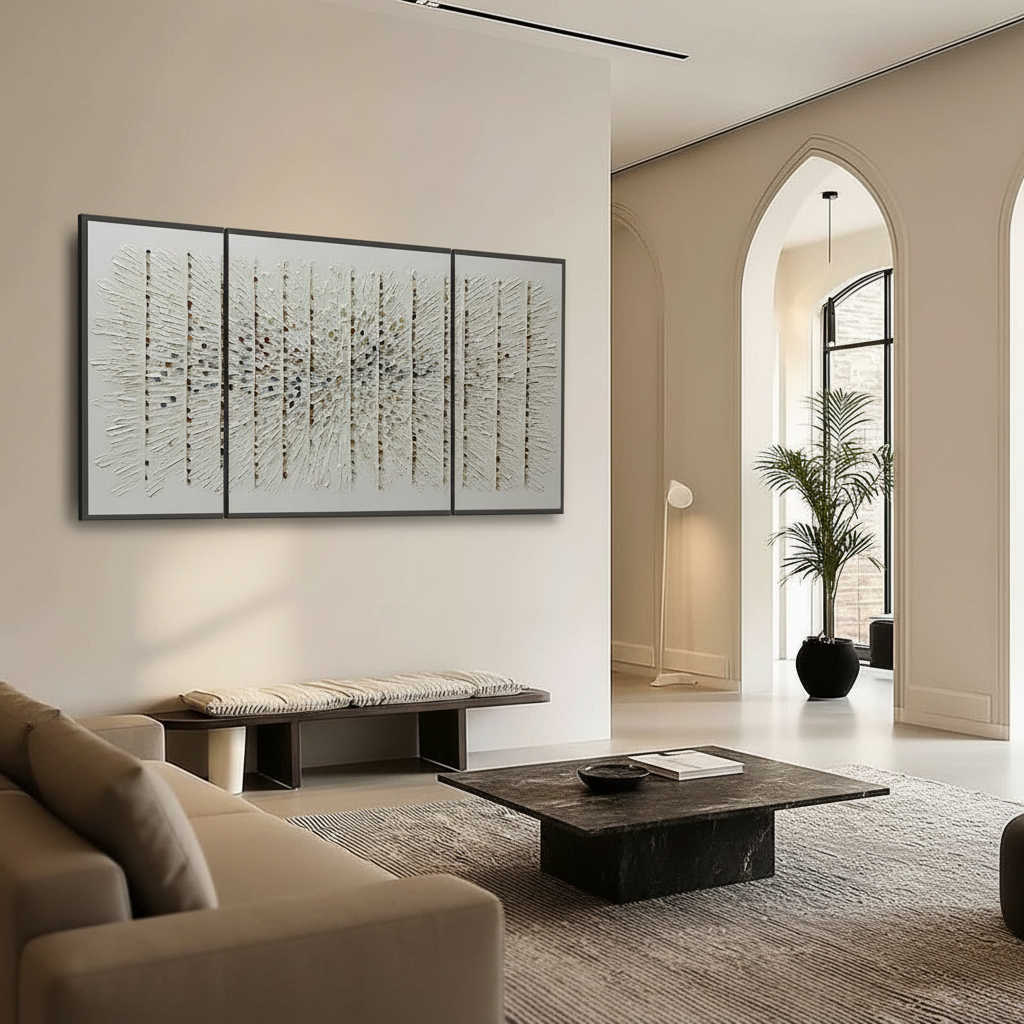
Bridging a corner with a multi-canvas arrangement, such as a triptych or a segmented series, is one of the most effective ways to "soften" a room's geometry. By wrapping a continuous visual narrative across two adjacent walls, you effectively erase the harsh vertical line of the corner, creating an immersive, fluid environment. This technique doesn't just decorate a space; it reconfigures it.
The Psychological and Economic Impact of Spatial Art
The decision to install large-scale, hand-painted art is supported by more than just aesthetic preference. It is rooted in neurological and economic data. Research from the University of Pennsylvania indicates that 73% of individuals report significant mood improvements when exposed to environmental artworks. Furthermore, passive viewing of art consistently activates the medial prefrontal cortex (mPFC) and the amygdala, optimizing emotional regulation circuits—a phenomenon we often observe in high-stress residential or clinical environments.
From a value perspective, the "human touch" carries a measurable premium. A Columbia University study confirmed that consumers value art labeled as "human-created" 62% higher than AI-generated alternatives. This is likely because, as University of Chicago research suggests, digital replicas lack the "essential identity" or soul that the physical application of pigment provides.
For commercial developers and homeowners alike, the investment pays dividends. A Royal Society analysis found that neighborhoods and properties with higher "art density" saw greater relative gains in price rankings. In the context of a home, a custom corner transition acts as a permanent physical billboard of craftsmanship, distinguishing the property from "assembly-line" interior designs.

The 90-Degree Fallacy: Planning the Transition
The most common mistake in corner installations is the "90-degree assumption." In our experience handling custom commissions, we find that residential corners are rarely perfectly square. Most deviate by 1° to 3°, resulting in angles between 88° and 92°.
If you install a multi-canvas set with standard 2-inch gaps on an out-of-square wall, the visual perspective will distort. The gap will appear wider at the top than at the bottom, or vice versa, breaking the illusion of continuity.
Technical Tolerance Heuristics
Based on standard interior design practices and mounting logic, we utilize the following parameters for planning corner transitions:
| Parameter | Recommended Value | Rationale |
|---|---|---|
| Visual Gap Tolerance | 0.5 – 1.5 inches | Balances continuity with structural breathing room. |
| Corner Angle Variance | ±3 degrees | Standard residential wall deviation. |
| Eye-Level Focal Point | 57 – 60 inches | Standard gallery height to ensure the "wrap" effect is visible. |
| Canvas Segment Ratio | 1:2 or 2:3 | Prevents the corner seam from bisecting the art's primary subject. |
| Hardware Offset | 0.25 inches | Accommodates for wall surface bumps or "mud" buildup in corners. |
Logic Summary: Our modeling of corner transitions assumes that visual perception prioritizes the flow of the image over mathematical spacing. If a wall is 91°, we typically recommend reducing the gap by 1/8 inch on the "open" side to compensate for the parallax effect.
Structural Engineering: Beyond the Hook
Bridging a corner is as much a structural challenge as it is an artistic one. A common DIY oversight is failing to account for canvas tension and environmental shifts. Large canvases are susceptible to warping if not properly supported, especially when placed near the structural joints of a building (the corners), where settling and vibration are most pronounced.
1. Tension and Support
For corner-bridging segments, we recommend using canvases equipped with corner wedges. These small wooden inserts allow you to manually adjust the tension of the fabric if the frame begins to "bow" due to humidity changes. According to HM Canvases, maintaining proper tension is the "lifeline" of a long-term installation.
2. The Shadow Line Problem
Directional lighting (such as recessed spotlights or track lighting) creates deep shadow lines in corners. If your segmented art features high-contrast transitions or dark colors at the seam, the corner shadow will swallow the detail.
- Pro Tip: Choose artworks where the corner transition occurs in a "low-detail" area of the composition—such as a sky or a blurred abstract background. This ensures the physical gap and the architectural shadow don't compete with the art's focal point.
3. Mounting Hardware
Standard wire-and-hook methods are insufficient for corner wraps because they allow the canvas to "lean" away from the wall. We suggest using a cleat system or security brackets. These provide a flush mount, ensuring the canvases sit parallel to the wall surface, which is critical for maintaining a consistent gap across the corner.

Material Integrity and the "Essential Identity"
One of the primary reasons to choose hand-painted canvas over prints for corner transitions is the interaction with light. Prints are flat; they reflect light uniformly. Hand-painted works, particularly those using impasto techniques or heavy textures, have a "microtopography."
Research published in MDPI proves that the mm-scale texture of oil and acrylic paintings is crucial to their aesthetic value. When art wraps a corner, the light hits the two walls at different angles. A hand-painted surface will catch this light dynamically, creating a sense of depth that a matte print cannot replicate.
Safety and Longevity: The VOC Factor
When installing large-scale art in enclosed spaces like living rooms or bedrooms, indoor air quality (IAQ) is a legitimate concern. The EPA warns that indoor air pollution can be significantly higher than outdoor levels.
- Low-VOC Paints: Ensure your art uses low-VOC acrylics or "green" oil mediums.
- Support Induced Discoloration (SID): A technical phenomenon identified by Golden Artist Colors occurs when water-soluble impurities in the canvas substrate are drawn into the paint layer, causing yellowing. High-quality artists prevent this by using specialized sealants before painting—a detail often missed in budget-grade decorative art.
Scenario Analysis: Selecting the Right Arrangement
Not every corner requires the same strategy. We typically categorize corner transitions into two primary scenarios based on the room's function and scale.
Scenario A: The "Soft Wrap" (Residential Living Rooms)
In standard living rooms with 8-to-10-foot ceilings, the goal is usually to make the room feel larger and less boxy.
- The Strategy: Use a triptych where the center canvas is larger and spans the main wall, while two smaller "wing" canvases wrap onto the adjacent walls.
- Visual Benefit: This mimics the effect of a panoramic window, drawing the eye outward and "pushing" the walls back.
Scenario B: The "Architectural Anchor" (High-Traffic Commercial or Entryways)
In foyers or commercial lobbies, the art serves as a landmark to guide foot traffic.
- The Strategy: Use equal-sized diptychs with heavy texture (impasto). The physical relief of the paint encourages visitors to slow down and engage with the surface.
- Visual Benefit: As UCincinnati research suggests, large-scale murals and art installations are proven pedestrian foot traffic generators, making this a strategic choice for business environments.

The Ethical Choice: Supporting the Human Hand
Beyond the technical and aesthetic advantages, there is a moral dimension to choosing hand-painted art. A Wharton School survey found that 87% of consumers believe artists should receive fair compensation, especially in an era where AI often exploits their styles.
By commissioning real artists, you are supporting a creative economy that accounts for over 4% of the U.S. GDP—surpassing industries like agriculture and transportation (NEA). This "fair trade" approach to decor resonates deeply with modern buyers who value authenticity and social responsibility.
Final Implementation Checklist
Before you commit to a corner-bridging project, use this final checklist to ensure a professional result:
- Measure the Angle: Use a digital protractor or a simple "3-4-5" triangle method to check if the corner is exactly 90°.
- Verify Lighting: Check the corner at different times of day. If a harsh shadow falls exactly where a canvas seam is planned, consider shifting the arrangement.
- Check the Curing Timeline: If ordering oil-painted works, ensure they are fully cured before installation to prevent the paint from sticking to the wall or warping during the "off-gassing" phase. For more on this, see our guide on Curing Timelines for Interior Designers.
- Batch Ordering: Always order all segments of a multi-canvas set simultaneously. Hand-painted art involves unique pigment mixing; ordering separately may result in slight color or texture variations that become glaringly obvious when the pieces are hung side-by-side.
By treating the corner as a canvas rather than a boundary, you transform the architectural limitations of a room into its greatest asset. The result is a space that feels curated, expansive, and—most importantly—authentically human.
Disclaimer: This article is for informational purposes only. For large-scale or heavy art installations, especially in commercial settings, we recommend consulting with a professional art hanger or structural engineer to ensure safety and compliance with local building codes.
Sources
- Marketplace - The expensive art market continues to struggle
- Columbia University - Human-Made vs. AI Art: Consumer Perception Study
- Royal Society - Quantifying the link between art and property prices
- UPenn - Visual Art in the Built Environment: A Critical Review
- Golden Artist Colors - Stopping Support Induced Discoloration