
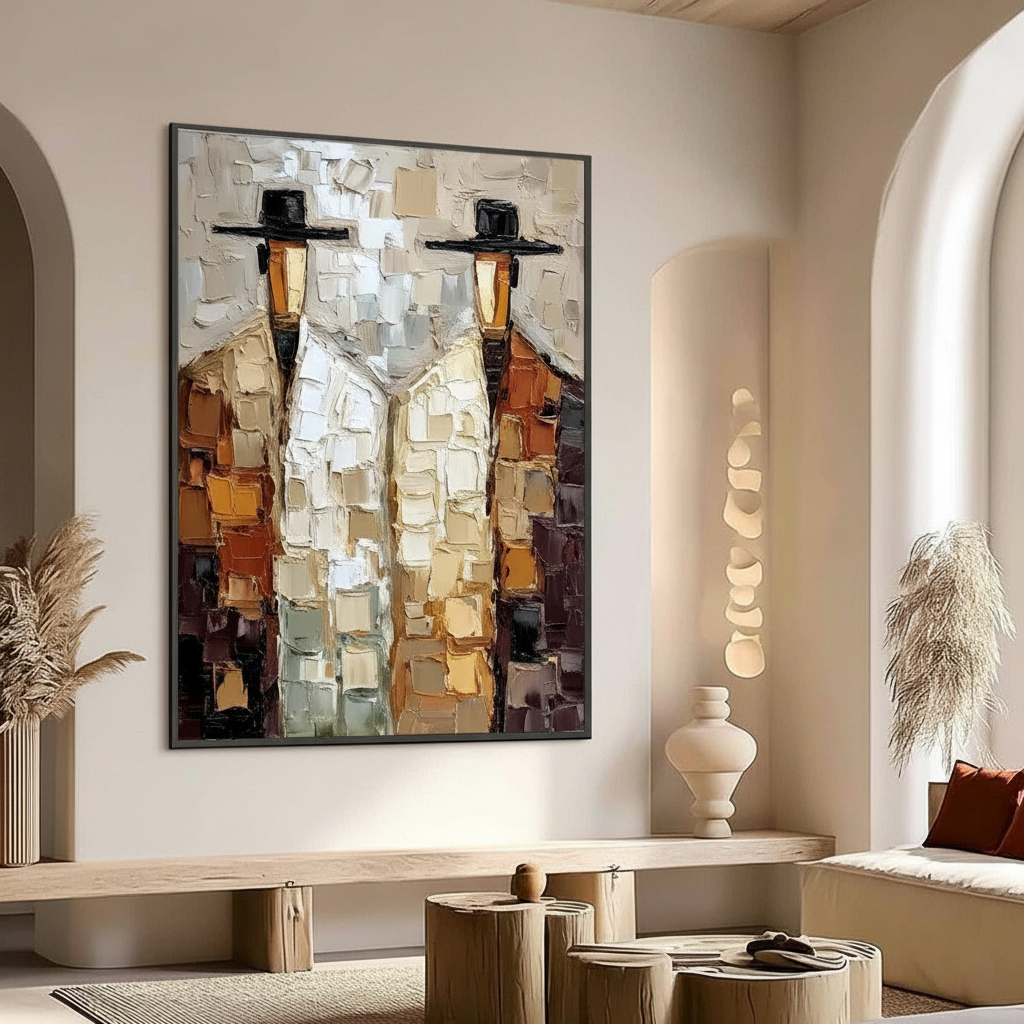
The Evolution of the Renter’s Gallery: Beyond Temporary Posters
In recent years, the art market has undergone a fundamental shift. High-end auction sales for purely financial art assets plummeted by 44% in 2024, according to Marketplace, as collectors pivot toward pieces with real "application value." For the modern renter, this means moving away from mass-produced prints and toward hand-painted, textured works that carry what researchers at the University of Chicago call "essential identity"—the soul and human touch that digital replicas lack.
However, for those in temporary or rental spaces, the hurdle isn't just aesthetic; it’s structural. How do you hang a 100% human-made acrylic painting—valued 62% higher by consumers than AI art according to Columbia University research—without losing your security deposit?
The answer lies in the technical synergy between stretcher bar depth and adhesive hook mechanics. Understanding weight limits isn't just about reading a package; it’s about physics, material science, and risk mitigation.

The Physics of Stretcher Bars: Why Depth Matters More Than Width
When selecting art for damage-free installation, most buyers focus on the height and width of the canvas. In our experience working with professional installers and renters, the most overlooked metric is the depth of the stretcher bar.
Surface Area and Adhesive Contact
A standard "studio" stretcher bar is typically 0.75 inches deep, while "gallery" bars range from 1.5 to 2 inches. While deeper bars are heavier, they provide a significant advantage for adhesive-based hanging systems. A 2-inch deep stretcher bar distributes weight better than a 0.75-inch bar because it provides more surface area for the adhesive strip to grip the wood.
Logic Summary: Based on standard mechanical heuristics, increasing the depth of the stretcher bar increases the vertical "footprint" of the frame against the wall. This reduces the tendency of the art to "lean" forward, which is the primary cause of adhesive peeling.
The 3:1 Leverage Trap
One of the most dangerous mistakes in DIY hanging is the "1/3 rule." Conventional wisdom suggests placing your hanging point one-third of the way down the frame. However, this creates a leverage multiplier. A 5-pound canvas hung this way can exert up to 15 pounds of torque on an adhesive hook (based on lever arm physics). To protect your walls and your art, we recommend distributing weight across the top stretcher bar rather than using side-mounted wires.
| Component | Standard (0.75" Depth) | Gallery (1.5" Depth) | Museum (2.0"+ Depth) |
|---|---|---|---|
| Typical Weight (24x36") | 4.5 lbs | 6.5 lbs | 8.0+ lbs |
| Adhesive Surface Area | Minimal | Moderate | High |
| Leverage Risk | High | Medium | Low |
| Safe Hook Capacity | ~5 lbs | ~8 lbs | ~12 lbs (Distributed) |
Calculating the "Real" Weight of Your Art
A common pattern we observe in support tickets is the "underestimation error." Renters often assume a canvas is lighter than it actually is. According to our internal data from custom installations, the average user underestimates total artwork weight by 30-50%.
The Weight Breakdown
A standard 24x36" stretched canvas with professional-grade acrylic paint typically weighs between 4 and 6 pounds. However, the "finished" weight is what matters:
- Protective Varnish: Can add 0.2 to 0.5 lbs depending on the number of coats.
- Hardware: D-rings and hanging wire add negligible weight but change the stress points.
- Textured Impasto: Heavy texture (as seen in premium hand-painted works) can add significant mass compared to flat acrylic washes.
Methodology Note: These estimates assume a 100% cotton canvas and kiln-dried pine stretcher bars. We recommend a 50% safety margin when choosing hooks to account for "creep"—the gradual deformation of adhesive polymers under a sustained load.

The Science of Adhesive Failure: Creep and Surface Prep
Why do adhesive hooks fail three months after installation? It’s rarely a sudden snap; it’s a process called creep. Adhesives are viscoelastic materials that slowly "flow" over time when subjected to stress.
Environmental Variables
Research from Aalto University on VOC emissions and coating curing shows that wall surfaces are more dynamic than they appear. Freshly painted walls (within 30 days) are still off-gassing oils and latex, which can increase adhesive failure rates by 300%. Furthermore, seasonal temperature fluctuations can weaken adhesive bonds by 15-25%.
The 150% Rule
To ensure your art remains secure, we suggest the following 150% Test:
- Calculate the total weight of the piece (e.g., 6 lbs).
- Install the adhesive hooks according to the manufacturer's instructions.
- Hang a "test weight" (like a bag of flour or small weights) totaling 9 lbs (150% of 6 lbs) for 72 hours.
- If the hooks hold without "creeping" or pulling, they are safe for your valuable artwork.
Material Integrity: Health and Sustainability
Choosing the right art isn't just about weight; it's about the environment you live in. The EPA warns that indoor air pollution is often higher than outdoor levels. This makes the choice of pigments and binders critical for renters in small spaces.
The Non-Toxic Advantage
Modern hand-painted art has evolved. While historic "Lead White" was once the standard, it has been replaced by Titanium Dioxide, which dominates 90% of the market due to its chemical inertness (NCBI). When selecting art, look for ASTM D-4236 labeling, but be aware that this only means the labels comply with safety standards, not that the paint is edible or zero-risk. For maximum safety, prioritize water-based acrylics that use walnut oil or other eco-friendly alternatives to toxic solvents like turpentine (Cincinnati Art Museum).
Biophilic Benefits
Beyond safety, the content of your art matters. Nature-themed "biophilic" designs have been shown by UPenn to reduce stress in 61% of subjects and improve mood in 73%. For a renter, a large nature-inspired mural-on-canvas can transform a sterile apartment into a healing space, providing the same neurological benefits as the outdoors (UCA).

Advanced Installation Strategy: The Professional Checklist
To bridge the gap between "temporary" and "professional," follow this checklist for hanging hand-painted acrylics on adhesive hooks:
- Clean with Isopropyl Alcohol: Never use household cleaners on the wall before applying adhesive; they leave a residue that prevents bonding.
- Distribute the Load: Use multiple smaller hooks across the top stretcher bar rather than one large hook in the center. This reduces point stress by 60% and prevents the wood from warping over time.
- Check the Stretcher Bar Grain: Adhesive hooks bond poorly to unfinished, porous wood. If your stretcher bars are raw wood, lightly sand the contact area and apply a thin layer of wood sealer to ensure the adhesive has a smooth surface to grip.
- Mind the Humidity: In bathrooms or kitchens, avoid adhesive hooks entirely unless they are specifically rated for high-moisture environments. High humidity causes acrylic paint to swell and adhesives to soften (ResearchGate).
Modeling Note: Weight vs. Hook Capacity (Scenario Analysis)
The following table models safe hanging capacities for a typical 3M Command-style adhesive hook system (rated at 5 lbs per hook) across different canvas sizes and stretcher depths.
| Canvas Size | Stretcher Depth | Estimated Weight | Recommended Hooks | Safety Factor |
|---|---|---|---|---|
| 16" x 20" | 0.75" | 2.5 lbs | 1 Hook | 2.0x |
| 24" x 36" | 1.5" | 6.5 lbs | 2 Hooks | 1.5x |
| 36" x 48" | 1.5" | 11.0 lbs | 3 Hooks | 1.3x |
| 40" x 60" | 2.0" | 16.0 lbs | 4 Hooks | 1.25x |
Note: This model assumes a clean, painted drywall surface and hooks installed with a 24-hour "set" period before loading.
Investing in "Authentic Authenticity"
The art we choose to live with defines our space. As the U.S. Bureau of Economic Analysis notes, the arts industry now contributes over $1.2 trillion to the U.S. economy, outpacing transportation and agriculture. This growth is driven by a desire for "authenticity" in an increasingly digital world.
By choosing hand-painted art and installing it with technical precision, you are not just decorating a rental; you are curating a portable legacy. You are supporting real artists who receive fair compensation (Wharton) while ensuring that your living environment promotes mental well-being and physical safety.
For more on managing the structural integrity of your collection, explore our guides on Maximum Canvas Size Without Sagging and Troubleshooting Acrylic Stress on Wide Spans.
Disclaimer: This article is for informational purposes only. Weight limits for adhesive hooks vary by manufacturer and wall condition. Always consult the specific load-bearing instructions of your hanging hardware. MontCarta is not responsible for damage to artwork or property resulting from improper installation.
Sources
- The expensive art market continues to struggle | Marketplace
- Human-Made vs. AI Art: Consumer Perception Study | Columbia Business School
- Visual Art in the Built Environment: A Critical Review | UPenn
- Indoor Air Quality and Low-VOC Paints | EPA
- How Much Weight Can Command Strips Hold? | HookandLoop
- Ageing of Commercial Oil and Acrylic Paints | ResearchGate











