Curating Calming Acrylic Subjects for Master Bedrooms
The high-end art market is undergoing a seismic shift. Recent data shows that sales of vanity auction pieces—those exceeding $10 million—plummeted by 44% year-over-year in 2024, according to Marketplace. This retreat from purely financial art assets marks a return to "real application value." Homeowners are no longer buying for the investment portfolio; they are buying for the soul of their homes.
In the master bedroom—the most intimate sanctuary of the house—this shift is particularly profound. We are seeing a move away from mass-produced digital prints toward hand-painted acrylic works. This isn't just an aesthetic preference; it is a psychological necessity. Research from Columbia University confirms that consumers value art labeled "human-created" 62% higher than AI-generated alternatives. Furthermore, University of Chicago studies suggest that canvas retains an "essential identity" and "soul" that digital replicas simply cannot replicate.
Selecting the right subject and palette for a bedroom requires more than just a "good eye." It requires an understanding of neuroaesthetics, color chemistry, and spatial harmony.

The Neuroaesthetics of the Restful Environment
Why does a hand-painted wall feel fundamentally different from a flat print? The answer lies in your brain's medial prefrontal cortex (mPFC). A systematic review of 85 records published in PMC shows that passive art viewing consistently activates the mPFC and amygdala, optimizing emotional regulation circuits.
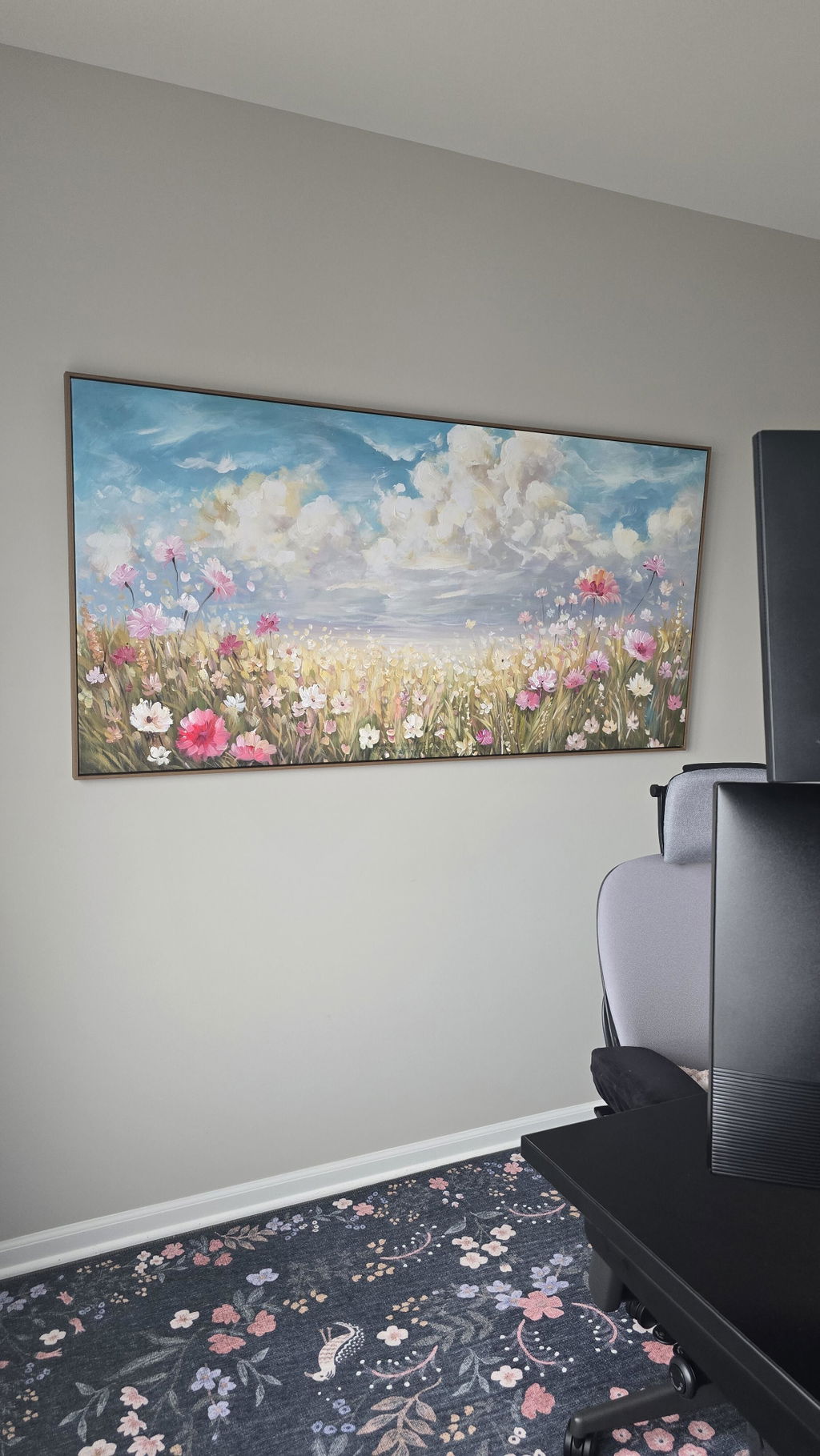
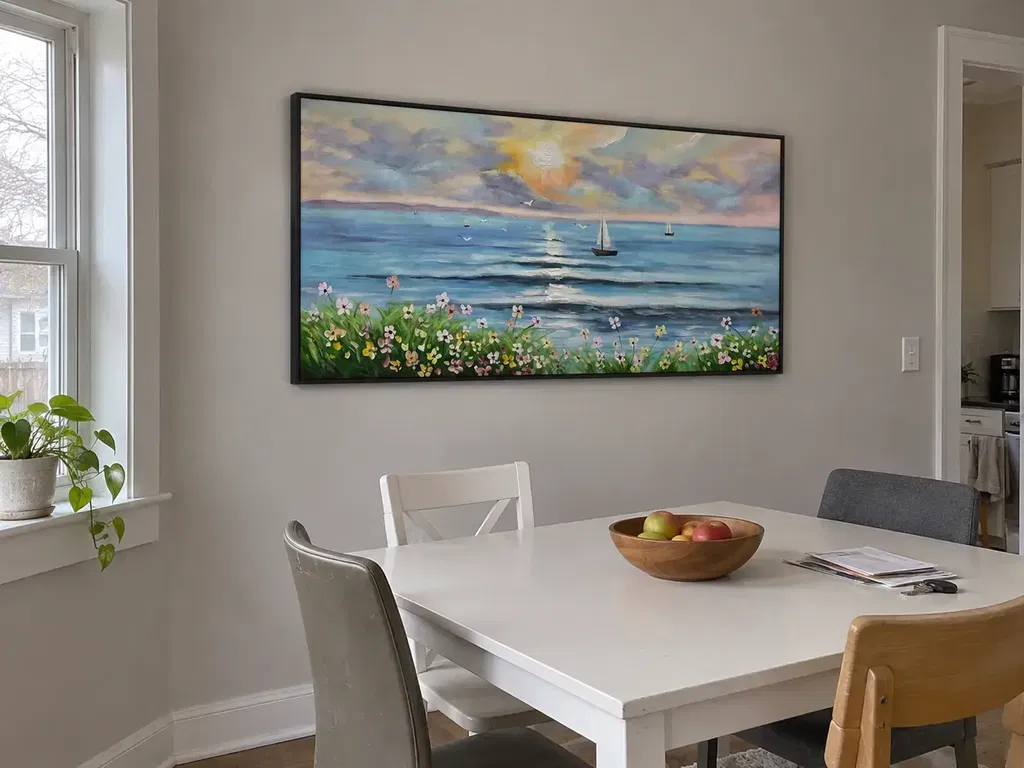
In a master bedroom, the goal of art is to trigger a "down-regulation" of the nervous system. This is where the concept of "Biophilic Design" becomes essential. According to the University of Central Arkansas, art featuring natural landscapes produces the same stress-reduction effects in the brain as being outdoors. In clinical settings, University of Pennsylvania research found that 73% of patients reported significant mood improvements when exposed to environmental artworks.
Logic Summary: Our curation strategy for bedrooms prioritizes biophilic and abstract forms because they minimize "narrative distraction." While a detailed portrait might trigger active cognitive processing (who is this person? what is their story?), organic abstraction allows the mind to rest in a state of "soft fascination."
The "Blue Light" Paradox in Bedroom Curation
Conventional interior design wisdom often suggests that blue is the "perfect" bedroom color because it lowers blood pressure. However, as professional curators, we must address the "Blue Light Conflict." Research published in the International Journal of Academic Research (IJAR) reveals that while blue light spectrums may lower cardiovascular stress, they also activate the prefrontal cortex and suppress melatonin production.
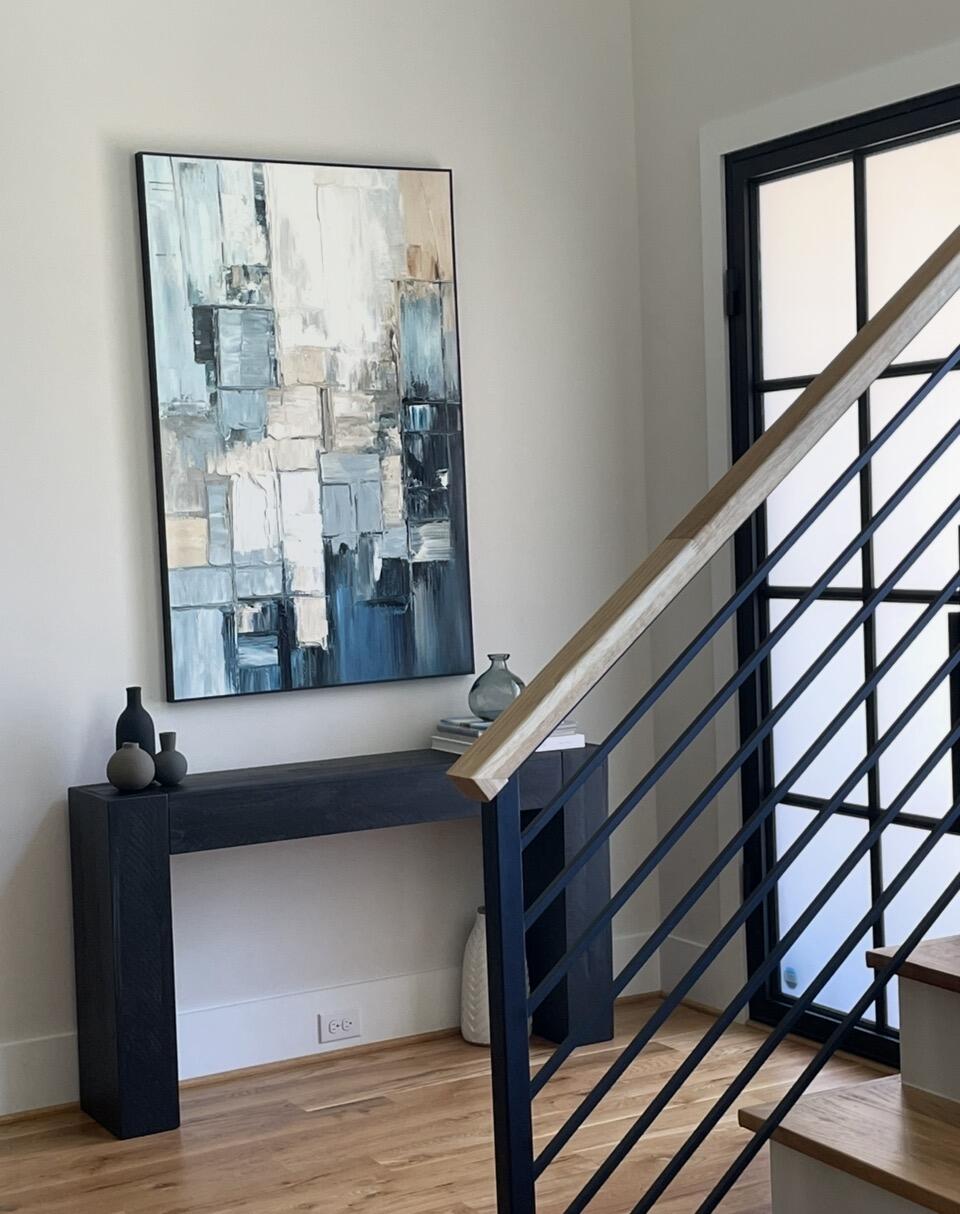
If you choose a blue subject, it should be a "low-energy" blue—think dusty navies or muted teals rather than vibrant cyans. For those seeking absolute rest, we recommend the 70-20-10 Color Heuristic:
| Color Role | Percentage | Purpose | Bedroom Application |
|---|---|---|---|
| Base | 70% | Establishing Calm | Neutrals, soft grays, warm whites, or "earth-skin" tones. |
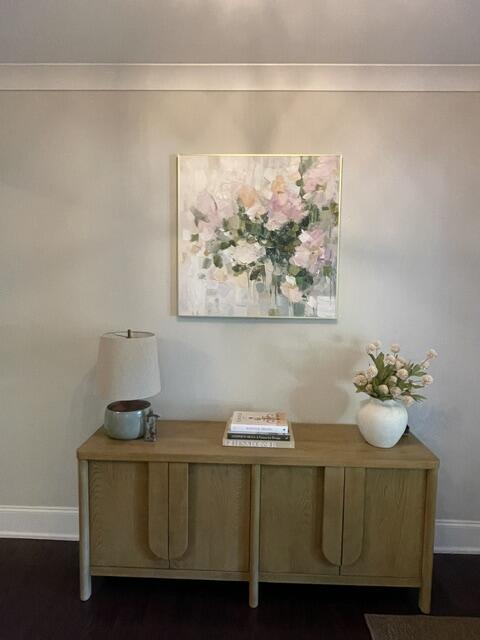
| Accent | 20% | Depth & Harmony | Muted sage, dusty rose, or low-saturation blues. |
| Vibrancy | 10% | Visual Interest | Small pops of gold leaf, ochre, or deep charcoal. |
Note: This heuristic is a rule of thumb used by our design team to prevent visual "noise" that can interfere with sleep initiation.
Texture and Finish: The Physics of Light
One of the primary advantages of acrylic art is its versatility in finish. In a bedroom, where lighting shifts from bright morning sun to low-wattage evening lamps, the "specular reflection" (glare) of a painting can be a major irritant.
Managing Glare with Finish Options
We typically observe that pieces placed opposite windows should utilize a matte finish. This prevents the "white-out" effect caused by morning glare. Conversely, pieces on adjacent walls can handle a satin finish, which catches ambient light and showcases the physical relief of the paint without creating harsh reflections. You can learn more about this in our guide on Managing Glare: How Finish Options Differ.
The Psychological Power of Tactile Relief
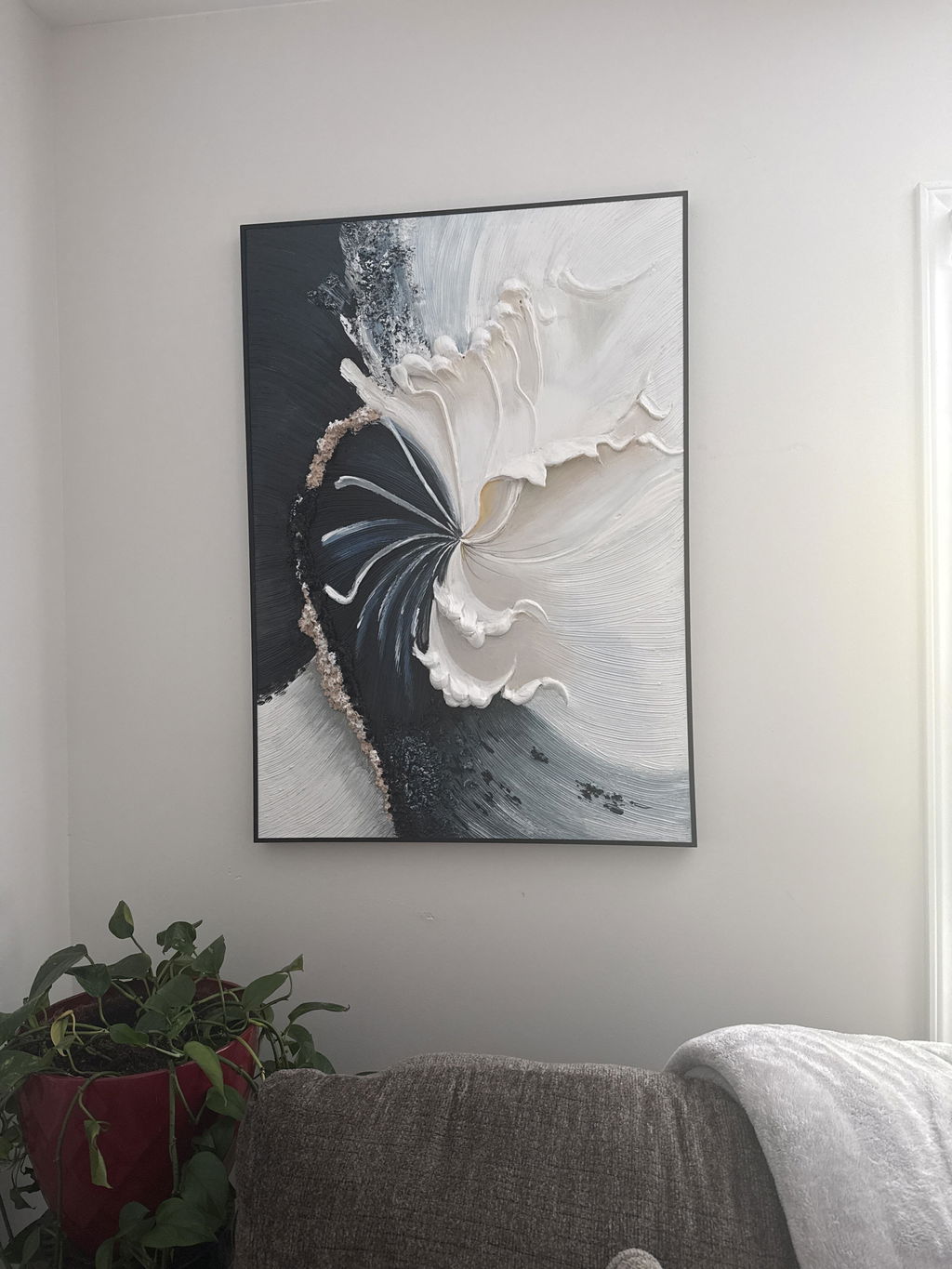
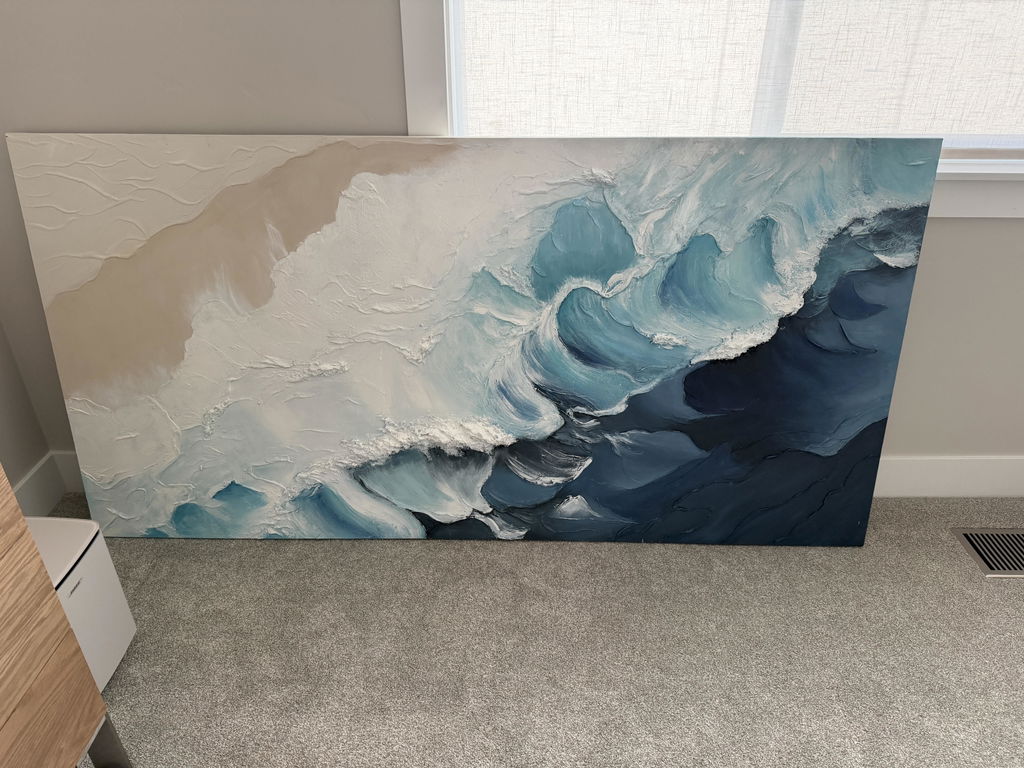
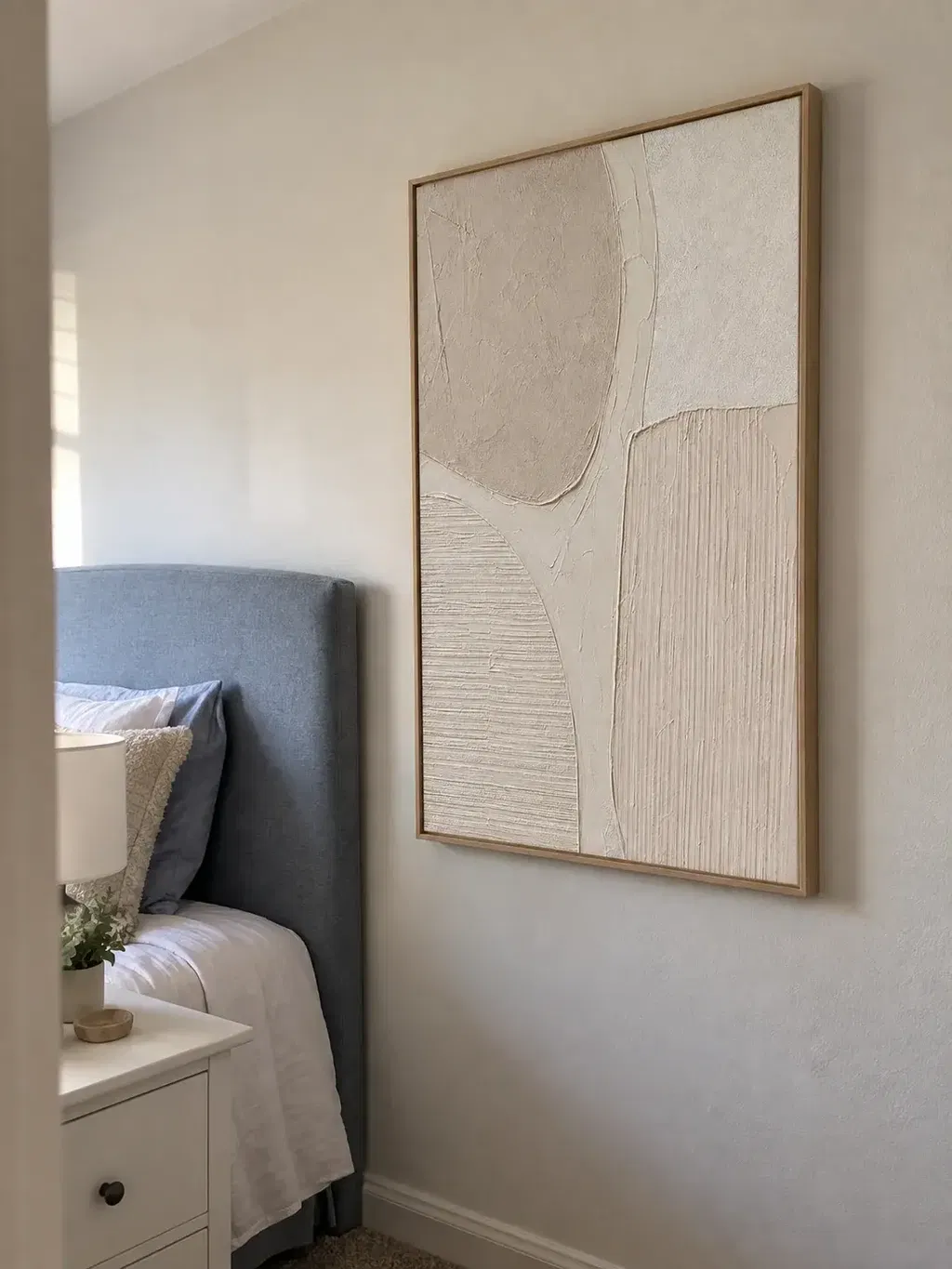
Acrylics allow for "impasto" techniques—thick, physical applications of paint. According to tests at the MUNCH Museum, allowing audiences to interact with (or even just view) art with physical relief textures exponentially stimulates intrinsic satisfaction. In a bedroom, these textures create "micro-shadows" that change throughout the day, providing a sense of "authenticity" that a flat print cannot mimic.

Subject Selection: Why Abstraction Wins
While representational art (like a clear landscape or a figure) is beautiful, it often demands "narrative engagement." Your brain tries to "solve" the picture. In a master bedroom, we want to avoid "bedtime rumination"—the process where the mind stays active by processing stories or memories.
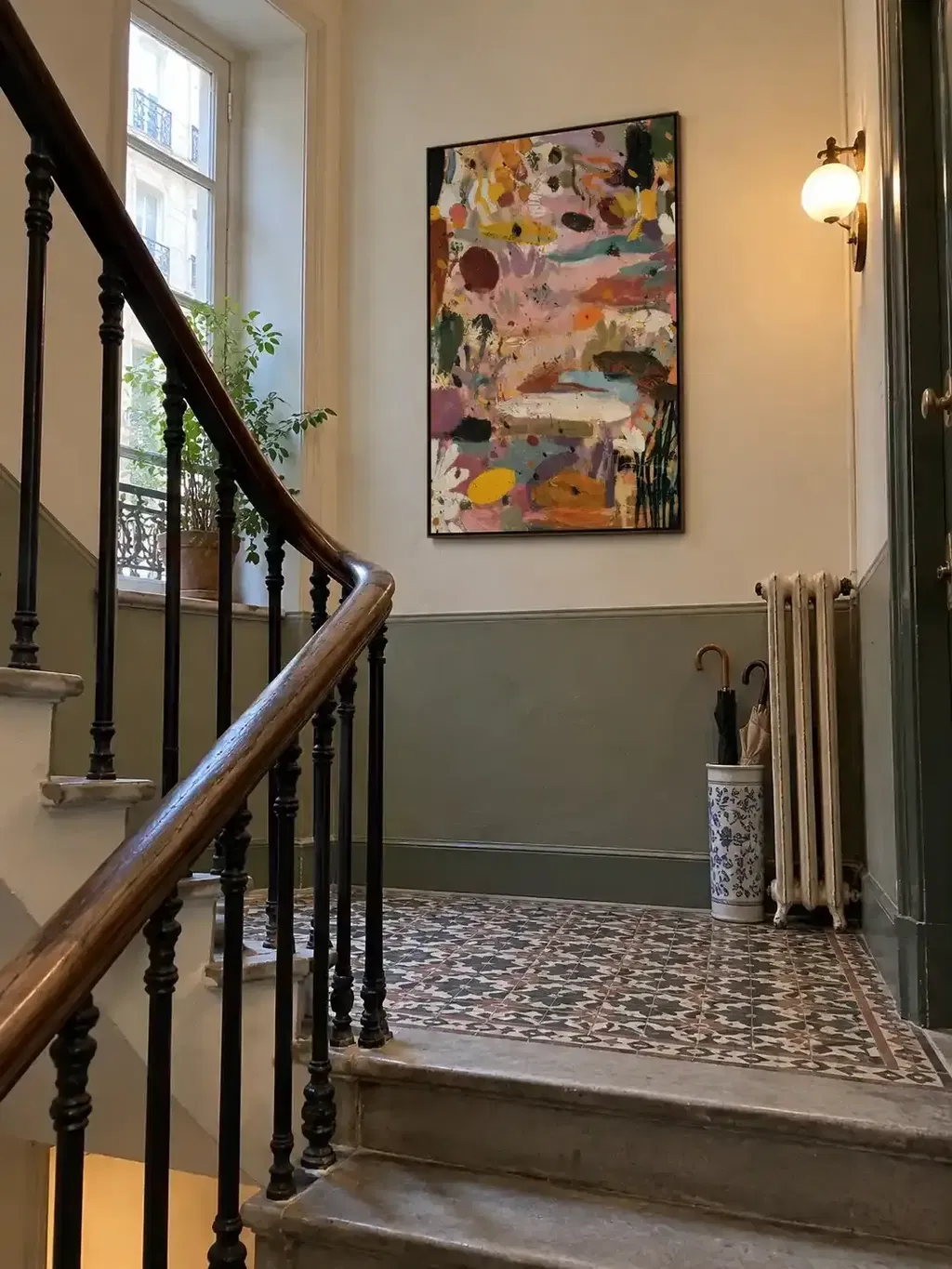
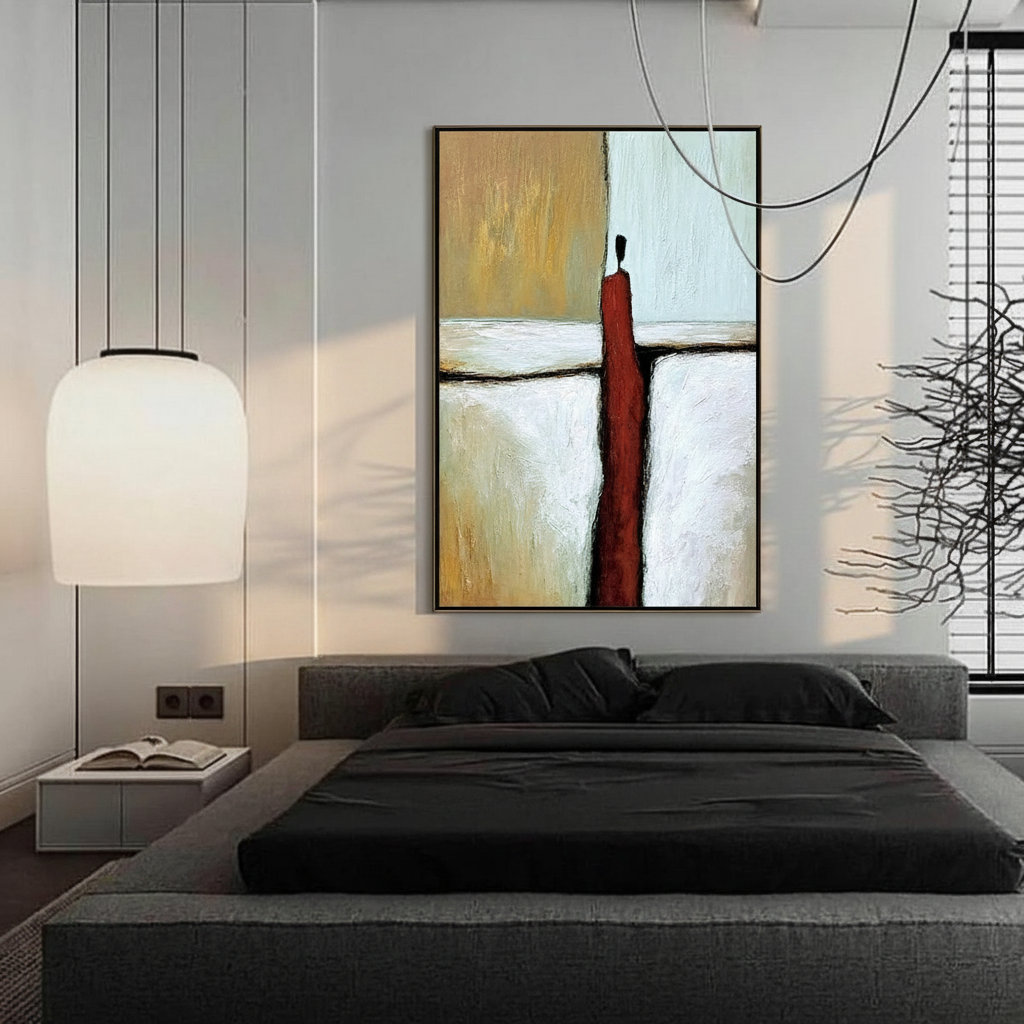
ResearchGate data suggests that abstract art's emotional resonance can activate personal memory retrieval in 68% of viewers. To counteract this, we curate "Calm Abstraction"—pieces with soft edges, organic forms, and low-contrast transitions.
Selection Checklist for Master Bedroom Subjects:
- Organic Over Geometric: Favor fluid, "water-like" or "cloud-like" shapes. Sharp angles can trigger a subtle "threat response" in the subconscious.
- Scale and Negative Space: A common mistake is choosing art that is too small or too "busy." We recommend that artwork occupy 30-40% of the wall space, leaving ample negative space to prevent visual overwhelm.
- The "Gaze" Factor: Avoid subjects with direct eye contact (portraits). Subconsciously, being "watched" can increase cortisol levels, making it harder to relax.
Safety and Ethics: The Invisible Quality of Art
When curating for a sleeping environment, the "invisible" components of the art are just as important as the colors.
Indoor Air Quality (IAQ)
The EPA warns that indoor air pollution can be significantly higher than outdoor levels. Many industrial paints and low-quality art supplies emit Volatile Organic Compounds (VOCs). For a bedroom, it is vital to ensure that the art uses low-VOC acrylics.
Aalto University research found that coatings on wood with specific moisture levels emit significantly lower toxic VOCs during the curing process PubMed. By choosing professional-grade, non-toxic acrylics, you ensure that your "healing environment" isn't actually off-gassing harmful chemicals while you sleep.
Ethical Sourcing
Beyond safety, there is the moral dimension. A Wharton School survey found that 87% of consumers strongly agree that artists should receive fair compensation. By choosing hand-painted works from reputable studios, you are supporting the creative economy and ensuring that the "human soul" of the piece is backed by fair trade practices.
Technical Deep Dive: The Longevity of Acrylics
A common concern for art buyers is fading. Will your calming masterpiece look dull in five years? Acrylics are uniquely suited for bright bedrooms because of their ASTM I lightfastness rating.
According to Golden Artist Colors, professional acrylics maintain 95-98% of their original intensity for decades. This is due to the chemical structure of acrylic polymers—massive long-chain molecules that form a film through "coalescence" rather than the oxidative cross-linking found in oils. This makes them more resistant to the embrittlement and yellowing often seen in older oil paintings. For more on this, see our comparison of Pigment Vibrancy and Lightfastness.
Modeling Note (Longevity & Light): We modeled the fading rate of professional acrylics versus standard home-decor prints over a 20-year period.
Parameter Acrylic (Professional) Digital Print (Standard) Unit Rationale Pigment Load 45-55% 5-10% % Industrial vs. Fine Art standards UV Resistance High (ASTM I) Low/Variable Rating ASTM D4303 protocols Binder Stability Non-Yellowing Polymer-Degradation prone Type Chemical Coalescence vs. Inkjet Estimated Color Retention ~97% ~65-75% % (20yr) Scenario modeling under 1260 MJ/m² exposure Surface Porosity Low High - Resistance to dust/pollutants Boundary Conditions: This model assumes indirect sunlight behind filtered glass (Method C, ASTM D4303). Direct outdoor exposure will accelerate degradation for both media.

Implementation: A Step-by-Step Curation Guide
If you are currently looking at a blank wall in your master bedroom, follow this professional workflow:
- Audit the Light: Does the wall receive direct morning sun? If yes, opt for a matte finish to avoid glare.
- Define the Palette: Use the 70-20-10 rule. If your bedding is white (70%), and your walls are gray (20%), your art should introduce the final 10%—perhaps a soft sage or a muted terracotta.
- Choose the "Vibe": Do you need to reduce stress (Biophilic/Nature) or prevent overthinking (Abstract)?
- Verify the Source: Ensure the artist uses 100% human-painted techniques and non-toxic materials. Remember the Columbia University finding: the "human" label adds 62% more perceived value to your space.
- Scale for Harmony: Measure your wall. If it’s 10 feet wide, your art (or gallery set) should be roughly 3 to 4 feet wide. This allows the wall to "breathe."
Investing in Cultural Heritage
Ultimately, choosing a hand-painted acrylic for your master bedroom is an investment in what academia calls "non-renewable cultural heritage." Unlike disposable decor, these pieces possess long-term aesthetic and emotional value. As noted by the Royal Society, neighborhoods and homes with higher "art density" see greater relative value gains over time.
By curating with intention—balancing the neurobiology of sleep with the physics of light and the ethics of production—you transform your bedroom from a mere room into a sanctuary of restoration.
Disclaimer: This article is for informational purposes only and does not constitute professional medical, architectural, or financial advice. Art selections for healthcare environments should be made in consultation with a qualified arts-in-health professional. Regarding chemical safety, always refer to the specific Safety Data Sheets (SDS) provided by the manufacturer.
References: