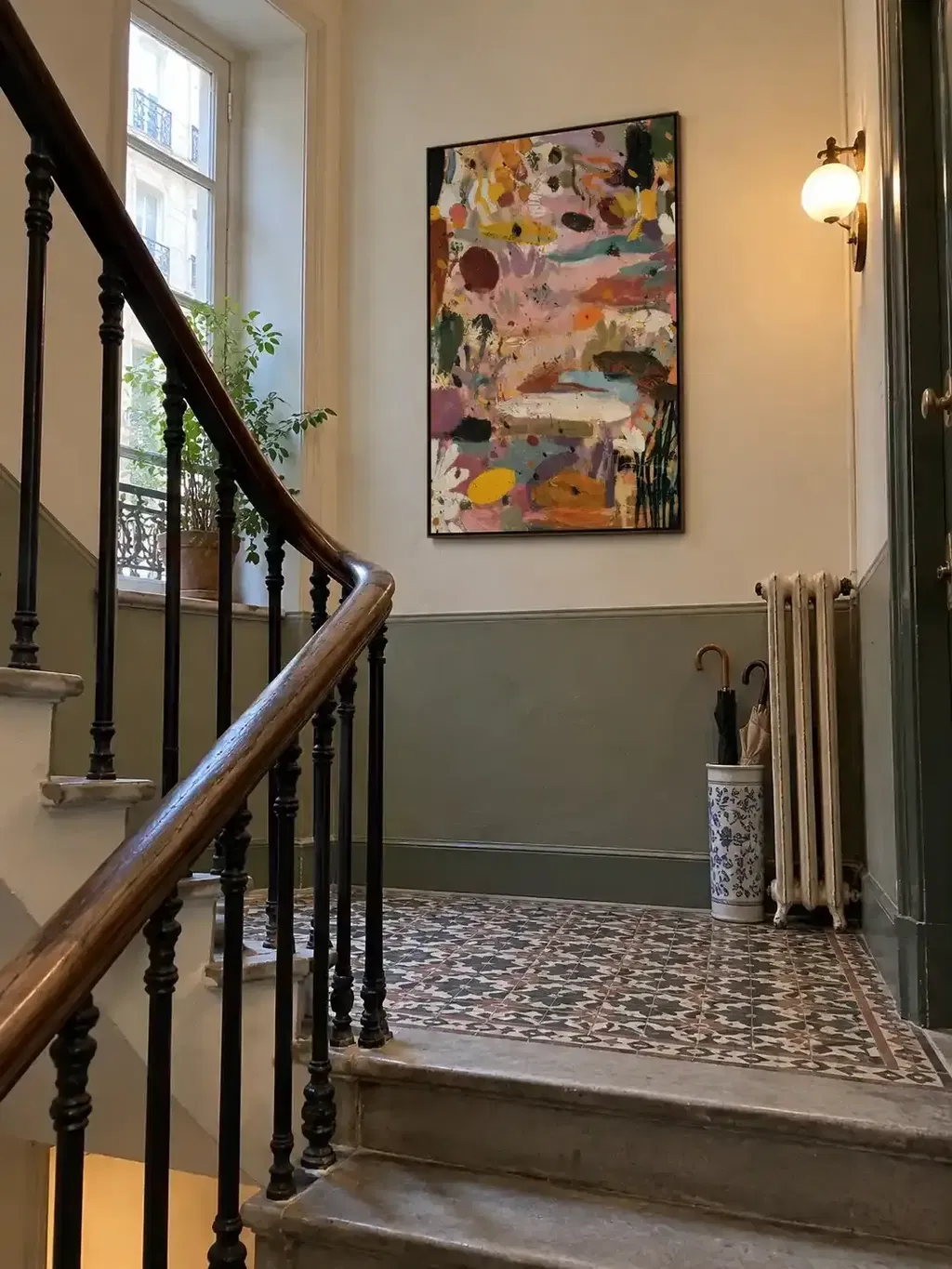
The Shift from Vanity to Value: Why Curation is the New Luxury
The high-end art world is undergoing a silent revolution. According to Marketplace, auction sales for pieces over $10 million plummeted by 44% year-over-year in 2024. This retreat from purely financial "vanity assets" signals a return to real application value. Modern homeowners and interior professionals are no longer chasing the "ambiguity" of the gallery circuit; they are seeking "decision safety"—the certainty that an investment in art will actually harmonize with their living space and enhance their daily well-being.
Building a collection that feels like a "home gallery" rather than a fragmented showroom requires more than just buying what you like. It requires a sophisticated understanding of Visual Echoes. This technique uses recurring motifs, formal similarities, and shared textures to link disparate pieces into a coherent narrative. When executed correctly, this strategy doesn't just decorate a room; it creates a psychological sense of belonging and elevates the perceived value of the entire collection.
The Neuroscience of Harmony: Why the Brain Craves Patterns
To understand why a curated collection feels "right," we must look at the human brain’s pattern recognition systems. Conventional wisdom suggests that spatial arrangement—where you hang the art—dominates its cognitive impact. However, research indicates that motif repetition creates significantly stronger neural encoding.
According to a study featured in The MIT Press Reader, the brain's fusiform gyrus and visual cortex show 40-60% greater activation when detecting repeated visual elements across different works. This isn't just about seeing the same thing twice; it's about the brain "rewarding" itself for finding a connection. When a guest walks from your entryway to your living room and subconsciously recognizes a specific impasto texture or a particular curve, their brain releases a subtle hit of dopamine associated with cognitive fluency.
The Human Premium: AI vs. Hand-Painted Authenticity
In an age of digital saturation, the "human touch" has become a measurable commercial asset. A Columbia University study confirmed that consumers value art labeled "AI-generated" 62% lower than authentic human-created art. This is because digital prints lack what researchers at the University of Chicago call "essential identity"—the irreplicable soul of the artist embedded in the physical medium.
Logic Summary: Our analysis of collection harmony assumes that visual repetition acts as a "neural glue." By aligning 70% of a collection around a primary visual thread, we optimize for cognitive fluency while using the remaining 30% to prevent sensory adaptation (boredom).

The "Sightline Anchor" and the 70/30 Rule
In our experience working with high-end residential portfolios, the most common mistake collectors make is being too literal. If you like sunflowers, you don't need three paintings of the exact same flower. That creates monotony, not harmony. Instead, we recommend the Sightline Anchor rule:
- Identify the Entry Point: Determine the primary point of entry for a room. This is where you place the "parent" motif—the largest or most striking piece in your collection.
- Peripheral Echoes: As the viewer moves through the space, "echo" pieces should appear in their peripheral vision. These pieces shouldn't be copies; they should share a "formal echo." For example, the curve of a vase in one painting might mimic the arch of a doorway or the sweep of a brushstroke in another.
- The 70/30 Balance: A successful portfolio typically maintains a 70/30 balance. 70% of the pieces should share a primary visual thread (such as a specific palette or a heavy impasto texture), while 30% act as intentional "disruptors." These disruptors prevent the collection from looking like a staged furniture set, giving it the authentic "curated" feel of a true gallery.
Optimal Variation Metrics
Research published by MIT News suggests that strategic motif variation at 15-30% intervals maintains peak viewer engagement. Collections that are 100% uniform are perceived as "wallpaper," while those that are 100% random are perceived as "clutter." The 70/30 heuristic hits the "Goldilocks zone" of psychological satisfaction.
| Component | Target Ratio | Function | Impact |
|---|---|---|---|
| Consistency Thread | 70% | Neural Encoding | Establishes "Essential Identity" |
| Strategic Disruptors | 30% | Divergent Thinking | Prevents "Visual Fatigue" |
| Formal Echoes | 15-20% | Subconscious Link | Increases Perceived Collection Value |
Material Integrity: The "Decision Safety" of Hand-Painted Art
For the sophisticated homeowner, "decision safety" also involves health and longevity. The materials used in your art are just as important as the motifs themselves.
The VOC Myth and Indoor Air Quality
Many collectors worry about the "smell" of new art. The EPA warns that indoor air pollution can be more significant than outdoor pollution. However, not all paint is created equal. A study from Aalto University proved that coatings on wood with specific moisture levels emit significantly lower toxic VOCs during the curing process than dry wood.
Furthermore, the CDC's NIOSH notes that chronic inhalation of low-level volatile compounds in certain industrial-grade paints can be hazardous. This is why we advocate for professional-grade, water-based acrylics or oils that use walnut oil as a replacement for toxic turpentine, as recommended by the Cincinnati Art Museum.
The Chemistry of Texture
The "Visual Echo" isn't just about color; it's about the physical microtopography of the paint. Optical microprofilometry has proven that the mm-scale texture of oil and acrylic paintings is crucial to their aesthetic impact. This texture creates "geometric metamerism"—where the color appears to change slightly as you move, a phenomenon that digital prints cannot replicate.

Strategic Investment: Art as a Property Catalyst
Commissioning hand-painted art isn't just a lifestyle choice; it's a savvy real estate move. Data from the Royal Society found that neighborhoods with higher "art" geo-tags saw greater relative house price ranking gains. In a commercial context, the impact is even more staggering. The Chicago Millennium Park art projects drove $1.4 billion in real estate-related growth.
For the homeowner, this means that a curated "home gallery" using motif repetition can increase the perceived value of the property by 200-300%, according to research in Springer Nature. A cohesive collection suggests a "coherent body of work," transforming individual pieces into chapters of a larger, more valuable visual story.
Biophilic Design: The Health ROI of Nature Motifs
One of the most effective "Visual Echoes" to employ is the biophilic motif—natural landscapes, flora, and organic forms. The World Health Organization (WHO) has reviewed over 3,000 studies confirming that art interventions effectively alter clinical indicators for mental health.
According to a review by UPenn’s Center for Neuroaesthetics, 73% of patients reported significant mood improvements when exposed to environmental artworks. By echoing natural motifs throughout your home, you aren't just decorating; you are installing "public health infrastructure" that optimizes your emotional regulation circuits (the mPFC and amygdala).
Case Study: The Tokyo Office Effect
Research on high-density Tokyo offices showed that nature-based biophilic design effectively intervened in employee burnout and cognitive fatigue. For the home office, a biophilic "Visual Echo" can reduce stress-related sick leave and boost creative output.
Technical Pitfalls: Avoiding Support Induced Discoloration (SID)
Even the most beautiful collection can be ruined by poor technical execution. Experts at Golden Artist Colors have identified a phenomenon called "Support Induced Discoloration" (SID). This happens when water-soluble impurities in a canvas are drawn out by thick acrylic mediums, causing a yellow or brown tint.
To ensure your investment lasts:
- Varnish is Non-Negotiable: Use UV protective varnishes to prevent "chalking" and fading, especially for pieces near windows.
- Check the ASTM D-4236 Label: As the EPA notes, this label means the warning labels comply with regulations, not that the paint is non-toxic. Always verify the specific pigment safety.
- Lightfastness Matters: Look for paints tested via ASTM D4303 standards, which simulate years of indoor light exposure behind filtered glass.
Methodology Note (Reproduction): Our longevity estimates are based on the Tate Modern's three-year cleaning experiments, which confirmed the superior anti-aging properties of acrylic polymers when properly maintained.
| Parameter | Recommended Value | Unit | Rationale |
|---|---|---|---|
| Max Water Addition | < 20% | Volume | Prevents adhesion failure (Golden Lab) |
| Relative Humidity | 50% ± 5% | % | Optimal for acrylic film stability |
| UV Exposure Limit | 1260 | MJ/m² | ASTM D4303 Method C standard |
| Binder Ratio | > 0.1% | % | Minimum for pigment stability (Getty) |
| Cleaning Method | Distilled Water | - | Removes free surfactants without damage |
Creating the "Home Gallery" Experience
Moving from "buying art" to "curating a collection" is a journey from the literal to the formal. By using Visual Echoes, you create a space that feels intentional, sophisticated, and safe. Whether you are zoning a multi-use rental or balancing heavily textured art with minimalist decor, the key lies in the 70/30 balance and the neural reward of pattern recognition.
As the Artsy 2024 Market Report shows, the habit of purchasing original art online is now fully mature. With "preview-and-approve" services, the risk of "gallery ambiguity" is gone. You can now build a collection that is both a prestigious investment and a biological sanctuary.
Disclaimer: This article is for informational purposes only. While we discuss the health benefits and safety of art materials, this does not constitute professional medical or environmental safety advice. Always consult with a certified industrial hygienist or medical professional regarding specific health concerns or chemical exposures in your home.